V-69 Code in Turkey: Residence Permit Cancelled — and How It Differs from the N-82 'Prior Permission' Code (2026)
What the V-69 code (residence permit invalid) and the N-82 prior permission code mean in Turkish rulings, how they differ, entry bans and deportation, the 60-day and 7-day lawsuit periods and the key court decisions.
V-69 is a restriction code that Turkish authorities enter on a foreigner's record when a residence permit is cancelled. In published Council of State rulings it is written as "İkamet tezkeresi geçersiz", which means "residence permit invalid". N-82 is a different code: it makes a foreigner's entry into Turkey depend on prior permission from the Presidency of Migration Management, and in the rulings it appears as one of the reasons residence permits were cancelled.
If you have a matter on this topic:
This guide covers V-69 and the N-82 code that, in the rulings, ended in the loss of residence permits; the general list of codes is in our restriction codes guide. Marks such as [L1] point to the laws, [R1] to Council of State rulings and [C1] to Constitutional Court judgments, listed in the Sources table at the end. The article gives general information; every file depends on its own documents.
How do V-69 and N-82 fit together? The two codes do different jobs. N-82 records a reason: on grounds of public order and public security, the Presidency of Migration Management makes the person's admission to Turkey subject to prior permission [L1] [C1]. Under the law, one condition of a short-term residence permit is that the person is not among the inadmissible passengers covered by Article 7; in the rulings, the permits of people with N-82 were cancelled on the basis of this chain [L2] [C1] [R9]. V-69, in two Council of State rulings, is the record entered when a permit was cancelled [R1] [R2]. None of the rulings discussed here mentions both codes in the same file, and the published rulings do not show whether V-69 was also entered when a permit was cancelled because of N-82. Where both appear on one record, the basis of the cancellation is found in the decision's reasoning and the authority's letter.
What Does the V-69 Code Mean in Turkey?
Turkish migration and police systems (named GöçNet and PolNet in court files) let officials enter short letter-and-number marks on a foreigner's record. In Turkish these marks are called "tahdit kodu", which translates as "restriction code". The mark is not a decision in itself; it records that a decision was taken about the person.
Two published decisions of the Council of State (Danıştay, Turkey's highest administrative court) write the code the same way:
- A September 2021 ruling: "davacı hakkında V-69 (İkamet tezkeresi geçersiz) tahdit veri girişi yapılmış, ancak bu yönde davacıya herhangi bir tebligat yapılmamıştır." In English: a V-69 (residence permit invalid) record was entered against the claimant, but no notification of it was ever served [R1].
- A December 2020 ruling: the claimant asked the court to annul the decision by which the Balıkesir provincial police cancelled the permit "by entering the V-69 (İkamet Tezkeresi Geçersiz) and V-71 (Semti Meçhul) restriction codes" [R2].
Until 2014 the residence document was called "ikamet tezkeresi". Law No. 6458 on Foreigners and International Protection replaced the term with "ikamet izni", residence permit. So the code's old wording, "residence permit invalid", is used in practice as a record that the permit was cancelled.
Where does this meaning come from? There is no official list
The Presidency of Migration Management (Göç İdaresi Başkanlığı, the national immigration authority) does not publish a list of restriction codes or their meanings. What is known comes from court files (see our main codes guide); for V-69 the meaning here relies only on the two rulings quoted above. As of 14 October 2026 the phrase "ikamet tezkeresi geçersiz" appears in only these two published rulings, and no Constitutional Court judgment mentioning V-69 was found.
Does the letter "V" mean anything?
Many codes starting with V in the rulings concern residence: V-70 "Formalite Evlilik" (sham marriage), V-71 "Semti Meçhul" (whereabouts unknown), V-84 "conditional entry" and V-91 "leaving the country subject to permission" [R5] [R6] [R7] [R8]. No official definition of the letter has been published, so it is safer not to read a general rule into it and to look at each code separately.
Why Was My Residence Permit Cancelled? When V-69 Is Entered
Both rulings show V-69 being entered at the moment a residence permit was cancelled. The law sets out the grounds for cancellation separately for short-term permits and for family permits.
Under Article 33/1 of Law No. 6458 on Foreigners and International Protection, a short-term residence permit "is not granted, is cancelled if granted, and is not extended when it expires" where one of the conditions in Article 32 is not met or no longer exists, where it is found that the permit is "used for a purpose other than the one for which it was granted", or where there is "a valid deportation or entry ban decision" against the person [L2].
Article 36 lists similar grounds for the family residence permit: its conditions are not met or no longer exist, a short-term permit is not granted after those conditions end, there is a valid deportation or entry ban decision, or the family permit is found to be used for another purpose [L3].
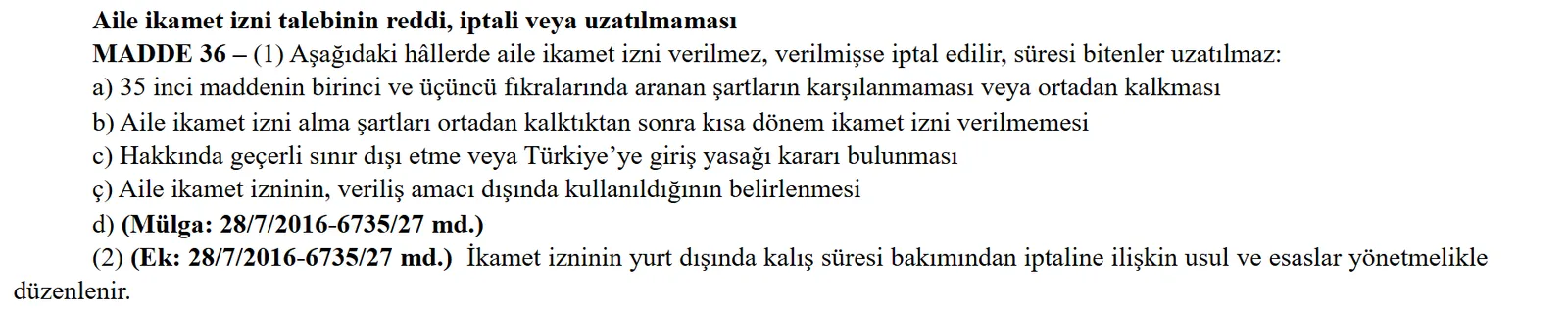
Both published V-69 files concern a permit based on marriage to a Turkish citizen. In one, the authority found that the couple did not live at the address they had declared; in the other, the Turkish spouse had died and the foreigner had not reported a change of address [R1] [R2]. These are only the published examples, not every situation in which V-69 is entered; no published V-69 ruling concerns a student or property-based permit.
Spouse of a Turkish citizen: the address check
For a foreigner married to a Turkish citizen, the authority can check whether the couple actually live together by sending officers to the address (an "adres tahkikatı"). In the September 2021 file, the officers wrote in their report that the couple had "moved" from their declared address in Güngören, Istanbul, and that although the flat, the building and the surroundings were asked, nobody knew them [R1]. On the basis of that report the permit was cancelled and V-69 was entered.
The same kind of check can end with a different code. Where the authority concludes that the marriage was made only to obtain residence, the rulings show the V-70 "sham marriage" code [R5]. No public rule explains which code is chosen after which kind of finding. Marriage-based residence in general is covered in our guide to marrying a Turkish citizen.
Death of the spouse, divorce or moving to another city
In the December 2020 file, a Russian national had received a permit in 2011 because of a marriage to a Turkish citizen, with the condition of living in Bandırma. The spouse died in 2013. The administrative court found that, with the spouse's death, the permit "granted because of marriage to a Turkish citizen had become invalid", and also that the foreigner was not living at the permitted address and had not reported the place of residence "in the proper way" [R2].
On appeal, the foreigner said the move to Marmaris came after the spouse's death, that the new address had been reported to the Marmaris population office about two and a half months before the cancellation, and that the Balıkesir authority had no power to cancel. The Council of State upheld the rejection [R2]. When a marriage ends, the basis of a family permit can disappear, but not every death or divorce leads to the same result; see also our guide to divorce in Turkey for foreigners.
I Have a V-69 Code. Can I Enter Turkey?
This is the question most people with a V-69 record ask. The short answer is that the published rulings do not describe V-69 as an entry ban; there the code appears as a record that the residence permit was cancelled [R1] [R2]. Whether it has a duration, whether it disappears when a period ends, and how it is treated at the border are not explained in any published ruling, and this article does not guess.
Under the law, an entry ban is a separate decision. According to Article 9 of Law No. 6458 on Foreigners and International Protection, the Presidency of Migration Management (written as "Genel Müdürlük" in the law) or, for people who were deported, the governorships impose entry bans; a ban lasts "at most five years" and, where there is a serious threat to public order or security, it "may be extended by up to ten more years" [L1]. In the rulings, entry bans usually carry Ç or G codes, such as the two-year Ç-104 ban. The article's seventh paragraph separately provides for a "prior permission requirement", recorded as N-82 and explained below [L1] [C1].
So for a person with V-69, the real question is this: after the permit was cancelled, was a separate deportation decision or entry ban also taken? The answer is in the person's current record and in the documents that were notified to them.
Does a cancelled residence permit lead to deportation?
Article 54 of the law lists the foreigners about whom a deportation decision is to be taken, including "f) those whose residence permits are cancelled" [L4]. Whether a decision is actually taken is decided in each file, and Article 55 lists people who are not deported.
A deportation decision can be challenged within seven days of notification [L4]; the removal centre and the appeal are explained in our deportation and restriction codes guide. A deported person also receives an entry ban with its own code and duration, separate from V-69 [L1].
I left Turkey after the cancellation. What happens when I come back?
Both published files involve people who were in Turkey at the time. No published ruling was found on how a V-69 record is treated when a person whose permit was cancelled, and who was not deported, later tries to enter again or applies for a visa, so general guidance cannot be given. In practice, finding out the current record before leaving, or before a new visa application, is seen as a step that reduces uncertainty. For N-82 the rulings are clearer: return from abroad depends on a specially annotated visa issued after consulting the Presidency, and in two files the visa requests were refused [C1].
Staying on after the cancellation: overstay fines and Ç codes
A cancelled permit no longer gives a right to stay. Remaining in Turkey may count as overstaying, with fees and fines at exit and, depending on its length, an entry ban with its own code, such as Ç-104, separate from V-69. Our overstay and entry ban calculator shows the ban periods in the migration authority's published table; it does not assess any individual case.
What Is the N-82 Code? "Prior Permission" and Residence Permits
N-82 is a restriction code that makes a foreigner's entry into Turkey depend on prior permission from the Presidency of Migration Management. The rulings we reviewed mention three N codes (N-78, N-82 and N-87); only N-82 has its meaning written out. In a February 2024 Plenary judgment of the Constitutional Court (Anayasa Mahkemesi), all applicants were living in Turkey on valid residence permits when "the Presidency of Migration Management applied the N-82 restriction code, meaning that their entry into the country is made subject to a prior permission requirement" (translated) [C1]. An October 2024 judgment uses the same words in the singular [C2]. Council of State rulings of 2023 call it "the act making entry into the country subject to prior permission with the N-82 restriction code" (translated) [R9] [R10] [R11].
The legal basis: Law No. 6458, Article 9/7
Prior permission sits in Article 9/7 of Law No. 6458, the article on entry bans: "The admission of foreigners into the country may be made subject to a prior permission requirement by the Directorate General on grounds of public order, public security or public health, and by governorships on grounds of administrative fines and public debts." (translated) [L1] The paragraph separates prior permission set by the Presidency for security or health from prior permission set by a governorship for unpaid fines and debts. All N-82 files in the rulings are of the first kind; the code rested on reports of the National Intelligence Organisation (MİT) [C1] [C2].
The Implementing Regulation, as quoted by the Constitutional Court, defines the term: "Prior permission requirement: the permission that must be obtained from the Directorate General for entry into the country" (translated) [C1] [L7]. A person with N-82 must therefore first obtain the Presidency's permission to enter Turkey.
An older, similar mechanism appears as "istizan" (consultation): a 2015 Council of State ruling quoted by the Constitutional Court describes an "istizan decision, meaning 'not to allow entry into our country without consulting the Ministry of Interior'" for a US citizen (translated); N-82 is not named there [C1].
Is N-82 an entry ban? Circular No. 2020/17
The key information comes from an unpublished internal rule. The Constitutional Court summarises Circular No. 2020/17 of 30/6/2020 on Restriction Codes: it provides that "the N-82 restriction code applied by the Presidency of Migration Management is not an entry ban decision, that the foreigner may be allowed to enter Turkey with the permission and knowledge of the Ministry of Interior, and accordingly that foreigners holding a specially annotated visa issued after consultation of the Presidency through foreign missions shall be allowed to enter, with the 'N' code reserved" (translated) [C1].
From this the Court concludes that N-82 was "not designed as a practice that directly affects the foreigner's legal situation and can therefore be the subject of an annulment action", but as "a tool made available for the internal working" of the Presidency (translated) [C1].
The same judgment records that practice departed from this. Four applicants who left on holiday with valid residence permits "could not re-enter the country because of the N-82 restriction code"; in the Court's words, the code "in practice created a legal effect in the form of being unable to return", which "produced the same result as enforcement of a deportation decision" (translated) [C1].
As for duration, published rulings do not say whether N-82 has a set period; in the files in the rulings the code stayed on the record throughout the lawsuits [C1] [C2]. For neither V-69 nor N-82 do the rulings describe a duration or an automatic expiry.
N-82 and residence permits: cancellation, refusal and "10 days"
The most common effect of N-82 in the rulings is the loss of a residence permit. Among the grounds for refusing or cancelling a short-term permit the law lists the "non-fulfilment or loss" of a condition in Article 32, which requires the person not to fall under Article 7 (Law No. 6458, Arts. 32/1-b, 33/1-a) [L2]; Article 7 treats those listed in Article 15 as inadmissible passengers [L6]. The Constitutional Court sets out this chain in its judgment [C1].
- In an Erzincan file, a US citizen's short-term permit was cancelled "because of the N-82 restriction code record, under Article 33 of Law No. 6458 ... as of 15/11/2022" (translated) [R9].
- In another file, "the notification form of the decision refusing" a residence application "because of the N-82 restriction code" said the person "must leave the country within 10 days" (translated) [R10].
- For a long-term permit holder, the first-instance court held that, since the case against N-82 had already been finally rejected, the administration had "no discretion" over cancellation [C1]. The law cancels a long-term permit where the foreigner "poses a serious threat to public order or public security" (Law No. 6458, Art. 45/1-a) [C1].
The "10 days" comes from a deportation ground: a deportation decision is taken for "those whose residence permit extension applications are refused and who do not leave Turkey within ten days" (Law No. 6458, Art. 54/1-j) [L4]. Those whose permits are cancelled are listed in subparagraph (f), the ground discussed above for V-69.
N-82 and visas: the Minister's approval and the specially annotated visa
For a person abroad with N-82, the decisive provision is Article 15, which lists foreigners not to be issued a visa:
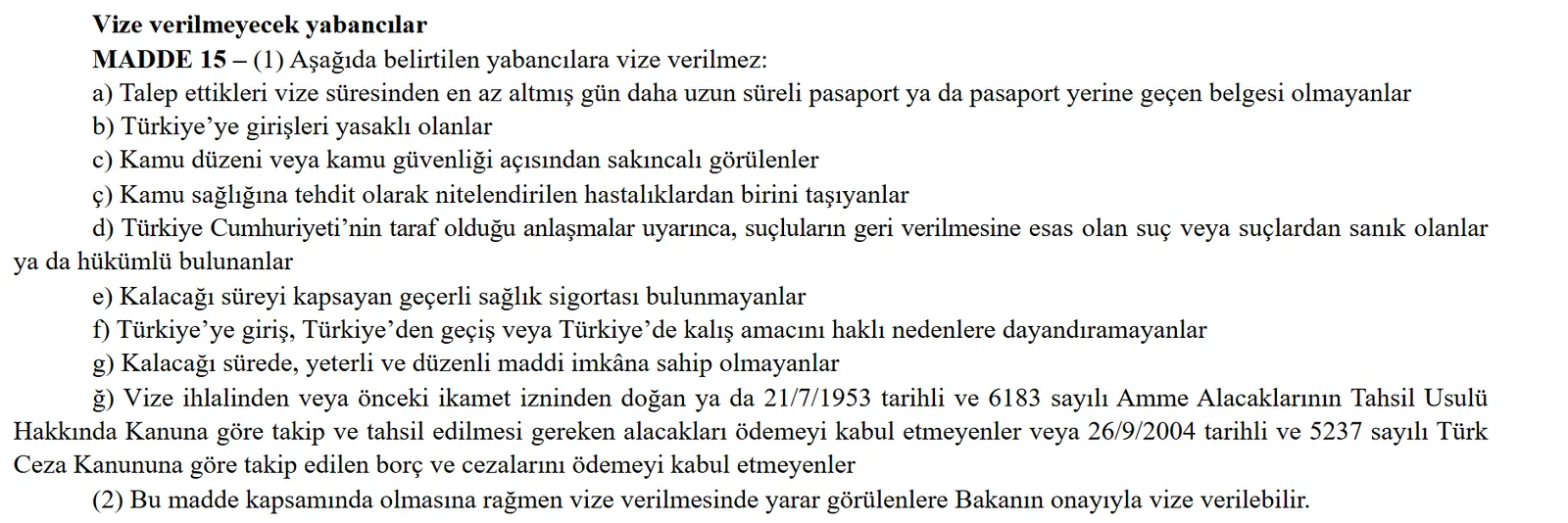
Subparagraph (c) bars visas for "those considered objectionable in terms of public order or public security"; the second paragraph says: "Those who fall within this article but to whom it is considered beneficial to issue a visa may be issued a visa with the approval of the Minister." (translated) [L6] The Circular's specially annotated visa (özel meşruhatlı vize) is described in this frame, as a visa issued after the consulate consults the Presidency [C1].
Two applicants on holiday asked the local Turkish consulate for a visa to return; the requests were refused "on the ground that the Presidency of Migration Management did not approve", and their cases against the refusals were rejected, one court relying on the earlier final rejection of the case against N-82 (translated) [C1]. Another first-instance court had said N-82 "is not an act completely banning entry into Turkey" and that the person "can enter with a special permit or visa suited to the purpose" (translated) [C1].
N-82 and a deportation decision
N-82 is not itself a deportation decision, but in the rulings it often led to one. According to the Constitutional Court, cancelling a residence permit "ends the foreigner's lawful status in the country" (translated), after which a deportation decision can be taken directly under the law [C1]. In the Istanbul Airport file, "a deportation procedure was first applied on the ground of an N-82 code when the person did not leave from the airport, and the residence permit was cancelled later" (translated) [C1]. The seven-day period is covered in the time-limit section below.
Constitutional Court: Amanda Jolyn Krause and Others (Plenary, 2024)
N-82 reached the Constitutional Court twice, and the main complaints failed both times. In Krause, applicants from the US, Australia and Germany said that because of N-82 their permits were cancelled, they were deported or they could not get visas. The administration's defences and court decisions mentioned some applicants' links to missionary activity and attendance at a "Family Conference" in Antalya [C1].
- Freedom of religion: The Court held that N-82, the cancellation and the deportation "did not constitute an interference" with the external sphere of freedom of religion; this part was inadmissible by majority (translated) [C1].
- Right to an effective remedy: The Court accepted that the public order and security assessment was "reasonably connected" to the statutory deportation grounds and that the courts examined the merits, and found no violation by majority (translated) [C1].
- Dissents: Six members dissented. One dissent said it was hard to hold that the prior permission rule met the legality requirement, given "the abstract nature of the concepts of public order and public security" and the uncertainty in practice (translated) [C1].
The judgment also notes that, "because of the uncertainty in administrative and judicial practice", it could not assess which was the effective remedy: suing against the N-82 act, or requesting prior permission and suing against its refusal (translated) [C1].
Constitutional Court: Hans Jürgen Peter Louven (Second Section, 2024)
A German national living in Muğla with his wife and daughter since 1994 had his extension request refused for "other reasons"; in its defence the administration disclosed N-82 and an MİT letter of 25/2/2019 [C2]. The Court found no violation of the right to respect for family life, stressing that no deportation decision had been taken, that "the applicant has the right to sue against any possible deportation" and that his daughter was an adult (translated) [C2].
Procedurally, "applying the N-82 restriction code to the applicant is not a dispute over civil rights and obligations or a criminal charge" (translated) [C2], so the fair trial complaint was not examined, for lack of jurisdiction ratione materiae. The same finding was made for one applicant in Krause [C1].
What do the two Constitutional Court judgments show?
| Point | Krause and Others [C1] | Louven [C2] |
|---|---|---|
| Applicants | US, Australian and German nationals | German national living in Muğla since 1994 |
| Effect of N-82 | Residence cancellation, deportation, visa refusal; unable to return from abroad | Refusal of the residence extension request |
| Basis of the code | MİT reports | MİT letter of 25/2/2019 |
| Rights examined | Freedom of religion; right to an effective remedy | Right to respect for family life; fair trial |
| Result | Religion complaint inadmissible; no violation of the effective remedy right (majority, six dissents) | No violation of family life; fair trial complaint not examined (no jurisdiction ratione materiae) |
Read together, the Court accepts N-82's legal basis and legitimate aim, reviews applications through family life or deportation safeguards, and treats fair trial complaints as outside its scope; the strength of family ties in Turkey is decisive. Judgments on security codes where the Court applied the "sufficient and serious information" test and found violations are covered in our guide to G-87 and its G-82 section; those applicants had Turkish citizen spouses and children.
How can an N-82 code be removed?
There is no specific rule on lifting N-82, and published rulings contain no example of the code being lifted. The routes seen in the rulings are:
- Annulment action against the code: Five applicants in Krause sued directly "against the act of applying the N-82 code" (translated); the cases were rejected at first instance and on appeal [C1]. The 2023 Council of State files also contained cases against the prior permission act [R9] [R10] [R11].
- Cases against linked acts: Residence cancellation or refusal, visa refusal and deportation were each challenged separately [C1] [C2].
- Request to the Presidency: The law lets the Presidency lift an entry ban or allow entry for a set period [L1]; under the Circular, entry with N-82 is possible with a specially annotated visa issued after consulting the Presidency [C1]. An unanswered request is deemed refused after thirty days, as for V-69, and that refusal can be challenged [L5].
Because of the "uncertainty" noted by the Constitutional Court, which act to challenge, and in what order, is assessed file by file; the court and time limits for both codes are set out below.
N-82 compared with N-87, G-87 and G-82
N-87 appears in the rulings as an "entry ban code" whose meaning is not explained; in one file it was entered with G-87 and later annulled. G-87 ("General Security") and G-82 ("activities against national security") are entry ban codes. Under the Circular N-82 is a prior permission requirement, not a ban, though Krause shows that for a person abroad the result can be the same [C1]. See our guide to G-87 and G-82, and our Ç-114 guide for the timed ban linked to judicial proceedings.
V-69 and N-82 Compared
In the rulings both codes can end in the loss of a residence permit, but their meaning, the authority that enters them and the act taken to court differ. The table relies only on the rulings and provisions cited in this article:
| Point | V-69 | N-82 |
|---|---|---|
| Meaning in the rulings | "Residence permit invalid" (İkamet tezkeresi geçersiz) [R1] [R2] | Entry "made subject to a prior permission requirement" [C1] [C2] [R9] |
| Legal basis | Grounds for cancelling a residence permit: Law No. 6458, Arts. 33 and 36 [L2] [L3] | Law No. 6458, Art. 9/7; definition in the Implementing Regulation [L1] [L7] |
| Who entered it in the rulings | The authority that cancelled the permit: Istanbul Governorship, Balıkesir provincial police [R1] [R2] | Presidency of Migration Management, relying on MİT reports and a letter [C1] [C2] |
| Is it an entry ban? | The rulings do not describe it as one | Not a ban under the Circular; in practice people who left Turkey could not return [C1] |
| Duration | Not stated in the rulings | Not stated in the rulings |
| When it came to light | At the airport on exit, about two years after the cancellation [R1] | In a residence cancellation case, on refusal of an extension, on leaving Turkey, at airport exit control [C1] [C2] |
| Linked acts | Residence cancellation; a deportation decision may follow [L4] | Residence cancellation and refusal, extension refusal, visa refusal, deportation [C1] [C2] [R9] [R10] |
| Act taken to court | The residence cancellation [R1] [R2] | The code itself and the linked residence, visa and deportation acts [C1] [C2] |
| Results in the rulings | One cancellation annulled, one rejection upheld [R1] [R2] | No violation in either Constitutional Court judgment; no example of the code being lifted [C1] [C2] |
| Court in the rulings | Where the acting authority sits: Istanbul, Balıkesir [L5] [R1] [R2] | Ankara against the code; the province for governorship acts [R9] [C1] [C2] |
How Do I Check Whether I Have a V-69 or N-82 Code?
In the rulings, people usually discovered the code while doing something else, not because they were told. In the V-69 files:
- At the airport when leaving: In the September 2021 file, the foreigner learned at the passport check at Istanbul Atatürk Airport on 5 July 2015 that the permit had been cancelled in 2013, almost two years earlier [R1].
- When applying for a new permit: The migration office checks the system; codes such as V-70 and V-84 came to light at that stage [R5] [R6].
- By a written request: A petition can be given to the provincial migration office or to the Presidency asking for the records, as explained in the "how to find out your code" section of our main codes guide.
There is no "turkey entry ban check" or restriction code service on e-Devlet, the Turkish government portal. A code, its date and the office that entered it usually become clear only through a written answer from the authority or a notification document, for N-82 as much as for V-69.
When did N-82 come to light in the rulings?
N-82 is not notified to the person as a separate decision, so it usually emerges during another procedure. The rulings show four moments:
- In a residence cancellation case: Two applicants whose short-term permits were cancelled learned during their lawsuit that N-82 was the reason [C1].
- On refusal of an extension: In the Louven file, N-82 and the MİT letter emerged in the administration's defence [C2].
- When leaving Turkey: Two applicants were told N-82 was applied on exit, and "this information was entered on their flight cards" (translated) [C1].
- At airport exit control: A long-term permit holder leaving the country was told about N-82 and taken to the Istanbul Airport police; the same day the Istanbul Governorship applied deportation and invitation-to-leave procedures [C1].
My permit was cancelled but I was never notified
The law requires the cancellation of a residence permit to be notified to the foreigner, their legal representative or their lawyer, and the notification has to explain how the foreigner can effectively use the right to object [L2]. In the September 2021 file, however, V-69 had been entered "but no notification of it was ever served" [R1]. The person learned of the cancellation only at the airport, where it was notified that day.
Whether notification was made directly affects when the time limit for a lawsuit starts. Under Article 7 of Law No. 2577 on Administrative Procedure, the period to file a case is 60 days as a rule and starts on the day after written notification [L5]. Without notification, the starting date is argued on the facts; in another restriction code file the Council of State counted from the date the person learned of the ban, as described in our main codes guide.
How to Remove a V-69 Code: From Turkey or From Abroad
The answer to "how do I remove V-69" depends on what the code rests on. In the rulings, V-69 records that the residence permit was cancelled, so the dispute is less about the code itself and more about the cancellation decision behind it. The routes seen in the rulings are these:
- A lawsuit against the cancellation: In both Council of State files, the foreigners sued in the administrative court to annul the cancellation [R1] [R2]. If the cancellation is annulled, the basis of the record falls away with it.
- A request to the migration authority: A petition to remove the code can go to the provincial migration office or the Presidency. Without an answer within 30 days it is treated as refused (implied refusal), and that refusal can be taken to court [L5].
- A new residence application: Where the reason for the cancellation no longer exists, or there is a new purpose for staying, a new application can be made; a refusal is a separate decision that can be challenged.
The route and its order depend on when and how the cancellation was notified, whether the person is in Turkey, and whether there is also a deportation decision or an entry ban; one "removal petition" does not fit every file. Where N-82 lies behind the cancellation, the routes against the code itself (see the N-82 section) also come into play. The court and time-limit rules below apply to both codes.
Which court hears a V-69 or N-82 case: Istanbul or Ankara?
The cancellation and the V-69 record are administrative acts, so the case goes to an administrative court. Under Article 32 of Law No. 2577 on Administrative Procedure, the competent court is the administrative court "of the place where the administrative authority that took the act" is located, and this rule is a matter of public order [L5]. The cancellations were made by the Istanbul Governorship and the Balıkesir provincial police [R1] [R2]. Today provincial directorates of migration management decide on behalf of the governorships, so permits cancelled in Istanbul are litigated before the Istanbul administrative courts; see our Istanbul court guide and Ankara court guide.
With N-82, two authorities are involved. The Presidency entered the code, so cases against it are heard in Ankara; residence cancellation and similar acts are taken by the governorship where the person lives, and cases against them go to that province's court, as in the Erzincan, Muğla and Istanbul examples [R9] [C2] [C1]. In three 2023 files where a case against the N-82 act ran alongside a case against the same person's residence cancellation, refusal or deportation, the Council of State found the cases connected [R9] [R10] [R11]; connected cases can be heard by one court, avoiding conflicting judgments.
It is not always clear which office entered a code. In a Ç-104 file entered by the Istanbul provincial migration office but filed against the Presidency, the Istanbul and Ankara courts each declared the other competent until the Council of State settled it [R4]; see our Ç-104 guide.
The 60-day period and the 7-day period are different
No special period is set for a cancelled residence permit, so the general 60-day period of Article 7 of Law No. 2577 on Administrative Procedure applies, counted from the day after written notification [L5]. If a request is made to the authority within that period, Article 11 stops the clock; if no answer comes within 30 days the request is treated as refused and the remaining period continues to run [L5]. The same rule applies in N-82 files: against the code, a residence cancellation, an extension refusal or a visa refusal, the period is normally 60 days [L5].
A deportation decision taken around the same time runs on a separate clock: seven days against the deportation [L4], 60 days against the cancellation [L5]. Under Article 53 as amended by Law No. 7533 on 21 November 2024, subject to the foreigner's consent, deportation is not carried out during the lawsuit period or until the case ends [L4]. In N-82 files a residence cancellation, an extension refusal, a "leave within 10 days" letter, a deportation decision or a visa refusal may each be notified separately, and each date can start its own period. Our appeal period calculator counts the days from a notification date; it does not assess any individual case.
Acting from abroad: power of attorney
Many people with V-69 or N-82 are no longer in Turkey, and being abroad does not close the routes above. A lawyer in Turkey can file the request and the lawsuit under a power of attorney (vekâletname), usually signed at a Turkish consulate, or before a local notary with an apostille and a sworn Turkish translation; see our guide to hiring a lawyer in Turkey from abroad. A request signed by a lawyer has to include the power of attorney; our main codes guide describes a file in which a request was not processed because none was attached.
Two Council of State Rulings on V-69, Two Different Outcomes
The two published V-69 rulings look alike but ended differently, because of the facts behind each cancellation.
September 2021: no notification, no concrete finding, cancellation annulled
A Kyrgyz national married a Turkish citizen in 2012 and in 2013 applied in Istanbul for a residence permit as the spouse. After the address report, the permit was cancelled and V-69 entered without notification; the foreigner learned of it at the airport in 2015 and sued. The administrative court annulled the cancellation and the administration appealed [R1].
The Council of State noted that the 2013 act fell under the old Law No. 5683 rather than Law No. 6458, whose residence provisions came into force on 11 April 2014, but did not see this as a reason to reverse [R1]. On the merits, it found that the report did not include statements from "the building manager, the neighbours, the doorman or the neighbourhood head (muhtar)", and that it had not been "clearly and plainly shown" whether the marriage was made in order to obtain residence. The foreigner had also stated that the couple lived at the same address and that their child, a Turkish citizen, was born on 12 April 2014. The Council of State concluded that there was "no concrete finding made by the defendant administration" of any circumstance preventing the foreigner from residing in Turkey, and unanimously upheld the annulment with corrected reasoning [R1].
December 2020: spouse's death and an unreported address, case rejected
The facts are those described above: a 2011 marriage-based permit tied to Bandırma, the spouse's death in 2013, and a finding on 13 March 2014 after which the Balıkesir provincial police cancelled the permit on 18 March 2014 by entering V-69 and V-71. The administrative court rejected the case. On appeal the foreigner also argued that the report was untrue; the Council of State found none of the arguments sufficient to reverse and unanimously upheld the rejection [R2].
What made the difference?
| Point | September 2021 ruling [R1] | December 2020 ruling [R2] |
|---|---|---|
| Basis of the permit | Ongoing marriage to a Turkish citizen | Marriage to a Turkish citizen; spouse had died |
| Reason for cancellation | Report that the couple had moved | Marriage ended by death; not living at, and not reporting, the address |
| Codes | V-69 | V-69 and V-71 (whereabouts unknown) |
| Notification | Never notified; learned at the airport two years later | No dispute about notification in the ruling |
| Council of State's view | Investigation incomplete; no concrete finding | No reason to reverse |
| Result | Annulment upheld (in favour of the foreigner) | Rejection upheld (against the foreigner) |
Two rulings do not make a general rule. They show that the court looks at how concrete the investigation was, and whether the facts relied on (family, children, address) are documented.
V-69, V-70 and V-71: How the Neighbouring Codes Differ
V-69 sometimes appears alone and sometimes with other codes. Two neighbouring codes seen in the rulings are:
- V-70 "Formalite Evlilik" (sham marriage): entered where the authority concludes that the marriage was made to obtain residence. The Council of State upheld a judgment finding a refusal unlawful where the administration could not "concretely show" the basis of a V-70 code entered after a divorce case [R5].
- V-71 "Semti Meçhul" (whereabouts unknown): shows that the person's address is not known. It was entered together with V-69 in the December 2020 file [R2]; in another file the administration said the code is entered "so that the person can be found" [R8].
With V-70 on the record the question moves to whether the marriage is genuine; with V-71, address reporting comes to the front. Other V codes are in our restriction codes guide.
Can I Get a New Turkish Residence Permit With V-69 on My Record?
No provision of the law says that a person with a V-69 record cannot be given a residence permit. The conditions for a short-term permit are in Article 32 and the grounds for refusal and cancellation in Article 33. A valid entry ban or deportation decision is among those grounds, but a permit cancelled in the past is not listed as a ground on its own [L2].
In a different file, the Council of State found unlawful the refusal of a residence application, for a person with no active record, "on the grounds of restriction records entered earlier and later cancelled" [R3]. The ruling is not specific to V-69, but it shows how old records are treated in a new application.
An active N-82 record looks different: in the rulings N-82 was relied on directly to refuse a residence application and an extension request [R10] [C2]. Where the record also shows N-82, the outcome of a new application may depend first on the status of N-82.
Article 25 of the law adds that when the governorship refuses, does not extend or cancels a permit, it takes into account "the foreigner's family ties in Turkey, the length of residence, the situation in the country of origin and the best interest of the child" [L2]. In the September 2021 file, the Turkish citizen child was among the facts the Council of State noted [R1]. People who have lived in Turkey for many years may also look at the long-term residence permit, which has its own conditions.
The marriage ended: moving to a short-term permit
Where the marriage behind a family permit ends by divorce or death, the law lists as a separate cancellation ground that "a short-term residence permit is not granted after its conditions cease" [L3], so a move to a short-term permit is contemplated. The December 2020 ruling does not say whether such an application was made [R2].
What a Lawyer in Istanbul Checks in a V-69 or N-82 File
In a file with a V-69 or N-82 record, the following questions are usually taken one by one:
- Which codes are on the record? N-82, V-70, V-71, or a Ç or G code alongside V-69 sets the direction of the file.
- When and why was the permit cancelled? The investigation report, the decision and its legal basis; in N-82 files the ground often emerged only from the administration's defence [C1] [C2].
- Which act was notified, and when? A cancellation, an extension refusal, a "leave within 10 days" letter, a deportation decision or a visa refusal; without notification, the document through which the person first learned of it. These dates drive the 60-day count.
- Is there also a deportation decision or entry ban? If so, the 7-day period runs as well.
- Family ties and settled life: marriage and civil registry records, children's citizenship, a shared address, years in Turkey, work, property. In Louven these facts directly affected the result [C2].
- Is the person in Turkey or abroad? In Turkey the issue is usually residence and deportation; abroad, the visa, entry and the power of attorney.
This list is not a road map; other steps may arise in each file depending on the documents.
Immigration Lawyer in Istanbul, Ankara and Across Turkey for V-69 and N-82
Cases against permits cancelled by the Istanbul Provincial Directorate of Migration Management are heard by the Istanbul administrative courts; living in Kadıköy, Maltepe, Kartal or Ataşehir does not change that, as what counts is the office that took the decision [L5]. Codes entered by the Presidency are challenged in Ankara, where a lawyer registered with any Turkish bar can follow the case. One N-82 example comes straight from Istanbul: a long-term permit holder learned of N-82 on exit at Istanbul Airport, and the Istanbul Governorship acted the same day [C1].
Our office is in Maltepe, on the Asian side of Istanbul. As an immigration lawyer in Istanbul, we deal with foreigners' residence, visa and restriction code files, including those of foreign spouses of Turkish citizens whose permits were cancelled and of people who are already abroad. Other topics are on our Law on Foreigners and Administrative Law pages, and Turkish terms in our legal glossary; for the criminal side, see our guide on being arrested in Turkey as a foreigner.
Sources
Frequently Asked Questions
What does the V-69 code mean in Turkey?
In two Council of State rulings V-69 is written as "İkamet tezkeresi geçersiz", residence permit invalid. In both published files it was entered on the foreigner's record when a residence permit based on marriage to a Turkish citizen was cancelled.
I have a V-69 code. Is it an entry ban, and can I enter Turkey?
The published rulings do not describe V-69 as an entry ban; it appears as a record of a cancelled permit. An entry ban is a separate decision under Article 9 of Law No. 6458, usually carrying a Ç or G code. Whether a separate ban or deportation decision was also taken is what decides entry, and that can only be seen from the current record and the documents notified to the person.
What is the N-82 code, and what does 'prior permission requirement' mean?
Constitutional Court judgments define N-82 as the restriction code meaning that a foreigner's entry into the country is subject to a prior permission requirement. The Implementing Regulation defines prior permission as the permission that must be obtained from the Presidency of Migration Management to enter the country; the legal basis is Article 9/7 of Law No. 6458.
What is the difference between V-69 and N-82?
In the rulings V-69 means 'residence permit invalid' and is entered when a residence permit is cancelled. N-82 is entered by the Presidency of Migration Management and makes entry subject to prior permission; in the rulings it was one of the reasons permits were cancelled, extensions refused, deportations ordered and visas refused. No published ruling mentions both codes in the same file.
Is the N-82 code an entry ban?
According to Circular No. 2020/17, as quoted by the Constitutional Court, N-82 is not an entry ban decision, and entry can be allowed with a specially annotated visa issued after consulting the Presidency. The same judgment found, however, that some people who left Turkey could not return in practice because of the code.
How long do V-69 and N-82 codes last?
Published rulings do not say whether either code has a set duration. V-69 appears as a record of a cancelled permit rather than a ban for a fixed number of years, and in the N-82 files the code stayed on the record throughout the lawsuits.
How do I remove a V-69 code in Turkey?
Because the code rests on the cancellation of the permit, the rulings show the cancellation being challenged in the administrative court. A removal request can also be made to the migration authority; if there is no answer within 30 days it is treated as refused and that refusal can be taken to court.
How can an N-82 code be removed?
There is no specific rule on lifting it, and published rulings show no example of it being lifted. The rulings show annulment actions against the code, lawsuits against the linked residence, visa and deportation acts, and requests to the Presidency.
What is the deadline to challenge a cancelled residence permit or an N-82 act?
As no special period is set, the general 60-day period of Article 7 of Law No. 2577 applies, counted from the day after written notification; it covers the cancellation, an extension or visa refusal and the N-82 act. A deportation decision has a separate 7-day period.
My residence permit was cancelled and I was never notified. What then?
The law requires the cancellation to be notified with information on how to object. In a 2021 Council of State file the code was entered without notification, the foreigner learned of it two years later at the airport, and the cancellation was annulled. The date from which the period runs is assessed on the facts of each file.
Will I be deported because of V-69 or N-82?
Neither code is itself a deportation decision. Article 54 of Law No. 6458 lists persons whose residence permits are cancelled, and those whose extension is refused and who do not leave within ten days, among those about whom a deportation decision is taken. Whether one is taken is decided in each file, and Article 55 lists persons who are not deported.
Will my residence permit be cancelled because of N-82?
In the rulings, short-term and long-term residence permits were cancelled and extension requests refused on the ground of N-82, and in one file the refusal form said the person must leave the country within 10 days. Each of these is a separate administrative decision and can be challenged separately.
Can I get a Turkish visa with an N-82 code?
The law bars visas for those considered objectionable for public order or security, but allows a visa with the Minister's approval where it is considered beneficial. In two files in the rulings, consulates refused visas because the Presidency did not approve.
N-82 was applied while I was on holiday abroad. Can I come back?
Under the Circular, entry is possible with a specially annotated visa issued after consulting the Presidency. In two files in the rulings, however, the visa requests were refused and the people could not return; each file is assessed on its own.
Can I remove V-69 from abroad?
Being abroad does not close the routes. A lawyer in Turkey can file the request to the migration authority and the lawsuit at the administrative court under a power of attorney signed at a Turkish consulate or before a local notary with an apostille and a sworn translation.
Can I get a new residence permit if I have V-69?
The law does not bar a person with V-69 from a new permit, and the Council of State has found it unlawful in one file to refuse an application because of earlier records that had later been cancelled. An active N-82 record is different: in the rulings it was relied on to refuse a residence application and an extension.
What is the difference between V-69, V-70 and V-71?
In the rulings V-69 means residence permit invalid, V-70 means sham marriage and V-71 means whereabouts unknown. V-69 and V-71 were entered together in a 2020 file about a foreigner whose Turkish spouse had died.
My Turkish spouse died or we divorced. Will my residence permit be cancelled?
A family residence permit can be cancelled when its conditions no longer exist, and the law contemplates a move to a short-term permit after that. In a 2020 ruling, a cancellation after the spouse's death and an unreported change of address was upheld.
Which court hears a V-69 or N-82 case?
The administrative court of the place of the authority that took the decision. Cancellations made in Istanbul are heard by the Istanbul administrative courts; cases against the N-82 code, entered by the Presidency of Migration Management, are heard in Ankara, and the Council of State has treated these cases as connected.
How can I check if I have a V-69 or N-82 code?
There is no restriction code check on e-Devlet. In the rulings the codes came to light at passport control, during a new residence application, in a residence cancellation case, on refusal of an extension and at airport exit control; a written petition to the provincial migration office or the Presidency of Migration Management is another way.
What did the Turkish Constitutional Court say about N-82?
In Krause it held by majority that there was no interference with freedom of religion and no violation of the right to an effective remedy. In Louven it found no violation of the right to respect for family life and said N-82 falls outside the right to a fair trial.
I live on the Asian side of Istanbul. Where is my V-69 or N-82 case heard?
Cases against cancellations made by the Istanbul Provincial Directorate of Migration Management are heard by the Istanbul administrative courts, and living in Kadıköy, Maltepe, Kartal or Ataşehir does not change that. A case against the N-82 code itself, entered by the Presidency, goes to Ankara.
- V-69 code Turkey
- n82 code turkey
- prior permission turkey
- Turkey restriction codes
- tahdit kodu
- residence permit cancelled Turkey
- family residence permit Turkey
- entry ban Turkey
- deportation from Turkey
Our services in this area
Law on Foreigners