Turkey's 20-Year Tax Exemption (2026): Who Pays No Tax on Foreign Income, How to Apply in Time and What Is Still Taxed
Law No. 7582 and Communiqué No. 333 explained: who becomes tax resident in Turkey, the three-year look-back, the exemption certificate deadline, the official examples on rent, dividends and remote work, the 1% inheritance tax rate and the 2027 asset disclosure rule.
Since June 2026, people who move their tax residence to Turkey can have their foreign income exempt from Turkish income tax for twenty years. The rule has strict conditions, a deadline that is easy to miss, and clear limits on what remains taxable in Turkey.
If you have a matter on this topic:
1. What is Turkey's 20-year tax exemption on foreign income?
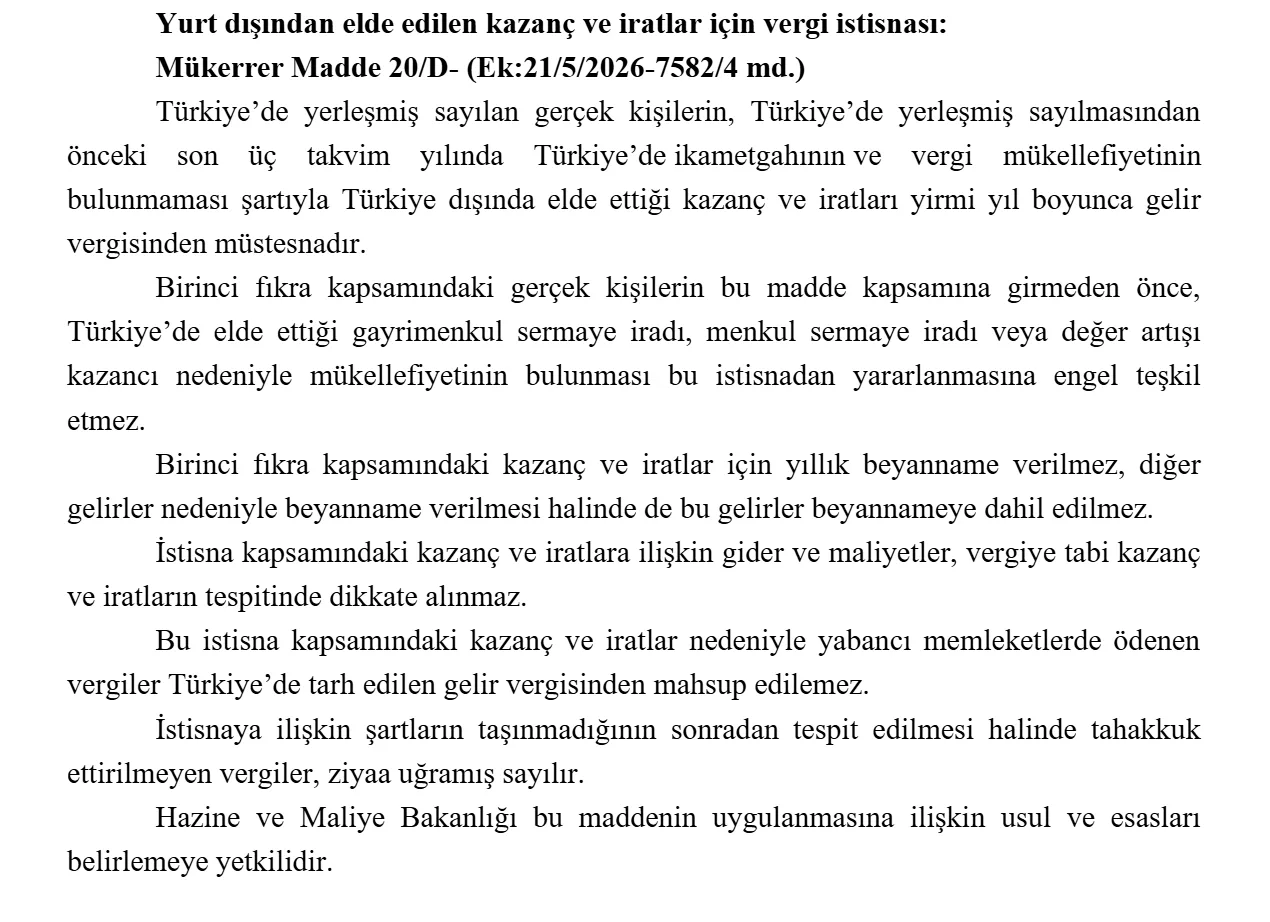
Law No. 7582, published in the Official Gazette on 4 June 2026, added a new Article 20/D to the Income Tax Law No. 193 [M2]. The article exempts from income tax, for twenty years, the gains and income earned outside Turkey by individuals who are deemed resident in Turkey, provided they had neither a domicile nor a tax liability in Turkey in the last three calendar years before becoming resident [M1]. The law states that it applies to people deemed resident in Turkey from 1 January 2026 (Law No. 7582, Art. 14/a) [M2]. The Ministry of Treasury and Finance set the procedure in Income Tax General Communiqué No. 333, published on 4 July 2026 [T1].
| Point | Rule | Source |
|---|---|---|
| Who | Individuals deemed resident in Turkey (not companies) | Art. 20/D; Communiqué 333, Art. 3/10 |
| Condition | No domicile and no tax liability in Turkey in the previous three calendar years | Art. 20/D/1 |
| What is exempt | Gains and income earned outside Turkey | Art. 20/D/1 |
| How long | Twenty years | Art. 20/D/1 |
| From when | People deemed resident on or after 1 January 2026 | Law 7582, Art. 14/a; Communiqué 333, Art. 3/3 |
| Procedure | Exemption certificate from the tax office within a deadline | Communiqué 333, Art. 3/4 |
| Annual return | Not filed for the exempt income | Art. 20/D/3 |
| Inheritance tax | 1% on inheritance transfers during the exemption period | Law 7582, Art. 2 |
2. Who counts as "resident" in Turkey for tax purposes?
The exemption is only for people who are deemed resident in Turkey. Residents are taxed on their worldwide income (Income Tax Law, Art. 3) [M1]. The law treats two groups as resident (Art. 4) [M1]:
- people whose domicile is in Turkey, meaning the place where a person lives with the intention of staying permanently (Civil Code, Art. 19) [M5];
- people who stay in Turkey continuously for more than six months in a calendar year; temporary departures do not interrupt the stay.
Foreigners who are not deemed resident even after six months
Article 5 lists foreigners who do not become resident even if they stay more than six months: business people, scientists, experts, officials, press correspondents and similar people who come for a specific and temporary task or job, and people who come for education, medical treatment, rest or travel; as well as people kept in Turkey against their will, for example through detention or illness [M1].
| Situation | Resident for tax? | Basis |
|---|---|---|
| Moves to Turkey with the intention of staying permanently | Yes (domicile) | Art. 4/1 |
| Stays more than six months continuously in a calendar year | Yes, unless an Article 5 exception applies | Art. 4/2 |
| Comes for a specific, temporary assignment | No, even after six months | Art. 5/1 |
| Comes for study, treatment, rest or travel | No, even after six months | Art. 5/1 |
| Kept in Turkey by detention or illness | No | Art. 5/2 |
Does nationality matter? Turkish citizens returning from abroad
Article 20/D speaks of "individuals" and sets no nationality condition [M1]. The Communiqué's own Example 4 concerns a person who lived in Turkey, left in November 2024 and returned in 2027; the certificate was refused only because that person was still resident in Turkey in 2024, inside the three-year window [T1]. The test is therefore the three-year look-back, not citizenship.
3. The three-year look-back: what blocks the exemption and what does not
The person must have had no domicile and no tax liability in Turkey in the last three calendar years before becoming resident [M1]. For someone who becomes resident in 2026, those years are 2023, 2024 and 2025; for someone who becomes resident in 2028, they are 2025, 2026 and 2027 (Communiqué 333, Examples 1-3) [T1].
What does not block it: Turkish rent, investment income and capital gains
The law makes one important exception. Having been a taxpayer in Turkey before only because of Turkish real estate income, securities income or capital gains does not prevent the exemption (Art. 20/D/2) [M1]. Many foreigners who already owned and rented out an apartment in Turkey fall into this group.
What blocks it: Turkish wages, business income and a Turkish domicile
| Communiqué example | Facts | Result |
|---|---|---|
| Example 1 | Resident from 12 July 2026, applies on 1 December 2026, no domicile or tax liability in 2023-2025 | Certificate issued |
| Example 2 | Resident from 2 March 2028, applies on 1 May 2030 | Refused: application not made by the end of 2028 |
| Example 3 | Resident from 12 May 2028, opens a retail clothing business in Turkey in October 2028, applies in November 2028 | Certificate issued (no liability in 2025-2027) |
| Example 4 | Lived in Turkey, left in November 2024, returned in 2027 | Refused: resident in Turkey in 2024 |
| Example 5 | Has been declaring Turkish rental income since May 2026, resident from May 2028 | Rental income does not block the certificate |
| Example 6 | Earned Turkish wages from one employer in 2026, resident from July 2028 | Refused: wage income within the three years |
| Example 7 | Taxpayer for Turkish business income since 1 January 2026, resident from September 2028 | Refused: tax liability in 2026 |
Source: Communiqué No. 333, Article 3, Examples 1-7 [T1].
4. How to apply: the exemption certificate and its deadline
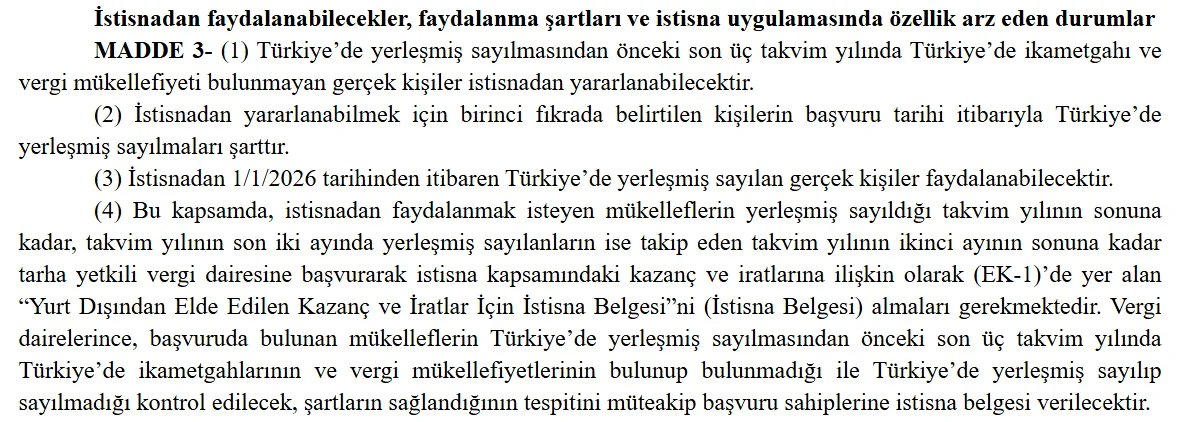
The exemption is not automatic in practice. To benefit, a person must apply to the tax office responsible for assessing his or her tax and obtain the "Exemption Certificate for Gains and Income Earned Abroad" in the form attached to the Communiqué (Annex 1) [T1]. The person must be resident in Turkey on the application date (Art. 3/2) [T1]. The tax office checks whether the person had a domicile or tax liability in Turkey in the previous three calendar years and whether the person is now resident, and issues the certificate once the conditions are met (Arts. 3/4 and 4) [T1].
| Became resident on | Look-back years | Deadline for the certificate |
|---|---|---|
| 12 July 2026 | 2023, 2024, 2025 | 31 December 2026 |
| 15 November 2026 (last two months of the year) | 2023, 2024, 2025 | End of February 2027 |
| 2 March 2028 | 2025, 2026, 2027 | 31 December 2028 (Example 2: an application in 2030 was refused) |
The rule behind the table: the deadline is the end of the calendar year in which the person becomes resident; for people who become resident in the last two months of a year, it is the end of the second month of the following year (Communiqué 333, Art. 3/4) [T1].
From arrival to certificate: the sequence in the rules
| Stage | What the rules look at | Source |
|---|---|---|
| 1. Before the move | No domicile and no tax liability in Turkey in the three previous calendar years (Turkish rent, securities income and capital gains excepted) | Art. 20/D/1-2 |
| 2. Becoming resident | Domicile in Turkey, or more than six months' continuous stay in a calendar year | Art. 4 |
| 3. Application | To the responsible tax office, while resident, before the deadline | Communiqué 333, Art. 3/2, 3/4 |
| 4. Tax office check | Residence, the three-year look-back and the timing of the application | Communiqué 333, Art. 4 |
| 5. Certificate issued | Exemption Certificate in the form of Annex 1 | Communiqué 333, Art. 3/4 |
| 6. Following years | No return for foreign income; Turkish-source income declared and taxed as usual | Art. 20/D/3; Communiqué 333, Art. 3/7 |
5. What is exempt, and what stays taxable in Turkey?
Only income earned outside Turkey is exempt. Income earned in Turkey remains taxable, and the person's Turkish tax obligations continue (Communiqué 333, Art. 3/7) [T1].
| Income | Under the exemption? | Communiqué example |
|---|---|---|
| Rent from a property abroad (for example in Monaco) | Yes | Examples 8, 11 |
| Dividends from a company resident abroad (for example in Spain) | Yes | Example 11 |
| Rent from a property in Turkey (for example in İstanbul) | No | Examples 9, 11 |
| Dividends from a Turkish company | No | Example 11 |
| Consultancy services performed in Turkey for clients abroad | No | Example 10 |
| Income of a company (corporate taxpayer) | No; only individuals can benefit | Art. 3/10 |
Remote workers and digital nomads
Example 10 concerns an engineer living in Turkey who advises foreign clients on their investments in Turkey: the self-employment income from that service performed in Turkey is not covered [T1]. The Income Tax Law's rules on where income is earned point the same way: wages count as earned in Turkey when the work is performed or evaluated in Turkey, and self-employment income when the activity is carried out or evaluated in Turkey (Art. 7, written for non-resident taxpayers) [M1]. Whether a particular remote work arrangement is Turkish-source or foreign-source therefore depends on where and how the work is done.
A worked illustration from the Communiqué
Example 11 describes a person under the exemption who in 2026 earns TRY 600,000 rent from a property in İstanbul and TRY 500,000 dividends from a Turkish company, plus dividends from a Spanish company and rent from a property in Monaco. The İstanbul rent and the Turkish dividends are taxed and declared in Turkey; the Spanish dividends and the Monaco rent are exempt, no return is filed for them, and they are not included in the return filed for the Turkish income [T1].
6. Do I file a tax return? Can I deduct taxes paid abroad?
| Question | Rule |
|---|---|
| Is an annual return filed for exempt foreign income? | No; if a return is filed for other income, the exempt income is left out (Art. 20/D/3) |
| Can expenses of the exempt income be deducted from taxable income? | No (Art. 20/D/4) |
| Can foreign taxes paid on the exempt income be credited in Turkey? | No (Art. 20/D/5) |
Whether the other country still taxes the same income is a separate question under that country's law and any tax treaty it has with Turkey; Article 20/D only governs Turkish income tax [M1].
7. What happens if the conditions turn out not to be met?
If it is later found that the conditions were not met, the tax that was not assessed is treated as tax loss (Art. 20/D/6) [M1]. The Communiqué adds that the missing tax is collected with a tax loss penalty and late payment interest (Art. 5) [T1]. In its Example 12, a person received a certificate in December 2026; a 2027 audit found unregistered business income in 2025 and 2026, so the certificate was cancelled as of the residence date and the undeclared foreign income was taxed with a penalty and interest [T1].
| Step in Example 12 | What happened |
|---|---|
| 12 May 2026 | Deemed resident in Turkey |
| 1 December 2026 | Certificate issued after the tax office check |
| 2027 tax audit | Unregistered business income found for 2025 and 2026 |
| Result | Certificate cancelled as of 12 May 2026; tax, tax loss penalty and late payment interest |
8. Leaving Turkey and non-residents
The Communiqué recalls the general rule: residents are taxed on worldwide income, while people who are not resident, including those who held a certificate and later stop being resident, are taxed in Turkey only on income earned in Turkey (Art. 6; Income Tax Law, Arts. 3 and 6) [T1][M1]. Example 13 concerns a person resident in the United Arab Emirates who transfers USD 100,000 to a Turkish bank account and also sends EUR 50,000 of rent from a property in France to that account: because the person is not resident in Turkey, neither the transfer nor the foreign income is taxed in Turkey [T1]. Banking checks on large incoming transfers are a separate matter, explained in our guide to frozen bank accounts in Turkey.
9. Inheritance tax at 1% during the exemption period
Law No. 7582 also added a paragraph to Article 16 of the Inheritance and Transfer Tax Law: for people benefiting from the Article 20/D exemption, the tax rate on transfers of property by inheritance that take place within the exemption period is 1% (Law No. 7582, Art. 2) [M2][M3]. How inheritance works for foreigners in Turkey, including which country's law applies to Turkish property, is explained in our guide to inheritance in Turkey for foreigners.
10. Bringing money and gold from abroad: the 2027 asset declaration
The same law introduced a temporary asset disclosure regime as Provisional Article 19 of the Corporate Tax Law (Law No. 7582, Art. 10) [M2][M4]. It is separate from Article 20/D and applies to individuals and companies:
| Point | Rule |
|---|---|
| What | Cash, gold, foreign currency, securities and other capital market instruments held abroad |
| Disclosure | To a bank or intermediary institution in Turkey by 31 July 2027 |
| Transfer | Into a Turkish account within two months of disclosure |
| Tax | 5% of the value, withheld by the bank |
| Reduced rates | 0% with a five-year holding commitment, 1% four years, 2% three years, 3% two years, 4% one year (deposits, government bonds, lease certificates, venture capital funds) |
| Later disclosures | Rates increase by half a point for disclosures from 1 January 2027 to 31 July 2027 |
| Effect | No tax audit or assessment on the disclosed amounts, subject to the conditions |
11. Common misunderstandings about the 20-year exemption
| Common belief | Position in the law and the Communiqué |
|---|---|
| "All my income is tax-free for twenty years" | Only income earned outside Turkey; Turkish-source income stays taxable (Communiqué Art. 3/7) |
| "It is automatic once I move" | An exemption certificate must be obtained within the deadline (Art. 3/4) |
| "Only foreigners can use it" | No nationality condition; the test is the three-year look-back (Art. 20/D; Example 4) |
| "My Turkish rental apartment disqualifies me" | Earlier liability only for Turkish rent, securities income or capital gains does not (Art. 20/D/2; Example 5) |
| "My company abroad can use it" | Only individuals; corporate taxpayers are excluded (Art. 3/10) |
| "Foreign taxes will be credited" | Foreign taxes on the exempt income cannot be credited (Art. 20/D/5) |
| "Working from Turkey for a foreign client is foreign income" | Services performed in Turkey were treated as not covered in Example 10 |
| "A residence permit makes me tax resident" | Tax residence follows the domicile and six-month tests (Income Tax Law, Art. 4) |
12. Tax residence is not a residence permit
Being resident for tax purposes and holding a residence permit are two different things. A residence permit or citizenship does not by itself make a person tax resident, and a tax certificate does not give a right to stay. The residence routes are explained in our guide to permanent residence in Turkey, and property purchases in our guide to buying property in Turkey as a foreigner. Selling Turkish property remains subject to Turkish capital gains rules, as explained in our guide to selling property in Turkey as a foreigner.
13. Tax lawyer in Istanbul, Ankara and across Turkey
The certificate application is made to the tax office responsible for the person, and disputes about a refusal or a later assessment go to the tax courts. Many newcomers settle in İstanbul and consult a tax lawyer in Istanbul; matters before the tax offices and tax courts in the capital are followed by a lawyer in Ankara; and people who are still abroad while preparing the move often work with a lawyer in Turkey under a power of attorney.
14. Documents that matter for the exemption
| Document | Why it matters |
|---|---|
| Entry and exit records | Six-month test and the date of becoming resident (Art. 4) |
| Proof of the previous domicile abroad (lease, registration, foreign tax residence certificate) | No domicile in Turkey in the three look-back years |
| Turkish tax records, if any | Which earlier liabilities are harmless (rent, securities, capital gains) and which block the exemption (wages, business) |
| Residence permit or proof of settling in Turkey | Being resident on the application date (Communiqué 333, Art. 3/2) |
| Records of foreign income sources | Separating foreign-source from Turkish-source income |
Sources and References
Legislation
[M1] Income Tax Law No. 193, Arts. 3, 4, 5, 6, 7, 20/D
[M2] Law No. 7582 Amending Certain Laws, Official Gazette 4 June 2026, No. 33270, Arts. 2, 4, 10, 14
[M3] Inheritance and Transfer Tax Law No. 7338, Art. 16 (paragraph added by Law No. 7582)
[M4] Corporate Tax Law No. 5520, Provisional Art. 19 (added by Law No. 7582)
[M5] Turkish Civil Code No. 4721, Art. 19
Official publications
[T1] Income Tax General Communiqué No. 333, Official Gazette 4 July 2026, No. 33300, Arts. 1-8 and Examples 1-13
This article is general information about Turkish law as of 2 October 2026. It is not tax or legal advice and does not assess any individual case.
Frequently Asked Questions
What is Turkey's 20-year tax exemption?
Article 20/D of the Income Tax Law, added by Law No. 7582 in 2026, exempts from income tax for twenty years the income earned outside Turkey by individuals who become resident in Turkey after having no domicile and no tax liability there in the previous three calendar years.
From when does the exemption apply?
To individuals deemed resident in Turkey on or after 1 January 2026 (Law No. 7582, Art. 14/a; Communiqué No. 333, Art. 3/3).
Who is considered resident in Turkey for tax?
People whose domicile is in Turkey, and people who stay in Turkey continuously for more than six months in a calendar year; temporary departures do not interrupt the stay (Income Tax Law, Art. 4).
Can foreigners stay more than six months without becoming tax resident?
Yes, in the cases in Article 5: foreigners who come for a specific and temporary task or job, or for education, medical treatment, rest or travel, and people kept in Turkey by detention or illness.
Do I need to apply, or is the exemption automatic?
Communiqué No. 333 requires an exemption certificate from the tax office responsible for the person, applied for within the deadline (Art. 3/4).
What is the deadline to apply for the exemption certificate?
By the end of the calendar year in which the person becomes resident; for people who become resident in the last two months of the year, by the end of February of the following year (Communiqué No. 333, Art. 3/4).
What happens if I miss the deadline?
In the Communiqué's Example 2, a person resident from March 2028 who applied in 2030 was refused because the application was not made by the end of 2028.
Must I already be resident when I apply?
Yes. The person must be deemed resident in Turkey on the application date (Communiqué No. 333, Art. 3/2).
Does owning a rented apartment in Turkey disqualify me?
No. Earlier tax liability only because of Turkish real estate income, securities income or capital gains does not prevent the exemption (Art. 20/D/2; Communiqué Example 5).
Does working in Turkey in the last three years disqualify me?
Wage income in Turkey within the three look-back years led to refusal in Communiqué Example 6, and Turkish business income in Example 7.
Can Turkish citizens returning from abroad benefit?
Article 20/D sets no nationality condition. The test is the three-year look-back; in Example 4, a returning person was refused only because they were still resident in Turkey in 2024.
Is my foreign salary exempt if I work remotely from Turkey?
Only income earned outside Turkey is exempt. Under Article 7, wages count as earned in Turkey when the work is performed or evaluated in Turkey, and the Communiqué's Example 10 treats services performed in Turkey for foreign clients as not covered.
Is rent from my property abroad exempt?
Yes. Rent from property abroad is covered by the exemption (Communiqué Examples 8 and 11), and no return is filed for it.
Are foreign dividends exempt?
Yes. Dividends from a company resident abroad are covered (Communiqué Example 11). Dividends from a Turkish company are not.
Is rent from my apartment in Istanbul exempt?
No. Income from property in Turkey is Turkish-source and stays taxable (Communiqué Examples 9 and 11).
Can a company use the 20-year exemption?
No. Only individuals can benefit; corporate taxpayers cannot (Communiqué No. 333, Art. 3/10).
Do I file a tax return for exempt foreign income?
No. No annual return is filed for it, and if a return is filed for other income, the exempt income is not included (Art. 20/D/3).
Can I credit foreign taxes against Turkish tax?
Not for the exempt income: foreign taxes paid on it cannot be credited against Turkish income tax (Art. 20/D/5), and its expenses cannot be deducted (Art. 20/D/4).
What if the tax office later finds I did not qualify?
The certificate can be cancelled from the residence date and the missing tax collected with a tax loss penalty and late payment interest (Art. 20/D/6; Communiqué Art. 5 and Example 12).
What is the inheritance tax rate for people under the exemption?
1% on transfers of property by inheritance that take place within the exemption period (Inheritance and Transfer Tax Law Art. 16, as amended by Law No. 7582, Art. 2).
- Turkey 20-year tax exemption
- Turkey tax exemption foreign income
- Article 20/D Income Tax Law
- Law 7582
- Communique 333
- tax residency Turkey
- six-month rule tax residence Turkey
- moving to Turkey tax
- exemption certificate Turkey
- foreign dividends tax Turkey
- foreign rental income Turkey
- remote work tax Turkey
- digital nomad tax Turkey
- returning Turkish citizens tax
- inheritance tax 1% Turkey
- asset disclosure 2027 Turkey
- Turkey non-dom regime
- tax office Turkey
- tax lawyer Istanbul
- tax lawyer Turkey
Our services in this area
Tax Law