Marrying a Turkish Citizen (2026): Documents You Need, Where to Marry, Prenup, Residence Permit and Citizenship by Marriage
How a foreigner marries a Turkish citizen in Turkey: the municipal marriage office, the certificate of capacity to marry and health report, polygamy and religious ceremonies, prenuptial agreements, family residence and citizenship after three years.
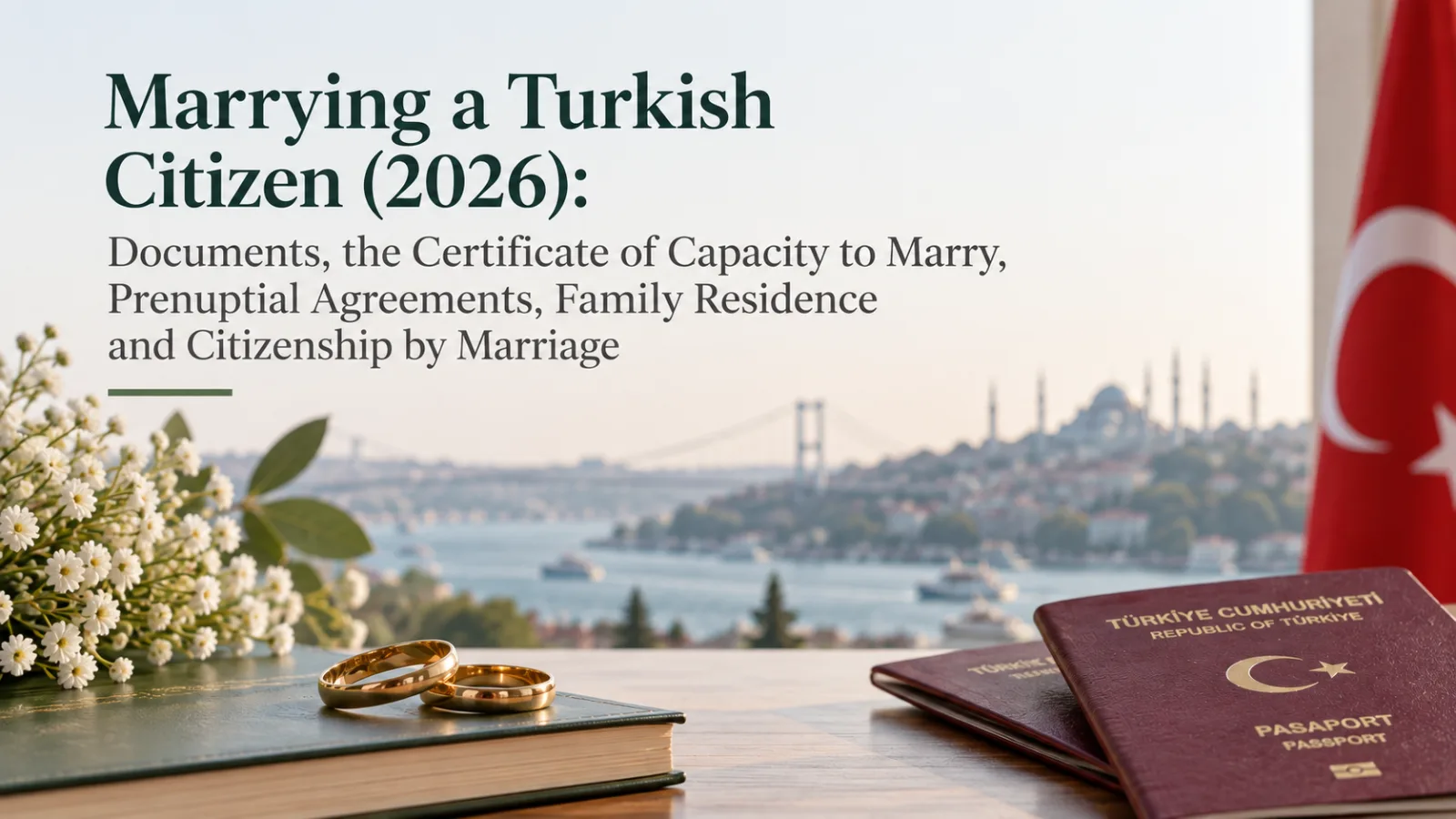
A foreigner can marry a Turkish citizen in Turkey in a civil ceremony at the municipal marriage office. The file is not accepted without a certificate of no impediment from the foreigner's own country and a health report, and the marriage has consequences for residence, citizenship and property.
If you have a matter on this topic:
1. Can a foreigner marry a Turkish citizen in Turkey?
Yes. The Marriage Regulation provides that a Turkish citizen and a foreigner, or two foreigners of different nationalities, may marry in Turkey before the competent Turkish marriage officer; when one spouse is a foreigner, the municipal marriage offices and the population directorates are competent (Art. 12) [M1]. The same rules of procedure that apply to Turkish citizens apply to foreigners.
Turkish private international law decides which law governs: each person's capacity and conditions to marry are governed by his or her national law at the time of marriage, and the form of the marriage by the law of the country where it takes place (Law No. 5718, Art. 13) [M4]. That is why the foreigner proves, through a document from home, that there is no impediment under national law, while the ceremony itself follows Turkish form.
Two foreigners of the same nationality may marry before their own consulate in Turkey if their national law allows it, or before the Turkish officer (Art. 12) [M1].
2. Documents required to marry in Turkey as a foreigner
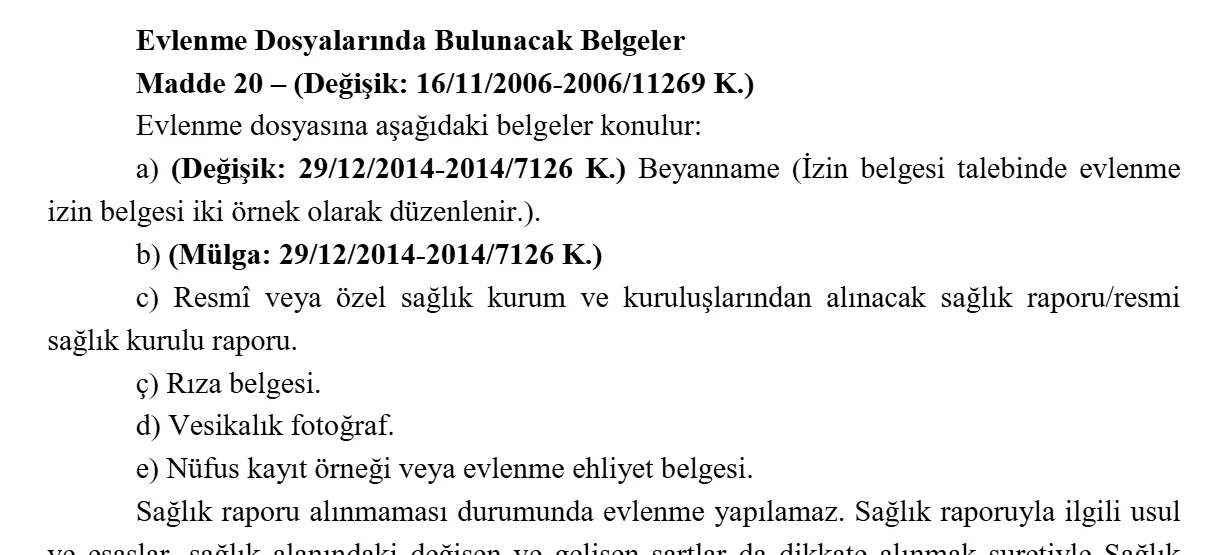
| Document | What the Regulation says | Practical notes |
|---|---|---|
| Declaration form | Completed at the application | For foreigners the address in the declaration is accepted; no other address document is requested |
| Certificate of legal capacity to marry (evlenme ehliyet belgesi) | Issued by the central authorities of the foreigner's state or its missions, showing name, surname, parents' names, date of birth and that there is no impediment to marriage, duly certified | Documents issued by honorary consulates are not accepted |
| Health report | From a public or private health institution | "No marriage can take place without a health report" |
| Photographs | Colour, recent (last six months), full face | Photos with a headscarf are accepted if forehead, chin and face are visible |
| Consent document | Where a parent's, guardian's or judge's consent is required (age or legal restriction) | Signed before the officer or certified |
| Passport | Identity | Sworn translations of foreign documents where needed |
The foreigner normally obtains the certificate from his or her own authorities; where that is not possible, the marriage officer may request it through the General Directorate of Population (Art. 12). If the officer doubts a document, it can be verified through the Ministry of Foreign Affairs with the issuing state's mission (Art. 20) [M1]. Refugees, people under temporary protection and international protection applicants obtain the certificate from the provincial migration directorate based on their file (Art. 13) [M1].
3. Where and how the ceremony takes place
The couple apply together to the marriage office of the municipality where one of them lives (Art. 16) [M1]. If a party does not speak Turkish, the officer may use an interpreter who knows the first official language of a state recognised by Turkey; the couple bring the interpreter to the ceremony (Art. 27) [M1]. After the ceremony the couple receive a family booklet (aile cüzdanı) and, on request, a multilingual marriage certificate for use abroad (Art. 34) [M1].
4. Conditions to marry under Turkish law
| Condition | Rule | Article |
|---|---|---|
| Age | 17 completed years; a judge may exceptionally allow marriage at 16 for a very important reason | Civil Code Art. 124 |
| Kinship | Marriage is prohibited between ascendants and descendants, siblings, uncles and aunts with nephews and nieces, and with a spouse's ascendants or descendants even after that marriage ends | Art. 129 |
| Previous marriage | A person who wishes to remarry must prove that the previous marriage has ended | Art. 130 |
| Waiting period for women | 300 days after the end of a marriage; ends with childbirth; the court lifts it if the woman is not pregnant from the previous marriage or the former spouses remarry each other | Art. 132 |
A foreign divorce used to prove that a previous marriage has ended may need to be registered or recognised in Turkey first when a Turkish citizen is involved; our guide to recognition of a foreign divorce explains the registry route and the court route.
5. Polygamy and marrying while already married
A marriage entered into while one spouse is already married is absolutely void (Civil Code Art. 145/1) [M2], and contracting a marriage while married is a crime punishable by six months to two years' imprisonment, as is knowingly marrying a married person (Criminal Code Art. 230/1-2) [M3]. This is why marriage offices require proof that any earlier marriage has ended.
6. Religious ceremonies without a civil marriage
A religious ceremony alone is not registered and does not have the legal effects of a civil marriage. The Criminal Code used to penalise performing a religious ceremony before the civil marriage, but the Constitutional Court annulled those paragraphs in 2015 [M3]. The practical consequences remain: no inheritance rights as a spouse, no family residence permit and no citizenship by marriage based on a religious ceremony alone. Couples usually marry at the municipality first and hold any religious ceremony afterwards.
7. Prenuptial agreements in Turkey
The default matrimonial property regime in Turkish law is participation in acquired property: property acquired during the marriage is in principle shared equally when the regime ends, while personal property such as inheritances is not (Civil Code Art. 202) [M2]. Spouses may choose another regime provided by law through a matrimonial property agreement, made before or after the marriage (Art. 203), drawn up or certified by a notary; they may also declare their chosen regime in writing when applying to marry (Art. 205) [M2].
| Option | How | Effect |
|---|---|---|
| No agreement | Nothing | Participation in acquired property (if Turkish law applies) |
| Prenuptial or postnuptial agreement | Before a notary | Another regime provided by the Civil Code |
| Declaration at the marriage application | In writing at the marriage office | Choice of regime |
| Choice of law | Expressly | The law of habitual residence or of either spouse's nationality at the time of marriage |
In an international marriage, the spouses may expressly choose the law of their habitual residence or the national law of either of them at the time of marriage; without a choice, their common national law applies, then the law of their common habitual residence, then Turkish law. Immovable property is liquidated under the law of the country where it is located (Law No. 5718, Art. 15) [M4]. For couples with property in several countries, the prenuptial agreement and the choice of law are usually considered together.
8. Mahr (mehr) in Turkish law
Turkish civil law does not regulate mahr as a separate institution. Where a written mahr undertaking exists, courts treat it as a promise of gift that can be enforced, so the written document matters. Our glossary entry on mehr summarises the approach.
9. Family residence permit after marrying a Turkish citizen
The foreign spouse of a Turkish citizen may apply for a family residence permit. The law requires the sponsoring spouse to show (Law No. 6458, Art. 35) [M6]:
| Condition | Detail |
|---|---|
| Income | Monthly income of at least one third of the minimum wage per family member, and not less than the minimum wage in total |
| Housing and insurance | Suitable housing for the family size, and health insurance covering all family members |
| Criminal record | No conviction for offences against family order in the five years before the application |
| Address registration | Registered in the address system |
| One year of residence | Not required for spouses of Turkish citizens (Art. 35/2) |
The marriage must not have been entered into to obtain a residence permit, and both spouses must be at least 18 (Art. 35/3) [M6]. Family residence permits are issued for up to two years at a time (Regulation Art. 27) [M7]. If a marriage is found to be a sham, the permit is cancelled and its period is not counted towards later residence totals (Regulation Art. 34/5) [M7]. Family residence years otherwise count in full towards the long-term residence permit.
10. Turkish citizenship by marriage
Marriage to a Turkish citizen does not give citizenship directly. A foreigner who has been married to a Turkish citizen for at least three years, with the marriage continuing, may apply, provided that the couple live in family unity, the applicant does not act in a way incompatible with the marriage, and there is no obstacle on grounds of national security or public order (Citizenship Law No. 5901, Art. 16) [M5].
- If the Turkish spouse dies after the application, the family unity condition is no longer required (Art. 16/2).
- A spouse who obtained citizenship by marriage keeps it if the marriage is later annulled, provided he or she acted in good faith (Art. 16/3).
- Citizenship obtained by marriage stands on its own basis: under Article 58/2 of the Citizenship Regulation, the cancellation of an investor spouse's citizenship does not affect a spouse who became a citizen through marriage, as explained in our guide to the 2026 citizenship cancellations.
11. Children's citizenship in a mixed marriage
A child born within marriage to a Turkish mother or a Turkish father, in Turkey or abroad, is a Turkish citizen. A child born outside marriage to a Turkish mother and a foreign father is Turkish; a child born outside marriage to a Turkish father and a foreign mother acquires Turkish citizenship once the procedures establishing paternity are completed (Citizenship Law Art. 7) [M5]. This is one of the clearest practical differences between a registered marriage and a religious ceremony alone.
12. Marrying abroad: is the marriage valid in Turkey?
A Turkish citizen may marry a foreigner before the competent authorities of the country where they are, and the marriage is valid in Turkey unless it conflicts with Turkish legislation (Marriage Regulation Art. 11) [M1]. The marriage is reported through the Turkish mission and registered in the population records within 30 days of reaching it (Art. 32) [M1]. Registration matters later for residence, citizenship and inheritance.
13. Family lawyer in Istanbul, Ankara and across Turkey: when couples ask for help
Most marriages are completed at the municipality without a lawyer. Couples usually ask for legal help in specific situations: drafting a prenuptial agreement that covers property in several countries, a refused or cancelled family residence permit, registering a marriage made abroad, or later divorce and custody. In İstanbul many international couples consult a family and divorce lawyer in Istanbul; marriages and family cases in the capital are handled by a lawyer in Ankara before the Ankara offices and courts; and spouses abroad look for a family lawyer in Turkey who can act under a power of attorney.
14. A short checklist before applying
| Step | What is needed |
|---|---|
| 1. Certificate of capacity to marry | From your country's authorities or mission, certified and translated |
| 2. Health report | From a public or private health institution |
| 3. Photos and passport | Recent photos, valid passport |
| 4. Joint application | At the marriage office of the municipality where one of you lives |
| 5. Interpreter | If one of you does not speak Turkish |
| 6. Property regime | Declaration at the application or a notarial agreement if you want a regime other than the default |
| 7. After the ceremony | Family booklet, multilingual certificate, then the family residence permit application |
Sources and References
[M1] Marriage Regulation (Evlendirme Yönetmeliği), Arts. 11, 12, 13, 16, 20, 27, 32, 34
[M2] Turkish Civil Code No. 4721, Arts. 124, 129, 130, 132, 145, 202, 203, 205
[M3] Turkish Criminal Code No. 5237, Art. 230 (paragraphs 5 and 6 annulled by the Constitutional Court, E.2014/36, K.2015/51, 27 May 2015)
[M4] Law No. 5718 on Private International and Procedural Law, Arts. 13, 15
[M5] Turkish Citizenship Law No. 5901, Arts. 7, 16
[M6] Law No. 6458 on Foreigners and International Protection, Art. 35
[M7] Regulation on the Implementation of Law No. 6458, Arts. 27, 34
This article is general information about Turkish law as of 2 October 2026. It is not legal advice and does not assess any individual situation.
Frequently Asked Questions
Can a foreigner marry a Turkish citizen in Turkey?
Yes. Under Article 12 of the Marriage Regulation, a Turkish citizen and a foreigner may marry in Turkey before the competent Turkish marriage officer: the municipal marriage offices and population directorates when one spouse is a foreigner.
What documents do I need to marry in Turkey as a foreigner?
A declaration form, a certificate of legal capacity to marry from your country's authorities or missions (duly certified), a health report, recent photographs, your passport and, where needed, a consent document (Marriage Regulation Art. 20). Honorary consulate documents are not accepted.
What is a certificate of legal capacity to marry (evlenme ehliyet belgesi)?
A document from your country's central authorities or missions showing your name, surname, parents' names and date of birth and confirming there is no impediment to your marriage, duly certified (Marriage Regulation Art. 20).
Is a health report required to marry in Turkey?
Yes. Article 20 of the Marriage Regulation states that no marriage can take place without a health report from a public or private health institution.
What is the minimum age to marry in Turkey?
17 completed years. A judge may exceptionally allow marriage at 16 for a very important reason (Civil Code Art. 124).
Where do we apply to get married in Turkey?
Together, at the marriage office of the municipality where one of you lives (Marriage Regulation Art. 16). When one spouse is a foreigner, municipal marriage offices and population directorates are competent.
Can we marry in Turkey if I don't speak Turkish?
Yes. The marriage officer may use an interpreter who knows the first official language of a state recognised by Turkey; you bring the interpreter to the ceremony (Marriage Regulation Art. 27).
Are prenuptial agreements valid in Turkey?
Yes. Spouses may choose a property regime provided by law through an agreement made before or after the marriage (Civil Code Art. 203), drawn up or certified by a notary, or declare their choice in writing at the marriage application (Art. 205).
What happens to our property if we don't sign a prenup?
If Turkish law applies, the default regime is participation in acquired property: property acquired during the marriage is in principle shared equally when the regime ends, while personal property such as inheritances is not (Civil Code Art. 202).
Which law governs property in an international marriage?
The spouses may expressly choose the law of their habitual residence or the national law of either at the time of marriage. Without a choice: common national law, then common habitual residence, then Turkish law; immovables are liquidated under the law of their location (Law No. 5718, Art. 15).
Do I get Turkish citizenship by marrying a Turkish citizen?
Not directly. After at least three years of continuing marriage you may apply, provided you live in family unity, do not act in a way incompatible with the marriage and pose no national security or public order obstacle (Citizenship Law Art. 16).
What happens to my citizenship application if my Turkish spouse dies?
If the Turkish spouse dies after the application, the family unity condition is no longer required (Citizenship Law Art. 16/2).
Can I get a residence permit after marrying a Turkish citizen?
Yes, a family residence permit. The Turkish spouse needs income of at least one third of the minimum wage per family member (total not below the minimum wage), suitable housing, health insurance for the family and a clean record regarding family offences for five years (Law No. 6458, Art. 35).
Does my Turkish spouse need to have lived in Turkey for a year before I get a family permit?
No. The one-year residence requirement for the sponsor does not apply to spouses of Turkish citizens (Law No. 6458, Art. 35/2).
What happens if the authorities think our marriage is a sham?
The law requires that the marriage was not entered into to obtain a residence permit (Art. 35/3). If a sham marriage is established, the family permit is cancelled and its period does not count towards later residence totals (Regulation Art. 34/5).
Is polygamy allowed in Turkey?
No. A marriage entered into while one spouse is already married is absolutely void (Civil Code Art. 145), and contracting a marriage while married is punishable by six months to two years' imprisonment (Criminal Code Art. 230).
Is a religious marriage (imam nikahı) valid in Turkey?
A religious ceremony alone is not registered and does not have the legal effects of a civil marriage, such as inheritance rights, family residence or citizenship by marriage. The criminal penalty for holding it before the civil marriage was annulled by the Constitutional Court in 2015.
How long must a divorced woman wait before remarrying in Turkey?
300 days from the end of the previous marriage. The period ends with childbirth, and the court lifts it if she is not pregnant from the previous marriage or the former spouses remarry each other (Civil Code Art. 132).
Is a marriage abroad between a Turkish citizen and a foreigner valid in Turkey?
Yes, if made before the competent authorities of that country and not in conflict with Turkish legislation (Marriage Regulation Art. 11). It is reported through the Turkish mission for registration (Art. 32).
Will our children be Turkish citizens?
A child born within marriage to a Turkish mother or father is a Turkish citizen. Outside marriage, a child of a Turkish mother is Turkish; a child of a Turkish father and foreign mother becomes Turkish once paternity is established (Citizenship Law Art. 7).
What do we receive after the marriage ceremony in Turkey?
A family booklet (aile cüzdanı) and, on request, a multilingual marriage certificate for use abroad (Marriage Regulation Art. 34).
How is mahr treated under Turkish law?
Mahr is not regulated as a separate institution. Where a written undertaking exists, courts treat it as an enforceable promise of gift, so the written document matters.
Do I need a family lawyer in Turkey to get married?
Usually not; most marriages are completed at the municipality. Couples ask a family lawyer in Turkey mainly for prenuptial agreements covering property in several countries, refused family permits, registration of a marriage abroad, or later divorce and custody.
Where can I find a family lawyer in Istanbul or Ankara?
In İstanbul many international couples consult a family and divorce lawyer in Istanbul; marriages and family cases in the capital are handled by a lawyer in Ankara before the Ankara offices and courts. Our family law page explains the service.
Can two foreigners of the same nationality marry in Turkey?
Yes. They may marry before their own consulate in Turkey if their national law allows it, or before the Turkish marriage officer (Marriage Regulation Art. 12).
- marrying a Turkish citizen
- marriage in Turkey for foreigners
- documents to marry in Turkey
- certificate of no impediment Turkey
- evlenme ehliyet belgesi
- prenuptial agreement Turkey
- prenup Turkey notary
- Turkish citizenship by marriage
- citizenship by marriage 3 years Turkey
- family residence permit Turkey
- spouse visa Turkey
- sham marriage residence Turkey
- religious marriage Turkey imam nikahı
- waiting period 300 days Turkey
- multilingual marriage certificate
- marry Turkish woman
- marry Turkish man
- children citizenship mixed marriage Turkey
- family lawyer Istanbul
- divorce lawyer Istanbul
- family lawyer Turkey
Our services in this area
Family Law