Child Custody in Turkey (2026): Custody Laws for Foreign Parents, Taking a Child Abroad and the Hague Convention
How Turkish courts decide custody for international families: which country's law applies, the child's interests with no fixed age rule, joint custody, visitation and child support, moving abroad, and the Hague return procedure under Law No. 5717.
When an international couple separates in Turkey, two questions come first: who will the child live with, and can the child be taken to another country? Turkish law answers both through the child's interests, a family court and, when a child has already been moved across a border, the Hague Convention procedure.
If you have a matter on this topic:
1. Who has custody of a child in Turkey?
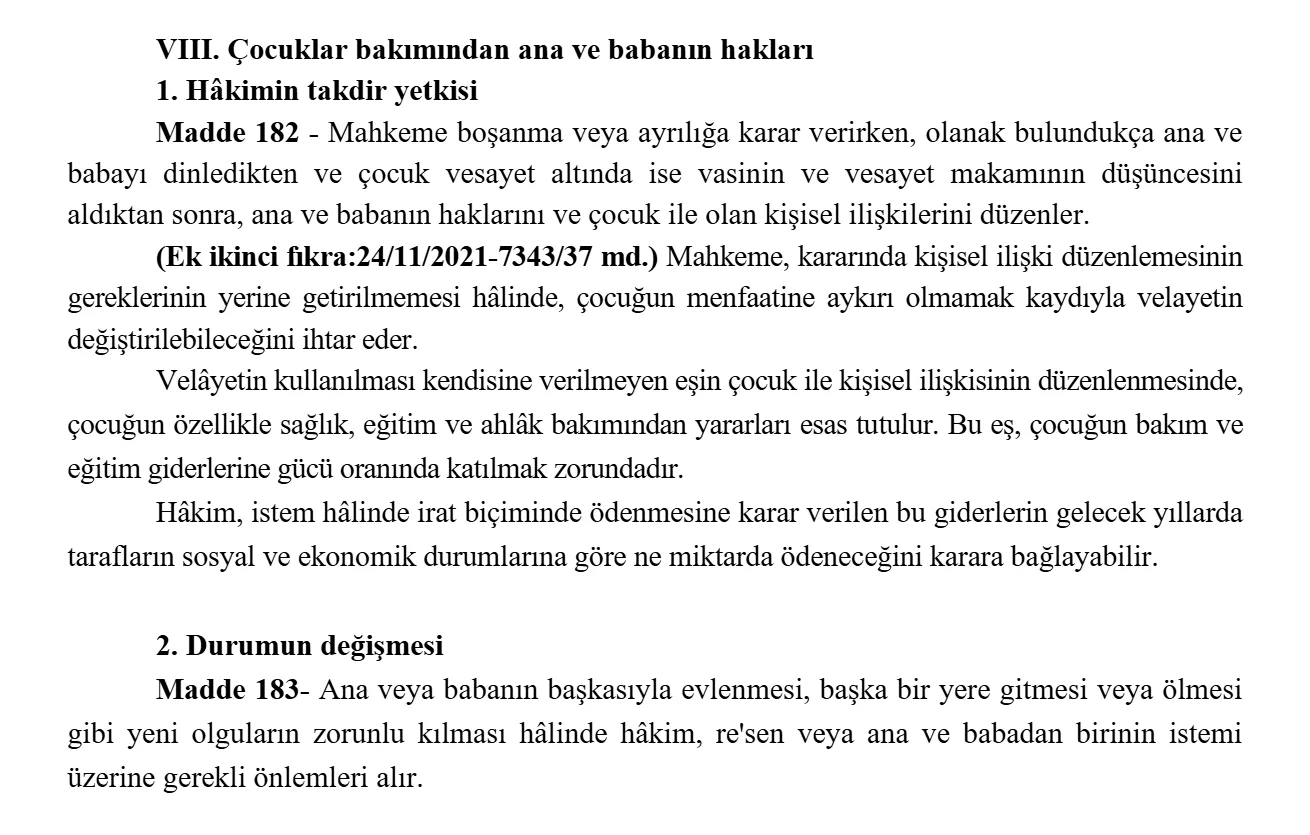
A minor child is under the custody of the mother and father, and custody cannot be taken from the parents without a legal reason (Civil Code, Art. 335) [M1]. While the marriage continues, the parents exercise custody together. If they stop living together or a separation is ordered, the judge may give custody to one of them; after a divorce, custody belongs to the parent to whom the child is entrusted (Art. 336) [M1]. The court that grants the divorce therefore also decides custody, after hearing the parents where possible, and regulates the rights of both parents and the child's personal relations with the other parent (Art. 182) [M1].
| Stage | Who exercises custody | Basis |
|---|---|---|
| During the marriage | Both parents together | Civil Code Art. 336/1 |
| Common life ended or separation | The judge may give custody to one parent | Art. 336/2 |
| While the divorce case continues | Interim measures for the children's care and protection | Art. 169 |
| After the divorce | The parent the child is entrusted to | Art. 336/3; Art. 182 |
| Death of a parent | The surviving parent | Art. 336/3 |
| Parents never married | The mother; the judge may appoint a guardian or give custody to the father in listed cases | Art. 337 |
2. Which country's law decides custody for international couples?
When a Turkish court hears the divorce of a mixed or foreign couple, it first decides which law applies. Under Turkey's Private International Law, custody in divorce follows the same rule as the divorce itself: the spouses' common national law; if they have different nationalities, the law of their common habitual residence; and if there is none, Turkish law (Law No. 5718, Art. 14/1 and 14/3) [M3]. Interim measures during the case are always governed by Turkish law (Art. 14/4), and child support claims follow the law of the habitual residence of the person entitled to support, usually the child (Art. 19) [M3].
| Family situation | Law applied to custody in a Turkish divorce case |
|---|---|
| Both parents are nationals of the same foreign country | That country's law (common national law) |
| One Turkish and one foreign parent, living in Turkey | Turkish law (common habitual residence) |
| Different nationalities, both living in the same foreign country | That country's law (common habitual residence) |
| Different nationalities, no common habitual residence | Turkish law |
| Interim measures during the case | Always Turkish law (Art. 14/4) |
| Child support | Law of the child's habitual residence (Art. 19) |
The same family can therefore receive different answers depending on the parents' nationalities and where the family lived before the separation. These connecting rules are why the first questions in an international custody file are usually about passports and the family's last common home.
3. How do Turkish courts decide custody? No fixed age rule
It is often said that young children automatically stay with the mother, or that custody changes at a certain age. The Civil Code contains no such rule. When regulating personal relations, the law directs the court to the child's interests, "especially in terms of health, education and morals" (Art. 182) [M1].
Factors examined in practice
The matters examined in custody files usually include:
- the child's age, health and developmental needs;
- which parent has been caring for the child day to day;
- each parent's home, working hours and support network;
- continuity of schooling, language and friendships;
- each parent's willingness to support the child's relationship with the other parent;
- social worker, psychologist or pedagogue reports ordered by the family court.
Does the child's opinion matter?
The Civil Code requires parents to give the child room to organise his or her life according to the child's maturity and, in important matters, to take the child's views into account as far as possible (Art. 339) [M1]. Family courts commonly hear children who are old enough to express a view, often with an expert present. A child's view is weighed with the other factors; it does not decide the case on its own.
4. Is joint custody possible after divorce in Turkey?
The Civil Code describes joint custody only during the marriage; after divorce it refers to the parent the child is entrusted to (Art. 336) [M1]. Joint custody after divorce entered Turkish practice through Article 5 of Protocol No. 7 to the European Convention on Human Rights, which provides that spouses have equal rights and responsibilities towards their children during marriage and after its dissolution [M5]. In a 2017 file concerning the divorce of two British nationals, the Court of Cassation (2nd Civil Chamber, E.2016/15771, K.2017/1737) approved joint custody with reference to that article [Y1]. In later files, joint custody has been approved where both parents asked for it and the child's interests allowed it.
| Question | Position |
|---|---|
| Is joint custody written in the Civil Code after divorce? | No; Art. 336 refers to the parent the child is entrusted to |
| Legal basis used in practice | Protocol No. 7 to the ECHR, Art. 5 |
| First Court of Cassation file | 2nd Civil Chamber, E.2016/15771, K.2017/1737 (two British nationals) |
| Typical setting | Both parents ask for it, usually in an uncontested divorce protocol |
5. Parents who were never married
If the parents are not married, custody belongs to the mother. If the mother is a minor, restricted, deceased or has had custody removed, the judge appoints a guardian or gives custody to the father, according to the child's interests (Civil Code, Art. 337) [M1]. Unmarried foreign couples living in Turkey are often surprised by this rule, because many countries give unmarried fathers parental responsibility once paternity is established.
6. Personal relations (visitation) with the other parent
Each parent has the right to adequate personal relations with a child not in his or her custody (Civil Code, Art. 323) [M1]. The court sets the arrangement in the divorce decision: weekends, holidays, summer periods and, for international families, how time is spent in the other parent's country and who pays for travel.
| Issue | What the law says |
|---|---|
| Right to see the child | Each parent has the right to adequate personal relations (Art. 323) |
| Criteria | The child's interests, especially health, education and morals (Art. 182) |
| Duty of both parents | Not to damage the other's relationship with the child or hinder upbringing (Art. 324/1) |
| Obstruction by the custodial parent | Custody may be changed, if not against the child's interests (Arts. 182/2, 324/3) |
| Grandparents and relatives | Contact can be granted in extraordinary circumstances (Art. 325) |
When can contact be refused or restricted?
Contact can be refused or taken away if it endangers the child's peace, if a parent uses it in breach of the duty not to damage the other parent's relationship with the child, if the parent does not seriously care for the child, or for other important reasons (Civil Code, Art. 324/2) [M1].
If the custodial parent blocks contact
Since 2021 the Civil Code has said this directly: if the parent with custody does not comply with the personal relations arrangement, custody may be changed, provided this is not against the child's interests, and the court warns the parties of this in its decision (Arts. 182/2 and 324/3, added by Law No. 7343) [M1]. For parents abroad whose contact is not being honoured, this warning in the decision is often the first document they look at.
Grandparents and other relatives
Where extraordinary circumstances exist, the right to personal relations can also be granted to other people, especially relatives, to the extent this suits the child's interests (Art. 325) [M1].
7. Child support after divorce in Turkey
The non-custodial parent contributes to the child's care and education costs according to his or her means (Civil Code, Art. 182/3) [M1]. The amount is set by the child's needs and the parents' living conditions and ability to pay; the child's own income is also considered, and support is paid monthly in advance (Art. 330) [M1]. The parent caring for the child can file the support claim on the child's behalf (Art. 329), and the amount can be re-set or ended when circumstances change (Art. 331) [M1].
| Question | Civil Code rule |
|---|---|
| How long? | Until the child reaches majority; if education continues, until it ends, to the extent the parents can be expected to pay (Art. 328) |
| Who files? | The parent actually caring for the child, on the child's behalf (Art. 329) |
| How much? | Child's needs, parents' living conditions and ability to pay (Art. 330) |
| Future increases | The judge can decide in advance how payments will be adjusted in future years (Arts. 182, 330) |
| Change | Re-set or ended on request when circumstances change (Art. 331) |
8. Can the custodial parent move abroad with the child?
This is the central question for many foreign parents. The Civil Code provides that new facts, such as a parent remarrying, moving to another place or dying, allow the judge to take the necessary measures of the court's own motion or at a parent's request (Art. 183) [M1]. A move abroad is therefore not an automatic loss of custody, but it is a change the court can review, especially because it affects the other parent's personal relations.
What the court usually looks at
- the reason for the move (work, family support, remarriage);
- the child's ties in each country, including language and school;
- whether the contact arrangement can realistically continue across borders;
- travel costs and holiday periods;
- the child's views, depending on age and maturity.
The child's passport and consent
Under the Passport Law, a minor's passport requires an officially certified document containing the consent of the child's legal representative (Law No. 5682, Art. 17/C) [M4]. Since 2019, custody or guardianship decisions given by foreign courts or authorities can be accepted in passport applications made at Turkish missions in the country where the decision was given (Art. 17/E) [M4]. A parent who moves a child without the other parent's consent or a court decision may face the Hague return procedure described next.
9. My child was taken to or from Turkey without my consent: what happens?
Turkey applies the 1980 Hague Convention on the Civil Aspects of International Child Abduction through Law No. 5717 [M2]. The law covers a child under 16 whose habitual residence, immediately before the breach, was in a Convention state, when custody or contact rights actually being exercised were breached by moving or keeping the child in another Convention state (Arts. 2-3) [M2]. It applies to cases arising after 1 August 2000 (Provisional Art. 1) [M2].
| Step | Rule in Law No. 5717 |
|---|---|
| Where to apply | The Central Authority of the child's habitual residence, Turkey's Central Authority (Ministry of Justice), or any Convention state's Central Authority (Art. 7/1) |
| Who files the case in Turkey | The local chief public prosecutor's office, on behalf of the Central Authority (Arts. 4, 7/2) |
| Documents | No certification is required for documents sent by a Central Authority (Art. 7/3) |
| Court | The family court where the child lives or is placed under protection (Art. 6) |
| Settlement first | The court encourages a voluntary return, with experts, before deciding (Art. 8) |
| Speed | Simple procedure, with priority and urgency; also heard during the judicial recess (Arts. 9, 16) |
| Custody decisions | A custody decision given after the return application is not a reason to refuse return; a custody case is stayed while the return case is pending (Arts. 13-15) |
| Appeal | The Central Authority, the applicant or the respondent can appeal (Art. 17/2) |
| Costs | No court fees; the applicant may obtain legal aid (Arts. 27-28) |
Who can apply, and where
The applicant is the person or institution that was actually exercising care or contact rights before the child was moved (Art. 3/b) [M2]. The application can be made in the country the child was taken from; the Central Authorities then communicate with each other, and in Turkey the prosecutor files the case in the family court where the child is.
Can the court refuse to return the child?
The grounds for refusing return come from the Convention itself [M5]:
| Convention article | Rule |
|---|---|
| Art. 12 | If less than one year has passed between the wrongful removal and the start of proceedings, return is ordered forthwith; after one year, return is still ordered unless the child is now settled in the new environment |
| Art. 13(a) | The applicant was not actually exercising custody rights, or consented to or later acquiesced in the removal |
| Art. 13(b) | Grave risk that return would expose the child to physical or psychological harm or an intolerable situation |
| Art. 13, second paragraph | The child objects to return and has reached an age and maturity at which the child's views should be taken into account |
| Art. 20 | Return would conflict with the fundamental principles of the requested state on human rights |
Because time matters under Article 12, the date of removal and the date the application is made are often the first facts examined in these files.
Measures to stop the child from being moved again
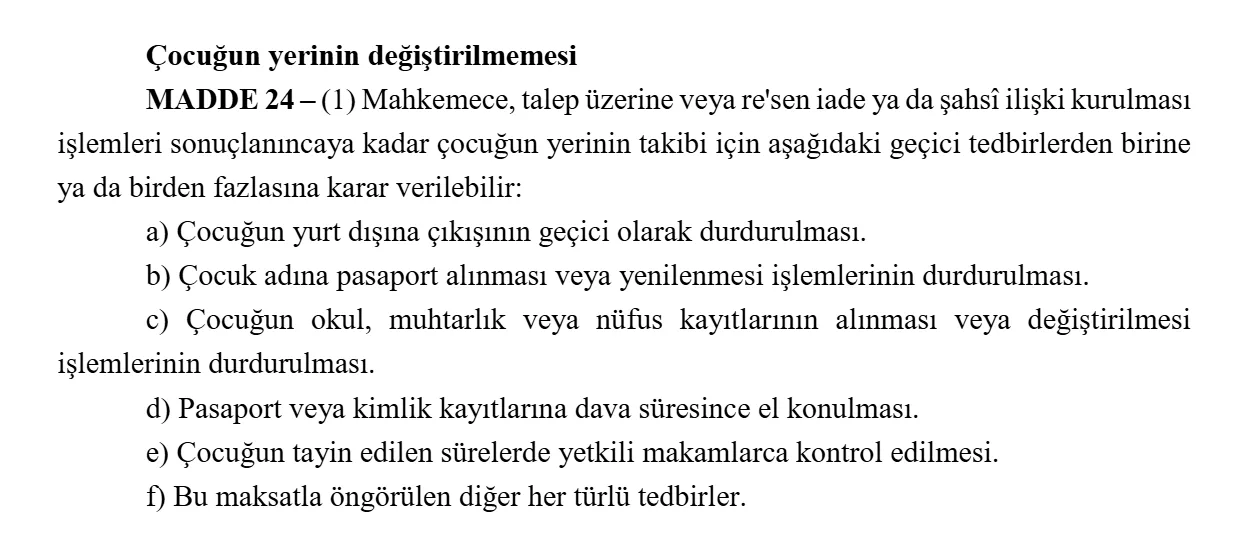
Until the return or contact case ends, the court may order, at a request or of its own motion, one or more of the following: a temporary stop on the child's exit from Turkey, a stop on obtaining or renewing the child's passport, a stop on changing school, neighbourhood or population records, seizure of passports or identity records, and periodic checks on the child (Law No. 5717, Art. 24) [M2]. Our guide to exit bans in Turkey explains how exit stops are applied at the border.
The court can also take interim protective measures for the child during the case, such as placing the child with a relative or a trusted family, after obtaining the child's view and expert reports where necessary (Art. 10), and it can order temporary contact between the applicant and the child (Art. 11/2) [M2].
How a return order is enforced
Return and contact orders are enforced once final (Art. 17) [M2]. Since the 2021 amendments, they are enforced under the Child Protection Law by the judicial support and victim services directorates rather than enforcement offices, without serving a separate delivery order (Arts. 18-19) [M2]. Experts such as psychologists, pedagogues or social workers are present to protect the child (Art. 21), handover can be postponed if an expert finds a serious danger to the child's physical or emotional development (Art. 22), and the child is handed over only in the presence of the applicant or a person or institution the applicant names (Art. 23) [M2]. Hiding the child during enforcement or taking the child again after enforcement leads to sanctions under the Child Protection Law (Art. 25) [M2].
Costs and legal aid
Cases under Law No. 5717 are not subject to court fees; court costs are advanced from public funds but charged to the losing party (Art. 27/1) [M2]. The costs of a lawyer acting for the applicant and the costs of the child's return are not covered by public funds (Art. 27/2), and the applicant may obtain legal aid (Art. 28) [M2].
10. During the divorce case: interim measures for the child
Once a divorce or separation case is filed, the judge takes, of the court's own motion, the interim measures needed during the case, in particular for the care and protection of the children (Civil Code, Art. 169) [M1]. These usually decide where the child lives during the case, the other parent's interim contact and interim child support, and they are governed by Turkish law even when foreign law applies to the divorce (Law No. 5718, Art. 14/4) [M3]. Our guide to divorce in Turkey for foreigners explains how a contested and an uncontested divorce proceed.
11. Custody decided abroad: does it apply in Turkey?
A custody decision made by a foreign court usually needs recognition or enforcement to have effect before Turkish courts and registries. The conditions and the court that hears recognition cases are explained in our guide to recognition of a foreign divorce in Turkey. For passports alone, Turkish missions abroad can accept a custody decision given in their country (Passport Law, Art. 17/E) [M4]. In abduction cases the Hague procedure is separate: a return order does not decide custody (Law No. 5717, Art. 12) [M2].
12. Can custody be changed later?
Custody decisions are not fixed forever. The judge acts when new facts make it necessary (Civil Code, Art. 183), and child protection measures are adapted when circumstances change (Art. 351) [M1].
| Situation | Civil Code rule |
|---|---|
| Custodial parent remarries | Does not by itself require removal of custody; custody can be changed if the child's interests require it (Art. 349) |
| Custodial parent moves elsewhere | The judge takes the necessary measures (Art. 183) |
| Contact arrangement not respected | Custody may be changed if not against the child's interests (Art. 324/3) |
| Child's development in danger | Protective measures, placement, or in serious cases removal of custody (Arts. 346-348) |
| Reason for removal disappears | Custody can be given back (Art. 351) |
13. The child's nationality and two passports
A child born within marriage to a Turkish mother or father is a Turkish citizen (Citizenship Law No. 5901, Art. 7) [M6]. Many children of international marriages therefore hold two nationalities and two passports, which is one reason family courts use the passport and exit measures of Article 24 of Law No. 5717 when a removal risk is raised. Children's nationality in mixed marriages is explained in our guide to marrying a Turkish citizen.
14. Family lawyer in Istanbul, Ankara and across Turkey for custody cases
Custody is decided by the family court hearing the divorce, and Hague return cases by the family court where the child is. Many international families live in İstanbul and consult a divorce and custody lawyer in Istanbul; cases in the capital are followed by a lawyer in Ankara before the Ankara family courts; and a parent living abroad can act through a family lawyer in Turkey under a power of attorney, while the Central Authority and the prosecutor act in Hague return cases.
15. Documents that matter in custody and relocation cases
| Document | Why it matters |
|---|---|
| Birth certificate and all passports of the child | Nationality, travel and exit measures |
| Proof of the family's habitual residence | Which law applies (Law No. 5718, Art. 14) and Hague jurisdiction |
| School and health records | The child's ties, needs and stability |
| Evidence of who cares for the child day to day | Central to the assessment of the child's interests |
| Existing court decisions (Turkish or foreign) | Custody and contact arrangements in force |
| Travel records and messages about the move | Consent, acquiescence and the date of removal in Hague cases |
| Income documents of both parents | Child support (Civil Code, Art. 330) |
Sources and References
Legislation
[M1] Turkish Civil Code No. 4721, Arts. 169, 182, 183, 323-325, 327-331, 335-337, 339, 346-351
[M2] Law No. 5717 on the Legal Aspects of International Child Abduction, Arts. 2-28, Provisional Art. 1
[M3] Law No. 5718 on Private International Law and International Civil Procedure, Arts. 14, 19
[M4] Passport Law No. 5682, Art. 17/C and 17/E
[M5] Hague Convention of 25 October 1980 on the Civil Aspects of International Child Abduction, Arts. 12, 13, 20; Protocol No. 7 to the European Convention on Human Rights, Art. 5
[M6] Turkish Citizenship Law No. 5901, Art. 7
Decisions
[Y1] Court of Cassation, 2nd Civil Chamber, 20 February 2017, E.2016/15771, K.2017/1737 (joint custody, two British nationals)
This article is general information about Turkish law as of 2 October 2026. It is not legal advice and does not assess any individual case.
Frequently Asked Questions
Who gets custody of a child after divorce in Turkey?
The parent the court entrusts the child to. During the marriage both parents exercise custody together; after divorce custody belongs to the parent to whom the child is entrusted (Civil Code Art. 336), decided by the child's interests (Art. 182).
Does the mother automatically get custody in Turkey?
No. The Civil Code has no automatic rule in favour of either parent after divorce. The court decides by the child's interests, especially health, education and morals (Art. 182). Only for parents who were never married does custody belong to the mother (Art. 337).
Is there an age at which custody changes in Turkey?
No. Turkish law sets no fixed age for custody. The child's age is one factor in the assessment, and the court can review custody when circumstances change (Art. 183).
Which law applies to custody if we have different nationalities?
In a Turkish divorce case, custody follows the spouses' common national law; with different nationalities, the law of their common habitual residence; failing that, Turkish law (Law No. 5718, Art. 14). Interim measures are always under Turkish law.
Is joint custody possible in Turkey after divorce?
The Civil Code does not regulate it after divorce, but the Court of Cassation approved joint custody in a 2017 file of two British nationals (E.2016/15771, K.2017/1737) with reference to Protocol No. 7 to the ECHR, Art. 5. It has since been approved where both parents asked for it.
Who has custody if the parents were never married?
The mother. If she is a minor, restricted, deceased or has had custody removed, the judge appoints a guardian or gives custody to the father according to the child's interests (Civil Code Art. 337).
What rights does the non-custodial parent have?
Each parent has the right to adequate personal relations with a child not in his or her custody (Civil Code Art. 323). The court sets the arrangement, and the non-custodial parent contributes to care and education costs according to means (Art. 182).
Can custody be changed if the other parent blocks visitation?
Yes, since 2021: if the custodial parent does not comply with the personal relations arrangement, custody may be changed provided this is not against the child's interests, and the court warns the parties of this in its decision (Civil Code Arts. 182/2, 324/3).
When can a parent's contact with the child be restricted?
If contact endangers the child's peace, if the parent breaches the duty not to damage the child's relationship with the other parent, if the parent does not seriously care for the child, or for other important reasons (Civil Code Art. 324/2).
Can grandparents ask for contact with a child in Turkey?
In extraordinary circumstances, the right to personal relations can also be granted to other people, especially relatives, to the extent this suits the child's interests (Civil Code Art. 325).
How long is child support paid in Turkey?
Until the child reaches majority; if the child's education continues, until it ends, to the extent the parents can be expected to pay (Civil Code Art. 328).
How is the amount of child support decided?
By the child's needs and the parents' living conditions and ability to pay, also considering the child's own income; support is paid monthly in advance and can be changed when circumstances change (Civil Code Arts. 330-331).
Can I move abroad with my child after divorce in Turkey?
A move is a new fact the judge can act on, of the court's own motion or at a parent's request (Civil Code Art. 183). It does not automatically end custody, but the court can review custody and contact. Moving a child without consent or a decision can lead to a Hague return case.
Does a child's passport need the parents' consent in Turkey?
The Passport Law requires an officially certified document with the consent of the minor's legal representative (Law No. 5682, Art. 17/C). Foreign custody decisions can be accepted at Turkish missions in the country where they were given (Art. 17/E).
What is the Hague Convention procedure in Turkey?
Under Law No. 5717, a parent can apply to the Ministry of Justice (Central Authority) or another state's Central Authority; the local prosecutor files a return case before the family court where the child lives, which hears it urgently and also during the judicial recess.
Which children are covered by the Hague procedure?
Children under 16 who were habitually resident in a Convention state immediately before the breach, where custody or contact rights actually being exercised were breached by moving or keeping the child in another Convention state (Law No. 5717, Arts. 2-3).
Does it matter how much time has passed since the child was taken?
Yes. Under Article 12 of the Hague Convention, if less than one year has passed before proceedings start, return is ordered forthwith; after one year, return is still ordered unless the child is now settled in the new environment.
When can a Turkish court refuse to return a child?
On the Convention's grounds: the applicant was not exercising custody or consented or acquiesced (Art. 13(a)), grave risk of harm or an intolerable situation (Art. 13(b)), the child's objection at a suitable age and maturity, or human rights principles (Art. 20).
Do I pay court fees for a Hague return case in Turkey?
No. Cases under Law No. 5717 are not subject to court fees, and the applicant may obtain legal aid (Arts. 27-28). The costs of the applicant's own lawyer and of the child's return are not covered by public funds.
Can the court stop my child from being taken out of Turkey?
Yes. During a return or contact case the court can temporarily stop the child's exit from Turkey, stop passport issue or renewal and seize passports (Law No. 5717, Art. 24). During a divorce case, interim measures for the child's protection are also available (Civil Code Art. 169).
Does a new custody decision stop a Hague return?
No. A custody decision given after the return application is not a reason to refuse return, and a custody case is stayed while the return case is pending (Law No. 5717, Arts. 13-14).
Who files the return case in Turkey?
The local chief public prosecutor's office files it on behalf of the Ministry of Justice as Central Authority (Law No. 5717, Art. 7/2).
How is a return order enforced in Turkey?
Once final, under the Child Protection Law through the judicial support and victim services directorates, with experts present to protect the child; handover can be postponed if an expert finds a serious danger to the child (Law No. 5717, Arts. 17-23).
Is a foreign custody decision valid in Turkey?
It usually needs recognition or enforcement before Turkish courts and registries. For passports, Turkish missions can accept it in the country where it was given (Passport Law Art. 17/E). The Hague return procedure is separate and does not decide custody (Law No. 5717, Art. 12).
Does remarriage of the custodial parent change custody?
Not by itself. Remarriage does not require removal of custody, but custody can be changed if the child's interests require it (Civil Code Art. 349).
Is my child a Turkish citizen if one parent is Turkish?
A child born within marriage to a Turkish mother or Turkish father is a Turkish citizen (Citizenship Law Art. 7), so many children of mixed marriages hold two nationalities and passports.
Where is a custody case heard in Turkey?
Custody is decided by the family court hearing the divorce; Hague return and contact cases are heard by the family court where the child lives or is placed under protection (Law No. 5717, Art. 6).
Where can I find a custody lawyer in Istanbul or Ankara?
Many international families in İstanbul consult a divorce and custody lawyer in Istanbul; cases in the capital are followed by a lawyer in Ankara before the Ankara family courts. A parent abroad can act through a family lawyer in Turkey under a power of attorney.
My ex-partner took our child to Turkey without my consent. What happens?
If both countries are Hague Convention states and the child is under 16, an application can be made to the Central Authority of the child's country or to Turkey's Ministry of Justice; the prosecutor then files a return case before the family court where the child is (Law No. 5717, Arts. 4-7).
- child custody Turkey
- child custody laws in Turkey
- custody after divorce Turkey
- child custody Turkey foreigner
- joint custody Turkey
- unmarried parents custody Turkey
- taking child abroad after divorce Turkey
- relocation with child Turkey
- child abduction Turkey
- Hague Convention child abduction Turkey
- Law 5717
- Central Authority Ministry of Justice Turkey
- stop child leaving Turkey
- child passport consent Turkey
- visitation rights Turkey
- child support Turkey
- family court Turkey custody
- Civil Code Article 182
- Private International Law 5718
- divorce lawyer Istanbul
- custody lawyer Istanbul
- family lawyer Turkey
Our services in this area
Family Law