Exit Ban in Turkey (2026): Can I Leave, How to Check, Do Debts Count, How Long It Lasts and How It Is Lifted
Who can stop you leaving Turkey, how to check for an exit ban, how long judicial control can last, the two-week objection, the five-day request to lift and the four-month review, what the Constitutional Court said about people with family abroad, compensation after acquittal, why tax and private debts no longer lead to bans, children, and what foreigners do about residence meanwhile.
An exit ban stops a person from leaving Turkey at passport control; it is not an entry ban and not a travel advisory. Today it comes almost only from a criminal judge, it can be checked, challenged and reviewed, and it has maximum durations written into the law.
If you have a matter on this topic:
Istanbul time (UTC+3), weekdays 09:00–18:00
Exit ban, entry ban or travel advisory: what "travel ban Turkey" means
"Travel ban Turkey" is searched for three different situations with different sources and different solutions.
| Exit ban (yurt dışı çıkış yasağı) | Entry ban (giriş yasağı) | Travel advisory | |
|---|---|---|---|
| What it does | Stops a person from leaving Turkey | Stops a foreigner from entering Turkey | A government's advice to its own citizens |
| Who imposes it | A court (Passport Law, Art. 22) | The migration authority (Law No. 6458) | The traveller's own government |
| Typical cause | A criminal investigation or trial | Overstay, deportation, restriction codes | Security or health situation |
| Where explained | This guide | Our deportation and entry ban guide | Not a legal measure in Turkey |
Who can impose an exit ban in Turkey today?
Article 22 of the Passport Law lists the people who are not issued a passport and are stopped at the border: people whom courts have banned from going abroad, and people determined by the Ministry of Interior to be founders, managers or employees of institutions abroad linked to terrorist organisations [M1]. The persons' identity details and the reason for the restriction are reported to the police, who pass them to the border gates and the General Directorate of Security; their exit is prevented and a passport already issued is taken back [M1].
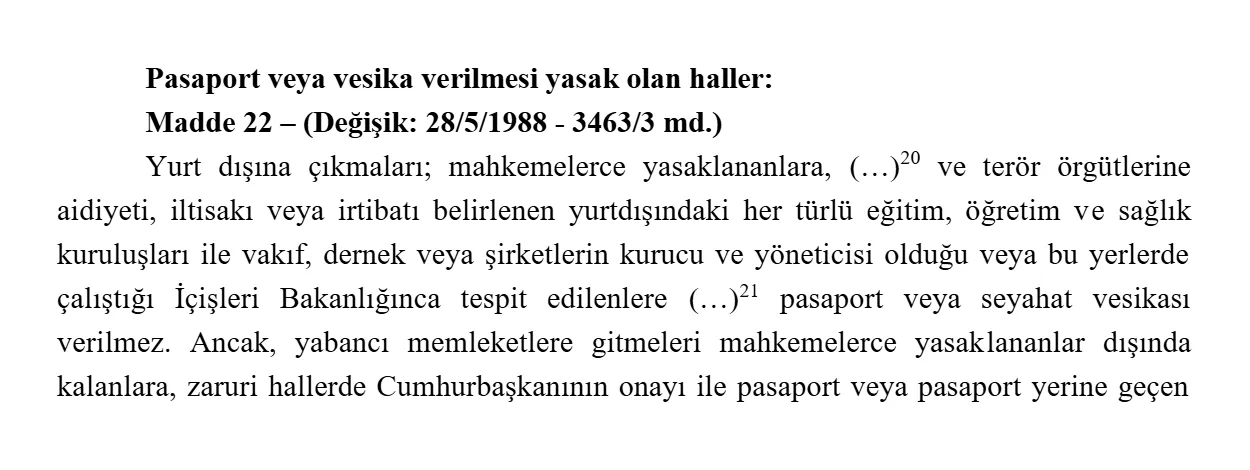
Two changes narrowed the list and are often missed:
- Tax debts: the phrase allowing a passport ban for people reported as tax debtors was removed from Article 22 by Law No. 5766 in 2008 [M1]. The same law added a separate "exit ban abroad" for public debts to Law No. 6183 (Art. 36/A), and that article was repealed by Law No. 6111 in 2011 [M5]. Since 2011 there has been no statutory basis for an exit ban because of a tax or social security debt.
- "General security" bans by the Ministry: the Constitutional Court annulled the phrase allowing the Ministry of Interior to restrict people whose departure was considered objectionable for general security, by its decision of 24 September 2024 (E.2024/112, K.2024/160), which took effect on 21 November 2024 [M1].

| Common belief | Position under the current law |
|---|---|
| "I have a tax debt, so I cannot leave" | The tax debtor clause was removed in 2008 and the public-debt exit ban repealed in 2011 [M1] [M5] |
| "An enforcement (icra) file stops me at the airport" | A private debt or enforcement file is not a ground in Article 22; creditors use attachment and garnishment, explained on our enforcement law page |
| "The police can ban me from leaving" | The ban comes from a court decision; the police apply it at the border |
| "A criminal complaint against me means an exit ban" | Only if a judge orders it, for example as judicial control |
| "A frozen bank account means I cannot travel" | A freeze is a separate measure; whether a judge adds judicial control depends on the file (see our frozen account guide) |
Why was I banned from leaving Turkey? Exit bans in criminal cases
When a person is suspected of an offence and grounds that could justify detention exist, the judge may order judicial control instead (Code of Criminal Procedure, Art. 109/1). One of the listed obligations is "not leaving the country" (Art. 109/3-a) [M2]. During the investigation it is ordered by the criminal judgeship of peace at the prosecutor's request; during the trial, by the trial court (Art. 110/1 and 110/3) [M2]. Judicial control can also be ordered where detention is prohibited by law (Art. 109/2), and for persons released because the maximum detention period has expired (Art. 109/7).
The exit ban is often combined with other obligations: reporting to a police station at set intervals (Art. 109/3-b), bail in the form of a security amount fixed by the judge according to the person's financial situation (Art. 109/3-f), or not leaving a city (Art. 109/3-k) [M2]. For foreigners an exit ban is common in files involving fraud, drugs, assaults, traffic accidents and bank-account investigations, because the court considers the risk of leaving Turkey. Our guide for foreigners arrested in Turkey explains the custody and detention stage that usually comes first, and sold crypto on Binance P2P, bank account frozen explains the fraud files in which many foreigners are first questioned.
How long can an exit ban last? The time limits in Article 110/A
| Type of case | Maximum duration of judicial control | Basis |
|---|---|---|
| Cases not within the high criminal court's jurisdiction | 2 years, extendable by 1 year in compulsory cases with reasons | Art. 110/A-1 |
| Cases within the high criminal court's jurisdiction | 3 years, extendable with reasons; the extension may not exceed 3 years in total (4 years for certain offences against the State and terrorism offences) | Art. 110/A-2 |
| Children | Half of the above periods | Art. 110/A-3 |

In addition, whether the measure is still needed is decided at least every four months: during the investigation by the criminal judgeship of peace at the prosecutor's request, during the trial by the court on its own motion (Art. 110/4) [M2]. Time spent under judicial control is not deducted from a later sentence, except for house arrest, where every two days count as one (Art. 109/6).
Exit ban, detention or house arrest: how they compare
| Exit ban (judicial control) | House arrest (judicial control) | Pre-trial detention | |
|---|---|---|---|
| Freedom of movement in Turkey | Unrestricted inside Turkey | Has to stay at home | In prison |
| Basis | Art. 109/3-a | Art. 109/3-j | Art. 100 et seq. |
| Counted towards a later sentence | No (Art. 109/6) | Every two days count as one day (Art. 109/6) | Yes |
| Maximum duration | Art. 110/A limits | Art. 110/A limits | Separate detention limits |
| Review | At least every four months (Art. 110/4) | At least every four months | Periodic detention reviews |
| Compensation if cleared | Not listed in Art. 141/1; awarded in one file under Art. 141/3, refused in another | Listed since 2024 (Art. 141/1-l) | Listed (Art. 141/1-e) |
For many foreigners an exit ban is the measure that lets them stay out of prison during the case, at the cost of not travelling. Whether a lighter measure can replace it is the usual subject of objections and reviews.
What happens if I leave anyway, or breach the ban?
A suspect or defendant who "wilfully fails to comply" with judicial control may be detained at once by the competent judicial authority, "whatever the length of the prison sentence that may be imposed" (Art. 112/1) [M2]. The border systems stop the person in any event, so the practical risk is not escaping but being detained after an attempt. In a file examined by the Constitutional Court, a German citizen left Turkey by irregular means after his requests to lift the ban were refused; the Court still found a violation of his right to family life because the courts had not assessed his ties abroad, but the departure itself was a breach of the measure [D2].
How to challenge or lift an exit ban in Turkey
There are four routes in the Code of Criminal Procedure:
| Route | How it works | Basis |
|---|---|---|
| Objection | Within two weeks of learning of the decision, by petition to the judge who made it or by a statement recorded by the clerk. A decision of the criminal judgeship of peace on judicial control is reviewed by the criminal court of first instance in its area. | Art. 268/1 and 268/3-b |
| Request to lift or change | The judge may lift, change or temporarily suspend obligations, or replace them with others; on the suspect's request the judge decides within five days after taking the prosecutor's view. | Art. 110/2 and 111/1 |
| Four-month review | The need for the measure is reviewed at least every four months. | Art. 110/4 |
| End of the case or time limit | A non-prosecution decision, an acquittal, a final judgment or the expiry of the maximum period ends the measure. | Arts. 110/A; the decision in the case [D7] |
Decisions on judicial control are subject to objection (Art. 111/2) [M2], and the court is required to tell the defendant so: in a 2025 ruling the Court of Cassation corrected a regional court's judgment by adding the warning that the defendant could object to the judicial control decision within two weeks of notification [D8]. Arguments raised in practice include: strong ties to Turkey (residence, work, family, property), the stage of the case, the time already spent under the ban, a fixed address abroad, readiness to attend hearings or to be heard through letters rogatory, and replacing the ban with bail. Each request is decided on its own facts, and the two-week period can be computed with our deadline calculator.
What the Constitutional Court has said about long exit bans
Freedom of movement as such is outside the Constitutional Court's individual application jurisdiction, because Turkey is not a party to Protocol No. 4 to the European Convention; but the Court examines an exit ban under the right to respect for private and family life where the person has strong family, personal or economic ties abroad and shows the measure's concrete effects [D1] [D2]. Two findings of violation show what the courts are expected to do.
In a December 2025 decision, the applicant had spent more than four years in detention and was then placed under an exit ban for nearly two years after a conviction that was not yet final; the applicant's son and daughter lived in Germany and the applicant asked to attend the son's engagement and wedding. The Court found that the courts had rejected the requests "with general, abstract and repetitive reasons" without discussing the family ties abroad or alternative measures, held that the right to private and family life had been violated, and awarded 34,000 TL in non-pecuniary damages [D1]. In the 2022 decision on a German citizen questioned over a social media post during a holiday, stopped at the Kapıkule border gate and then banned from leaving from August 2017 to January 2021, the Court found that it was "not understood what other evidence had to be collected and what effect preventing exit from the country would have on collecting it", that the judgeships "did not discuss in any way" the objections based on family and personal ties abroad, and that the ban was extended for an unforeseeable period; it found a violation [D2]. The principle stated in both: when ordering or continuing an exit ban, the person's family, personal and professional ties abroad, the nature of the charge, the evidence and the likely sentence are weighed together and the result is explained with sufficient reasons [D1] [D2].
Compensation for a long exit ban if I am cleared
Judicial control is not among the measures listed in Article 141/1 of the Code of Criminal Procedure, under which compensation is claimed from the State for unlawful custody, detention or seizure [M2]. The Court of Cassation's 12th Criminal Chamber has treated this differently in two files. In an April 2023 ruling it upheld an award of 3,500 TL for a 518-day exit ban applied to a person later acquitted: the regional court had found that the measure "exceeded a restriction on freedom of travel and deprived the claimant of liberty", that repeated requests to lift it had been rejected without "an effective assessment" of whether a lighter measure would do, and that the loss fell under Article 141/3 [D5]. In a September 2024 ruling, it upheld the rejection of a claim for an exit ban of about three years, on the ground that judicial control is not listed in Article 141/1 and that no loss within Article 141/3 had been shown [D6]. Whether compensation is possible therefore depends on the file; the claim, where made, follows the time limits in Article 142: three months from notification that the decision became final, and at most one year [M2].
How to check if you have an exit ban in Turkey
There is no public register of exit bans that anyone can search by name. The ban exists in a court decision and in the police restriction records fed from it, and the ways to see it are listed below.
| Way | What it shows | Who can use it |
|---|---|---|
| The judicial control decision itself | The court, the date and every obligation imposed, including "not leaving the country" | The suspect or defendant, who is notified; the lawyer |
| The investigation or case file | The measure, its review dates and any request to lift it | Parties and their lawyers, in person or through UYAP |
| UYAP Citizen Portal (e-Devlet login) | Criminal files in which the person is a party and the decisions in them | Turkish citizens and foreigners with an e-Devlet password |
| e-Devlet queries on judicial measures and travel restrictions | Measures recorded in the Ministry of Justice and police systems; service names change and not every ban appears, so a negative result is not conclusive | People with e-Devlet access |
| Petition to the passport branch of the provincial police | Whether a restriction is recorded against the person and on which authority's notification | Anyone, in person or through a lawyer |
A notification of a judicial control decision states the obligations imposed. A person who was released after a statement without reading the decision carefully often learns of the ban only at the airport; the decision document is therefore the first thing to get. A foreigner who has already left Turkey, or who is in Turkey without a lawyer, usually asks a lawyer with a power of attorney to check the file; what that document contains is explained in hiring a lawyer in Turkey from abroad.
What happens at the airport if you have an exit ban
The border police check passports against the restriction records. A person under an exit ban is not allowed through passport control and, under Article 22, a passport already issued can be taken back [M1]. Where a warrant exists rather than a judicial control decision, the person is taken to the prosecutor; this is what happened in the 2022 Constitutional Court file, where the applicant was stopped at Kapıkule because of an arrest warrant issued in a social media investigation, gave a statement and was then placed under judicial control [D2]. If the ban was lifted recently, the update may not yet appear in every system; travellers in that position often carry the decision lifting the measure to avoid delays, and the court that lifted it can be asked to notify the authorities again.
I am a foreigner with an exit ban: what happens to my residence permit?
A foreigner who cannot leave because of a court decision may also face an expiring visa or residence permit. The Law on Foreigners provides a short-term residence permit for people who need to stay in Turkey at the request or by decision of judicial or administrative authorities (Law No. 6458, Art. 31/1-g) [M3]. This route matters, because staying without a permit can otherwise be treated as an overstay, with fines and entry ban consequences explained by our overstay calculator. Other residence questions are on the law on foreigners page.
An exit ban and deportation are also different: an exit ban keeps the person in Turkey for the case, while a deportation order requires the person to leave. When both appear in the same file, the order of events and the authorities involved are examined; our guide to deportation and entry bans explains the 7-day appeal against a deportation order and the restriction codes entered afterwards. A foreigner's statement and hearings are held with an interpreter appointed by the prosecutor or the court where the person does not know enough Turkish (Code of Criminal Procedure, Art. 202) [M2].
Dual nationals and Turks living abroad: the holiday that becomes a long stay
A frequent situation involves Turkish citizens who live in Germany, the Netherlands, the UK or the Gulf and who are investigated during a visit, for example after a traffic accident, a dispute, a social media post or a complaint about a bank account. The rules are the same as for anyone in Turkey: if the judge orders judicial control with an exit ban, the person cannot return to the country of residence until the measure is lifted or eased, even if work, school or a residence permit abroad depends on it. The two Constitutional Court decisions above both concern people with families in Germany, and both say that these ties abroad are exactly what the judge has to weigh and answer in the decision [D1] [D2]. Proof of the address abroad, the employment or business there and the readiness to attend hearings or be heard through letters rogatory are the documents presented in an objection or a four-month review. Who pays after an accident in a hire car is explained in crashed a rental car in Turkey.
The same applies to foreigners whose investigation began during a short stay, such as a tourist involved in a dispute or a medical tourist in a disagreement with a clinic; the civil claim after a failed treatment is explained in medical malpractice in Turkey. A related civil claim does not itself create an exit ban; only a criminal judge's measure does. Whether a person's Turkish citizenship is still in force can also matter at the border, and can be checked as described in was my Turkish citizenship cancelled.
After a conviction: does the exit ban continue, and when does it end?
A conviction at first instance does not end judicial control by itself; the court can order its continuation while the appeal is pending, and the first-instance court that gave the judgment can itself order judicial control or detention after examining the UYAP records (Arts. 109/4 and 112/1, last sentences) [M2]. In the December 2025 Constitutional Court file the ban was continued after a six-year sentence and lifted about a year after the judgment became final [D1]. Once the judgment is final, the Court of Cassation has held that judicial control ends by itself: in a 2016 ruling on a request to lift a travel ban after a conviction had been upheld, the 1st Criminal Chamber reasoned from Article 103/2, under which judicial control ends automatically on a non-prosecution decision, that the measure also ends automatically when the prosecution ends with an acquittal, a conviction or another final decision, and reversed the lower courts' refusal to record this [D7]. What follows a final conviction is a question of enforcement of the sentence, not of judicial control.
Children: stopping a child from being taken abroad
In family disputes the question is usually the opposite: a parent wants to prevent the other parent from taking a child abroad. Once a divorce or separation case is filed, the family judge takes the interim measures needed during the case, in particular for the care and protection of the children (Civil Code, Art. 169) [M4]. In practice these can include a measure preventing the child from being taken abroad, but the Court of Cassation has not accepted such a measure automatically: in a 2019 ruling it reversed a decision that had banned a two-year-old child from leaving the country, finding that the measure "was not compatible with the child's superior interest" [D3]. In a February 2026 ruling it upheld a judgment with the note that a travel ban ordered for a child as an interim measure "will disappear when the judgment becomes final" [D4]. When a child has already been taken across borders, the Hague Convention on International Child Abduction and Law No. 5717 provide a return procedure. Our guides on child custody in Turkey for foreign parents and divorce in Turkey for foreigners explain custody, relocation and the Hague route, and other family questions are on the family law page.
Debts, enforcement and exit bans: what the law does not do
Many people fear that an unpaid loan, a credit card debt or an enforcement file will stop them at the border. Enforcement law protects creditors through attachment of assets, salary deductions and precautionary attachment, not through exit bans; the Passport Law grounds exclude private debts [M1]. The same applies to tax and social security debts since the repeal of Article 36/A of Law No. 6183 in 2011 [M5]. Where a debt is connected to a criminal complaint (for example cheque fraud or breach of trust), the criminal case, not the debt itself, may lead to judicial control. A frozen bank account is likewise a separate measure, explained in bank account frozen in Turkey.
Criminal lawyer in Istanbul, Ankara and across Turkey for exit bans
Exit bans are decided by the criminal judgeships of peace and criminal courts where the investigation or trial is held. Many cases involving foreigners are investigated in İstanbul, and families often look for a criminal lawyer in Istanbul to get the decision, file the objection within two weeks and request the four-month review; the Istanbul courthouses are described in our Istanbul court guide. Files in the capital are followed by a lawyer in Ankara before the Ankara courts, listed in the Ankara court guide, and a criminal lawyer in Turkey can follow any court's file electronically through UYAP. The Turkish terms used here, such as adli kontrol and itiraz, are explained in the glossary, and first steps in other urgent situations are on the what to do page.
What is examined after an exit ban: a short overview
| Point | Why it matters |
|---|---|
| The written decision | Shows the court, the date and the obligations; the two-week objection runs from learning of it |
| The review dates | The measure is reviewed at least every four months |
| Residence status (foreigners) | Article 31/1-g permit for those who have to stay by court decision |
| Ties abroad and in Turkey | Address, work, family and property are the grounds the Constitutional Court expects the judge to weigh |
| The decision lifting the measure | Records may update with a delay; the document is carried when travelling |
Sources
| Code | Source | Subject |
|---|---|---|
| M1 | Passport Law No. 5682 | Art. 22 (tax debtor phrase removed by Law No. 5766 in 2008; "general security" phrase annulled by the Constitutional Court, 24.09.2024, E.2024/112, K.2024/160) |
| M2 | Code of Criminal Procedure No. 5271 | Arts. 103, 109, 110, 110/A, 111, 112, 141, 142, 202, 268 |
| M3 | Law No. 6458 on Foreigners and International Protection | Art. 31/1-g |
| M4 | Turkish Civil Code No. 4721 | Art. 169; Law No. 5717 on the Civil Aspects of International Child Abduction |
| M5 | Law No. 6183 on the Collection of Public Receivables | Art. 36/A (added by Law No. 5766, 2008; repealed by Law No. 6111, 2011) |
| D1 | Constitutional Court, Second Section, App. No. 2022/24039 (Mustafa Telli), 23.12.2025 | Exit ban of nearly two years after a non-final conviction; children in Germany; violation of the right to private and family life, 34,000 TL |
| D2 | Constitutional Court, First Section, App. No. 2017/33469 (Hakkı Gök), 03.11.2022 | German citizen stopped at Kapıkule; exit ban 2017-2021 in a social media investigation; violation |
| D3 | Court of Cassation, 2nd Civil Chamber, 16.01.2019, E.2018/7363, K.2019/278 | Interim travel ban on a child not compatible with the child's superior interest; reversed |
| D4 | Court of Cassation, 2nd Civil Chamber, 10.02.2026, E.2025/5521, K.2026/1462 | Interim travel ban on a child ends when the judgment becomes final |
| D5 | Court of Cassation, 12th Criminal Chamber, 03.04.2023, E.2021/4868, K.2023/1064 | 518-day exit ban; 3,500 TL non-pecuniary damages under Art. 141/3 upheld |
| D6 | Court of Cassation, 12th Criminal Chamber, 17.09.2024, E.2021/8530, K.2024/4328 | Exit ban of about three years; rejection of the compensation claim upheld |
| D7 | Court of Cassation, 1st Criminal Chamber, 23.05.2016, E.2016/3193, K.2016/2613 (reversal in the interest of law) | Judicial control ends by itself when the judgment becomes final |
| D8 | Court of Cassation, 8th Criminal Chamber, 25.06.2025, E.2025/1982, K.2025/5265 | Right to object to a judicial control decision has to be notified |
This guide describes Turkish law as of 11 October 2026 in general terms. It is not legal advice and does not assess any individual case.
Frequently Asked Questions
What is an exit ban in Turkey?
A measure that stops a person from leaving Turkey. Under Article 22 of the Passport Law, people whom courts have banned from going abroad are not issued a passport and are stopped at the border. In practice it is the judicial control obligation 'not to leave the country' ordered by a criminal judge.
Who can impose an exit ban in Turkey?
Courts. The most common case is a criminal judge ordering 'not leaving the country' as judicial control instead of detention (Code of Criminal Procedure, Art. 109/3-a). The Passport Law also covers people linked by the Ministry of Interior to institutions of terrorist organisations; the Ministry's former 'general security' power was annulled in 2024.
Can I leave Turkey if I have a tax debt?
A tax debt is not a ground under the current law. The tax debtor phrase was removed from Article 22 of the Passport Law by Law No. 5766 in 2008, and the separate public-debt exit ban in Article 36/A of Law No. 6183 was repealed by Law No. 6111 in 2011. Collection is pursued through attachment instead.
Can an enforcement (icra) file or a bank debt stop me at the airport?
No. Private debts and enforcement files are not grounds in Article 22 of the Passport Law. Creditors use attachment, garnishment and salary deductions, not exit bans. A debt connected to a criminal complaint can lead to judicial control through the criminal file, not through the debt itself.
How do I check if I have an exit ban in Turkey?
The reliable sources are the judicial control decision and the criminal file, which a lawyer can examine and which appear in the UYAP Citizen Portal for parties. e-Devlet offers queries on judicial measures and travel restrictions, but not every ban appears there, so a negative result is not conclusive. A petition to the passport branch of the provincial police shows whether a restriction is recorded.
How long can an exit ban last in a criminal case?
Judicial control may last up to 2 years in cases outside the high criminal court's jurisdiction (extendable by 1 year), and up to 3 years in high criminal court cases (extendable with limits). For children the periods are halved (Code of Criminal Procedure, Art. 110/A). Within those limits the need for the measure is reviewed at least every four months.
How do I object to an exit ban?
By petition to the judge who made the decision, or by a statement recorded by the clerk, within two weeks of learning of it (Code of Criminal Procedure, Art. 268). A decision of the criminal judgeship of peace on judicial control is reviewed by the criminal court of first instance in its area. The court has to inform the defendant of this right.
How do I ask the judge to lift the exit ban outside the objection period?
The suspect or defendant can request that the judge lift, change or temporarily suspend the obligation under Article 110/2; on such a request the judge decides within five days after taking the prosecutor's view (Art. 111/1). The request can be repeated as circumstances change, and the measure is in any event reviewed every four months.
Is an exit ban reviewed automatically?
Yes. Whether judicial control is still needed is decided at least every four months: during the investigation at the prosecutor's request by the criminal judgeship of peace, during the trial by the court on its own motion (Art. 110/4).
Can an exit ban be replaced by bail?
The judge can lift, change or replace judicial control obligations (Art. 110/2), and bail, a security amount fixed according to the person's financial situation, is one of the listed measures (Art. 109/3-f). Whether it is accepted depends on the case; the Constitutional Court expects the judge to discuss such alternatives when the person has family or work abroad.
What has the Constitutional Court said about exit bans on people with family abroad?
In decisions of 2022 and 2025 it found violations of the right to private and family life where applicants with children or a business in Germany had their requests rejected with general reasons and without discussion of their ties abroad or of lighter measures. In the 2025 decision the Court awarded 34,000 TL for an exit ban of nearly two years.
I am a foreigner under an exit ban and my residence permit is expiring. What happens?
Law No. 6458 provides a short-term residence permit for people who have to stay in Turkey at the request or by decision of judicial or administrative authorities (Art. 31/1-g). Without a permit, the stay can be treated as an overstay with fines and an entry ban on departure.
Is an exit ban the same as an entry ban?
No. An exit ban stops you leaving Turkey and comes from a court; an entry ban stops a foreigner entering Turkey and comes from the migration authority, usually after an overstay or deportation, and is recorded with restriction codes.
Can the Ministry of Interior ban me from leaving for security reasons?
The Constitutional Court annulled the Passport Law phrase on people whose departure was considered objectionable for general security by the Ministry, in its decision of 24 September 2024 (E.2024/112, K.2024/160), effective from 21 November 2024. The remaining Ministry ground concerns institutions abroad linked to terrorist organisations.
What happens at the airport if I have an exit ban?
The border police stop you at passport control. Under Article 22 of the Passport Law, a passport already issued can be taken back. If there is also an arrest warrant, you are taken to the prosecutor for a statement.
What happens if I breach the exit ban?
A suspect or defendant who wilfully fails to comply with judicial control may be detained at once by the competent judicial authority, whatever the length of the sentence that may be imposed (Code of Criminal Procedure, Art. 112). The border systems stop the person in any event.
My exit ban was lifted but I am still stopped. Why?
Records may update with a delay. Carrying the decision lifting the measure helps; if the problem continues, the court that lifted it can be asked to notify the authorities again.
Can a parent stop the other parent from taking a child abroad?
During a divorce or separation case the family judge takes interim measures for the children's care and protection (Civil Code, Art. 169), which can include preventing the child from being taken abroad. The Court of Cassation has reversed such a measure where it was not compatible with the child's superior interest, and has noted that an interim ban on a child ends when the judgment becomes final. Abduction cases are handled under the Hague Convention and Law No. 5717.
Does a criminal complaint against me automatically mean an exit ban?
No. An exit ban requires a judge's decision, for example judicial control during an investigation. A complaint alone does not restrict travel.
Can I leave Turkey if I am a witness in a case?
Being a witness is not a ground for an exit ban. Witnesses can be heard through other means, including by letters of request; an exit ban concerns suspects and defendants under judicial control.
Does an exit ban end when the case ends?
A non-prosecution decision or an acquittal ends judicial control, and so does the expiry of the maximum period under Article 110/A. A first-instance conviction does not end it by itself; the Court of Cassation has held that it ends automatically once the judgment becomes final, after which the sentence is enforced under separate rules.
Can I get compensation for an exit ban if I am acquitted?
Judicial control is not listed in Article 141/1 of the Code of Criminal Procedure. The Court of Cassation upheld an award of 3,500 TL under Article 141/3 for a 518-day ban in a 2023 ruling, and upheld the rejection of a claim for a ban of about three years in 2024. The outcome depends on the file; the claim follows the time limits in Article 142.
Can I travel for medical treatment or a family event while under an exit ban?
The judge can lift, change or temporarily suspend judicial control obligations (Art. 110/2). A request supported by medical documents or proof of the event is decided by the judge in the file within five days after the prosecutor's view; the Constitutional Court's 2025 decision concerned a father who asked to attend his son's wedding abroad.
Do I need a criminal lawyer in Turkey to challenge an exit ban?
It is not compulsory, but the objection period is two weeks and the arguments depend on the file. Many foreigners act through a criminal lawyer in Turkey who can read the decision, follow the case in UYAP and present the ties abroad that the courts are expected to weigh.
Where can I find a criminal lawyer in Istanbul or a lawyer in Ankara for an exit ban?
Exit bans are decided by the courts where the investigation or trial is held. Many foreigners' cases are in İstanbul, where families look for a criminal lawyer in Istanbul; files in the capital are followed by a lawyer in Ankara before the Ankara courts. Our office is in Maltepe, on the Anatolian side of Istanbul.
Is 'travel ban Turkey' the same as an exit ban?
Not in every case. The phrase is used for exit bans, entry bans and governments' travel advisories. An exit ban is the court measure that stops a person leaving Turkey; an entry ban keeps a foreigner out; an advisory is a foreign government's guidance to its citizens.
Can the court order an exit ban without hearing me?
Judicial control is ordered by a judge in the investigation or trial, usually after the suspect is brought before the judge. A suspect who does not know enough Turkish is heard with an interpreter. The decision can be challenged by objection within two weeks.
Can an exit ban be imposed in a civil case?
The Passport Law speaks of people banned by courts. In civil family cases the common measure concerns children (interim measures under Civil Code Art. 169); in criminal cases it is judicial control under the Code of Criminal Procedure. A civil debt or compensation claim does not lead to an exit ban.
What documents help to lift an exit ban?
Proof of address, work, family and property in Turkey or abroad, the stage of the case, the time already spent under the measure, and an offer of bail or a lawyer's undertaking to attend hearings are the documents the Constitutional Court and the criminal courts have referred to.
- exit ban Turkey
- travel ban Turkey
- can't leave Turkey
- check exit ban Turkey
- yurt dışı çıkış yasağı
- judicial control Turkey
- adli kontrol yurt dışı çıkış yasağı
- lift exit ban Turkey
- objection to judicial control
- Passport Law Article 22
- tax debt exit ban Turkey
- foreigner exit ban Turkey
- residence permit during criminal case
- child taken abroad Turkey
- Hague Convention child abduction Turkey
- airport passport control Turkey ban
- CMK 109
- CMK 110/A
- exit ban compensation Turkey
- Constitutional Court exit ban
- stopped at airport Turkey
Our services in this area
Criminal Law