Deportation and Entry Bans in Turkey (2026): Restriction Codes, the 7-Day Appeal and How to Lift a Ban
The grounds for deportation from Turkey, who cannot be deported, the 7-day appeal to the administrative court, removal centres and detention limits, entry ban durations, restriction codes such as Ç-113, and how to lift an entry ban.
Few legal problems move as fast as deportation. A foreigner can be stopped at a routine check in Istanbul, taken to a removal centre within 48 hours and, without a timely application to court, be put on a plane with an entry ban that lasts for years. Others only discover a problem at the airport, when passport control refuses entry because of a restriction code on their record.
This guide explains deportation and entry bans in Turkey under the Law on Foreigners and International Protection (Law No. 6458): the grounds for a deportation decision, who cannot be deported, the seven-day deadline to apply to the administrative court, administrative detention in removal centres, how long entry bans last, what restriction codes such as Ç, G, N and V codes mean in practice, and how an entry ban can be lifted.
If you have a matter on this topic:
Who Can Be Deported From Turkey? Grounds for Deportation
Article 54 of Law No. 6458 lists the foreigners in respect of whom a deportation decision is taken. The most common grounds in practice are:
Ground (Art. 54/1) | Typical situation |
|---|---|
Overstaying a visa or visa exemption by more than ten days, or visa cancelled | Tourist who stayed beyond the permitted 90 days |
Overstaying a residence permit by more than ten days without an acceptable reason | Expired permit not renewed in time |
Residence permit cancelled | Permit obtained on grounds that no longer exist |
Residence permit renewal rejected and no exit within ten days | Renewal refused, foreigner stays on |
Working without a work permit | Employment detected during an inspection |
False information or forged documents in entry, visa or residence procedures | Forged rental contract or sham documents |
Earning a living by unlawful means | Income from illegal activities |
Threat to public order, public security or public health | Often linked to criminal investigations |
Violation of legal entry or exit rules | Irregular border crossing |
Entering Turkey despite an entry ban | Ban in force at the time of entry |
Deportation assessed under Article 59 of the Turkish Penal Code | After a criminal conviction |
Links to terrorist or organised criminal organisations | Security-based decisions |
A criminal investigation does not automatically mean deportation, but it is one of the most frequent triggers of a "public order" assessment. See our guide on being arrested in Turkey as a foreigner for the criminal side.
How a Deportation Decision Is Made
A deportation decision is taken by the governorate, on its own initiative or on instruction from the Presidency of Migration Management (Art. 53/1). When the police apprehend a foreigner falling under Article 54, they refer the case to the governorate immediately, and the assessment and decision may not take longer than 48 hours (Art. 57/1).
The decision, with its reasons, is served on the foreigner, their legal representative or their lawyer. If the foreigner has no lawyer, they must be informed of the result of the decision and of the appeal procedures and time limits (Art. 53/2).
Appealing a Deportation Decision in Turkey: The Seven-Day Deadline
Article 53/3 of Law No. 6458, as last amended by Law No. 7533 in November 2024, sets the most important rule for any foreigner facing deportation:
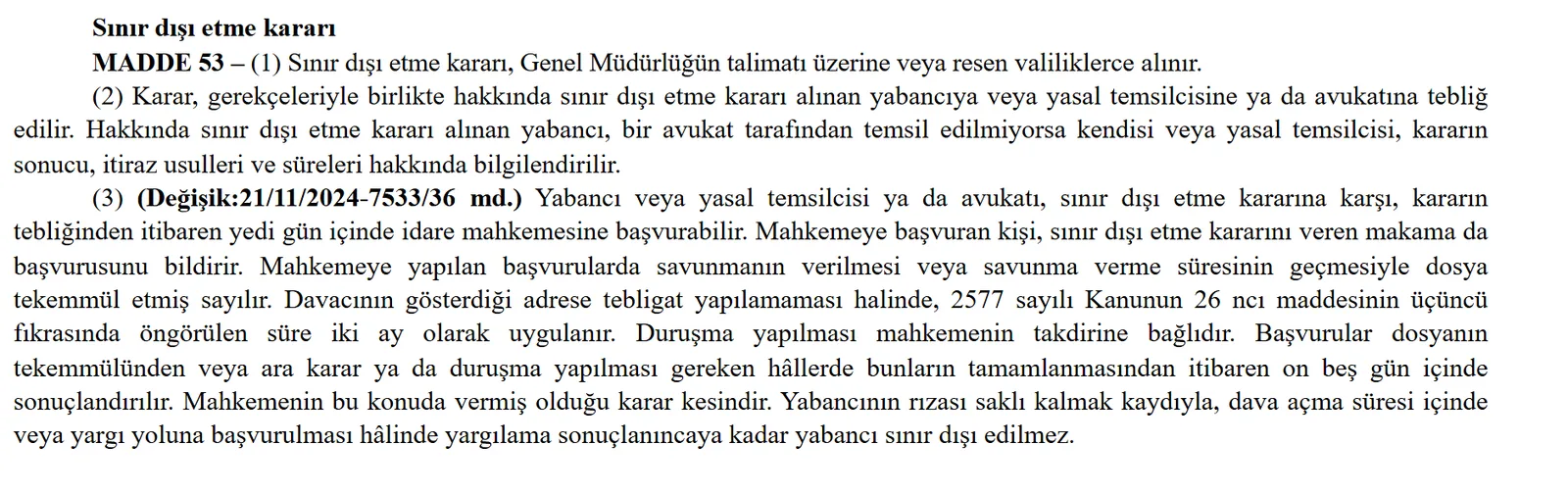
Law No. 6458 Article 53: an application against a deportation decision must be made to the administrative court within seven days of notification (Source: mevzuat.gov.tr)
Rule | What it means for you |
|---|---|
Seven days from notification | The application must reach the administrative court within seven days |
Notify the deciding authority | You must also inform the authority that issued the decision of your application |
Fast-track decision | The court decides within 15 days after the file is complete |
Final decision | The administrative court's decision on the deportation application is final |
No removal while the case runs | Unless you consent, you are not deported during the seven days or until the court decides |
Who Cannot Be Deported From Turkey?
Even if a ground for deportation exists, Article 55 prohibits a deportation decision in certain situations. Each case is assessed individually.

Law No. 6458 Article 55: no deportation where there is a serious risk of the death penalty, torture or inhuman treatment, or in certain health and victim situations (Source: mevzuat.gov.tr)
Serious indications that the person would face the death penalty, torture, or inhuman or degrading treatment in the country of return.
Persons for whom travel is risky because of serious health problems, age or pregnancy.
Persons undergoing treatment for a life-threatening illness that is not available in the country of return.
Victims of human trafficking benefiting from the victim support process.
Victims of psychological, physical or sexual violence, until their treatment is completed.
Where there is a risk of torture or death, an application to the Constitutional Court and, where necessary, a request for an interim measure to the European Court of Human Rights can also be considered.
Time to Leave Turkey: Invitation to Depart
A deportation decision may give the foreigner between 15 and 30 days to leave Turkey voluntarily, with an Exit Permit Document (Art. 56). This period is not granted where there is a risk of absconding, a breach of entry or exit rules, the use of false documents, or a threat to public order, security or health. Leaving within the period matters: under Article 9/5, an entry ban may not be imposed on those who leave within the time given.
Administrative Detention in Removal Centres
A foreigner subject to a deportation decision may be placed under administrative detention (idari gözetim) if there is a risk of absconding, a breach of entry or exit rules, use of false documents, failure to leave within the period given, or a threat to public order, security or health (Art. 57/2). They are taken to a removal centre within 48 hours.
Question | Rule under Articles 57 and 57/A |
|---|---|
Maximum duration | Six months, extendable by a further six months if removal cannot be completed because the foreigner does not cooperate or provide correct information |
Review | The governorate reviews monthly whether detention is still necessary |
How to challenge it | Application to the criminal judgeship of peace; decided within five days; decision final; a new application is possible if circumstances change |
Legal aid | Available on request for those who cannot afford a lawyer (Art. 57/7) |
Alternatives to detention | Residence at a set address, reporting, family-based return, return counselling, voluntary community service, a guarantee or electronic monitoring, for up to 24 months (Art. 57/A) |
The application against detention and the application against the deportation decision are two separate procedures before two different courts. Both may be needed.
Entry Bans to Turkey: How Long Do They Last?
An entry ban can be imposed on its own, for reasons of public order, public security or public health, or as a consequence of deportation. Foreigners deported from Turkey are banned from entering by the Presidency or the governorate (Art. 9/2).

Law No. 6458 Article 9: an entry ban lasts at most five years, extendable by up to ten more years in case of a serious threat (Source: mevzuat.gov.tr)
Rule (Art. 9) | Effect |
|---|---|
Maximum duration | Five years |
Serious threat to public order or security | The Presidency may extend the ban by up to ten more years |
Overstayers who leave voluntarily | If they apply to leave before being detected, pay their fines and did not exceed the set violation periods, an entry ban may not be imposed (Art. 9/4) |
Foreigners who leave within the departure period | An entry ban may not be imposed (Art. 9/5) |
Lifting or temporary entry | The Presidency may lift the ban or allow entry for a specific period while the ban remains (Art. 9/6) |
Prior authorisation | Entry can be made subject to prior authorisation for public order reasons, or by governorates for unpaid fines and public receivables (Art. 9/7) |
Restriction Codes in Turkey (Tahdit Kodları)
Entry bans and other restrictions are recorded in the migration authority's system as restriction codes. These codes are internal administrative categories: they are not listed in the law, and their descriptions are not officially published. In practice, foreigners usually learn their code at the border or when a residence application is refused. The letter groups are consistently reported as follows:
Letter group | Commonly reported meaning |
|---|---|
Ç codes | Immigration violations and timed bans, such as visa or residence overstays, illegal entry or exit, work without a permit and unpaid fines |
G codes | Security, public order and public health concerns |
N codes | Entry subject to prior authorisation, often linked to fines or administrative matters |
V codes | Residence permit and personal status issues |
O codes | Outcomes of international protection (asylum) applications |
K codes | Smuggling and trafficking-related records |
Specific codes are widely reported in practice, for example the Ç-101 to Ç-105 range for timed bans after visa or residence overstays, and Ç-113 for illegal entry or exit. Because descriptions are not officially published and may change, do not rely on lists found online for your own case. Obtain the exact code, the decision it is based on and the date of notification, through the provincial migration directorate, a request for information, or a lawyer's review of the file.
How to Lift an Entry Ban or Restriction Code in Turkey
Route | How it works | Time limit |
|---|---|---|
Application to the migration authority | A reasoned petition asking for the ban to be lifted or corrected, or for temporary entry (Art. 9/6) | No strict limit, but act early |
Annulment action (iptal davası) | Lawsuit at the administrative court against the entry ban or restriction decision, with a request for a stay of execution | Generally 60 days from notification (Administrative Procedure Law Art. 7) |
Appeal against deportation | Application to the administrative court under Art. 53/3 | 7 days from notification |
Temporary entry | Where compelling reasons exist, the Presidency can allow entry for a specific period while the ban remains in force | Applied for through the competent authorities |
Many foreigners only learn about a ban years after it was imposed, often because the decision was served at an old address or was never properly notified. Whether the 60-day period has started depends on proper notification, which is why obtaining the file is the first step.
Practical Situations
Overstayed Your Visa or Residence Permit
If you have overstayed, the best course is usually to regularise or leave on your own initiative before you are detected. Under Article 9/4, if you apply to leave, pay the administrative fines and have not exceeded the violation periods set by the Ministry, an entry ban may not be imposed. Waiting until you are caught removes this possibility and exposes you to deportation.
Residence Permit Refused or Cancelled
If a renewal is refused, you have ten days to leave before deportation becomes possible (Art. 54/1-j). The refusal itself can be challenged before the administrative court. If you depend on a family permit after a divorce, see our guide on divorce in Turkey for foreigners; if you rely on property ownership, see buying property in Turkey as a foreigner.
Criminal Investigation and Deportation
A criminal case and a deportation procedure run in parallel. Even if you are released by the criminal judge, the governorate may still take a deportation decision on public order grounds, with its own seven-day deadline. Coordinate both procedures from the start.
Refused Entry at the Airport
If passport control refuses entry, ask for the written notification of the refusal and the restriction code. This document is the starting point for any application or lawsuit.
Common Mistakes
Missing the seven-day deadline: After it passes, the deportation decision can be enforced.
Forgetting to notify the deciding authority: Article 53/3 requires you to inform it of your court application.
Signing papers in the removal centre without understanding them: Consent to removal ends the protection against deportation during the case.
Relying on online code lists: Obtain your own code and decision.
Staying after a refused renewal: The ten-day window in Article 54/1-j is short.
Ignoring unpaid fines: They can make future entry subject to prior authorisation.
Immigration Lawyer in Istanbul and Ankara
An administrative case is in principle filed at the administrative court of the place where the authority made its decision (Article 32 of the Administrative Procedure Act). Deportation decisions of the Istanbul Governorate are challenged in Istanbul, while decisions taken centrally by the Presidency of Migration Management, including many entry bans, are challenged in Ankara. An immigration lawyer in Turkey registered with a Turkish bar can act before the courts in both cities.
We act as an immigration lawyer in Istanbul and before the administrative courts in Ankara. See our immigration lawyer in Turkey page, and our overstay and entry ban calculator for the ban linked to the length of an overstay.
Conclusion
Deportation and entry bans in Turkey are governed by strict and short deadlines: seven days against a deportation decision, five days for the judge to decide on administrative detention, and generally sixty days against a standalone entry ban. Certain people cannot be deported at all, entry bans are limited in time, and the Presidency can lift a ban or allow temporary entry. The key is to act immediately, obtain the decision and the restriction code, and choose the right procedure. For representation in deportation, detention and entry ban cases, see our immigration lawyer in Istanbul page, and for cases before administrative courts our administrative lawyer page.
Sources
Frequently Asked Questions
How long do I have to appeal a deportation decision in Turkey?
Seven days from notification of the decision. The application is made to the administrative court, and you must also inform the authority that issued the decision (Law No. 6458 Art. 53/3, as amended in November 2024).
Can I be deported while my appeal is pending in Turkey?
No, unless you consent. Under Article 53/3, a foreigner is not deported during the seven-day period for applying to court or, if an application is made, until the court decides.
How quickly does the administrative court decide on deportation?
The court decides within 15 days after the file is complete, or after any interim decision or hearing is completed. Its decision on the deportation application is final.
What are the grounds for deportation from Turkey?
Article 54 of Law No. 6458 lists them, including overstaying a visa or residence permit by more than ten days, working without a work permit, using false documents, threats to public order, security or health, irregular entry or exit, and entering despite an entry ban.
Who cannot be deported from Turkey?
Under Article 55, persons facing a serious risk of the death penalty, torture or inhuman treatment in the country of return; persons who cannot travel because of serious health problems, age or pregnancy; persons being treated for a life-threatening illness unavailable there; certain trafficking victims; and victims of violence until their treatment is completed.
How long can I be held in a removal centre in Turkey?
Administrative detention may not exceed six months, extendable by a further six months if removal cannot be completed because the foreigner does not cooperate or provide correct information (Art. 57/3). The need for detention is reviewed monthly.
How do I challenge administrative detention in Turkey?
By applying to the criminal judgeship of peace, which decides within five days; the decision is final. A new application can be made if the conditions change (Art. 57/6). Legal aid is available on request for those who cannot afford a lawyer.
Are there alternatives to detention in a removal centre?
Yes. Under Article 57/A, the authorities can impose residence at a set address, reporting duties, family-based return, return counselling, voluntary community service, a guarantee or electronic monitoring, for up to 24 months.
How long does an entry ban to Turkey last?
At most five years. Where there is a serious threat to public order or security, the Presidency of Migration Management can extend it by up to ten more years (Law No. 6458 Art. 9/3).
Will I get an entry ban if I overstayed my visa in Turkey?
Not necessarily. Under Article 9/4, if you apply to leave before being detected, pay the administrative fines and did not exceed the violation periods set by the Ministry, an entry ban may not be imposed.
What are restriction codes (tahdit kodları) in Turkey?
They are internal codes in the migration authority's system recording entry bans and other restrictions. They are not listed in the law and their descriptions are not officially published; letter groups such as Ç, G, N and V are commonly reported to relate to immigration violations, security concerns, prior authorisation and residence issues respectively.
What does a Ç code mean in Turkey?
Ç codes are commonly reported to relate to immigration violations and timed entry bans, for example the Ç-101 to Ç-105 range after visa or residence overstays and Ç-113 for illegal entry or exit. Obtain your own code and decision officially rather than relying on online lists.
How can I find out my restriction code in Turkey?
Ask passport control for the written notification if you are refused entry, apply to the provincial migration directorate, submit a request for information, or have a lawyer review your file to obtain the exact code, the decision it rests on and the notification date.
How do I lift an entry ban to Turkey?
You can apply to the Presidency of Migration Management, which may lift the ban or allow entry for a specific period (Art. 9/6), or file an annulment action at the administrative court, generally within 60 days of notification, with a request for a stay of execution.
Can I enter Turkey temporarily while I have an entry ban?
The Presidency of Migration Management may allow a foreigner to enter Turkey for a specific period while the entry ban remains in force (Art. 9/6), typically where there are compelling reasons.
What happens if my residence permit renewal is refused?
You have ten days to leave Turkey; after that, a deportation decision can be taken (Art. 54/1-j). The refusal itself can be challenged before the administrative court.
Can a criminal case lead to deportation even if I am released?
Yes. The criminal and immigration procedures are separate. The governorate can take a deportation decision on public order grounds even if the criminal judge releases you, and that decision has its own seven-day deadline.
Should I sign a voluntary return form in a removal centre?
Not without understanding it and taking legal advice. Consent to removal can end the protection against deportation that applies while the seven-day period runs and during the court case.
How long do I have to leave Turkey after a deportation decision?
The decision may give you between 15 and 30 days to leave with an Exit Permit Document (Art. 56). This period is not granted in cases such as risk of absconding, false documents or threats to public order. Leaving within the period can prevent an entry ban (Art. 9/5).
Why did I only learn about my entry ban years later?
Decisions are sometimes served at an old address or never properly notified. Whether the 60-day period for a lawsuit has started depends on proper notification, so obtaining the file is the first step.
Is a case against an entry ban heard in Istanbul or Ankara?
At the administrative court where the issuing authority is located: Istanbul for decisions of the Istanbul Governorate, Ankara for decisions of the Presidency of Migration Management. An immigration lawyer in Istanbul or an immigration lawyer in Ankara can follow the case, as a lawyer registered with a Turkish bar can appear before all courts.
- deportation from Turkey
- entry ban Turkey
- Turkey restriction codes
- tahdit kodu
- deportation appeal Turkey 7 days
- removal centre Turkey
- administrative detention Turkey
- Ç-113 code
- lift entry ban Turkey
- visa overstay Turkey
- immigration lawyer Istanbul
- Law on Foreigners 6458
- deportation order appeal 7 days
- V-87 code
- G-87 code
- entry ban duration Turkey
- removal centre detention Turkey
- invitation to depart Turkey
Our services in this area
Law on Foreigners