Selling Property in Turkey as a Foreigner (2026): How Much Tax You Pay, When You Pay None After 5 Years, and Selling From Abroad
How a foreigner sells property in Turkey: the title deed fee, capital gains tax only within five years, the 2026 exemption, the 15-day return for sellers abroad, selling by power of attorney and the three-year rule for citizenship property.
A foreigner can sell property in Turkey on the same terms as a Turkish owner, at the title deed office, in person or through a power of attorney. What surprises most sellers is the tax: capital gains tax applies only if the property is sold within five years of purchase, and a seller living abroad has just 15 days to declare it.
If you have a matter on this topic:
1. Can a foreigner sell property in Turkey?
Yes. A foreign owner has the same right to sell as a Turkish owner. Ownership of real estate is transferred only by registration at the title deed office; a private sale contract or a deposit receipt does not transfer ownership, and a valid sale of real estate must be made in official form (Code of Obligations, Art. 237; Civil Code, Art. 706) [M3] [M4]. In practice this means the sale is signed at the title deed office before a land registry officer, and the price is usually paid at the same appointment.
Since 4 March 2019, a valuation report has been required in transactions where a foreigner is the buyer or the seller (TKGM Circular 2019/1) [Y1]. The report is prepared by a valuation company listed by the Capital Markets Board, and the declared price may be lower or higher than its value; the report is not binding one-to-one for the price [Y1].
2. Can I sell a property I bought for Turkish citizenship?
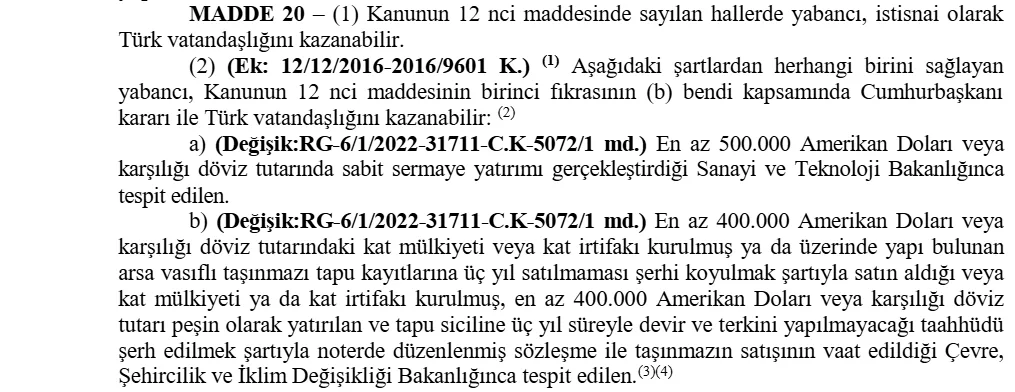
A property bought to obtain Turkish citizenship carries an annotation on the title deed that it will not be sold for three years (Regulation on the Implementation of the Turkish Citizenship Law, Art. 20/2-b) [M5]. Until the annotation ends, the title deed office does not process a sale of that property.
After the three years, the owner can sell. Owners whose citizenship was reviewed in 2026 sometimes ask whether selling affects that review: the review looks at whether the conditions existed when citizenship was granted, so a later sale does not change the historical facts. What happens to the property if citizenship is cancelled (liquidation only if the decision orders it, and postponed if the decision is challenged in court) is explained in our guide to the 2026 citizenship cancellations.
3. How to sell property in Turkey as a foreigner, step by step
| Step | What happens | Notes |
|---|---|---|
| 1. Check the title deed | Confirm the registered owner, shares, mortgages, annotations (including any citizenship annotation) | A mortgage must usually be cleared at or before the sale |
| 2. Agree the price | Seller and buyer agree the price and how it will be paid | Bank transfer leaves a record for tax and transfer purposes |
| 3. Valuation report | Obtained from a licensed valuation company | Required when a foreigner is a party [Y1] |
| 4. Appointment | Application to the title deed office (online appointment or in person) | The seller attends in person or through an attorney |
| 5. Fees | Title deed fee (2% seller, 2% buyer) and the office's service fee are paid | See section 4 |
| 6. Signing | The official sale deed is read and signed before the officer | A sworn interpreter attends if a party does not speak Turkish |
| 7. After the sale | Tax return if the gain is taxable; transfer of funds; residence permit review | Sections 5–9 |
4. Costs of selling: the title deed fee and the declared price
The title deed fee for a sale is 2% for the seller and 2% for the buyer, calculated on the declared price, which may not be lower than the property's tax value (Fees Law No. 492, Art. 63 and Tariff 4) [M6]. Our title deed fee calculator shows the amounts.
Declaring a lower price than the one actually paid is a common mistake. If it is later found that the declared price did not reflect reality, the fee difference is assessed together with a tax-loss penalty equal to that difference, that is, one times the missing fee (Fees Law, Art. 63, as amended in 2025) [M6]. A low declared price can also hurt the buyer later, because the buyer's own future gain is calculated from the declared cost.
| Cost | Who usually pays | Basis |
|---|---|---|
| Title deed fee 2% | Seller | Fees Law, Tariff 4 |
| Title deed fee 2% | Buyer | Fees Law, Tariff 4 |
| Title deed office service fee | Usually the applicant | Set annually |
| Valuation report fee | As agreed | Required with a foreign party |
| Agent's commission | As agreed | Contract |
| Capital gains tax | Seller, only if within 5 years | Income Tax Law, repeated Art. 80 |
5. Capital gains tax when selling property in Turkey: the five-year rule
Under the Income Tax Law, gains from selling immovable property are taxed as "value increase gains" only if the property is sold within five years of its acquisition, whatever the way it was acquired, except property acquired free of charge such as by inheritance or gift (repeated Art. 80/6) [M1]. After five years from the acquisition date, the gain is not taxed under this rule.
| Situation | Capital gains tax? |
|---|---|
| Bought and sold after more than 5 years | No |
| Bought and sold within 5 years, with a gain above the exemption | Yes, on the net gain |
| Inherited property | Not under this rule (acquired free of charge) |
| Received as a gift | Not under this rule (acquired free of charge) |
| Sold at a loss or no gain | No tax |
How the net gain is calculated
The net gain is the sale price minus the acquisition cost, minus the expenses borne by the seller and the taxes and fees paid on the sale (repeated Art. 81) [M1]. Two rules reduce the taxable amount:
- Inflation indexation: the acquisition cost is increased by the rise in the producer price index, excluding the month of sale, provided the rise is at least 10% (repeated Art. 81) [M1].
- Annual exemption: TRY 150,000 of the value increase gains obtained in a calendar year is exempt for 2026 (repeated Art. 80, as updated by General Communiqué No. 332, Official Gazette 31 December 2025) [M1] [T1]. The figure was TRY 120,000 for 2025.
The remaining gain is taxed at the progressive income tax rates. Because the calculation depends on dates, index figures and documents, sellers usually keep the purchase deed, payment records and receipts for any costs.
6. Example: how much tax is paid on a real sale?
The figures below are illustrative only; the index rise in particular is an assumed number chosen to show the method. The real calculation uses the official index figures for the actual months.
| Item | Amount (TRY) | Rule |
|---|---|---|
| Purchase (March 2023), declared price | 3,000,000 | Acquisition cost |
| Assumed index rise from purchase to the month before sale | +150% | Indexation applies because the rise is at least 10% |
| Indexed acquisition cost | 7,500,000 | Repeated Art. 81 |
| Sale (September 2026), declared price | 9,000,000 | Sold within 5 years: taxable |
| Seller's title deed fee (2%) | 180,000 | Deducted as a fee paid on the sale |
| Net gain | 1,320,000 | 9,000,000 − 7,500,000 − 180,000 |
| 2026 exemption | 150,000 | Repeated Art. 80 |
| Amount subject to income tax | 1,170,000 | Taxed at the progressive rates |
Two points stand out. Indexation can remove a large part of a nominal gain in a high-inflation period, so the purchase month matters. And had the same property been sold after March 2028, when five full years from acquisition have passed, there would be no value increase gain to tax under this rule.
7. I live abroad and sold my apartment: do I file a tax return in Turkey?
A seller who is not resident in Turkey for tax purposes (a "limited taxpayer") and does not file an annual return must declare the gain from selling immovable property with a separate return (münferit beyanname) at the tax office where the property is located, within 15 days of obtaining the gain (Income Tax Law, Art. 101) [M1]. A seller resident in Turkey declares a taxable gain in the annual income tax return.
Tax treaties between Turkey and other countries generally allow the country where the property is located to tax gains from that property; whether the seller's home country also taxes the gain, and how double taxation is relieved, depends on that country's rules and the treaty.
8. Selling property in Turkey through a power of attorney
A foreign owner who cannot travel can sell through an attorney appointed by a power of attorney. People abroad usually sign it at a Turkish consulate, or before a notary in their country with an apostille and a sworn translation. The power of attorney should name the property clearly (city, district, parcel, unit) and state whether the attorney may sign the sale, receive the price and pay fees. If a power of attorney is forged or misused and a property is sold without the owner's knowledge, the remedies are explained in property in Turkey sold without your knowledge.
A broad power of attorney is a risk: the attorney can sign at any price. Sellers therefore often limit it to one property, set a minimum price or require the price to be paid into the seller's own bank account. Our Arabic guide to hiring a lawyer in Turkey from abroad explains how consulate powers of attorney work.
9. Receiving the money and moving it abroad
Payment through a bank, rather than in cash, creates the record that later supports the tax return, any question about the price and the transfer abroad. Banks may ask for the official sale deed and identity documents before sending funds abroad. When the buyer is also a foreigner who used foreign currency, the buyer may need a foreign-exchange purchase certificate for his or her own purposes, especially in citizenship files.
10. What happens to your residence permit after the sale?
Owners of property in Turkey can hold a short-term residence permit on that basis (Law No. 6458, Art. 31/1-b) [M7]. Once the property is sold, that basis ends. A seller who wants to stay needs another type of permit; staying without one can count as an overstay, which our overstay and entry ban calculator explains. Owners who have held permits for close to eight years may want to look at the long-term residence permit before selling, because the permit basis matters for the count.
11. Selling a property with a tenant
A sale does not end an existing lease. If leased property changes hands after the lease was made, the new owner becomes a party to the lease (Code of Obligations, Art. 310) [M3]. A buyer who needs the property for personal use has separate eviction routes under the lease rules; the seller cannot promise vacant possession unless the tenant actually leaves.
12. Selling a shared or inherited property
When a property is owned in shares (hisseli tapu), each co-owner can sell his or her share, but the other co-owners may have a pre-emption right to buy a share sold to an outsider, within the statutory periods. Inherited property owned jointly by heirs cannot be sold by one heir alone until it is divided or all heirs act together. Our guide to inheritance in Turkey for foreigners explains the certificate of inheritance and the registration of heirs that usually come before a sale.
13. Common mistakes when selling property in Turkey
| Mistake | Why it matters |
|---|---|
| Declaring a lower price than the real one | Fee difference plus a penalty equal to the missing fee if discovered (Fees Law, Art. 63); a higher taxable gain for the buyer later |
| Missing the 15-day return as a non-resident seller | The deadline runs from the date of the gain (Income Tax Law, Art. 101) |
| Counting five years from the wrong date | The period runs from acquisition; selling a few weeks early can make the gain taxable |
| Giving an unlimited power of attorney | The attorney can sign at any price and receive the money |
| Assuming the tenant leaves with the sale | The buyer becomes the landlord under the existing lease (Code of Obligations, Art. 310) |
| Forgetting the residence permit | A permit based on the property loses its basis after the sale |
| Trying to sell citizenship property early | The three-year annotation blocks the sale at the title deed office |
14. Property lawyer in Istanbul, Ankara and across Turkey: when sellers ask for help
Most sales are completed at the title deed office without disputes. Sellers usually ask for legal help in four situations: selling from abroad through a power of attorney, a property with a mortgage, attachment or annotation, a shared or inherited property, and a buyer who does not pay or a deposit dispute. Many foreign owners hold apartments in İstanbul and consult a property lawyer in Istanbul; for properties and title deed offices in the capital, a lawyer in Ankara handles the same steps locally; and owners abroad often look for a property lawyer in Turkey who can act under a power of attorney.
15. Seller's checklist
| Document or step | Why it matters |
|---|---|
| Title deed and current registry extract | Owner, shares, mortgages, annotations |
| Purchase deed and payment records | Acquisition date (5-year rule) and cost (tax) |
| Receipts for costs | Deductible in the gain calculation |
| Valuation report | Required with a foreign party |
| Passport and tax number | Identity at the title deed office |
| Power of attorney (if absent) | Specific property, price and payment limits |
| Bank account for the price | Record for tax and transfer |
| Calendar note: 15 days | Separate tax return for non-resident sellers with a taxable gain |
Sources and References
[M1] Income Tax Law No. 193, repeated Arts. 80 and 81, Art. 101
[M3] Code of Obligations No. 6098, Arts. 237, 310
[M4] Turkish Civil Code No. 4721, Art. 706
[M5] Regulation on the Implementation of the Turkish Citizenship Law, Art. 20/2-b
[M6] Fees Law No. 492, Art. 63 and Tariff 4
[M7] Law No. 6458 on Foreigners and International Protection, Art. 31
[T1] General Communiqué on Income Tax No. 332 (Official Gazette 31 December 2025): 2026 exemption for value increase gains, TRY 150,000
[Y1] Council of State, 10th Chamber, E.2020/5861, K.2024/6304, 12 December 2024: valuation reports required since 4 March 2019 when a foreigner is buyer or seller; sale price may differ from the report
This article is general information about Turkish law as of 2 October 2026. It is not legal or tax advice and does not assess any individual sale.
Frequently Asked Questions
Can a foreigner sell property in Turkey?
Yes. A foreign owner has the same right to sell as a Turkish owner. The sale is signed at the title deed office, in person or through an attorney, and ownership passes only on registration.
Do I pay capital gains tax when selling property in Turkey?
Only if you sell within five years of acquiring the property (Income Tax Law, repeated Art. 80/6). After five years the gain is not taxed under this rule. Inherited or gifted property is outside the rule.
How much is the capital gains tax exemption in Turkey for 2026?
TRY 150,000 of the value increase gains obtained in 2026 is exempt (General Communiqué No. 332). It was TRY 120,000 for 2025. The rest is taxed at the progressive income tax rates.
How is the gain calculated?
Sale price minus the acquisition cost, the expenses borne by the seller and the taxes and fees paid. The acquisition cost is indexed for inflation (producer price index, excluding the month of sale) if the index rose by at least 10% (repeated Art. 81).
I live abroad. When do I declare the gain?
A non-resident seller who does not file an annual return declares the gain with a separate return at the tax office where the property is located within 15 days of obtaining it (Income Tax Law, Art. 101).
Is inherited property taxed when sold in Turkey?
The five-year capital gains rule does not apply to property acquired free of charge, such as by inheritance or gift (repeated Art. 80/6). Inheritance and transfer tax is a separate matter linked to the inheritance itself.
What is the title deed fee for the seller?
2% of the declared price, which may not be lower than the property's tax value; the buyer pays another 2% (Fees Law, Art. 63 and Tariff 4).
What happens if we declare a lower price than we actually paid?
If it is found that the declared price did not reflect reality, the fee difference is assessed together with a tax-loss penalty equal to the missing fee (one times; Fees Law, Art. 63, as amended in 2025). A low declared cost can also increase the buyer's taxable gain on a later sale.
Can I sell property I bought for Turkish citizenship?
Not until the three-year no-sale annotation on the title deed ends (Citizenship Regulation, Art. 20/2-b). After three years the property can be sold.
Do I need a valuation report to sell my property?
Yes, when a foreigner is the buyer or the seller. TKGM has required a valuation report in such transactions since 4 March 2019 (Circular 2019/1).
Can I sell my property in Turkey without travelling?
Yes, through an attorney appointed by a power of attorney, usually signed at a Turkish consulate or before a notary with an apostille and sworn translation. The document should identify the property and the attorney's powers.
How can I protect myself when selling through a power of attorney?
Sellers often limit the power to one property, set a minimum price or require the price to be paid into their own bank account, because a broad power allows the attorney to sign at any price.
Does a sale end the tenant's lease?
No. If a leased property changes hands, the new owner becomes a party to the lease (Code of Obligations, Art. 310). The buyer has separate eviction routes under the lease rules.
What happens to my residence permit when I sell my property?
A short-term permit based on property ownership (Law No. 6458, Art. 31/1-b) loses its basis. Staying in Turkey then requires another type of permit; otherwise the stay can become an overstay.
Can one heir sell inherited property in Turkey?
Not alone while the heirs own it jointly. The heirs act together, divide the property, or one heir's share is registered separately before it is sold.
Do co-owners have a right to buy my share first?
In shared ownership, co-owners may have a pre-emption right to buy a share sold to an outsider, within the statutory periods. This is checked before selling a share of a property.
Is it better to receive the sale price by bank transfer?
A bank transfer creates a record that supports the tax return, any later question about the price and a transfer abroad. Banks may ask for the sale deed and identity documents before sending funds abroad.
Is the gain also taxed in my home country?
Tax treaties generally allow the country where the property is located to tax gains from it. Whether your home country also taxes the gain, and how double taxation is relieved, depends on its rules and the treaty.
Can I sell a property that has a mortgage?
A mortgage is registered on the title deed. It is usually paid off and removed at or before the sale, or the buyer agrees to take the property with it; the title deed office shows it in the registry extract.
My citizenship was cancelled. Can I still sell my property?
Liquidation applies only if the cancellation decision orders it, and it waits until the end of a lawsuit against the decision (Citizenship Law, Art. 33). Measures placed in a criminal investigation are separate and may block a sale.
Do I need a property lawyer in Turkey to sell?
Not necessarily. Sales are often completed directly at the title deed office. Sellers ask a property lawyer in Turkey mainly when selling from abroad, when the title has annotations or shares, or when a buyer or deposit dispute arises.
Where can I find a property lawyer in Istanbul or Ankara for a sale?
Many foreign owners hold apartments in İstanbul and consult a property lawyer in Istanbul; for property registered in Ankara, a lawyer in Ankara deals with the local title deed office. Our real estate law page explains the service.
When does the five-year period start?
From the acquisition date of the property, which in practice is the date ownership was registered at the title deed office.
Do I pay tax if I sell at a loss?
No. If there is no net gain after deducting the cost, expenses and fees, there is no value increase gain to tax.
Which documents should I keep for the tax calculation?
The purchase deed, payment records, receipts for costs, the sale deed and the bank records of the sale price. They prove the acquisition date, the cost and the deductible expenses.
- selling property in Turkey as a foreigner
- sell property in Turkey from abroad
- capital gains tax Turkey property
- five year rule property tax Turkey
- value increase gain Turkey
- capital gains exemption 2026 Turkey
- title deed fee seller Turkey
- declared price title deed
- power of attorney property sale Turkey
- non-resident seller tax return Turkey
- Income Tax Law Article 80
- inherited property sale Turkey
- citizenship property three year rule
- valuation report foreign seller
- sell apartment Turkey
- residence permit after selling property
- tenant after property sale Turkey
- shared title deed sale
- real estate lawyer Istanbul
- property lawyer Turkey
Our services in this area
Real Estate Law