Turkish Citizenship Revoked in 2026: What Happened to the 1,070 Investors and Their Families
Turkey cancelled or withdrew 6,134 investment citizenships and named 1,070 more in sales through Babacan, Gül İnşaat, Beyaz İnşaat and LİV. What the law says about cancellation and withdrawal, families, property and residence.
In 2026 Turkey cancelled or withdrew the citizenship of 6,134 people who had become Turkish through investment, and in September it named 1,070 more. This guide explains, in plain language, what was announced, which files are affected and what the law says happens to the investor, the family and the property.
If you have a matter on this topic:
1. What happened in 2026? The official figures
Three announcements set out the scale. All figures below come from official statements as reported by Anadolu Ajansı, the state news agency, and national newspapers; the source code next to each row points to the list at the end of this article.
| Date | Who announced it | What was announced | Source |
|---|---|---|---|
| 4 August 2026 | Ministry of Interior | Investment conformity certificates of 1,150 investors cancelled; citizenship decisions of 5,391 people (investors and families) cancelled. A further 263 investors assessed as a public order or national security risk after naturalisation; decisions of 743 people withdrawn. Total: 1,413 investors, 6,134 people. | [H1] |
| 4 August 2026 | Minister of Justice Akın Gürlek | First wave of an İstanbul investigation into Babacan İnşaat-linked sales: low-value properties sold with inflated valuation reports; 687 people found to have acquired citizenship irregularly; about TRY 2.5 billion that should have entered Turkey did not. | [H2] |
| 21 September 2026 | Minister of Justice | Second wave: sales made through Gül İnşaat AŞ, Beyaz İnşaat and LİV İnşaat examined. Of 734 sales to foreign nationals, 274 found to be sham (collusive). 1,070 people, family members included, found to have acquired citizenship irregularly; the process for 11 more still running. Transactions above TRY 3.5 billion (USD 72.25 million). | [H3] [H4] |
| 21 September 2026 | Ministry of Interior (update) | Since 11 February 2026, citizenship of 458 investors and their families, 1,393 people in total, cancelled. | [H3] |
| 25 September 2026 | Court measures | In the second wave, 33 suspects remanded in custody, 20 placed under house arrest and 21 under other judicial control measures. | [H5] |
The criminal investigation and the citizenship files are two separate tracks. A company or a person named in an investigation has not been convicted; the presumption of innocence applies to everyone in these files. What the figures do show is that the review covers files from different years and different developers, and that it was still continuing at the end of September 2026.
2. Babacan, Gül İnşaat, Beyaz İnşaat and LİV: which purchases are under investigation?
Many investors first learned about the review from the developer's name in the news. The official statements name four groups.
The first wave: Babacan İnşaat-linked sales
According to the Minister of Justice, the first wave examined transactions linked to Babacan İnşaat. The statement described low-value properties presented at much higher values through valuation reports that did not reflect reality, and 687 people who became citizens through those sales [H2] [H4]. In that operation 80 suspects were detained, 32 were remanded in custody, trustees were appointed to 7 companies and measures were placed on 1,045 properties [H2].
The second wave: Gül İnşaat AŞ, Beyaz İnşaat and LİV İnşaat
In the second wave, announced on 21 September 2026, the Minister stated that sales made through Gül İnşaat AŞ, Beyaz İnşaat and LİV İnşaat had been examined: 734 sales to foreign nationals, of which 274 were found to be sham transactions [H4]. The prosecutors described purchases in which the foreign currency required for citizenship did not actually come into Turkey. Measures were placed on 2,011 properties, a hotel in Bağcılar, 86 vehicles, 2 yachts and 42 bank accounts, and trustees were appointed to 30 companies [H3].
Does buying from one of these developers mean your citizenship will be cancelled?
No. Being named in a statement is not a finding against every buyer. In the second wave, 274 of the 734 sales examined were described as sham; the other 460 were not. What decides an individual file is that file's own documents: the price that was actually paid, the bank and currency records, the valuation report and the conformity certificate. The criminal investigation concerns the people suspected of organising the scheme; the citizenship review concerns whether the legal conditions of each grant were met. If you bought from one of these developers, the useful question is not "is my developer named?" but "what does my own file show?".
3. Revoked, cancelled or withdrawn: what is the difference for me?
News reports use the word "revoked" for everything. Turkish law has three separate routes, and the route decides who in the family is affected and from which date [M1].
| Cancellation (iptal) | Withdrawal (geri alma) | Deprivation (kaybettirme) | |
|---|---|---|---|
| Legal basis | Law No. 5901, Arts. 31–33 | Law No. 5901, Art. 40; Regulation, Art. 66 | Law No. 5901, Arts. 29–30 |
| Ground | The grant resulted from the person's false statement or concealment of a material fact | The decision was made although the legal conditions were not met, or was issued twice (the Regulation adds: by mistake) | Specific conduct, such as serving a foreign state against Turkey's interests |
| From when | From the date of the cancellation decision (Art. 32) | The withdrawn decision becomes void from the original decision date (Regulation Art. 66) | From publication in the Official Gazette (Art. 30) |
| Spouse and children | Applies to spouse and children who became citizens through the person (Art. 32), with exceptions | The family's citizenship rested on the same decision; affected in practice | Personal; does not affect spouse or children (Art. 30) |
| Property | Liquidation only if the decision says so; deferred if a lawsuit is filed (Art. 33) | No specific rule; general rules for foreigners apply | No specific rule |
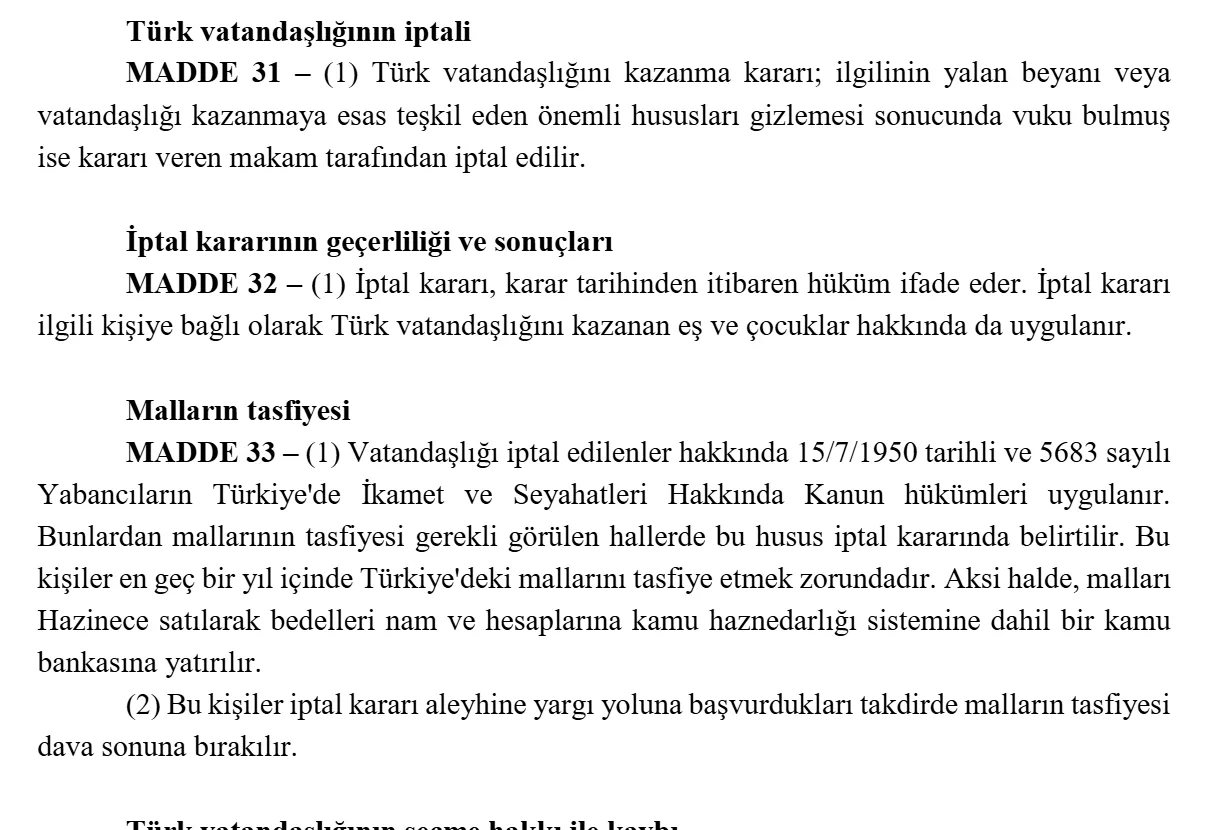
For citizenship by investment, the decision granting citizenship is a decision of the President of the Republic (Article 12 of Law No. 5901), and both cancellation and withdrawal are made by "the authority that made the decision" [M1] [M2]. That is why the citizenship decision itself is challenged before the Council of State (Danıştay) in Ankara, as explained in our appeal guide.
4. Which citizenship files are being reviewed?
The announcements and the published court decisions point to four kinds of problem. They are different from one another, and an investor's position depends on which one is alleged.
| Problem alleged | What it means in plain words | Where it appeared |
|---|---|---|
| Inflated valuation report | The property was worth less than the citizenship threshold, but a valuation report showed a higher value | First wave (Babacan-linked sales) [H2] |
| Sham (collusive) sale | The money shown as paid by the buyer did not really come into Turkey, or came from the seller or an intermediary | Second wave (Gül, Beyaz, LİV sales) [H3] [H4] |
| Untrue foreign-exchange purchase certificate | The bank document showing that the foreign currency was sold to a Turkish bank did not reflect reality | Danıştay case E.2024/405 [Y1] |
| Security or public order assessment | Information that the person posed a risk, assessed after naturalisation | 263 investors in the 4 August statement [H1]; Danıştay case E.2022/7637 [Y2] |
The first three concern the investment itself. The investment is confirmed by a conformity certificate (uygunluk belgesi) issued by the land registry authority (TKGM). In the 4 August figures, the Ministry first cancelled the conformity certificates of 1,150 investors, and the citizenship decisions of 5,391 people fell with them [H1]. In other words, the review usually works backwards: valuation and payment records, then the certificate, then the citizenship decision.
Which investment amount applied when you bought?
The threshold has changed three times, and a file is judged by the rule that applied to it, not by today's figure [M2] [T1].
| Period | Minimum property investment | Rule |
|---|---|---|
| 12 January 2017 – 18 September 2018 | USD 1,000,000 | Regulation Art. 20, added by Decision 2016/9601 |
| From 19 September 2018 | USD 250,000 | Presidential Decision No. 106 |
| Applications from 13 June 2022 | USD 400,000 | Presidential Decision No. 5554 (Official Gazette 13 May 2022) |
In every period the property had to carry a three-year no-sale annotation on the title deed, and the foreign currency had to be sold to a bank operating in Turkey before the transaction (Regulation Art. 20) [M2]. The second wave of 2026 is about exactly this point: whether the currency really came in.
5. What is a valuation report, and why is it at the centre of the 2026 review?
A valuation report is a document showing the current market value of a property. Since 4 March 2019, the land registry has required one in every transaction where a foreigner is the buyer or the seller (TKGM Circular 2019/1) [Y4]. The report must be prepared by a real estate valuation company listed by the Capital Markets Board (SPK) or the Turkish Association of Valuation Experts, following international valuation standards [Y4].
For citizenship, the report did an important job: it showed whether the property was really worth the threshold. That is why the first wave of 2026 focused on reports. According to the Minister of Justice, low-value properties were presented at much higher values through reports that did not reflect reality, so that the purchase looked like a qualifying investment on paper [H2] [H4].
Can the sale price be different from the valuation report?
Yes. A TKGM guide states that the declared sale price may be lower than the value in the valuation report, and that the report is not binding one-to-one for the sale price or the title deed fee; the Council of State found this rule lawful in December 2024 [Y4]. The TKGM procedures were later consolidated in Circular 2024/4 of 13 June 2024 [Y4]. For a citizenship file, however, the question is narrower: did the investor genuinely invest the required amount in a property genuinely worth it? A report that "lands exactly" on the threshold for a property worth much less is the pattern the authorities described.
6. What is a sham sale? Three situations in plain words
The second wave of 2026 used the word "muvazaalı", which means a transaction that looks real on paper but hides a different arrangement. The Minister described sales where the foreign currency required for citizenship did not actually enter Turkey [H3] [H4]. The table below shows, in general terms, why three buyers who all hold the same kind of title deed can be in very different legal positions.
| Situation | What happened | Why it matters legally |
|---|---|---|
| A. Genuine purchase | The buyer paid the full price from his or her own funds through a bank, the seller kept the money, and the property was worth the amount | The legal conditions existed on the grant date; this is the position the Council of State protected in the 2025 decision when the administration could not prove otherwise [Y2] |
| B. Genuine payment, inflated report | The buyer paid in good faith, but the valuation report, prepared by others, overstated the value | Whether the buyer's own "false statement or concealment" exists (Art. 31) and whether the investment condition was really met (Art. 40) both become live questions |
| C. Money shown, money returned | The payment was financed by the seller or an intermediary, or part of it went back | The investment the file relies on did not exist in the declared amount; this is the pattern described in the second wave |
A buyer in situation B often finds out only from the news. A buyer who was offered a large "discount" on a citizenship property may not realise that the discount was the gap between the declared price and the money that actually moved. The documents listed in section 17 are the ones that show which situation a file is in.
7. Can citizenship be ended if the investor did nothing wrong?
This is the question most families ask. The answer depends on the route.
Cancellation under Article 31 requires a false statement or concealment by "the person concerned" (ilgilinin). If someone else, such as a valuation company or a seller, made the false document without the investor's knowledge, whether Article 31 applies at all is a genuine legal question [M1].
Withdrawal under Article 40 does not ask whether the investor lied. It asks whether the legal conditions existed when citizenship was granted. In a case decided on 5 February 2026, the Council of State stated that if a legal condition was missing on the grant date, the decision can be withdrawn "at any time", even if the defect is discovered later; in that file the foreign-exchange purchase certificates had been found untrue, and the withdrawal was upheld [Y1].
The same court has also set a limit. In a decision of 26 June 2025, it held that the obstacle relied on must have existed on or before the date citizenship was granted; facts that arise later, with no link to the earlier period, cannot be read as "the legal conditions were not met". In that file the Council of State annulled the withdrawal of a family's citizenship, because the administration could not show concrete evidence and had known the same information before granting citizenship [Y2]. So a family is not without arguments simply because it was not the one who made the false document.

8. Is there a time limit? Can a 2018 file be reviewed in 2026?
Law No. 5901 does not set a time limit for cancellation or withdrawal. The Council of State's wording in the 2026 decision, that a decision issued without its legal conditions "can always be withdrawn", reflects this [M1] [Y1]. A file approved years ago can therefore still be reviewed. What protects a file is not its age but the strength of its documents: what was paid, how, to whom, and whether the valuation matched reality.
9. What happens to my spouse and children?
In citizenship by investment, the spouse and minor or dependent children usually become citizens together with the investor, on the same application (Article 12(1)(b) of Law No. 5901) [M1]. When the investor's decision falls, theirs is affected too, but not in every case.
| Family member | If the decision is cancelled (Art. 31) | If the decision is withdrawn (Art. 40) |
|---|---|---|
| Spouse included in the investor's application | Affected (Art. 32; Regulation Art. 58/1) | Affected in practice: the 743 people in the 4 August figures included family members [H1] |
| Children included in the application | Affected (Art. 32) | Affected in practice |
| Child born after the parent became a Turkish citizen | Not affected (Regulation Art. 58/2) | The Regulation's exception is written for cancellation; because withdrawal is retroactive, the child's position is examined on its own facts |
| Spouse who later became a citizen through marriage | Not affected (Regulation Art. 58/2) | Examined on its own legal basis |
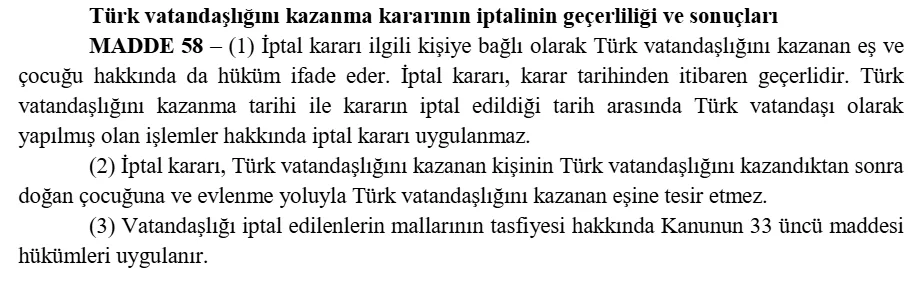
Two practical points follow. First, each adult family member is a separate person in the file and receives his or her own notification. Second, the Council of State has held that a family (investor, spouse and children) may file one joint lawsuit, but separate families cannot join together in one petition even when the same Presidential decision covers them all [Y3].
Where a family member gave up an earlier nationality after becoming Turkish, the question of statelessness also arises. The Turkish rules on cancellation do not contain a specific safeguard for this, so it is raised as an argument in the individual case.
10. What happens to my property in Turkey?
Losing citizenship does not mean the apartment is automatically taken by the state. Article 33 of Law No. 5901 sets the rules for cancellation [M1]:
- Liquidation (selling the property) is required only if the cancellation decision says so.
- If it does, the person must dispose of the property in Turkey within one year. Otherwise the Treasury sells it and deposits the proceeds in the person's name at a public bank. The value is not confiscated.
- If the person files a lawsuit against the cancellation, liquidation waits until the end of the case (Art. 33/2).
For withdrawal, Article 40 contains no liquidation rule. The person is treated as a foreigner, and ownership is then judged under the general rules for foreigners buying property in Turkey, such as Article 35 of the Land Registry Law, which limits ownership to nationals of countries approved by the President and to area limits [M7]. These rules are explained in our guide to buying property in Turkey as a foreigner.
A separate issue is the criminal investigation. In both waves, prosecutors placed measures on thousands of properties (1,045 in the first wave, 2,011 in the second) [H2] [H3]. A measure ordered in a criminal file is not lifted by the citizenship lawsuit; it is dealt with in the criminal proceedings. If a family member inherits such a property, the rules in our guide to inheritance in Turkey for foreigners apply as well.
11. What happens to things I did while I was a Turkish citizen?
Families ask whether a marriage registered, a company founded, a property bought or a contract signed as a Turkish citizen becomes invalid. For cancellation, the Regulation answers directly: transactions carried out as a Turkish citizen between the date citizenship was acquired and the date of the cancellation are not affected by the cancellation decision (Regulation Art. 58/1) [M2]. Each of those acts may still be checked under its own rules (for example, a company's registration or a property's ownership as a foreigner), but the cancellation itself does not erase them.
For withdrawal, the Regulation contains no equivalent sentence, and the withdrawn decision becomes void from the original date (Art. 66) [M2]. How that retroactive effect touches acts done in between is therefore examined act by act, which is one reason the difference between cancellation and withdrawal matters so much in practice.
12. If my citizenship ends, how do I stay in Turkey legally?
Article 33 of Law No. 5901 says that the foreigners' residence law applies to people whose citizenship is cancelled. The law it names (No. 5683) has been repealed; under Article 122 of Law No. 6458 on Foreigners and International Protection, references to it now mean Law No. 6458 [M1] [M6]. In plain words: a person whose citizenship has ended is a foreigner again, and staying in Turkey requires a valid visa or residence permit.
This matters in practice. A Turkish ID card and passport were the person's documents until the decision; after it, staying without a residence permit can be treated as an overstay. Overstays lead to fines and can lead to an entry ban when leaving. Our overstay penalty and entry ban calculator shows how the ban period is worked out, and our guide to deportation and entry bans in Turkey explains restriction codes and the 7-day appeal against a deportation order.
13. Is the criminal investigation the same as the citizenship process?
No. They are separate tracks with separate authorities:
| Criminal investigation | Citizenship process | |
|---|---|---|
| Who runs it | İstanbul Chief Public Prosecutor's Office and criminal courts | Ministry of Interior, TKGM and the President; court review by the Council of State |
| What it asks | Did a person commit a crime (forgery, migrant smuggling, fraud, organised crime)? | Were the legal conditions of this citizenship grant met? |
| Outcome | Conviction or acquittal; measures on property and accounts | Citizenship continues, is cancelled or is withdrawn |
The offences mentioned in the second wave were establishing an organisation to commit crimes, migrant smuggling, forgery of official and private documents and false statements in an official document [H3] [H5]. An investor can face a citizenship decision without being a suspect, and an investigation of a developer does not by itself decide any investor's file. Anyone invited to give a statement is protected by the rules on statements and legal assistance described in our guide for foreigners arrested or questioned in Turkey.
14. Can a person apply for Turkish citizenship again later?
Law No. 5901 does not contain a special "regain" route for people whose citizenship was cancelled or withdrawn. Article 43 is sometimes cited for this, but it concerns other groups (people who lost citizenship under the old Law No. 403, and people stripped of citizenship under the 1928 law) [M1]. A new application would be assessed under the general rules in force on the date of that application.
15. Has Turkey ended citizenship by investment?
No. As of 2 October 2026, the investment routes in Article 20 of the Regulation, including the USD 400,000 property route, remain in force [M2]. The 2026 measures concern how past files were prepared, not the existence of the programme.
16. Turkish citizenship lawyer in Istanbul, Ankara and across Turkey: where these files are handled
These files cross three places. The criminal investigation is run by the İstanbul Chief Public Prosecutor's Office, and many of the properties are in İstanbul; in a Council of State case, the conformity certificate was cancelled by the TKGM regional directorate in İstanbul [Y1]. The citizenship decision is a Presidential decision, so the lawsuit against it is heard by the Council of State in Ankara. The properties themselves are spread across Turkey, from İstanbul to Antalya.
For a family abroad, this means one file may involve a Turkish citizenship lawyer in Istanbul for the property and certificate side, and a lawyer in Ankara following the administrative case before the Council of State. Both lawsuits are filed electronically through the national court system (UYAP), so the file can be followed from either city. Many families search for a "citizenship lawyer in Turkey" only after the notification arrives; the 60-day period described in our appeal guide starts on the day after notification, wherever the family lives.
17. Which documents show what happened in your file?
Whether a file is strong or weak is decided by documents, not by the developer's name. The documents below are the ones the authorities and the courts look at in these cases:
| Document | Why it matters |
|---|---|
| Title deed and official sale record (resmi senet) | Shows the declared price and the date |
| Bank transfer records and SWIFT messages | Show where the money came from and where it went |
| Foreign-exchange purchase certificate (döviz alım belgesi) | Shows the currency was sold to a Turkish bank; this document was decisive in Danıştay case E.2024/405 [Y1] |
| Valuation report | Shows the value relied on; inflated reports were the core of the first wave |
| Conformity certificate (uygunluk belgesi) | The TKGM document the citizenship decision was built on |
| Sale contract, receipts, agent or developer correspondence | Show what the buyer knew and what the buyer was told |
| Citizenship decision and every notification received | The notification date starts the 60-day period |
Sources and References
Legislation
[M1] Turkish Citizenship Law No. 5901, Arts. 12, 20, 29–33, 40, 41, 43
[M2] Regulation on the Implementation of the Turkish Citizenship Law, Arts. 20, 58, 66
[M3] Administrative Procedure Law No. 2577, Arts. 7, 11, 27
[M4] Council of State Law No. 2575, Art. 24
[M6] Law No. 6458 on Foreigners and International Protection, Arts. 122, 124
[M7] Land Registry Law No. 2644, Art. 35
Official guidance
Council of State (Danıştay) decisions
[Y1] Danıştay 10th Chamber, E.2024/405, K.2026/361, 5 February 2026: withdrawal after the conformity certificate was cancelled for untrue foreign-exchange certificates; the certificate's cancellation had not been challenged
[Y2] Danıştay 10th Chamber, E.2022/7637, K.2025/3313, 26 June 2025: withdrawal annulled; the obstacle must exist on the grant date and be shown with concrete evidence
[Y4] Danıştay 10th Chamber, E.2020/5861, K.2024/6304, 12 December 2024: valuation reports required since 4 March 2019 (TKGM Circular 2019/1); sale price may be lower than the report value; TKGM guide later replaced by Circular 2024/4
[Y3] Danıştay 10th Chamber, E.2023/6208, K.2025/169, 14 January 2025: separate families must file separate petitions
Official statements and reporting
[H1] Ministry of Interior statement of 4 August 2026, as reported by Hürriyet
[H2] Anadolu Ajansı, 7 August 2026: first wave, 687 people, 32 remanded
[H3] Anadolu Ajansı, 21 September 2026: second wave, 1,070 people, Ministry of Interior update
[H5] Anadolu Ajansı, 25 September 2026: 33 suspects remanded
This article is general information about Turkish law as of 2 October 2026. It is not legal advice and does not assess any individual file.
Frequently Asked Questions
Why is Turkey revoking citizenship in 2026?
The Ministry of Interior said inspections by the land registry authority (TKGM), the Tax Inspection Board, the police and the intelligence service found citizenship files built on fake or irregular valuation reports and sham property sales, and others that raised public order or national security concerns. On 4 August 2026 it announced that the decisions of 6,134 people had been cancelled or withdrawn.
How many people have lost Turkish citizenship obtained through investment?
On 4 August 2026 the Ministry of Interior announced 6,134 people (1,413 investors and their families): 5,391 cancelled after 1,150 conformity certificates were cancelled, and 743 withdrawn on security grounds. On 21 September 2026 it reported that 1,393 people (458 investors and families) had been cancelled since 11 February 2026, and the Minister of Justice announced that 1,070 more people had acquired citizenship through sham sales.
Who are the 1,070 people announced in September 2026?
According to the Minister of Justice, they are people, family members included, who became citizens through 274 sales found to be sham among 734 sales to foreigners made through Gül İnşaat AŞ, Beyaz İnşaat and LİV İnşaat. The Minister said administrative proceedings to cancel their citizenship had been started. The process for 11 more people was still running.
I bought from Babacan, Gül İnşaat, Beyaz İnşaat or LİV. Will my citizenship be cancelled?
Not automatically. In the second wave, 274 of 734 sales examined were described as sham; the rest were not. Each file is assessed on its own documents: the price actually paid, bank and currency records, the valuation report and the conformity certificate. A developer being named in an investigation is not a finding against every buyer.
What is the difference between cancellation and withdrawal of Turkish citizenship?
Cancellation (Article 31 of Law No. 5901) applies when the grant resulted from the person's false statement or concealment of a material fact, and it takes effect from the date of the decision. Withdrawal (Article 40) applies when the legal conditions were never met; under Article 66 of the Regulation the withdrawn decision becomes void from the original decision date.
Can Turkish citizenship be taken away if I did not know about the fraud?
It can, if the authorities say the legal conditions were not met on the grant date; withdrawal under Article 40 does not require the investor's fault. But the Council of State requires the obstacle to have existed on or before the grant date and to be shown with concrete evidence; in a 2025 decision it annulled a family's withdrawal on that basis.
Is there a time limit for cancelling Turkish citizenship?
Law No. 5901 sets no time limit. In a February 2026 decision, the Council of State said a decision issued without its legal conditions can be withdrawn at any time, even if the problem is discovered later. A file approved years ago can therefore still be reviewed.
Will my wife and children also lose Turkish citizenship?
If they became citizens through your application, generally yes: Article 32 of Law No. 5901 applies a cancellation to the spouse and children who acquired citizenship through the person. Under Article 58/2 of the Regulation, a cancellation does not affect a child born after the parent became a citizen or a spouse who acquired citizenship through marriage.
What happens to a child born in Turkey after I became a citizen?
For cancellation, Article 58/2 of the Regulation says the decision does not affect a child born after the parent became a Turkish citizen. Because withdrawal is retroactive, a child's position after a withdrawal is examined on the child's own facts, such as date of birth and how the child's citizenship was recorded.
Will Turkey confiscate my apartment if my citizenship is cancelled?
No automatic confiscation. Under Article 33, liquidation is required only if the cancellation decision says so; the owner then has one year to sell, and if not, the Treasury sells and deposits the proceeds in the owner's name. If a lawsuit is filed against the cancellation, liquidation waits until the end of the case.
Can I keep my property in Turkey as a foreigner after losing citizenship?
Ownership is then judged under the rules for foreigners, mainly Article 35 of the Land Registry Law: nationals of countries approved by the President may own property in Turkey within the area limits. Whether a specific property can be kept depends on the person's other nationality and the property's location.
My property was seized in the criminal investigation. Does the citizenship lawsuit lift it?
No. A measure placed by a prosecutor or criminal court belongs to the criminal file and is dealt with in the criminal proceedings. The citizenship lawsuit before the Council of State concerns the citizenship decision, and the Article 33 liquidation rules concern cancellation.
After my citizenship is cancelled, do I need a residence permit?
Yes. Article 33 of Law No. 5901 applies the foreigners' law to people whose citizenship is cancelled, and under Article 122 of Law No. 6458 that now means the Law on Foreigners and International Protection. Staying in Turkey then requires a valid visa or residence permit; staying without one can be treated as an overstay.
Is my Turkish passport still valid after a cancellation decision?
The passport and ID card were issued because of the citizenship. Once a cancellation or withdrawal decision takes effect, the basis for those documents falls away, and the person's status in Turkey is that of a foreigner. If a court annuls the decision, the decision is removed and the citizenship continues.
Is the criminal investigation the same as the citizenship process?
No. The criminal investigation, run by the İstanbul Chief Public Prosecutor's Office, asks whether people committed crimes such as forgery or migrant smuggling. The citizenship process, run by the Ministry of Interior, TKGM and the President, asks whether each grant met the legal conditions. An investor can face one without the other.
Can I apply for Turkish citizenship again after a cancellation?
Law No. 5901 has no special route to regain citizenship after cancellation or withdrawal. Article 43, which is sometimes mentioned, concerns people who lost citizenship under the old laws. A new application would be assessed under the general rules in force on the date it is made.
Has Turkey ended the citizenship by investment programme?
No. As of 2 October 2026, the investment routes in Article 20 of the Regulation, including the USD 400,000 property purchase with a three-year no-sale annotation, remain in force. The 2026 measures concern how earlier files were prepared.
Which investment amount applied to my file?
USD 1,000,000 from 12 January 2017, USD 250,000 from 19 September 2018 (Presidential Decision No. 106), and USD 400,000 for applications from 13 June 2022 (Presidential Decision No. 5554). A file is judged under the rule that applied to it, not today's threshold.
Do I need a lawyer in Turkey if I live abroad?
Lawsuits can be filed through a lawyer acting under a power of attorney, which people abroad usually sign at a Turkish consulate. Because the 60-day period runs from notification wherever the family lives, families abroad often look for a citizenship lawyer in Turkey as soon as a notification or a news report concerns their developer.
Where are these citizenship files handled: Istanbul or Ankara?
The criminal investigation into the Babacan, Gül İnşaat, Beyaz İnşaat and LİV sales is run by the İstanbul Chief Public Prosecutor’s Office, and some conformity certificates were cancelled by TKGM’s İstanbul regional directorate; the citizenship decisions themselves are Presidential decisions examined in Ankara. Families therefore often contact a Turkish citizenship lawyer in Istanbul, while a lawyer in Ankara follows the Ankara side.
What documents should I keep if my developer is under investigation?
The documents courts and authorities look at are: the title deed and official sale record, bank transfers and SWIFT messages, the foreign-exchange purchase certificate, the valuation report, the conformity certificate, the sale contract and receipts, and every notification received. Together they show what was paid, how, and to whom.
What is a valuation report and who prepares it?
It is a document showing a property's current market value. Since 4 March 2019, TKGM has required one whenever a foreigner buys or sells property (Circular 2019/1). It must be prepared by a valuation company listed by the Capital Markets Board (SPK) or the Turkish Association of Valuation Experts. Inflated reports were at the centre of the first wave of the 2026 investigation.
What does 'sham sale' (muvazaalı satış) mean in the 2026 investigation?
A sale that looks real on paper but hides a different arrangement. In the second wave, the Minister of Justice described sales in which the foreign currency required for citizenship did not actually enter Turkey; 274 of 734 sales examined were found to be sham.
What happens to my marriage, company or contracts made while I was a Turkish citizen?
For cancellation, Article 58/1 of the Regulation says transactions carried out as a Turkish citizen between acquiring citizenship and the cancellation are not affected by the cancellation decision. For withdrawal, which is retroactive, the Regulation has no equivalent sentence, so the effect on each act is examined separately.
- Turkish citizenship revoked
- Turkish citizenship cancelled
- Turkish citizenship withdrawn
- citizenship by investment Turkey
- 1,070 citizenship cancellation
- 6,134 citizenship cancelled
- Babacan İnşaat citizenship
- Gül İnşaat citizenship
- Beyaz İnşaat citizenship
- LİV İnşaat citizenship
- valuation report fraud Turkey
- conformity certificate TKGM
- Article 31 Law 5901
- Article 40 Law 5901
- Council of State Ankara
- property after citizenship cancellation
- residence permit after losing citizenship
Our services in this area
Law on Foreigners