Buying Property in Turkey as a Foreigner (2026): Legal Guide to Title Deeds, Costs, Residence and Citizenship
Who can buy property in Turkey, the 10% and 30-hectare limits, why only the title deed office transfers ownership, tapu due diligence, costs, off-plan risks, and residence permits and citizenship through property.
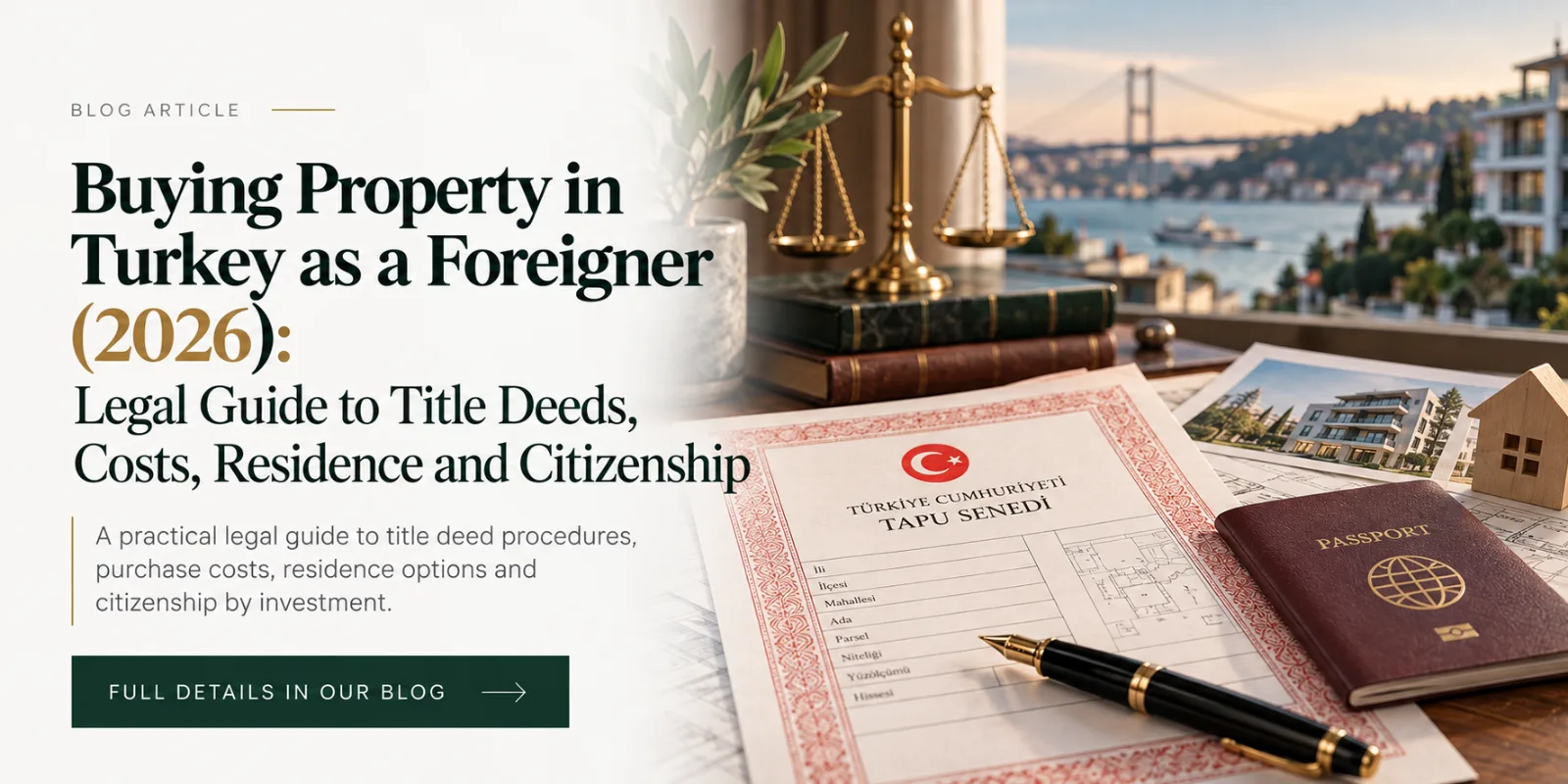
Turkey is one of the most popular countries in the world for foreign property buyers, from apartments in Istanbul and Ankara to holiday homes in Antalya, Bodrum and Fethiye. Buying property in Turkey as a foreigner is legally straightforward, but the process has its own rules: who may buy, which area limits apply, why only the title deed office can transfer ownership, and which checks protect you from buying a property with a mortgage, an attachment or no occupancy permit.
This guide explains buying property in Turkey as a foreigner from a lawyer's perspective: the legal conditions under Article 35 of the Land Registry Law, title deed (tapu) due diligence, the purchase process step by step, taxes and fees, off-plan purchases, residence permits and citizenship through property, and the mistakes that cost foreign buyers the most.
If you have a matter on this topic:
Can Foreigners Buy Property in Turkey?
Yes. Under Article 35 of the Land Registry Law (Law No. 2644, as amended in 2012), foreign natural persons who are nationals of countries determined by the President may acquire real estate and limited real rights in Turkey, subject to statutory restrictions. The reciprocity requirement that applied before 2012 was removed, which opened the market to nationals of most countries.

Land Registry Law Article 35: foreigners may acquire property in Turkey within the 10% district and 30-hectare limits (Source: mevzuat.gov.tr)
Area Limits: 10 Percent of a District and 30 Hectares per Person
Article 35 sets two ceilings. The total area of property and independent, permanent limited real rights acquired by foreign natural persons may not exceed 10% of the private property area of a district, and may not exceed 30 hectares per person nationwide. The President may double the per-person limit. For an individual buying an apartment or a villa, the 30-hectare limit is rarely relevant, but in popular districts the 10% ceiling can occasionally be reached, in which case the title deed office will not process further foreign acquisitions in that district.
Military, Security and Strategic Zones
Property in military forbidden zones, military security zones and strategic zones cannot be freely acquired by foreigners. The Ministry of National Defence and the Ministry of the Interior provide the maps and coordinates of these areas to the land registry, and title deed transactions are processed on that basis. In practice the title deed office checks this before the transfer.
Buying Land: The Two-Year Project Rule
A foreigner who buys undeveloped land must submit the project they will develop on it to the relevant Ministry for approval within two years. The approved project, with its start and completion dates, is recorded on the title deed. Land acquired contrary to Article 35, used contrary to its purpose, or on which the project is not completed in time can be liquidated by the Treasury. Buying land in Turkey therefore needs more planning than buying an apartment.
Buying Property Through a Company
Companies incorporated abroad under foreign law may acquire property in Turkey only within the framework of special laws. Turkish companies with foreign shareholders are subject to separate rules under the foreign direct investment legislation. If you plan to buy through a company, have the structure checked before signing anything.
The Rule Most Foreigners Miss: Only the Title Deed Office Transfers Ownership
Under Article 237 of the Turkish Code of Obligations and Article 706 of the Civil Code, a contract for the sale of real estate is valid only if it is made in official form. A promise to sell real estate must also be in official form, which in practice means a sale at the title deed office or a sale promise contract before a notary.

Code of Obligations Article 237: a real estate sale or sale promise that is not in official form is not valid (Source: mevzuat.gov.tr)
Title Deed (Tapu) Due Diligence Before Buying Property in Turkey
The Turkish land registry is reliable, but it records only what is registered. Your protection depends on checking the title deed record and the property's legal status before you pay anything significant.
What to check | Where | Why it matters |
|---|---|---|
Registered owner and shares | Title deed record | The seller must be the owner; with shared title deeds, all co-owners or a pre-emption risk are involved |
Mortgages (ipotek) | Title deed record | A bank mortgage stays on the property unless released at the transfer |
Attachments (haciz) and injunctions | Title deed record | Creditors' claims and court injunctions can block or burden the sale |
Annotations and declarations (şerh, beyan) | Title deed record | Leases, rights of use or project records may bind you |
Zoning status (imar durumu) | Municipality | Confirms permitted use and whether the building complies |
Occupancy permit (yapı kullanma izni) | Municipality | Without it the building may be incomplete or partly unlicensed |
Condominium status | Title deed record | Full condominium ownership (kat mülkiyeti) or only a construction servitude (kat irtifakı) |
Existing tenant | Seller, lease agreement | A new owner becomes a party to an existing lease (Code of Obligations Art. 310) |
Management fees and utility debts | Building management, utility companies | Unpaid charges create disputes after the purchase |
Shared Title Deeds (Hisseli Tapu) and the Pre-emption Right
Many properties, especially land and older buildings, are held in shares. If you buy a share of a property, the other co-owners generally have a statutory pre-emption right: they can take over your purchase by suing the buyer within three months of being notified of the sale through a notary and, for sales made from 25 December 2025, in any event within one year of the sale; the co-owner pays the market value set by the judge and the buyer's land registry costs (Civil Code Arts. 733-734). Buying a share also means you cannot use or sell the property freely without the co-owners. Know exactly what you are buying: a whole independent unit, or a share.
Condominium Ownership vs Construction Servitude
Kat mülkiyeti (condominium ownership) is established once a building is completed and has an occupancy permit. Kat irtifakı (construction servitude) is registered while the building is still a project or under construction. Buying a unit under a construction servitude is common in new developments, but it signals that the building's legal completion has not yet been documented. Ask when and whether the conversion to condominium ownership will be made.
Occupancy Permit (İskan)
The occupancy permit (yapı kullanma izin belgesi) confirms that the building was completed in accordance with its licence. Buildings without one may have unlicensed floors or changes, may face administrative penalties, and can create problems for utilities, sale and financing. It is also a key document for buyers relying on the property for residence or citizenship.
How to Buy Property in Turkey as a Foreigner: Step by Step
Step | What happens |
|---|---|
Choose the property | Avoid paying large deposits on private reservation documents |
Obtain a Turkish tax number | Issued by a tax office on presentation of your passport |
Legal due diligence | Title deed record, zoning, occupancy permit, debts and tenants |
Valuation report, if required | Prepared by a licensed valuation company; required for citizenship applications |
Compulsory earthquake insurance (DASK) | A valid DASK policy is required for the transfer of residential buildings |
Title deed application and appointment | Filed with the land registry office, often through its online system |
Payment and signing | Fees are paid; buyer and seller sign at the title deed office, with a sworn interpreter if needed |
Registration | The new title deed is issued in your name |
After the purchase | Transfer of utilities and registration for annual property tax |
Tax Number and Bank Account
A Turkish tax number (vergi numarası) is needed for the title deed transaction and for paying taxes and fees. A Turkish bank account is not always legally required, but paying through a bank creates a clear record of the purchase price, which matters for tax, residence permit and citizenship purposes.
Valuation Report: When Is It Required?
For purchases used in a citizenship application, a valuation report prepared by a valuation company licensed by the Capital Markets Board is required. For other purchases by foreigners, land registry practice has changed over the years. Confirm with the relevant land registry office whether a report is required for your transaction; even where it is optional, an independent valuation protects you from overpaying.
Sworn Interpreter at the Title Deed Office
If you do not speak Turkish, a sworn interpreter must be present when you sign at the title deed office, so that you understand the official deed. Arrange this in advance; the interpreter's identity is recorded in the transaction.
Buying Property in Turkey Through a Power of Attorney
You do not have to be in Turkey to buy. A power of attorney signed at a Turkish consulate, or before a foreign notary with an apostille and certified Turkish translation, can authorise a lawyer or a trusted person to complete the purchase. The document should clearly identify the property and the powers granted, including paying fees and signing the deed. Grant such powers only to someone you trust: a broad property power of attorney can also be used to sell or mortgage. How owners are protected when a power of attorney is forged or misused is explained in property in Turkey sold without your knowledge.
Taxes and Costs When Buying Property in Turkey
Cost | Who pays | Notes |
|---|---|---|
Title deed fee (tapu harcı) | Buyer 2%, seller 2% | Calculated on the declared sale price; the parties often agree who bears the total |
Land registry service fee | Buyer | A fixed revolving fund fee set each year |
DASK earthquake insurance | Owner | Required for the transfer of residential buildings; renewed annually |
Valuation report | Buyer | If required or requested |
Interpreter, translation and notary fees | Buyer | For foreign buyers and powers of attorney |
Annual property tax (emlak vergisi) | Owner | Paid to the municipality each year |
You can estimate the title deed fee with our title deed fee calculator.
Declared Price and the Title Deed Fee
Because the title deed fee is calculated on the declared price, sellers sometimes suggest declaring a lower price. This is risky. Under-declaring exposes the parties to tax assessments and penalties, weakens your position in any later dispute, and can make the property unusable for a residence permit or citizenship application, which rely on the price shown on the title deed. Declare the real price.
Buying Off-Plan Property in Turkey
Off-plan purchases, where you pay before the building is completed, carry the highest risk. Delays, changes to the project and, in the worst case, developer insolvency can leave buyers with neither the flat nor their money. Protect yourself by: What happens to buyers' money if the developer goes bust is explained in off-plan property in Turkey: what happens if the developer goes bust.
Signing a notarised sale promise contract, or taking title through a construction servitude registration, rather than relying on a private contract (Code of Obligations Art. 237).
Checking the developer's building licence, the land title and any mortgages on the land.
Linking payments to construction stages and keeping all payments traceable through banks.
Agreeing clear completion dates and penalties for delay.
Where you buy a home as a consumer, the Consumer Protection Law also contains special rules on pre-paid housing sales. Where the developer builds on land in exchange for flats, see flat-for-land construction contracts in our glossary.
Residence Permit by Buying Property in Turkey
Owning property in Turkey is one of the grounds for a short-term residence permit under Article 31(1)(b) of the Law on Foreigners and International Protection.

Law No. 6458 Article 31(1)(b): foreigners who own property in Turkey may be granted a short-term residence permit (Source: mevzuat.gov.tr)
Under the rules applied since 16 October 2023, a residential property bought after that date must have a title deed price of at least USD 200,000 to support a residence permit on this ground; purchases before that date remain subject to the lower thresholds in force at the time. The permit is renewable as long as you keep the property, but it does not give you the right to work. Because the thresholds and practice are set by regulation and can change, check the current rule with the Presidency of Migration Management before relying on a purchase. For permit refusals and appeals, see our immigration lawyer in Istanbul page.
Turkish Citizenship by Property Investment
Foreigners who buy real estate worth at least USD 400,000 and undertake not to sell it for three years, with this undertaking annotated on the title deed, can apply for Turkish citizenship by investment. A valuation report is required, and the purchase price must be paid and documented in the manner required by the regulation, including the foreign currency conversion requirements. The conditions for citizenship by investment have been amended several times in recent years, so check the rules in force on the day of purchase, not the day you start looking.
Owning Property in Turkey: Ongoing Obligations
Annual property tax to the municipality.
DASK earthquake insurance renewed each year.
Management fees (aidat) in apartment complexes.
Income tax on rental income, declared in Turkey where applicable.
Renting Out Your Turkish Property
Rent increases on residential leases are capped by law, and evicting a tenant requires specific legal grounds and procedures. Our rent increase calculator shows the legal cap, and our sample rent default notice and sample eviction commitment show the documents landlords use. Our landlord's guide to evicting a tenant in Turkey explains those grounds.
Selling Later: Capital Gains Within Five Years
If you sell a property within five years of buying it, the gain may be taxable as capital gains income under the Income Tax Law. After five years, gains from the sale of real estate acquired by purchase are generally not taxed as capital gains. Keep all purchase documents and receipts for improvement costs.
Property in Turkey, Divorce and Inheritance
Property in Turkey can become part of a divorce or an estate even if everything else about your life is abroad. In a divorce, immovable property in Turkey is liquidated under Turkish law (Private International Law Act Art. 15/2); see our guide on divorce in Turkey for foreigners. On death, Turkish law applies to immovable property located in Turkey regardless of the owner's nationality (Art. 20), which is why foreign owners should think about succession planning at the time of purchase.
Common Scams and Mistakes When Buying Property in Turkey
Paying a large deposit on a private contract: It does not give you ownership or a valid promise to sell.
Skipping the title deed check: Mortgages, attachments and injunctions stay with the property.
Buying a share without realising it: Shared title deeds come with co-owners and pre-emption claims.
Buying without an occupancy permit: Unlicensed floors or changes can mean penalties and problems selling.
Under-declaring the price: Tax risk and loss of residence or citizenship eligibility.
Granting an unlimited power of attorney: It can be used to sell or mortgage your property.
Relying on the seller's or agent's translation: Use your own sworn interpreter at the title deed office.
Property Lawyer in Istanbul and Ankara
Title deed transactions can be completed at any land registry office under a power of attorney, but disputes over ownership of real property must be brought before the court where the property is located (Article 12 of the Code of Civil Procedure). A flat in Ankara is therefore litigated in Ankara, and one in Istanbul in Istanbul. A property lawyer in Turkey registered with a Turkish bar can act before the courts in every city.
We act as a property lawyer in Istanbul and before the courts in Ankara for foreign buyers. See our property lawyer in Turkey page, and Inheritance in Turkey for Foreigners for property passing to heirs.
Conclusion
Buying property in Turkey as a foreigner is legally secure when it is done through the title deed office after proper checks. Confirm that you are eligible under Article 35 of the Land Registry Law, check the title deed, zoning and occupancy permit, pay only against official transfer or a notarised promise, declare the real price and plan ahead if you rely on the purchase for a residence permit or citizenship. For legal assistance with purchases, title disputes, leases or co-ownership, see our property lawyer in Turkey for foreigners page.
Sources
Land Registry Law No. 2644 (Art. 35)
Turkish Code of Obligations No. 6098 (Arts. 237, 310)
Turkish Civil Code No. 4721 (Art. 706)
Law No. 6458 on Foreigners and International Protection (Art. 31)
Law No. 5718 on Private International and Procedural Law (Arts. 15, 20)
Frequently Asked Questions
Can foreigners buy property in Turkey?
Yes. Under Article 35 of the Land Registry Law, foreign natural persons who are nationals of countries determined by the President may acquire real estate and limited real rights in Turkey, subject to statutory restrictions such as area limits and military or security zones.
Is there a limit on how much property a foreigner can buy in Turkey?
Yes. The total area acquired by foreign natural persons may not exceed 10% of the private property area of a district and 30 hectares per person nationwide. The President may double the per-person limit. For an apartment or villa, the limits rarely matter in practice.
Can foreigners buy land in Turkey?
Yes, but a foreigner who buys undeveloped land must submit the project to be built on it to the relevant Ministry for approval within two years. The approved project is recorded on the title deed, and land used contrary to its purpose or not developed in time can be liquidated.
Is a private sales contract valid when buying property in Turkey?
No. Under Article 237 of the Code of Obligations and Article 706 of the Civil Code, a real estate sale or a promise to sell is valid only in official form. Ownership passes at the title deed office, and a binding promise to sell requires a notarised sale promise contract.
What is a tapu?
A tapu is the Turkish title deed, the official record of ownership kept by the land registry (TKGM). Ownership of real estate in Turkey passes only when the transfer is registered at the title deed office.
What should I check before buying property in Turkey?
Check the registered owner and shares, mortgages, attachments, injunctions and annotations on the title deed record; the zoning status and occupancy permit at the municipality; whether the building has full condominium ownership; existing tenants; and unpaid management fees or utility debts.
What is the difference between kat mülkiyeti and kat irtifakı?
Kat mülkiyeti is full condominium ownership, established once a building is completed with an occupancy permit. Kat irtifakı is a construction servitude registered while the building is a project or under construction. Buying under kat irtifakı is common in new developments but shows that legal completion is not yet documented.
What is a shared title deed (hisseli tapu) in Turkey?
A shared title deed means the property is owned in shares by several people. If you buy a share, the other co-owners generally have a pre-emption right to take over your purchase within the statutory period, paying the market value set by the judge, and you cannot use or sell the whole property freely.
How much is the title deed fee in Turkey?
The title deed fee is 2% for the buyer and 2% for the seller, calculated on the declared sale price. The parties sometimes agree that one side bears the total. A fixed land registry service fee is also charged.
Do foreigners need a valuation report to buy property in Turkey?
A valuation report from a licensed valuation company is required for purchases used in a citizenship application. For other purchases, land registry practice has changed over the years, so confirm with the relevant land registry office whether one is required for your transaction.
Do I need a Turkish tax number to buy property?
Yes. A Turkish tax number is needed for the title deed transaction and for paying taxes and fees. It is issued by a tax office on presentation of your passport.
Can I buy property in Turkey without being in the country?
Yes. You can grant a power of attorney at a Turkish consulate, or before a foreign notary with an apostille and certified translation, authorising a lawyer or trusted person to complete the purchase at the title deed office.
Do I need an interpreter at the title deed office?
If you do not speak Turkish, a sworn interpreter must be present when you sign at the title deed office so that you understand the official deed. Arrange the interpreter in advance.
Is earthquake insurance (DASK) mandatory when buying property in Turkey?
Yes, a valid compulsory earthquake insurance (DASK) policy is required for the title deed transfer of residential buildings, and it must be renewed every year.
Can I get a residence permit by buying property in Turkey?
Owning property is a ground for a short-term residence permit under Article 31(1)(b) of Law No. 6458. Under the rules applied since 16 October 2023, a residential property bought after that date must have a title deed price of at least USD 200,000. Check the current rule with the migration authority before buying.
How much property do I need to buy for Turkish citizenship?
Real estate worth at least USD 400,000, with an undertaking not to sell it for three years annotated on the title deed. A valuation report is required and the payment must be documented as the regulation requires. The conditions have changed several times, so check the rules in force on the day of purchase.
Is it safe to buy off-plan property in Turkey?
Off-plan purchases carry the highest risk. Use a notarised sale promise contract or a construction servitude registration rather than a private contract, check the developer's licence and the land title, link payments to construction stages and agree clear completion dates and delay penalties.
What happens if the property I buy has a tenant?
Under Article 310 of the Code of Obligations, a new owner becomes a party to an existing lease. You cannot simply terminate it because you bought the property; eviction requires the legal grounds and procedures of Turkish tenancy law.
Should I declare a lower price on the title deed to save tax?
No. Under-declaring exposes the parties to tax assessments and penalties, weakens your position in later disputes, and can make the property unusable for residence permit or citizenship purposes, which rely on the price shown on the title deed.
Do I pay tax when I sell my property in Turkey?
If you sell within five years of buying, the gain may be taxable as capital gains income under the Income Tax Law. After five years, gains from the sale of real estate acquired by purchase are generally not taxed as capital gains.
Can a property lawyer in Istanbul handle a purchase or dispute for a flat in Ankara?
Yes. Title deed transactions can be done under a power of attorney at any land registry office, and a lawyer registered with a Turkish bar can appear before all courts. Ownership disputes are heard where the property is located, so a property lawyer in Ankara or in Istanbul follows the case before the Ankara courts.
- buying property in Turkey as a foreigner
- property lawyer Turkey
- Turkish title deed tapu
- real estate lawyer Istanbul
- foreigners buying property Turkey
- title deed fee Turkey
- property due diligence Turkey
- residence permit by property Turkey
- Turkish citizenship by investment
- off-plan property Turkey
- DASK earthquake insurance
- kat mülkiyeti kat irtifakı
- can foreigners buy property in Turkey
- Land Registry Law Article 35
- occupancy permit iskan
- shared title deed hisseli tapu
- buying property through power of attorney Turkey
- valuation report Turkey property
- title deed fee 4 percent
Our services in this area
Real Estate Law