Divorce in Turkey for Foreigners (2026): Complete Legal Guide to Uncontested and Contested Divorce
Can foreigners get divorced in Turkey, and which law applies? Jurisdiction, MÖHUK Article 14, uncontested and contested divorce, the 2024 one-year rule, custody, alimony, property, documents and your residence permit.
Every year thousands of foreign nationals living in Istanbul, Ankara, Antalya and elsewhere in Turkey ask the same question when a marriage ends: can I get divorced in Turkey as a foreigner, and which rules will apply to me? The short answer is yes. A Turkish family court can dissolve the marriage of two foreigners, or of a Turkish citizen and a foreigner, provided it has jurisdiction. But the court may not apply Turkish law to the divorce itself, and several practical details, from apostilled marriage certificates to personal attendance at the hearing, catch foreign spouses by surprise.
This guide explains divorce in Turkey for foreigners step by step: when Turkish courts can hear your case, which country's law governs the divorce, alimony and custody, how uncontested and contested divorces work, what happens to property and your residence permit, and the documents you will need. Every rule is tied to the article of Turkish law it comes from.
If you have a matter on this topic:
Can Foreigners Get Divorced in Turkey?
Yes. Turkish law does not restrict divorce to Turkish citizens. What matters is whether a Turkish court has international jurisdiction. Under Article 40 of the Turkish Private International and Procedural Law Act (Law No. 5718, known as MÖHUK), the international jurisdiction of Turkish courts follows the domestic rules on venue. For divorce, the domestic rule is Article 168 of the Turkish Civil Code: the competent court is the court of either spouse's domicile, or of the place where the spouses lived together for the last six months before the case was filed.
In practice this means that a foreign couple living in Turkey, or a foreigner whose spouse lives in Turkey, can usually file for divorce before a Turkish family court (aile mahkemesi). Where there is no separate family court in a district, the civil court of first instance hears family cases.
Divorce in Turkey When Both Spouses Are Foreign Nationals
Two foreigners who have made Turkey their home can divorce here, even if they married abroad and even if neither has Turkish citizenship. The key question is domicile: a spouse who lives in Turkey with the intention of settling, typically evidenced by a residence permit, an address registration and a centre of life in Turkey, gives the Turkish court jurisdiction. A holiday stay or a short visit is generally not enough.
Divorce in Turkey Between a Turkish Citizen and a Foreigner
Mixed marriages are the most common foreign-element divorces in Turkey. Where the couple lives in Turkey, the case is filed at the family court of either spouse's domicile. Where the Turkish spouse lives abroad, Article 41 of MÖHUK allows a Turkish citizen to bring a personal status case in Turkey if it is not or cannot be brought before a foreign court, at the court of their residence or last domicile in Turkey, and failing that in Ankara, Istanbul or Izmir.
Divorce in Turkey When You Married Abroad
A marriage concluded abroad in the form required by the law of that country is formally valid in Turkey (MÖHUK Art. 13/2). You can therefore divorce in Turkey even if your wedding took place in London, Berlin or Moscow. The court will ask for the foreign marriage certificate with an apostille (or consular legalisation) and a certified Turkish translation. If one spouse is a Turkish citizen, the marriage should also be registered with the Turkish civil registry; if it has not been, this is usually addressed before or during the proceedings.
| Your situation | Can a Turkish court hear the divorce? | Key condition |
|---|---|---|
| Two foreigners living in Turkey | Yes | One spouse domiciled in Turkey, or six months living together in Turkey |
| Foreigner in Turkey, spouse living abroad | Yes, usually | The spouse living in Turkey is domiciled here |
| Turkish citizen and foreigner living in Turkey | Yes | Domicile of either spouse |
| Turkish citizen living abroad | Yes, in many cases | MÖHUK Art. 41: case not or cannot be brought abroad |
| Two foreigners on a short visit to Turkey | Usually no | No domicile and no six months of living together in Turkey |
Which Country's Law Applies to a Divorce in Turkey?
This is the point most foreign couples do not expect. A Turkish court hearing your divorce does not automatically apply Turkish divorce law. Article 14 of MÖHUK sets a hierarchy of connecting factors for the grounds and consequences of divorce:

| Couple | Law governing the divorce | Why |
|---|---|---|
| Two German nationals living in Istanbul | German law | Common national law (Art. 14/1) |
| British husband and Russian wife living in Antalya | Turkish law | Different nationalities; common habitual residence is Turkey |
| Turkish citizen and French citizen living in Ankara | Turkish law | No common nationality; common habitual residence is Turkey |
| Dutch husband in Izmir, Ukrainian wife back in Kyiv | Turkish law (usually) | No common nationality and no common habitual residence: Turkish law as fallback |
| Dual Turkish-German couple (both also Turkish) | Turkish law | For dual nationals who are also Turkish, Turkish nationality prevails (MÖHUK Art. 4) |
The same law also governs alimony between divorced spouses (Art. 14/2) and custody questions arising in the divorce (Art. 14/3). Interim measures, such as temporary maintenance or who stays in the family home during the case, are always decided under Turkish law (Art. 14/4).
Uncontested Divorce in Turkey for Foreigners (Anlaşmalı Boşanma)
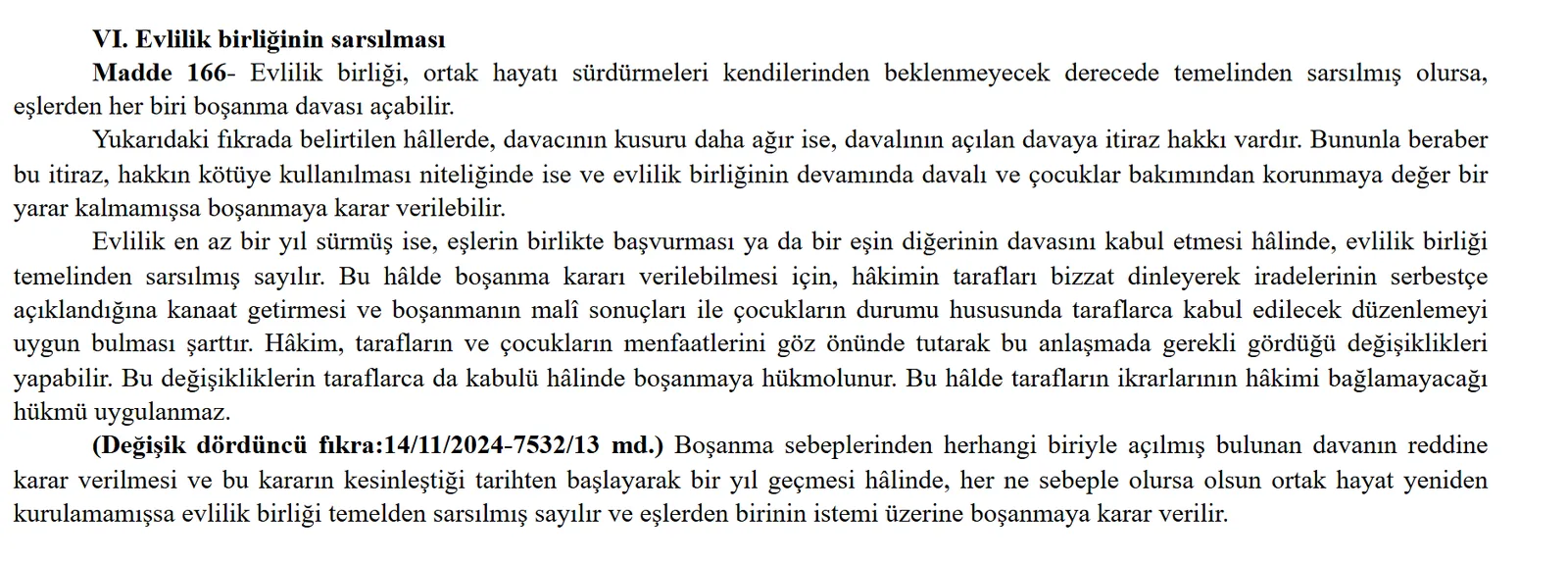
An uncontested divorce is the fastest route to a divorce in Turkey. Under Article 166/3 of the Turkish Civil Code, if the marriage has lasted at least one year and the spouses apply together, or one spouse accepts the other's case, the marriage is deemed irretrievably broken down. The judge does not examine fault. Instead, the judge must be satisfied that both spouses expressed their will freely and must approve the agreement on the financial consequences of divorce and the arrangements for the children.
Requirements for an Uncontested Divorce in Turkey
| Requirement | What it means in practice |
|---|---|
| Marriage of at least one year | Counted from the date of marriage to the filing of the case |
| Joint application or acceptance | Both spouses sign the petition, or the respondent accepts the claim |
| Written protocol | A settlement covering alimony, compensation, property and children |
| Personal hearing | The judge hears both spouses in person to confirm free will |
| Judicial approval | The judge may amend the protocol in the interests of the spouses and children; the amendments must be accepted by both |
What the Divorce Protocol Must Cover
The protocol (anlaşmalı boşanma protokolü) is the heart of an uncontested divorce. It should clearly settle custody and contact with children, child support, any alimony between the spouses, material and moral compensation (or a mutual waiver), division of property and household goods, and who keeps which bank accounts, vehicles and real estate. Vague wording is the most common reason for a judge to ask for amendments. You can see the structure in our sample uncontested divorce protocol.
For foreign spouses, the protocol must be prepared in Turkish. If you do not read Turkish well, insist on a translation you understand before signing: the protocol will bind you once the judgment becomes final.
Do Both Spouses Have to Attend the Hearing?
Yes. Article 166/3 requires the judge to hear the spouses in person ("bizzat dinleyerek"). A lawyer can prepare and file the case and attend with you, but cannot replace your personal statement in an uncontested divorce. A spouse who does not speak Turkish is heard with the help of an interpreter. If you live abroad, plan to be in Turkey for the hearing date.
How Long Does an Uncontested Divorce Take in Turkey?
An uncontested divorce is usually decided at a single hearing. How soon that hearing takes place depends on the family court's workload; in busy courthouses in Istanbul it can be a matter of weeks or a few months. After the judgment, the decision must become final (kesinleşme) before it is registered with the civil registry. In practice, where both spouses waive their right of appeal at the hearing, finality can follow much sooner than in contested cases.
Contested Divorce in Turkey: Grounds Under the Turkish Civil Code
If the spouses cannot agree, or the marriage has lasted less than a year, the divorce proceeds as a contested case. Where Turkish law applies, the petitioner must prove one of the grounds set out in the Civil Code:
| Ground | Article | Time limits and conditions |
|---|---|---|
| Adultery | Art. 161 | Within six months of learning of it and in any case within five years; no claim if forgiven |
| Attempt on life, very bad treatment or seriously humiliating conduct | Art. 162 | Within six months of learning of it and in any case within five years; no claim if forgiven |
| Crime or dishonourable life | Art. 163 | May be filed at any time if living together can no longer be expected |
| Abandonment | Art. 164 | At least six months of separation, plus a formal warning by a judge or notary that remained without result |
| Mental illness | Art. 165 | Incurability confirmed by an official medical board report |
| Irretrievable breakdown | Art. 166/1 | The general ground; most contested divorces are based on it |
| No reunion after a rejected divorce case | Art. 166/4 | One year after the rejection becomes final (since the 2024 amendment) |
Irretrievable Breakdown of the Marriage (Article 166)
Most contested divorces in Turkey are filed on the ground that the marriage has broken down so fundamentally that the spouses cannot be expected to continue their life together. The court examines the events that led to the breakdown and the degree of fault of each spouse, because fault affects compensation and alimony. Witness statements, messages, photographs, medical reports and police records are the usual evidence.
The 2024 Change: Divorce One Year After a Rejected Case
An important recent change is often missing from English-language guides. With Law No. 7532, published in November 2024, the fourth paragraph of Article 166 was amended: if a divorce case filed on any ground is rejected and one year passes from the date the rejection becomes final without the couple resuming life together, the marriage is deemed irretrievably broken down and the court grants a divorce at the request of either spouse. The period was previously three years.
How Long Does a Contested Divorce Take in Turkey?
A contested divorce involves an exchange of petitions, a preliminary hearing, the hearing of witnesses and, where necessary, expert reports on children or finances. At first instance this commonly takes one to two years, sometimes longer, and an appeal to the regional court of appeal (istinaf) and then to the Court of Cassation (temyiz) can add a further period. Serving documents on a spouse who lives abroad is a frequent source of delay.
| Question | Uncontested divorce | Contested divorce |
|---|---|---|
| Minimum marriage length | One year | None |
| Proof of fault | Not required | Required for the ground and for compensation |
| Number of hearings | Usually one | Several |
| Personal attendance | Required for both spouses | Lawyer can represent; personal attendance may be needed for statements |
| Typical duration | Weeks to a few months | Often one to two years at first instance, plus appeals |
Child Custody in a Turkish Divorce Involving Foreigners
Where a divorce involves children, the court decides on custody (velayet), contact arrangements and child support. The guiding principle is the child's best interests, particularly health, education and moral development (Civil Code Art. 182). Under MÖHUK Article 14/3, custody questions arising in the divorce follow the same law as the divorce itself.
The parent who does not receive custody is entitled to personal contact with the child and must contribute to the child's care and education expenses in proportion to their means (Civil Code Art. 182). Turkish courts have in recent years also accepted joint custody in some cases where both parents agree and it serves the child's interests; whether it is appropriate depends on the facts.
Taking a Child Abroad After Divorce: The Hague Convention
For international families the biggest fear is often that one parent will take the child to another country. Turkey is a party to the 1980 Hague Convention on the Civil Aspects of International Child Abduction, implemented by Law No. 5717. The Ministry of Justice acts as the central authority. If a child is wrongfully removed from, or retained outside, the country of their habitual residence in breach of custody rights, an application can be made for the child's return. During a divorce, a court may also order interim measures to protect the child, and parents should not relocate abroad with a child without the other parent's consent or a court decision.
Alimony and Compensation in a Turkish Divorce
Where Turkish law applies, the following financial claims are available. For foreign couples, remember that alimony between divorced spouses follows the law governing the divorce (MÖHUK Art. 14/2), while other maintenance claims generally follow the law of the creditor's habitual residence (Art. 19).
| Claim | Article | Purpose |
|---|---|---|
| Interim maintenance (tedbir nafakası) | Art. 169 | Support for a spouse and children while the case continues |
| Poverty alimony (yoksulluk nafakası) | Art. 175 | For a spouse who would fall into poverty because of the divorce, provided their fault is not heavier |
| Child support (iştirak nafakası) | Art. 182 | The non-custodial parent's contribution to the child's care and education |
| Material compensation | Art. 174/1 | For the less or non-faulty spouse whose existing or expected interests are harmed |
| Moral compensation | Art. 174/2 | For a spouse whose personality rights were attacked by the events leading to divorce |
Poverty alimony under Article 175 is granted without a fixed time limit, although it can later be increased, reduced or ended if circumstances change. For a general explanation of these terms, see alimony (nafaka) in our glossary.
Division of Property in a Divorce in Turkey
Property division follows the law governing the matrimonial property regime, which is determined separately from the divorce law. Under MÖHUK Article 15, spouses may choose the law of their habitual residence or of either spouse's nationality at the time of marriage. If they made no choice, their common national law at the time of marriage applies, then their common habitual residence, and otherwise Turkish law. For the liquidation of immovable property, the law of the country where it is located applies (Art. 15/2), so an apartment in Istanbul is liquidated under Turkish law even if the rest of the regime is foreign.
Where Turkish law governs, the statutory regime is participation in acquired property (Civil Code Art. 202), in force since 1 January 2002. Broadly, assets acquired for consideration during the marriage are shared, while personal assets such as property owned before the marriage and inheritances are excluded. Each spouse is entitled to half of the net value of the other's acquired property, known as the participation claim.
| Asset | Typical classification under Turkish law |
|---|---|
| Apartment bought during the marriage with salary income | Acquired property: shared through the participation claim |
| Apartment owned before the marriage | Personal property: not shared (but added value claims may arise) |
| Inheritance received during the marriage | Personal property |
| Savings from salaries during the marriage | Acquired property |
| Wedding jewellery given to the bride | Generally treated as the wife's personal property (see wedding jewellery claims) |
You can form a first estimate with our divorce asset division calculator. For specific situations, see our guides on the division of a mortgaged home in divorce and on fraudulent transfers before divorce.
Documents Foreigners Need for a Divorce in Turkey
| Document | Notes for foreign nationals |
|---|---|
| Marriage certificate | If issued abroad: apostille (or consular legalisation) plus a certified Turkish translation |
| Passport and residence permit | Your foreigner identification number (starting with 99) is used in court records |
| Children's birth certificates | Apostilled and translated if issued abroad |
| Proof of address in Turkey | Address registration supports the court's jurisdiction |
| Power of attorney for your lawyer | Must expressly authorise divorce proceedings (see below) |
| Protocol (uncontested) or evidence (contested) | Messages, witness details, financial records, medical or police reports |
Power of Attorney for a Divorce Case From Abroad
Divorce is a right strictly attached to the person. Under Article 74 of the Code of Civil Procedure, a lawyer cannot bring or pursue such cases unless the power of attorney expressly authorises it. A general power of attorney is therefore not enough: it must specifically mention divorce proceedings. If you are abroad, you can sign the power of attorney at a Turkish consulate, or before a local notary with an apostille and a certified Turkish translation.
Getting Divorced in Turkey While Living Abroad
Living outside Turkey does not rule out a Turkish divorce, but the route matters. In a contested divorce, your lawyer can conduct the case on your behalf, and you may only need to travel if the court requires your personal statement. In an uncontested divorce, both spouses must be heard in person, so at least one trip to Turkey is needed.
If the respondent spouse lives abroad, court documents must be served through international channels, usually via the Ministry of Justice under the applicable conventions or bilateral agreements. This can take several months per round of service and is the single biggest factor in the length of cross-border divorces. Where a spouse's address is genuinely unknown, service by public notice is possible after an address search.
What Happens to Your Residence Permit After a Divorce in Turkey?
A foreigner married to a Turkish citizen usually lives in Turkey on a family residence permit that depends on the marriage. Divorce ends the basis of that permit. Article 34 of the Law on Foreigners and International Protection (Law No. 6458) offers a way to stay:

| Situation | Residence option under Article 34 |
|---|---|
| Divorced from a Turkish citizen after at least three years on a family permit | May be granted a short-term residence permit (Art. 34/6) |
| Victim of domestic violence, established by a court decision | The three-year condition does not apply (Art. 34/6) |
| Death of the sponsoring spouse | Short-term permit may be granted without a time condition (Art. 34/7) |
| Child who held a family permit for at least three years and turned 18 | May convert to a short-term permit (Art. 34/5) |
Because these permits "may be granted" rather than being automatic, apply before your current permit expires. For work permits, citizenship or deportation questions, see our immigration lawyer in Istanbul page.
Domestic Violence and Protection Orders for Foreign Spouses
Law No. 6284 on the Protection of the Family and Prevention of Violence Against Women protects anyone in Turkey who is subjected to, or at risk of, violence. It does not limit its protection to Turkish citizens. Protective measures such as removal of the violent spouse from the home, a restraining order or a ban on contact can be requested from the family court or through the police and public prosecutor, independently of the divorce case. As noted above, a court decision establishing domestic violence also removes the three-year condition for a residence permit after divorce.
Will a Turkish Divorce Be Recognised in My Home Country?
A divorce granted in Turkey is a judgment of a Turkish court. To be effective in your home country, it usually has to be recognised or registered there under that country's rules. You will typically need the final judgment with a certificate of finality (kesinleşme şerhi), an apostille and a translation. Some countries register foreign divorces administratively, while others require a court procedure. Check the requirements with your home country's authorities before the case ends, so that the judgment and annotations are issued in the form you need.
Remarriage After a Divorce in Turkey
For Turkish citizens, Article 132 of the Civil Code provides that a woman may not remarry until 300 days have passed from the end of the marriage, unless she gives birth or the court lifts the waiting period, for example on proof that she is not pregnant or where the former spouses wish to remarry each other. For foreign nationals, the conditions for marriage are governed by each party's national law (MÖHUK Art. 13/1), so the waiting period may apply differently. Ask before you set a wedding date in Turkey.
Costs of a Divorce in Turkey
The costs of a divorce in Turkey consist of court fees and advances for service and hearings, expert fees where the court orders reports on children or finances, translation and apostille costs for foreign documents, and lawyer's fees. Lawyer's fees in Turkey may not be lower than the minimum fee tariff set each year by the Union of Turkish Bar Associations. An uncontested divorce with a well-prepared protocol is considerably cheaper than a contested case that requires expert reports and service abroad.
Common Mistakes Foreigners Make in a Turkish Divorce
- Assuming Turkish law will apply: Two nationals of the same foreign country are divorced under their own national law (MÖHUK Art. 14).
- Using a general power of attorney: Divorce requires an express authorisation (Code of Civil Procedure Art. 74).
- Signing a Turkish protocol you do not fully understand: Once final, it binds you on alimony, property and children.
- Relying on an uncontested divorce without planning to attend: The judge must hear both spouses in person.
- Forgetting the residence permit: Divorce ends a family permit; apply for a new permit in time.
- Moving abroad with the children during the case: This can have serious consequences under the Hague Convention and in the custody decision.
- Ignoring property abroad and in Turkey: Real estate in Turkey is liquidated under Turkish law even if another law governs the rest of the regime.
Divorce Lawyer in Ankara and Istanbul: Where Your Case Is Heard
The city of the case follows Article 168 of the Civil Code: where either spouse lives or where the spouses last lived together for at least six months. If your spouse lives in Ankara and you live in Istanbul, the case may be filed in either city. A divorce lawyer in Turkey registered with a Turkish bar can appear before family courts in all cities, so the same lawyer can follow the case in Istanbul or Ankara.
We act as a divorce lawyer in Istanbul and before the family courts in Ankara for foreign clients, including those living abroad. See our English-speaking divorce lawyer in Istanbul page, Recognition of a Foreign Divorce in Turkey if you divorced abroad, and Division of a Mortgaged Home in Divorce for property questions.
Conclusion
Divorce in Turkey for foreigners is entirely possible, but it is not simply a Turkish divorce with a translator. The court first checks jurisdiction, then applies the law chosen by MÖHUK Article 14, which may be your home country's law. An uncontested divorce is fast but requires a year of marriage, a clear protocol in Turkish and personal attendance. A contested divorce depends on evidence and can take much longer, especially when a spouse lives abroad. Plan ahead for custody, property, your residence permit and recognition of the judgment in your home country. For representation before Turkish family courts, see our divorce lawyer in Istanbul and Ankara page, and for courthouse details our Istanbul courthouse guide.
Sources
- Law No. 5718 on Private International and Procedural Law (MÖHUK) (Arts. 2, 4, 13, 14, 15, 19, 40, 41)
- Turkish Civil Code No. 4721 (Arts. 132, 161-169, 174, 175, 182, 202)
- Code of Civil Procedure No. 6100 (Art. 74)
- Law No. 6458 on Foreigners and International Protection (Art. 34)
- Law No. 5717 implementing the Hague Child Abduction Convention
- Law No. 6284 on the Protection of the Family and Prevention of Violence Against Women
- HCCH: Child Abduction Section (1980 Hague Convention)
Frequently Asked Questions
Can foreigners get divorced in Turkey?
Yes. A Turkish family court can dissolve the marriage of foreign nationals if it has jurisdiction, which exists when one spouse is domiciled in Turkey or the spouses lived together in Turkey for the last six months before filing (Turkish Civil Code Art. 168, applied through MÖHUK Art. 40).
Can two foreigners who married abroad divorce in Turkey?
Yes, if the Turkish court has jurisdiction. A marriage concluded abroad in the form required by the law of that country is valid in Turkey (MÖHUK Art. 13/2). The court will ask for the foreign marriage certificate with an apostille and a certified Turkish translation.
Which law applies to a divorce of foreigners in Turkey?
Under MÖHUK Article 14, the spouses' common national law applies. If their nationalities differ, the law of their common habitual residence applies, and otherwise Turkish law. So two German nationals divorcing in Istanbul are divorced under German law, while a British-Russian couple living in Turkey is divorced under Turkish law.
How long does an uncontested divorce take in Turkey?
An uncontested divorce is usually decided at a single hearing. Depending on the family court's workload, the hearing can take place within weeks or a few months of filing. If both spouses waive their right of appeal, the judgment can become final much sooner than in a contested case.
What are the requirements for an uncontested divorce in Turkey?
The marriage must have lasted at least one year, the spouses must apply together or one must accept the other's case, and they must agree on a protocol covering alimony, compensation, property and children. The judge must hear both spouses in person and approve the protocol (Turkish Civil Code Art. 166/3).
Do I have to attend the hearing for an uncontested divorce in Turkey?
Yes. Article 166/3 of the Turkish Civil Code requires the judge to hear both spouses in person to confirm that they expressed their will freely. A lawyer cannot replace your personal statement. A spouse who does not speak Turkish is heard through an interpreter.
How long does a contested divorce take in Turkey?
A contested divorce commonly takes one to two years at first instance, sometimes longer, and appeals to the regional court of appeal and the Court of Cassation can add further time. Serving documents on a spouse who lives abroad is one of the main causes of delay.
What are the grounds for divorce in Turkey?
Where Turkish law applies, the grounds are adultery (Art. 161), attempt on life or very bad or humiliating treatment (Art. 162), crime or dishonourable life (Art. 163), abandonment (Art. 164), incurable mental illness (Art. 165) and irretrievable breakdown of the marriage (Art. 166). Most contested divorces are based on irretrievable breakdown.
What changed in Turkish divorce law in 2024?
Law No. 7532 amended Article 166/4 of the Civil Code. If a divorce case is rejected and one year passes from the date the rejection becomes final without the spouses resuming life together, the court grants a divorce at the request of either spouse. The period was previously three years.
Can I get divorced in Turkey if my spouse lives abroad?
Yes, if the Turkish court has jurisdiction. The court documents must be served on your spouse abroad through international channels, usually via the Ministry of Justice, which can take several months. In an uncontested divorce, both spouses must still attend the hearing in person.
Can a lawyer handle my divorce in Turkey without me?
In a contested divorce, a lawyer can conduct the case on your behalf, but the power of attorney must expressly authorise divorce proceedings (Code of Civil Procedure Art. 74). In an uncontested divorce, the judge must hear you personally, so you need to attend the hearing.
How do I give power of attorney to a Turkish lawyer from abroad?
You can sign the power of attorney at a Turkish consulate, or before a local notary with an apostille and a certified Turkish translation. It must specifically authorise divorce proceedings; a general power of attorney is not sufficient.
Who gets custody of the children in a Turkish divorce?
The court decides custody based on the child's best interests, particularly health, education and moral development (Civil Code Art. 182). The other parent receives contact rights and must contribute to the child's care and education expenses. Turkish courts have also accepted joint custody in some cases where both parents agree.
Can my ex-spouse take our child out of Turkey after divorce?
Relocating a child abroad without the other parent's consent or a court decision can amount to wrongful removal. Turkey is a party to the 1980 Hague Child Abduction Convention, implemented by Law No. 5717, with the Ministry of Justice as the central authority for return applications.
What types of alimony exist in Turkey?
Interim maintenance during the case (Art. 169), poverty alimony for a spouse who would fall into poverty because of the divorce (Art. 175) and child support paid by the non-custodial parent (Art. 182). Material and moral compensation may also be awarded (Art. 174).
How is property divided in a divorce in Turkey?
The matrimonial property regime is determined under MÖHUK Article 15. Where Turkish law applies, the statutory regime is participation in acquired property: each spouse is entitled to half of the net value of the other's property acquired during the marriage, while personal property is excluded. Real estate in Turkey is always liquidated under Turkish law.
What documents does a foreigner need to divorce in Turkey?
Typically the marriage certificate (apostilled and translated if issued abroad), passport and residence permit, children's birth certificates, proof of address in Turkey, a power of attorney expressly authorising divorce if a lawyer is used, and either the settlement protocol or the evidence supporting a contested claim.
What happens to my residence permit if I divorce my Turkish spouse?
Divorce ends the basis of a family residence permit. Under Article 34/6 of Law No. 6458, a foreign spouse who held a family permit for at least three years may be granted a short-term residence permit. If the foreign spouse is a victim of domestic violence established by a court decision, the three-year condition does not apply.
Is mediation required before divorce in Turkey?
No. There is no mandatory mediation step before filing a divorce case in Turkey. The spouses can of course negotiate a settlement and file an uncontested divorce based on their agreement.
Will my Turkish divorce be recognised abroad?
A Turkish divorce judgment usually needs to be recognised or registered in your home country under its own rules. You will generally need the final judgment with a certificate of finality, an apostille and a translation. Check your home country's requirements before the case ends.
Can I remarry immediately after a divorce in Turkey?
For Turkish citizens, Article 132 of the Civil Code imposes a 300-day waiting period on a woman before remarrying, which ends with childbirth or can be lifted by the court. For foreign nationals, marriage conditions are governed by each party's national law (MÖHUK Art. 13/1), so the waiting period may apply differently.
How much does a divorce cost in Turkey?
Costs include court fees and advances, expert fees if reports are ordered, translation and apostille costs for foreign documents, and lawyer's fees, which may not be lower than the annual minimum fee tariff of the Union of Turkish Bar Associations. An uncontested divorce is considerably cheaper than a contested one.
Can I hire a divorce lawyer in Istanbul if my spouse lives in Ankara?
Yes. The case may be filed where either spouse lives or where you last lived together for six months, so it may be in Istanbul or Ankara. A lawyer registered with a Turkish bar can appear before all family courts in Turkey, so a divorce lawyer in Istanbul can also handle a case heard by a divorce lawyer in Ankara's courts.
- divorce in Turkey for foreigners
- divorce in Turkey
- uncontested divorce Turkey
- contested divorce Turkey
- divorce lawyer in Turkey
- Turkish divorce law
- foreign marriage divorce Turkey
- child custody Turkey
- alimony in Turkey
- Hague Convention Turkey
- residence permit after divorce Turkey
- Istanbul divorce lawyer
- divorce for foreigners Turkey 2026
- which law applies divorce Turkey
- MÖHUK Article 14
- Turkish Civil Code Article 166
- divorce protocol Turkey
- how long does divorce take in Turkey
- divorce in Turkey married abroad
Our services in this area
Family Law