Recognition of a Foreign Divorce in Turkey (2026): Civil Registry Route and Court Recognition (Tanıma)
Divorced abroad but still married in the Turkish registry? The registry route under Article 27/A, court recognition (tanıma) under MÖHUK Article 58, the conditions, documents, timing and what to do about alimony and custody orders.
You were divorced in Germany, the United Kingdom, the United States or another country, but the Turkish civil registry still shows you as married. This is one of the most common situations Turkish citizens abroad, and their foreign spouses, run into. A foreign divorce does not automatically change your status in Turkey. It must first be registered or recognised under Turkish law before it has legal effect here.
This guide explains the recognition of a foreign divorce in Turkey in practical terms. It covers the faster civil registry route introduced in 2017, the court route known as tanıma, the conditions Turkish courts check, the documents you need, how long it takes, and what to do about custody and alimony orders contained in a foreign judgment.
If you have a matter on this topic:
Why You Need Recognition of a Foreign Divorce in Turkey
A divorce granted abroad is valid in the country where it was granted. In Turkey, however, it has no effect as a final judgment until it is registered under Article 27/A of the Civil Registry Services Law (Law No. 5490) or recognised by a Turkish court under Article 58 of the Private International and Procedural Law Act (Law No. 5718, MÖHUK). Until then, a Turkish citizen continues to appear as married in the Turkish civil registry (nüfus kütüğü).
| Your situation | Do you need recognition in Turkey? | Why |
|---|---|---|
| Turkish citizen divorced abroad | Yes | Your registry record shows you as married until the divorce is registered |
| Turkish citizen wishing to remarry (in Turkey or at a Turkish consulate) | Yes | A new marriage cannot be concluded while the registry shows an existing marriage |
| Divorce affects property or inheritance in Turkey | Yes | Title deed offices, courts and heirs rely on the Turkish registry |
| Two foreigners divorced abroad, no ties to Turkey | Usually no | The divorce has no need to produce effects in Turkey |
| Foreigner divorced abroad who wants to marry in Turkey or rely on the divorce before Turkish authorities | Often yes | Turkish authorities may require a recognised or registered divorce |
Two Routes: Civil Registry Registration or Court Recognition
Since 2017 there have been two ways to give effect to a foreign divorce in Turkey. The registry route is simpler and faster but has strict conditions. The court route is available in every case.
| Question | Registry route (Art. 27/A) | Court route: tanıma (MÖHUK Art. 58) |
|---|---|---|
| Who applies? | Both spouses together, or the Turkish spouse alone if the other is foreign or deceased | Either spouse, as claimant, against the other |
| Where? | Turkish consulate in the country of the decision, or a designated registry office in Turkey | Turkish family court |
| Court hearing? | No | Yes, under the simple procedure |
| Typical speed | Faster | Slower; longer if the other spouse must be served abroad |
| If it fails | Go to the court route (Art. 27/A-3) | Appeal to the regional court of appeal |
Registering a Foreign Divorce Without a Court Case (Article 27/A)
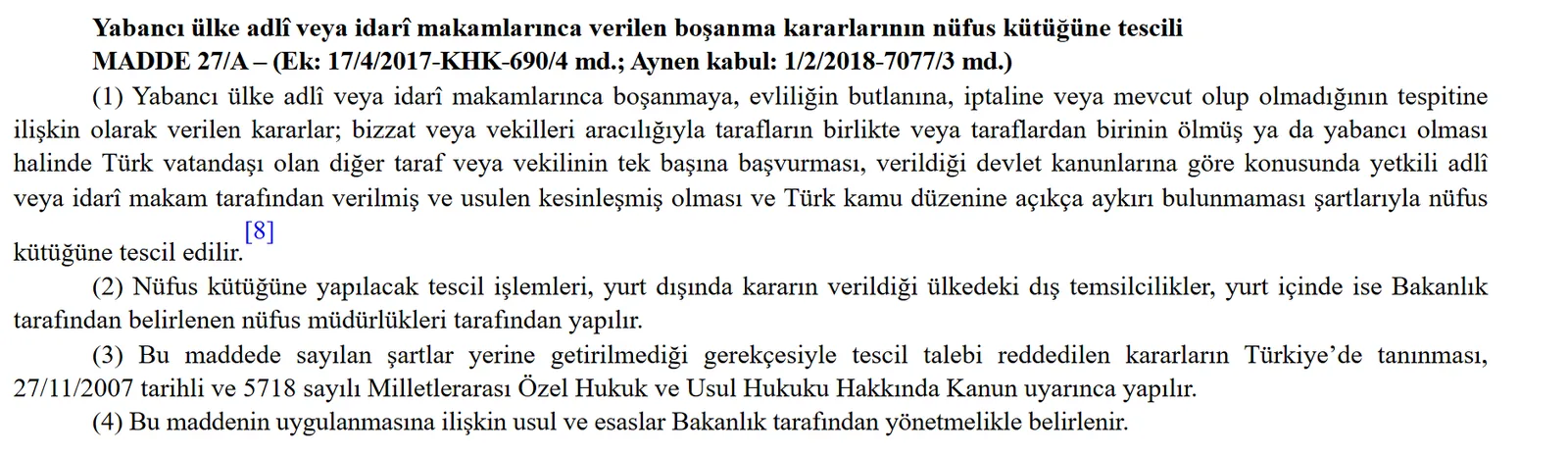
Article 27/A was added to the Civil Registry Services Law in 2017 and confirmed by Law No. 7077 in 2018. It allows decisions of foreign judicial or administrative authorities on divorce, annulment or the existence of a marriage to be entered directly in the Turkish civil registry, without a lawsuit.
Conditions of the Registry Route
| Condition | What it means |
|---|---|
| Joint application | Both spouses apply together, in person or through their attorneys |
| Exception: single application | If the other spouse is deceased or is a foreign national, the Turkish citizen spouse (or their attorney) can apply alone |
| Competent authority | The decision was given by the judicial or administrative authority competent under that country's law |
| Finality | The decision has become final (res judicata) under that country's law |
| Public order | The decision is not clearly contrary to Turkish public order |
The single-application exception is especially useful in mixed marriages: a Turkish citizen who divorced a German, British or Russian spouse abroad can register the divorce alone, without needing the former spouse's cooperation.
Where to Apply: Consulates Abroad or Registry Offices in Turkey
Abroad, the application is made at the Turkish consulate or embassy in the country where the divorce was granted. In Turkey, it is made at the civil registry offices designated by the Ministry of the Interior. Contact the relevant consulate or registry office beforehand: they will confirm the documents, translations and appointment procedure they apply.
When the Registry Route Is Not Available
If the spouses cannot apply jointly (for example, both are Turkish citizens and one refuses to cooperate), if the decision is not final, or if the authority considers it contrary to public order, the application is refused. In that case, Article 27/A-3 directs you to court recognition under MÖHUK.
Court Recognition of a Foreign Divorce in Turkey (Tanıma)
Under MÖHUK Article 58, a foreign court judgment can be accepted as conclusive evidence or as res judicata in Turkey only once a Turkish court has established that it meets the conditions for enforcement. For divorce judgments, this is the recognition case (tanıma davası), filed by one former spouse against the other.
Which Court Hears a Recognition Case?
The family court (aile mahkemesi), as the first-instance court for family matters, hears the recognition of foreign divorce judgments. Territorial jurisdiction follows MÖHUK Article 51: the court of the respondent's domicile in Turkey, failing that their place of residence, and if the respondent has neither in Turkey, one of the courts in Ankara, Istanbul or Izmir. This is why most recognition cases for spouses living abroad are filed in these three cities. Practical details for each courthouse are in our Istanbul, Ankara and Izmir court guides.
Conditions for Recognition: MÖHUK Article 54
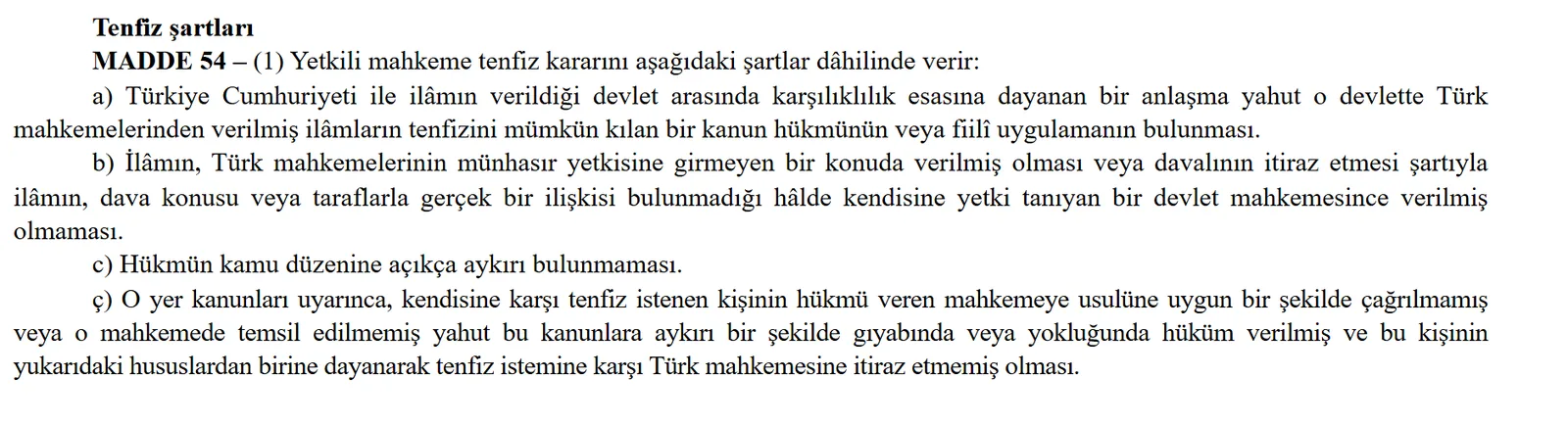
The court examines the conditions listed in Article 54, except the reciprocity requirement in paragraph (a):
| Condition | What the Turkish court checks | Common problem |
|---|---|---|
| Final foreign judgment | Proof that the judgment is final under the foreign law | Missing certificate of finality |
| No exclusive Turkish jurisdiction; genuine connection | The foreign court had a real connection with the case or the parties | Divorce obtained in a country neither spouse had ties to (if the respondent objects) |
| Not clearly contrary to Turkish public order | The result, not every detail of the foreign procedure | Unilateral divorces without any procedure for the other spouse |
| Right to be heard | The respondent was properly summoned or represented | Default judgments where the spouse was never properly notified, if the spouse objects on this ground |
No Reciprocity Needed for Recognition
Article 58 states expressly that the reciprocity condition does not apply to recognition. It does not matter whether the foreign country would recognise Turkish judgments. A divorce from almost any country can therefore be recognised in Turkey if the other conditions are met.

Recognition vs Enforcement (Tanıma vs Tenfiz)
Recognition gives the divorce itself effect in Turkey. If the foreign judgment also orders one spouse to pay alimony or a lump sum, and you want to collect that money through Turkish enforcement offices, you need enforcement (tenfiz) under MÖHUK Article 50. Enforcement additionally requires reciprocity between Turkey and the country of the judgment (Art. 54/a): a treaty, a statutory provision or actual practice enabling Turkish judgments to be enforced there. A single case can request both recognition of the divorce and enforcement of the financial orders.
Documents Required for Recognition of a Foreign Divorce in Turkey
| Document | Registry route | Court route |
|---|---|---|
| Original or certified copy of the foreign divorce decision | Yes | Yes (MÖHUK Art. 53/a) |
| Proof that the decision is final | Yes | Yes (Art. 53/b) |
| Apostille or consular legalisation | Yes | Yes |
| Certified Turkish translation of all documents | Yes | Yes |
| Passports or Turkish ID cards | Yes | Yes |
| Power of attorney (if using a lawyer) | If applying through an attorney | If represented by a lawyer |
| Other spouse's address | Not needed for a single application | Needed for service of the petition |
Apostille and Certified Translation
For countries that are party to the 1961 Hague Apostille Convention, the competent authority of that country adds an apostille to the decision and to the finality certificate. For other countries, consular legalisation is required. The documents are then translated into Turkish by a sworn translator and the translation is certified by a Turkish notary, or the translation is done and certified through the Turkish consulate.
Power of Attorney for a Recognition Case From Abroad
You do not have to travel to Turkey for a court recognition case: a lawyer can conduct it on your behalf. The power of attorney can be signed at a Turkish consulate, or before a foreign notary with an apostille and a certified translation. Because the case concerns personal status, the power of attorney should expressly mention recognition (tanıma) proceedings.
The Recognition Procedure Step by Step
| Step | What happens |
|---|---|
| Collect documents | Decision, finality certificate, apostilles, certified translations |
| Choose the route | Registry route if a joint or single application is possible; otherwise court |
| File the petition | At the competent family court, naming the former spouse as respondent |
| Service | The petition and hearing date are served on the respondent (MÖHUK Art. 55) |
| Hearing | Examined under the simple procedure; the respondent can object only on the limited grounds in Art. 55/2 |
| Judgment and finality | After finality, the court notifies the civil registry and your status is updated |
How Long Does Recognition of a Foreign Divorce Take in Turkey?
The registry route is usually the quickest, because there is no hearing. A court recognition case is decided under the simple procedure and, where the respondent lives in Turkey or accepts the case, can often be concluded within a few months. The main source of delay is service on a respondent who lives abroad, which goes through international judicial assistance channels and can take many months. If the respondent's address is unknown, service by public notice is possible after an address search.
Special Situations
Divorces Granted by Administrative Authorities or by Mutual Consent
In some countries a divorce by mutual consent is registered by an administrative office rather than a court. Article 27/A expressly covers decisions of foreign administrative authorities, so these divorces can also be registered through the registry route if the other conditions are met.
Unilateral and Religious Divorces
Where a divorce was pronounced unilaterally without any procedure in which the other spouse could be heard, recognition may be refused on public-order grounds or because of the right to be heard. Each case turns on how the divorce was obtained and on the other spouse's position. A religious ceremony alone, without a decision of a competent state authority, is not a divorce decision that can be registered or recognised.
Foreign Judgments Ordering Custody and Alimony
Custody and contact provisions are recognised together with the divorce, but custody can later be modified by a Turkish court if circumstances change and the child lives in Turkey. For cross-border child abduction concerns, see our guide on divorce in Turkey for foreigners, which covers the Hague Convention. Alimony orders need enforcement (tenfiz) to be collected in Turkey.
When the Former Spouse Has Died
If the former spouse has died, the surviving Turkish citizen spouse can use the registry route alone (Art. 27/A). Registration matters for inheritance: until the divorce is entered in the registry, the surviving spouse may appear as a statutory heir of the deceased.
When Both Spouses Are Turkish Citizens
If both former spouses are Turkish citizens, the registry route requires a joint application. If one refuses, the other must file a court recognition case.
Effects of Recognition: From When Is the Divorce Valid in Turkey?
Under MÖHUK Article 59, the res judicata or conclusive-evidence effect of a recognised foreign judgment runs from the date the foreign judgment became final, not from the date of the Turkish decision. Once registered, your civil registry record shows you as divorced, you can remarry, and the divorce can be relied on before title deed offices, courts and other authorities in Turkey.
Common Mistakes
- Assuming a foreign divorce automatically applies in Turkey: Registration or recognition is required first.
- Filing a court case when the registry route was available: The single-application exception covers many mixed marriages.
- Missing the finality certificate: A decision without proof of finality can be neither registered nor recognised.
- Forgetting the apostille on the finality certificate: Both the decision and the finality document need it.
- Using a general power of attorney: Recognition proceedings should be expressly mentioned.
- Expecting recognition to collect alimony: Collecting money in Turkey requires enforcement (tenfiz) and reciprocity.
Divorce Lawyer in Istanbul and Ankara for Recognition Cases
A recognition case is filed where the other party lives or resides in Turkey; if they have no domicile or residence in Turkey, it may be filed before the courts of Ankara, Istanbul or Izmir (Article 51 of the Private International Law Act). For foreigners and Turkish citizens living abroad, the case is therefore often heard in Istanbul or Ankara. A divorce lawyer in Turkey can bring the case on the basis of a power of attorney issued at a Turkish consulate, without the client travelling.
We handle recognition cases as a divorce lawyer in Istanbul and before the family courts in Ankara. See our divorce lawyer in Turkey page, and Divorce in Turkey for Foreigners if the divorce itself is still to be filed.
Conclusion
A foreign divorce has no effect in Turkey until it is registered under Article 27/A of the Civil Registry Services Law or recognised by a Turkish family court under MÖHUK Article 58. The registry route is quicker and often available in mixed marriages through a single application. The court route is always possible and does not require reciprocity, but service on a spouse abroad can make it slow. Prepare the decision, the finality certificate, apostilles and certified translations carefully, and decide early whether you also need enforcement of financial orders. For representation before Turkish family courts, see our divorce lawyer in Istanbul and Ankara page.
Sources
Frequently Asked Questions
Is a foreign divorce valid in Turkey?
A foreign divorce has no effect in Turkey until it is registered in the civil registry under Article 27/A of the Civil Registry Services Law or recognised by a Turkish court under Article 58 of MÖHUK. Until then, a Turkish citizen continues to appear as married in the Turkish registry.
How do I register a foreign divorce in Turkey without a court case?
Under Article 27/A of Law No. 5490, both spouses can apply together, in person or through attorneys, at the Turkish consulate in the country where the divorce was granted or at a designated civil registry office in Turkey. The decision must be final, given by a competent authority and not clearly contrary to Turkish public order.
Can I register my foreign divorce in Turkey alone, without my ex-spouse?
Yes, if your former spouse is a foreign national or has died. In that case the Turkish citizen spouse, or their attorney, can apply alone under Article 27/A. If both former spouses are Turkish citizens, a joint application is required; otherwise a court recognition case is needed.
What is tanıma in Turkish law?
Tanıma is the court recognition of a foreign judgment under MÖHUK Article 58. The Turkish court examines whether the foreign divorce judgment meets the conditions of Article 54, except reciprocity, and if so the judgment is given res judicata effect in Turkey.
Which court handles recognition of a foreign divorce in Turkey?
The family court hears recognition of foreign divorce judgments. Territorial jurisdiction follows MÖHUK Article 51: the respondent's domicile in Turkey, otherwise their residence, and if they have neither in Turkey, one of the courts in Ankara, Istanbul or Izmir.
Is reciprocity required to recognise a foreign divorce in Turkey?
No. MÖHUK Article 58 states that the reciprocity condition in Article 54(a) does not apply to recognition. Reciprocity is only required for enforcement (tenfiz), for example to collect alimony through Turkish enforcement offices.
What are the conditions for recognition of a foreign divorce in Turkey?
The judgment must be final, must not concern a matter within the exclusive jurisdiction of Turkish courts or come from a court without a genuine connection to the case (if the respondent objects), must not be clearly contrary to Turkish public order, and the respondent must have been properly summoned or represented (MÖHUK Art. 54).
What documents are needed to recognise a foreign divorce in Turkey?
The original or a certified copy of the foreign decision, proof that it is final, apostilles or consular legalisation on both, certified Turkish translations, passports or ID cards, and a power of attorney if a lawyer acts for you. For the court route, the former spouse's address is also needed for service.
How long does recognition of a foreign divorce take in Turkey?
The registry route is usually the fastest because there is no hearing. A court recognition case is decided under the simple procedure and can often be concluded within a few months, but serving the petition on a former spouse who lives abroad can add many months.
Do I need to travel to Turkey to have my foreign divorce recognised?
No. The registry route can be done at a Turkish consulate abroad, and a court recognition case can be conducted by a lawyer in Turkey under a power of attorney signed at a consulate or before a foreign notary with an apostille and translation.
What is the difference between tanıma and tenfiz?
Tanıma (recognition) gives the foreign divorce effect as a judgment in Turkey. Tenfiz (enforcement) is needed to execute orders in the judgment, such as alimony or a lump-sum payment, through Turkish enforcement offices, and it additionally requires reciprocity with the country of the judgment.
Can I remarry in Turkey before my foreign divorce is recognised?
No, not if you are a Turkish citizen. As long as the civil registry shows an existing marriage, a new marriage cannot be concluded in Turkey or at a Turkish consulate. The divorce must first be registered or recognised.
From when is a recognised foreign divorce effective in Turkey?
Under MÖHUK Article 59, the effect of a recognised foreign judgment runs from the date the foreign judgment became final, not from the date of the Turkish recognition decision.
Can a divorce granted by an administrative authority abroad be registered in Turkey?
Yes. Article 27/A of the Civil Registry Services Law covers decisions of foreign judicial or administrative authorities on divorce, annulment and the existence of a marriage, provided the other conditions are met.
Will Turkey recognise a religious or unilateral divorce?
A religious ceremony alone, without a decision of a competent state authority, cannot be registered or recognised. A unilateral divorce in which the other spouse had no opportunity to be heard may be refused on public-order grounds or under the right-to-be-heard condition; each case depends on how the divorce was obtained.
What happens if the registry refuses to register my foreign divorce?
Article 27/A-3 provides that decisions refused for failing its conditions are recognised through the court procedure under MÖHUK. You can then file a recognition case at the competent family court.
Does my ex-spouse have to agree to court recognition?
No. The court recognition case is filed against the former spouse, who can object only on the limited grounds in MÖHUK Article 55/2, such as the absence of the recognition conditions.
Are custody decisions in a foreign divorce recognised in Turkey?
Custody and contact provisions are recognised together with the divorce judgment. If the child lives in Turkey and circumstances change, a Turkish court can later be asked to modify custody arrangements.
Why does an unrecognised foreign divorce matter for inheritance?
If the divorce is not entered in the Turkish civil registry, the former spouse may still appear as the deceased's spouse and therefore as a statutory heir in Turkey. Registering or recognising the divorce avoids disputes in inheritance proceedings.
Do two foreigners divorced abroad need recognition in Turkey?
Usually not, unless the divorce has to produce effects in Turkey, for example to marry in Turkey, to deal with property registered in Turkey or to rely on the divorce before Turkish authorities.
Can a divorce lawyer in Istanbul file my recognition case in Ankara?
Yes. A lawyer registered with any Turkish bar can appear before all courts in Turkey. If the other party has no domicile or residence in Turkey, the case may be filed in Ankara, Istanbul or Izmir (Article 51 of the Private International Law Act). A divorce lawyer in Ankara or Istanbul can bring the case with a power of attorney issued at a Turkish consulate, without you travelling to Turkey.
- recognition of foreign divorce Turkey
- tanıma davası
- foreign divorce Turkey
- register foreign divorce Turkey
- Article 27/A civil registry
- MÖHUK Article 58
- tanıma and tenfiz
- enforcement of foreign judgments Turkey
- apostille divorce Turkey
- divorce abroad Turkish citizen
- Turkish consulate divorce registration
- divorce lawyer in Turkey
- recognize foreign divorce in Turkey
- foreign divorce registration Turkish citizen
- MÖHUK Article 54
- recognition case documents Turkey
- how long recognition foreign divorce Turkey
Our services in this area
Family Law