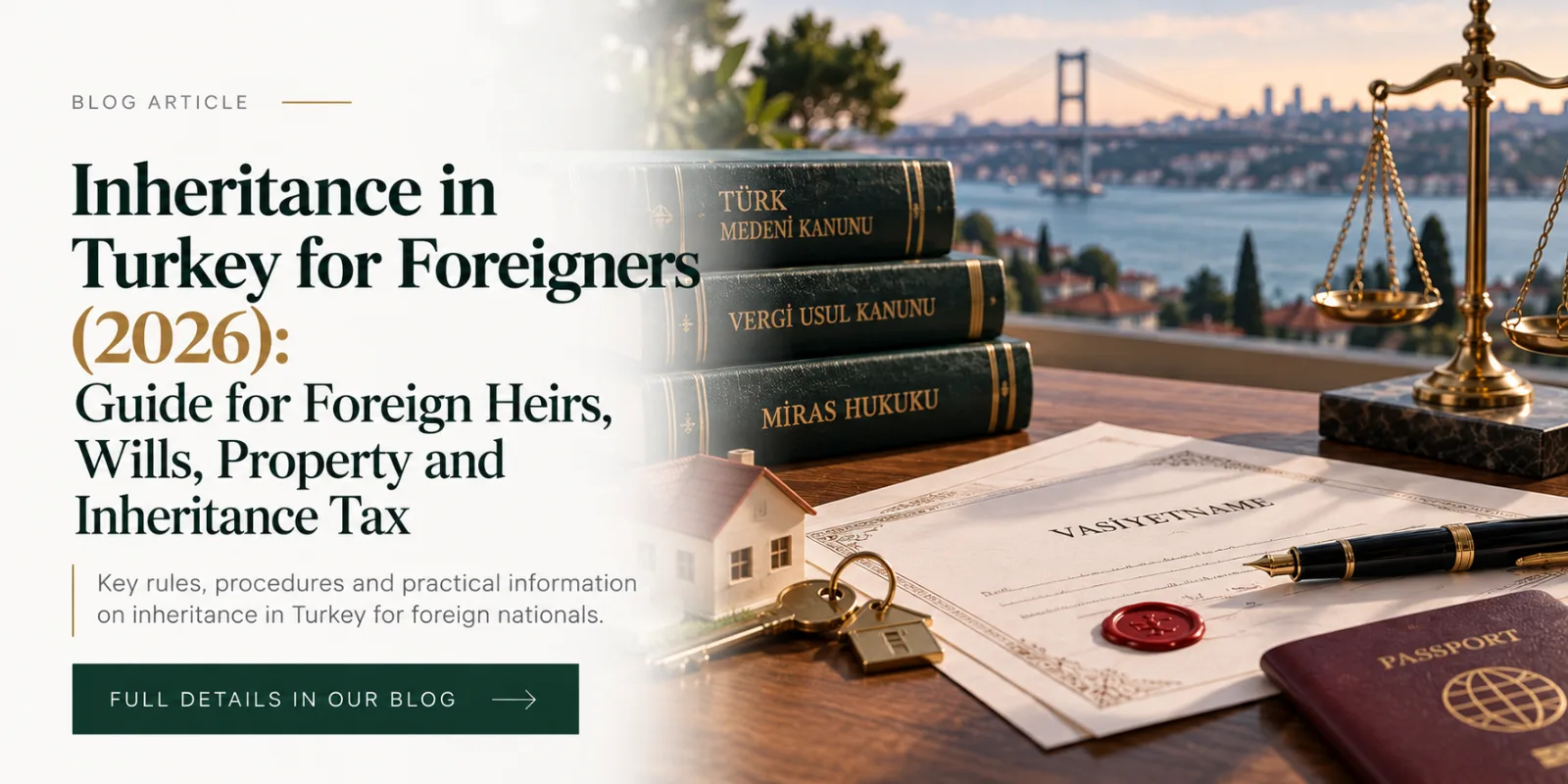
Inheritance in Turkey for Foreigners (2026): Guide for Foreign Heirs, Wills, Property and Inheritance Tax
Which law applies when a foreigner dies with assets in Turkey, who inherits, forced heirship, wills made abroad, the certificate of inheritance, transferring property to foreign heirs, inheritance tax deadlines and disclaiming an indebted estate.
When a relative dies leaving an apartment in Istanbul, a holiday home in Antalya or a bank account in Turkey, foreign heirs face a system they do not know, in a language they may not speak. Which country's law decides who inherits? Can a foreign heir keep a Turkish property? Is a will made in London or Berlin valid in Turkey? How is inheritance tax paid, and how do you refuse an inheritance burdened with debts?
This guide answers these questions for inheritance in Turkey for foreigners. It covers the conflict-of-laws rule in Article 20 of the Private International Law Act (MÖHUK), statutory heirs and forced heirship under the Turkish Civil Code, wills made abroad, the certificate of inheritance, transferring inherited property at the title deed office, inheritance tax, disclaiming an inheritance and dividing the estate among heirs.
If you have a matter on this topic:
Which Law Applies to Inheritance in Turkey for Foreigners?
Article 20 of MÖHUK (Law No. 5718) is the key rule. Succession is governed by the national law of the deceased. However, Turkish law applies to immovable property located in Turkey, whatever the deceased's nationality.

MÖHUK Article 20: succession follows the deceased's national law, but Turkish law applies to immovable property in Turkey (Source: mevzuat.gov.tr)
Situation | Law governing succession |
|---|---|
British national dies owning a flat in Istanbul | Turkish law for the flat; UK law (the national law) for movable assets |
German national dies with a bank account in Turkey only | German law as the national law, with Turkish rules on opening, acquisition and division of the estate in Turkey |
Turkish citizen living abroad dies owning property in Turkey | Turkish law |
Dual national who is also a Turkish citizen | Turkish law (MÖHUK Art. 4) |
Foreign national dies without heirs, leaving property in Turkey | The estate in Turkey passes to the Turkish State (Art. 20/3) |
Immovable Property in Turkey Is Always Governed by Turkish Law
The practical consequence is that the Turkish Civil Code decides who inherits a property in Turkey, in what shares, and whether forced heirship rules protect certain relatives, even if the deceased's home country has different rules. A foreign owner who wants a different result must plan within the limits Turkish law allows, for example through a will that respects the reserved shares.
Opening, Acquisition and Division of the Estate
Under Article 20/2, rules on the grounds for opening the succession, the acquisition of the estate and its division are governed by the law of the country where the estate is located. For assets in Turkey, the Turkish procedures therefore apply: the certificate of inheritance, the joint ownership of heirs until division, and the Turkish rules on disclaimer and partition.
Who Inherits Under Turkish Law? Statutory Heirs
Where Turkish law applies, the Civil Code determines the heirs through a system of classes (Arts. 495 to 499). Heirs of a closer class exclude those of more distant classes, and the surviving spouse inherits alongside each class.
Heirs alive | Surviving spouse's share | Remaining share |
|---|---|---|
Spouse and descendants (children, grandchildren) | One quarter | Three quarters shared equally among the children |
Spouse and parents (or their descendants) | One half | One half to the parents' class |
Spouse and grandparents (or their children) | Three quarters | One quarter to the grandparents' class |
Spouse only | The whole estate | — |
No spouse | — | Descendants first, then parents' class, then grandparents' class |
Children inherit equally, and a child who died before the deceased is represented by their own descendants (Art. 495). You can calculate the shares for your family with our inheritance share calculator.
Forced Heirship (Saklı Pay) in Turkey
Turkish law protects certain close relatives with a reserved share that a will cannot take away. Article 506 of the Civil Code sets the reserved shares:

Turkish Civil Code Article 506: forced heirship shares; the reserved share of siblings was abolished in 2007 (Source: mevzuat.gov.tr)
Heir | Reserved share |
|---|---|
Descendants | Half of their statutory share |
Each parent | One quarter of their statutory share |
Surviving spouse with descendants or parents | The whole of the statutory share |
Surviving spouse in other cases | Three quarters of the statutory share |
Siblings | No reserved share (abolished in 2007) |
If a will or lifetime gifts infringe a reserved share, the heir can file an abatement action to have the dispositions reduced.
Wills Made Abroad: Are They Valid in Turkey?
A will made abroad can be valid in Turkey. Under Article 20/4 of MÖHUK, the form of testamentary dispositions is governed by Article 7: a will is formally valid if it complies with the law of the country where it was made or with the law governing its substance. A will made in the form required by the deceased's national law is also valid. Capacity to make a will is governed by the national law of the testator at the time the will was made (Art. 20/5).
Turkish law itself recognises three forms of will: the official will made before an official with two witnesses, the handwritten will and, in exceptional circumstances, the oral will (Civil Code Art. 531). Whatever its form, a will cannot override Turkish forced heirship rules for property governed by Turkish law. A will must be opened by a Turkish civil court of peace before it can be relied on for assets in Turkey.
Certificate of Inheritance (Mirasçılık Belgesi) for Foreign Heirs
A certificate of inheritance (also called veraset ilamı) identifies the heirs and their shares. Title deed offices, banks and other institutions in Turkey require it before releasing any asset. Under Article 598 of the Civil Code, it is issued by a civil court of peace or a notary.
Notaries issue certificates on the basis of Turkish civil registry records. Where the deceased or the heirs are foreign nationals, or family relationships must be proved with foreign documents, the certificate is usually obtained from the civil court of peace. The court will ask for:
the death certificate, apostilled and translated if issued abroad,
documents proving family relationships (birth and marriage certificates, family registers),
the heirs' passports or identity documents,
any will, together with information on whether it has been opened.
Which Court Hears Inheritance Cases Involving Foreigners?
Under MÖHUK Article 43, inheritance cases are heard at the court of the deceased's last domicile in Turkey. If the deceased had no domicile in Turkey, the court of the place where estate assets are located is competent. For a foreigner who lived abroad but owned a flat in Istanbul, this is usually an Istanbul court.
Using a Foreign Certificate of Inheritance in Turkey
A certificate of inheritance or a similar document issued abroad is generally not accepted directly by Turkish land registries and banks. Either a Turkish certificate of inheritance is obtained, or the foreign document is recognised by a Turkish court. Which route is faster depends on the documents available and on whether the foreign certificate reflects the Turkish rule that immovable property in Turkey follows Turkish law.
Transferring Inherited Property in Turkey to Foreign Heirs
Step | What happens |
|---|---|
Certificate of inheritance | Obtained from the civil court of peace or a notary |
Inheritance tax return | Filed with the tax office within the legal deadline |
Tax clearance | The tax office certifies the inheritance tax position for the transfer |
Application to the title deed office | The heirs are registered as joint owners of the property |
Division or sale | By agreement among the heirs, or through a partition case |
After the transfer, the heirs hold the property in joint ownership (elbirliği mülkiyeti): no heir owns a specific part, and decisions such as selling require all of them. A foreign heir can also sign all steps through a power of attorney issued at a Turkish consulate or before a foreign notary with an apostille and translation.
When a Foreign Heir Cannot Keep the Property
Article 35 of the Land Registry Law allows nationals of countries determined by the President to acquire property in Turkey within area limits and outside restricted zones. Inheritance does not override these conditions. Property acquired by inheritance outside the limits of the first paragraph of Article 35 must be liquidated by the owner within a period of up to one year set by the Ministry; otherwise it is liquidated by the State and the proceeds are paid to the heir.

Land Registry Law Article 35: property inherited outside the limits must be sold within the period given; otherwise it is liquidated and the value paid to the heir (Source: mevzuat.gov.tr)
For most heirs from the EU, the UK, the US and other countries whose nationals may buy property in Turkey, this rule does not bite for an ordinary apartment. It matters for property in military or security zones, large land holdings, and heirs whose country is not on the permitted list.
The Two-Year Rule for Unregistered Inheritances
Heirs sometimes leave a deceased's property registered in the deceased's name for years. Under Additional Article 1 of the Land Registry Law, if the inheritance transfer has not been registered within two years of the death, the title deed office may itself apply to court for a certificate of inheritance and register the property in the heirs' joint names. It is better for heirs to control the process themselves.
Inheritance Tax in Turkey for Foreign Heirs
Assets located in Turkey that pass by inheritance are subject to Turkish inheritance and transfer tax (Law No. 7338). Heirs file an inheritance tax return with the tax office. The deadline depends on where the death occurred and where the heirs live (Art. 9):
Place of death | Heirs living in | Deadline from the date of death |
|---|---|---|
Turkey | Turkey | 4 months |
Turkey | Abroad | 6 months |
Abroad | Turkey | 6 months |
Abroad | The same country as the deceased | 4 months |
Abroad | Another foreign country | 8 months |
The tax is progressive, with exemption amounts for descendants and the surviving spouse that are updated every year. The assessed tax is paid in six equal instalments over three years, in May and November. Most of Turkey's double taxation treaties cover income taxes rather than inheritance tax, so check with a tax adviser in your home country whether Turkish inheritance tax can be credited there.
Bank Accounts and Other Assets of the Deceased in Turkey
Banks block the accounts of a deceased customer once they learn of the death. To release the funds, heirs generally present the certificate of inheritance and the inheritance tax clearance. Where there are several heirs, the bank pays according to the certificate, usually with the consent or presence of all heirs or their attorneys. Vehicles, company shares and receivables follow similar documentary steps.
Disclaiming an Inheritance in Turkey (Mirasın Reddi)
An inheritance may include debts. A statutory heir can disclaim the inheritance within three months, which for statutory heirs generally starts from the date they learned of the death (Civil Code Art. 606). The disclaimer is made orally or in writing before the civil court of peace and must be unconditional (Art. 609). If the deceased was clearly insolvent at the time of death, the inheritance is deemed disclaimed (Art. 605).
You can see what a disclaimer petition contains in our sample petition for renunciation of inheritance.
Dividing the Estate Between Heirs
Until the estate is divided, heirs own it jointly and must decide together (Civil Code Art. 640). Any heir can ask for division at any time (Art. 642). Where the heirs cannot agree on selling or dividing a specific asset, the route is a partition action before the civil court of peace, which can order division in kind or sale by auction. Before filing, mandatory mediation is required for disputes on the division of movable and immovable property (Mediation Law Art. 18/B).
At the request of any heir, the civil court of peace can also appoint a representative of the community of heirs until division (Art. 640/3), which is useful when some heirs live abroad and the estate needs day-to-day management.
Handling an Inheritance in Turkey From Abroad
Foreign heirs rarely need to travel to Turkey. A lawyer acting under a power of attorney can obtain the certificate of inheritance, file the tax return, transfer the property and bank assets, and represent the heir in any partition or abatement case. The power of attorney can be signed at a Turkish consulate or before a local notary with an apostille and certified translation, and should expressly cover inheritance proceedings, tax matters and title deed transactions. How a power of attorney for Turkey is signed abroad, and how lawyers' fees work, is explained in a separate guide.
Common Mistakes Foreign Heirs Make
Assuming home-country law governs a Turkish property: Turkish law always applies to immovable property in Turkey.
Relying on a will that ignores forced heirship: Reserved shares under Turkish law can be claimed through an abatement action.
Missing the inheritance tax deadline: Late filing leads to penalties and delays the transfer.
Using estate assets before deciding whether to disclaim: This can remove the right to refuse an indebted inheritance.
Leaving the property in the deceased's name for years: Joint heirs multiply over generations and division becomes harder.
Ignoring Article 35 limits: Heirs who cannot acquire property must sell within the period given.
Inheritance Lawyer in Istanbul and Ankara: Which Court Hears the Case
Actions for dividing an estate, challenging a will or reducing excessive gifts are heard by the court of the deceased's last domicile (Article 11 of the Code of Civil Procedure); for a foreign deceased with no domicile in Turkey, the court where the estate's assets are located is competent (Article 43 of the Private International Law Act). If the deceased lived in Ankara, the Ankara courts hear the case even if the heirs live in Istanbul or abroad. A certificate of inheritance itself can be obtained from any civil court of peace.
We act as an inheritance lawyer in Istanbul and before the courts in Ankara for foreign heirs. See our inheritance lawyer in Turkey page, and Buying Property in Turkey as a Foreigner for property-related rules.
Conclusion
Inheritance in Turkey for foreigners follows a clear logic: the deceased's national law generally governs succession, but Turkish law governs property located in Turkey. Foreign heirs need a certificate of inheritance, must file the inheritance tax return on time, and should decide whether to disclaim before touching any asset. Wills made abroad can be valid, but they cannot defeat Turkish forced heirship for Turkish property. For guidance on estates, cross-border succession, disclaimers and partition, see our inheritance lawyer in Turkey page, and for property questions our guide to buying property in Turkey as a foreigner.
Sources
Law No. 5718 on Private International and Procedural Law (MÖHUK) (Arts. 4, 7, 20, 43)
Turkish Civil Code No. 4721 (Arts. 495-499, 506, 531, 598, 605-610, 640, 642)
Land Registry Law No. 2644 (Art. 35, Additional Art. 1)
Mediation Law No. 6325 (Art. 18/B)
Frequently Asked Questions
Which law applies to inheritance in Turkey for foreigners?
Under MÖHUK Article 20, succession is governed by the deceased's national law, but Turkish law always applies to immovable property located in Turkey. The opening, acquisition and division of the estate follow the law of the country where the assets are located.
Does Turkish law apply to my foreign relative's apartment in Turkey?
Yes. Whatever the deceased's nationality, Turkish law decides who inherits immovable property located in Turkey and in what shares, including the forced heirship rules of the Turkish Civil Code.
Can foreigners inherit property in Turkey?
Yes. Foreign heirs can inherit property in Turkey. However, if the heir's acquisition falls outside the limits of Article 35 of the Land Registry Law, for example because of restricted zones, the property must be sold within the period given, otherwise it is liquidated and the proceeds are paid to the heir.
Who are the legal heirs under Turkish law?
Descendants inherit first, then the parents' class, then the grandparents' class. The surviving spouse inherits alongside them: one quarter with descendants, one half with the parents' class, three quarters with the grandparents' class, and the whole estate if there are no such relatives (Civil Code Arts. 495-499).
What is forced heirship in Turkey?
Certain relatives have a reserved share that a will cannot take away: descendants half of their statutory share, each parent one quarter, and the surviving spouse the whole statutory share when inheriting with descendants or parents, otherwise three quarters (Civil Code Art. 506). Siblings have no reserved share since 2007.
Is a will made abroad valid in Turkey?
Yes, if it complies in form with the law of the country where it was made, with the law governing its substance, or with the deceased's national law (MÖHUK Arts. 7 and 20/4). It must be opened by a Turkish civil court of peace before being relied on for assets in Turkey, and it cannot override Turkish forced heirship for property governed by Turkish law.
What is a certificate of inheritance (veraset ilamı) in Turkey?
It is the document identifying the heirs and their shares, required by title deed offices, banks and other institutions. It is issued by a civil court of peace or a notary (Civil Code Art. 598). Where foreign nationals or foreign documents are involved, it is usually obtained from the court.
Can I use my foreign certificate of inheritance in Turkey?
Generally not directly. Turkish land registries and banks usually require a Turkish certificate of inheritance, or a foreign document recognised by a Turkish court. Which route is faster depends on the documents available.
Which Turkish court handles an inheritance case for a foreigner?
Under MÖHUK Article 43, the court of the deceased's last domicile in Turkey. If the deceased had no domicile in Turkey, the court of the place where the estate assets are located is competent.
How do I transfer an inherited property in Turkey to my name?
Obtain a certificate of inheritance, file the inheritance tax return and obtain tax clearance, then apply to the title deed office, which registers the heirs as joint owners. The heirs can then divide or sell the property by agreement or through a partition case.
What happens if we do not register the inheritance at the title deed office?
Under Additional Article 1 of the Land Registry Law, if the inheritance transfer is not registered within two years of the death, the title deed office may apply to court for a certificate of inheritance and register the property in the heirs' joint names itself.
Do foreign heirs pay inheritance tax in Turkey?
Yes, assets located in Turkey that pass by inheritance are subject to Turkish inheritance and transfer tax. The tax is progressive, with annually updated exemptions for descendants and the surviving spouse, and is paid in six equal instalments over three years.
When is the Turkish inheritance tax return due?
Within 4 months of the death if the death occurred in Turkey and the heirs live in Turkey; 6 months if the heirs live abroad or the death occurred abroad and the heirs live in Turkey; 4 or 8 months if both the death and the heirs are abroad, depending on the country (Law No. 7338 Art. 9).
How do heirs access a deceased person's bank account in Turkey?
Banks block the account once they learn of the death. Heirs generally present the certificate of inheritance and the inheritance tax clearance, and the bank pays according to the certificate, usually with the consent or presence of all heirs or their attorneys.
How do I refuse an inheritance in Turkey?
A statutory heir can disclaim within three months, generally from learning of the death (Civil Code Art. 606), by an oral or written unconditional declaration before the civil court of peace (Art. 609). If the deceased was clearly insolvent, the inheritance is deemed disclaimed (Art. 605).
Can I lose the right to refuse an inheritance in Turkey?
Yes. An heir who, within the disclaimer period, intervenes in the estate beyond ordinary administration, hides estate assets or appropriates them can no longer disclaim (Civil Code Art. 610). Avoid using or selling estate assets before deciding.
How is an estate divided among heirs in Turkey?
Until division, heirs own the estate jointly and must decide together (Civil Code Art. 640). Any heir can ask for division at any time (Art. 642). If heirs cannot agree, a partition action is filed before the civil court of peace after mandatory mediation (Mediation Law Art. 18/B).
Do I need to travel to Turkey to deal with an inheritance?
Usually not. A lawyer acting under a power of attorney signed at a Turkish consulate, or before a foreign notary with an apostille and certified translation, can obtain the certificate of inheritance, file the tax return, transfer assets and represent you in court.
What happens to a foreigner's estate in Turkey if there are no heirs?
Under MÖHUK Article 20/3, an estate located in Turkey that has no heirs passes to the Turkish State.
Can a will disinherit children for a property in Turkey?
Not beyond the reserved share. Descendants are entitled to half of their statutory share as a reserved share under Civil Code Article 506, and dispositions that infringe it can be reduced through an abatement action.
My father lived in Ankara and we live in Istanbul. Where is the inheritance case heard?
At the court of the deceased's last domicile, so the Ankara courts. An inheritance lawyer in Ankara or an inheritance lawyer in Istanbul can follow the case, since a lawyer registered with a Turkish bar can appear before all courts in Turkey. A certificate of inheritance can be obtained from any civil court of peace.
- inheritance in Turkey for foreigners
- inheritance lawyer Turkey
- Turkish inheritance law
- foreign heirs Turkey
- certificate of inheritance Turkey
- veraset ilamı
- forced heirship Turkey
- will made abroad Turkey
- inheritance tax Turkey
- disclaim inheritance Turkey
- inherited property Turkey title deed
- MÖHUK Article 20
- foreign heirs Turkey property
- inheritance tax Turkey foreigners
- will made abroad valid in Turkey
- saklı pay forced share
- inheritance from abroad Turkey
Our services in this area
Inheritance Law