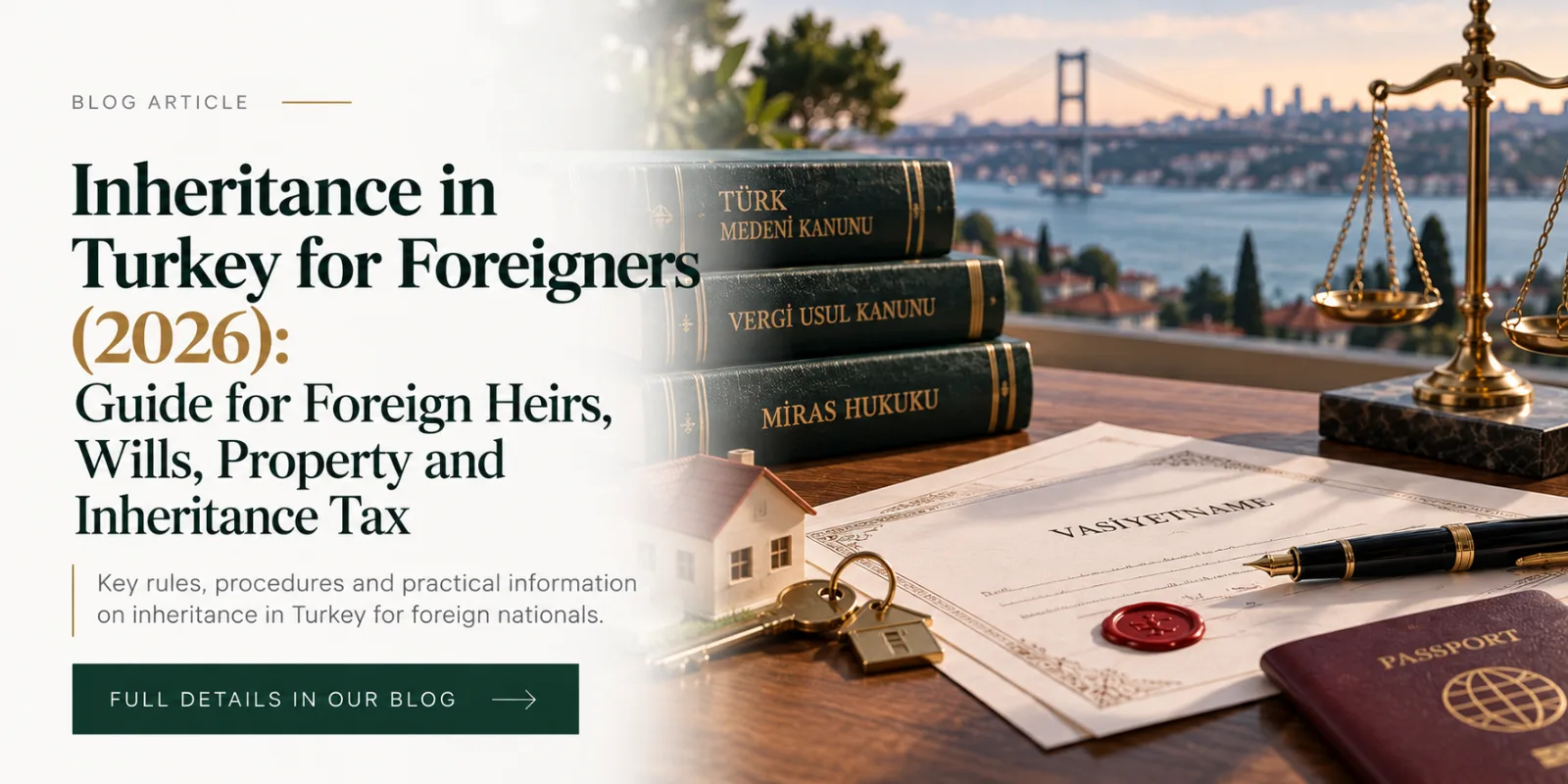
As an English-speaking inheritance lawyer based in Istanbul and acting in Ankara and across Turkey, our office advises Turkish and foreign heirs on estates, wills, and cross-border succession. Inheritance law governs to whom, and in what proportions, a person's assets pass on death. The Turkish Civil Code determines statutory heirs according to a system of classes; where the deceased has disposed of assets by will or by contract of inheritance, the rights of heirs entitled to a reserved portion are protected.
Time limits are decisive in this field. Disclaimer of inheritance, abatement claims, and actions to annul a will are all subject to preclusive periods or to prescription. Because the order and timing of the steps taken after the date of death directly affect the outcome, the position of the estate as of the date of death is the starting point of every inheritance case.
Inheritance Lawyer in Istanbul, Turkey: What We Do
An inheritance lawyer in Turkey typically starts by establishing exactly who the heirs are and what the estate consists of, then moves to whichever of several distinct actions the situation calls for — obtaining or contesting a certificate of inheritance, disclaiming an insolvent estate, bringing an abatement action to protect a reserved portion, challenging a collusive transfer, or dividing the estate where the heirs cannot agree among themselves. For an estate with a foreign element, an inheritance lawyer in Istanbul also coordinates which country's law governs which asset and prepares foreign documents for use before a Turkish court or the Land Registry.
How Long Does Inheritance (Probate) Take in Turkey?
An uncontested certificate of inheritance obtained from a notary can often be issued within days where the family records are clear and no foreign element is involved. Where the certificate must come from the civil court of peace — because heirship is disputed, a foreign national is involved, or the population records are incomplete — the process typically takes longer, and dividing the estate itself, where heirs cannot agree, adds the time needed for a full civil action. An inheritance lawyer in Turkey reviewing the estate early can generally indicate which of these tracks a given case is likely to follow.
How Much Does an Inheritance Lawyer Cost in Turkey?
As in other areas of practice, an inheritance lawyer's fees in Turkey cannot fall below the Attorneyship Minimum Fee Tariff (Avukatlık Asgari Ücret Tarifesi), which is prepared each year by the Union of Turkish Bar Associations. For an uncontested certificate of inheritance the work is comparatively limited; for contested matters — an abatement action, a collusive-transfer claim, or a cross-border estate requiring foreign document recognition — fees are assessed against the value of the estate and the complexity of the dispute, and can only be quoted once the file has been reviewed.
Inheritance Tax in Turkey
Turkey levies an inheritance and transfer tax (veraset ve intikal vergisi, Law No. 7338) on assets passing by inheritance, including Turkish assets inherited by foreign heirs. The tax is assessed by the tax office of the deceased's domicile or, where that domicile was abroad, of the deceased's last domicile in Turkey (Art. 6). Real estate is valued at its property-tax value and movable assets at their market value, as of the date the succession opened (Arts. 10 and 11).
Inheritance Tax Exemption Amounts for 2026
Under Article 4(b) of Law No. 7338, as updated for 2026 by the General Communiqué published in the Official Gazette of 31 December 2025, the inheritance share of each descendant (adopted children included) and of the surviving spouse is exempt up to 2,907,136 Turkish lira; where there are no descendants, the spouse's exemption is 5,817,845 lira. The exemption is given to descendants and the spouse only — parents, siblings and other heirs do not benefit from it. Above the exemption, inheritance is taxed at progressive rates of 1, 3, 5, 7 and 10 per cent; for 2026 the brackets are the first 3,000,000 lira, the next 7,000,000, the next 15,000,000, the next 30,000,000 and the part above 55,000,000 lira (Art. 16).
A Declaration Is Required Even Below the Exemption
The obligation to file an inheritance tax declaration applies to everyone who acquires assets by inheritance (Art. 7), so a declaration is filed even where a share stays below the exemption. Declarations may be filed jointly or separately for each heir, and heirs living abroad may file at a Turkish consulate (Art. 8). The deadline depends on where the death occurred and where the heirs are, as shown in the table below (Art. 9).
Paying the Tax and Selling Inherited Property
The assessed tax is paid within three years, in six equal instalments due in May and November of each year (Art. 19). Inherited real estate can be registered in the heirs' names at the Land Registry without waiting for the tax assessment. It cannot, however, be sold or otherwise transferred, and no right in rem can be created over it, until the tax attributable to that property has been paid in full and the tax office's clearance certificate (ilişik kesme belgesi) is produced, unless security of the kind accepted under the Collection of Public Receivables Law is provided.
Certificates of Inheritance and Division of the Estate in Turkey
A certificate of inheritance is an official document evidencing a person's status as heir and their share; it may be obtained from a notary or from the civil court of peace. Where heirs cannot agree, the estate is divided by the court through an action for dissolution of co-ownership.
How to Obtain a Certificate of Inheritance
The certificate may be requested by any one heir from a notary or the civil court of peace; a copy of the population register and identification are generally sufficient, and the other heirs need not be present. Where there is no dispute, the notary route is usually faster; where heirship itself is contested, the certificate can only be obtained from the court.
Action for Dissolution of Co-Ownership
Where the heirs cannot agree to end the joint ownership of the estate by consent, any heir may bring an action for dissolution of co-ownership before the civil court of peace. The court orders division in kind where possible, or otherwise a sale among the heirs or at public auction.
Transferring an Inheritance Share
Before the estate is divided, an heir may transfer their inheritance share. An agreement between heirs must be in writing; an agreement with a third party is valid only if drawn up by a notary. The third party does not join the community of heirs or take part in the division: they acquire only the right to receive the share allotted to the transferring heir once the division is complete (Art. 677 Civil Code).
Disclaiming an Inheritance in Turkey
Where the deceased's debts exceed the estate, statutory and appointed heirs may disclaim the inheritance. Disclaimer is made by a declaration to the civil court of peace within three months of learning of the death; once this period lapses the inheritance is deemed accepted without reservation.
The Period and Form of Disclaimer
The period is three months; for statutory heirs it runs from the date they learn of the death unless they prove they learned later that they were heirs, and for appointed heirs from the official notification of the disposition (Art. 606). Disclaimer is made by an unconditional written or oral declaration to a civil court of peace, which records it in minutes; a disclaimer made in time is entered in the special register of the civil court of peace of the place where the succession opened (Art. 609). The period is one of forfeiture; if it lapses, the inheritance is deemed accepted without reservation.
Deemed Disclaimer by Operation of Law
Where it is manifest, or has been officially established, that the deceased was insolvent at the date of death, the inheritance is deemed disclaimed without any heir needing to make a declaration within the three-month period. Where this fact is disputed, its existence may be established by an action.
Consequences of Disclaimer
The share of a disclaiming heir passes to the other heirs, calculated as though the deceased had not died; if disclaimer leaves no heir at all, the estate is liquidated by the civil court of peace under the rules on bankruptcy. Creditors retain the right to challenge a disclaimer made to their detriment.
Losing the Right to Disclaim
An heir who, before the period expires, deals with the estate beyond its ordinary administration or the steps needed to carry on the deceased's affairs, or who conceals or appropriates estate assets, can no longer disclaim (Art. 610). Bringing an action or enforcement proceedings only to stop a limitation or forfeiture period from running does not remove the right to disclaim.
Gifts Received in the Five Years Before Death
Heirs who disclaim the estate of an insolvent deceased remain liable to the deceased's creditors up to the value of what they received from the deceased in the five years before death and would have had to bring into account on division; ordinary education costs and customary trousseau are excluded, and heirs in good faith are liable only to the extent of their enrichment at the time of restitution (Art. 618).
Abatement Actions to Protect an Inheritance Reserved Portion in Turkey
Where gifts made by the deceased during their lifetime, or dispositions made by will, encroach upon the statutory share of heirs entitled to a reserved portion — descendants, parents, and the surviving spouse — those heirs may bring an abatement action seeking annulment of the disposition to the extent it exceeds the reserved portion.
Who Is Entitled to a Reserved Portion
The reserved portion is one half of the statutory share for descendants and one quarter for each parent; for the surviving spouse it is the whole statutory share when inheriting alongside descendants or the parental class, and three quarters in other cases (Art. 506 Civil Code). The reserved portion of siblings was abolished by Law No. 5650 in 2007. A person who leaves none of these heirs may dispose of the whole estate (Art. 505).
Lifetime Gifts That Can Be Reduced
Abatement is not limited to wills. Article 565 also subjects to abatement, like dispositions upon death: advances on the share made to a statutory heir who later loses heir status; transfers of assets or releases from debt made to descendants without a duty to bring them into account; unusually large dowries or establishment capital; transfers made to settle inheritance rights before death; gifts the deceased could freely revoke, and other gifts made in the year before death apart from customary presents; and dispositions clearly made to evade the reserved-portion rules.
Time Limit for Abatement
The action must be brought within one year of the heirs learning that their reserved portion has been infringed, and in any event within ten years of the opening of the will or, for other dispositions, of the opening of the succession; abatement may always be raised as a defence (Art. 571).
Collusive Transfers to Defeat Inheritance Rights in Turkey
Where the deceased, intending to keep assets from the heirs, presented as a sale an immovable they in fact wished to donate, all heirs — whether or not entitled to a reserved portion — may plead the invalidity of the apparent transaction on grounds of collusion. This action is not subject to any time limit.
Disinheritance and Disqualification from Inheritance in Turkey
Disinheritance is a deliberate act by the deceased, made in a valid will, excluding an heir entitled to a reserved portion for a reason recognised by law — most commonly a serious offence committed against the deceased or a close relative, or a grave breach of family duties. Disqualification is different: it applies automatically, without any act by the deceased, to a person who, for example, intentionally and unlawfully caused the death of the person they would have inherited from, or who concealed, destroyed, or forged that person's will. A disinherited or disqualified heir may challenge the basis for exclusion in court.
Inheritance Contracts in Turkey
Distinct from a will, a contract of inheritance is a binding agreement — most often between the deceased and an heir or a third party — under which the deceased undertakes to leave specified assets to the other party, sometimes in exchange for care, support, or a payment during the deceased's lifetime. Because it binds the deceased in a way an ordinary will does not (a will can be freely revoked, a contract of inheritance generally cannot be revoked unilaterally), it must be executed in the official form required for a will made before a notary, with two witnesses present.
Estate Debts and Creditor Claims in Turkey
Heirs who accept an inheritance become liable for the deceased's debts, not only entitled to the deceased's assets, which is precisely why the disclaimer mechanism described above exists for estates where debts exceed assets. Where the true state of the estate is uncertain, any heir entitled to disclaim may apply to the civil court of peace within one month for an official inventory (resmî defter tutulması); one heir's application is effective for the others too (Art. 619). An heir who accepts on the basis of the inventory is liable, with both estate assets and personal assets, only for the debts recorded in it. Towards creditors who failed to register their claims in time the heir is not liable, except up to the heir's enrichment where the creditor was not at fault (Arts. 628 and 629).
What Happens If Someone Dies in Turkey With No Will and No Heirs?
Where a person dies without a will and without any relative in the statutory classes of heirs or a surviving spouse, the estate passes to the Turkish State. Before that occurs, a thorough search for heirs — including heirs living abroad who may be unaware of the death — is carried out, since a class of statutory heirs extends fairly widely through descendants, parents and their descendants, and grandparents and their descendants before the estate is treated as having no heir at all.
Transferring Turkish Property Inherited by a Foreign Heir
Once heirship to Turkish assets is established — whether by a Turkish certificate of inheritance or by a foreign certificate that has gone through the recognition process described below — registering inherited real property in the heir's name at the Land Registry requires the certificate itself, the heir's identification and Turkish tax number, and, where the heir is not present in Turkey, a power of attorney authorising a representative to complete the registration. Registration in the heirs' names does not have to wait for the inheritance tax assessment; the tax office's clearance becomes necessary when the inherited property is later sold or otherwise transferred (Art. 19 of Law No. 7338). An inheritance lawyer in Turkey can coordinate this registration on behalf of an heir who is not present in the country.
Cross-Border Succession: Foreign Heirs and Foreign Nationals' Estates in Turkey
Inheritance cases with a foreign element — a foreign national who dies owning property in Turkey, or a Turkish estate with heirs living abroad — are governed by a specific conflict-of-laws rule rather than by ordinary domestic succession law alone.
Which Country's Law Applies (MÖHUK Art. 20)
Under Article 20 of Law No. 5718 (Turkish Private International Law and Procedure Act), succession is governed by the deceased's national law — except that immovable property located in Turkey is always governed by Turkish law, regardless of the deceased's nationality. In practice this means a foreign national's estate can be split across two legal regimes at once: their home country's succession law for movable assets and foreign real estate, and Turkish law for any Turkish real estate they owned.
The same article provides that the rules on the opening of the succession, its acquisition and its division are governed by the law of the country where the estate is located; that an heirless estate located in Turkey passes to the Turkish State; that the form of a will follows the general rule on form, a will made in the form required by the deceased's national law also being valid; and that capacity to make a will is governed by the testator's national law at the time it was made (Art. 20(2)-(5)).
Turkish Courts' Jurisdiction Over a Foreign National's Estate
Turkish courts have jurisdiction over the Turkish immovable property of a deceased foreign national even where the succession as a whole is otherwise governed by foreign law, and generally also have jurisdiction where the deceased was domiciled in Turkey at death or where assets of the estate are located in Turkey. A certificate of inheritance covering Turkish assets is generally obtained from the Turkish civil court of peace rather than from a notary once a foreign national or foreign documentation is involved.
Using a Foreign Will or Foreign Certificate of Inheritance in Turkey
A will validly executed abroad, or a foreign court's or authority's certificate of heirship, is not automatically effective before the Turkish land registry or a Turkish bank. It generally needs to be apostilled (or consular-legalised, for non-Hague Convention countries), officially translated into Turkish, and, depending on the document, either recognised by a Turkish court or presented for the Turkish court to issue its own certificate of inheritance covering the Turkish assets.
The Statutory Order of Heirs in Turkish Inheritance Law
Where there is no will, the estate is divided according to the class system in the Turkish Civil Code. The deceased's descendants (children, grandchildren) inherit first; if there are none, the estate passes to the parental class, and failing that to the grandparental class. The surviving spouse also takes a share, the proportion of which depends on which class they inherit alongside.
Representation by Descendants
Children inherit in equal shares, and a child who died before the deceased is replaced, at every degree, by their own descendants (Art. 495). The same representation applies in the parental and grandparental classes; where one side of the parental class has no heirs at all, the whole share passes to the other side (Arts. 496 and 497).
Children Born Outside Marriage
A child born outside marriage whose paternity has been established by recognition or by court judgment inherits on the father's side in the same way as a child born within marriage (Art. 498).
Types of Wills in Turkish Inheritance Law
The Turkish Civil Code provides for three types of will: an official will executed before a notary, a holographic will that the testator writes entirely in their own hand, dates, and signs, and an oral will, available only in exceptional circumstances such as imminent danger of death or a breakdown in communications. Failure to observe the formal requirements may result in the will being annulled.
Official Will
Executed before a notary or an authorised official in the presence of two witnesses; the testator states their last wishes orally or in writing, and the person drawing it up records this and reads it back to the testator. Carrying the greatest evidentiary weight, this route is generally preferred wherever a dispute is likely.
Holographic Will
The will must be written entirely in the testator's own hand from beginning to end, bear the date of drafting, and be signed; a typed, computer-printed will, or one written in another person's hand, is invalid on that ground alone. Because its custody is generally left to the testator, it carries a real risk of being lost or never found.
Action to Annul a Will
A will may be annulled on grounds such as the testator's lack of capacity at the time it was made, a defect of intent (mistake, fraud, or duress), content or purpose contrary to law or morality, or a formal defect. The action must be brought within one year of the claimant learning of the disposition, the ground for annulment and their own entitlement, and in any event within ten years of the will being opened as against defendants in good faith, or twenty years as against defendants in bad faith; invalidity may always be raised as a defence (Art. 559).
Contesting a Certificate of Inheritance
A certificate of inheritance can be wrong — an heir may have been omitted, shares miscalculated, or a later will overlooked — and, unlike most inheritance actions described above, an action to annul or correct a certificate of inheritance is not subject to any time limit, precisely because the certificate does not itself create substantive rights; it only records who the true heirs are believed to be. Anyone with an interest, including an heir left off the certificate entirely, may bring the action. An inheritance lawyer in Istanbul can review an existing certificate to check whether it correctly reflects the true heirs.
Inheritance Lawyer in Ankara: Which Court Hears an Inheritance Case
Turkish procedure fixes the venue of most inheritance disputes by law. Actions for division of the estate, for invalidity of a partition agreement, for annulment or abatement of dispositions upon death, for recovery of estate assets on the basis of inheritance, and disputes among heirs over the administration of the estate must be filed at the court of the deceased's last domicile, as must all actions against the heirs until the estate is finally divided (Art. 11 Code of Civil Procedure). An action to annul a certificate of inheritance and obtain a new one may also be filed where any of the heirs lives. Actions concerning rights in rem over real estate are heard where the property is located (Art. 12), and for a deceased whose last domicile was not in Turkey, inheritance cases are heard where the estate assets are located (Art. 43 of Law No. 5718).
Where the deceased lived in Ankara, the Ankara courts therefore hear the division and abatement actions, wherever the heirs themselves live. We act in inheritance matters in Istanbul, Ankara and other cities: a lawyer registered with a Turkish bar may appear before every court in Turkey, and filings are made through the national judicial system (UYAP). Our office itself is in Istanbul.
The Community of Heirs Before the Estate Is Divided
Where there are several heirs, a community of heirs arises on the death and lasts until division. The heirs own the estate jointly and, unless a representative or administrator has authority, dispose of estate rights together (Art. 640 Civil Code); one heir alone cannot sell an inherited flat. On the request of any heir, the civil court of peace may appoint a representative for the community, and each heir may request measures to protect the estate's rights.
Division by the Court
Any heir may demand division at any time unless bound by contract or law to continue the community. The civil court of peace divides specific assets in kind or, where that is not possible, by sale; on request it may allot each item of real estate as a whole to one heir, with balancing payments between the heirs, and it may postpone division where immediate division would substantially reduce the value of the estate (Art. 642).
Mediation Before Dividing Inherited Property
Since Law No. 7445 of 2023, disputes on the division of movable and immovable property and on the dissolution of co-ownership can only be brought to court after an application to a mediator (Art. 18/B of the Law on Mediation in Civil Disputes). Where the heirs agree, an agreement concerning real estate is drawn up in line with the legal restrictions on property and needs an enforceability annotation from the civil court of peace where the property is located; since Law No. 7531 of 2024, the Land Registry can register a transfer on the basis of such an annotated agreement without a separate official deed.
When a Will Is Found: Delivery, Opening and Notification
A will found after death must be delivered immediately to the civil court of peace, whether or not it appears valid; anyone who drew it up, kept it or found it among the deceased's belongings is liable for damage caused by failing to deliver it (Art. 595 Civil Code). The judge of the deceased's domicile opens the will within one month of delivery and reads it to those concerned, inviting the known heirs (Art. 596). A certificate showing that a person is an appointed heir or legatee is issued by the civil court of peace if no objection is raised within one month of the disposition being notified to the heirs or other legatees (Art. 598).
Protective Measures: Sealing and Inventory of the Estate
The civil court of peace of the deceased's domicile takes, on request or of its own motion, the measures needed to preserve the estate and pass it to those entitled — in particular an inventory of estate assets, sealing, official administration of the estate and the opening of wills (Art. 589 Civil Code). Where the death occurred elsewhere, the judge of that place notifies the court of the domicile and secures the assets found there.
Foreign Heirs and Inherited Turkish Real Estate: The Article 35 Limits
Foreign nationals may acquire real estate in Turkey only within the limits of Article 35 of the Land Registry Law: they must be nationals of countries determined by the President, and the total area held by foreign nationals may not exceed ten per cent of the private-property area of a district or thirty hectares per person nationwide (the President may double the per-person limit). Real estate acquired by inheritance outside these limits is not forfeited automatically: if the owner does not liquidate it within a period set by the Ministry of Treasury and Finance, not exceeding one year, it is liquidated and the proceeds are paid to the owner.
Why Legal Representation Matters in a Turkish Inheritance Matter
Several of the actions above are subject to short, strict, and non-extendable deadlines — three months to disclaim an insolvent estate is the clearest example — while others, like a collusive-transfer claim, have no deadline at all but demand a different kind of evidence entirely. Because the correct action, and the correct deadline, depends on which of these very different fact patterns actually applies, reviewing the estate's position early — rather than after a default has already occurred — is what most often protects an heir's rights, particularly for an heir living abroad who may learn of the death, and of the three-month clock, later than heirs residing in Turkey.
Types of Inheritance Actions
Action
When Brought
Time Limit
Disclaimer of inheritance
Where the estate is insolvent or is not wished to be accepted
3 months (Art. 606 Civil Code)
Abatement action
Where the reserved portion has been infringed
1 year from discovery, 10 years absolute (Art. 571)
Collusive transfer (title cancellation)
Where the deceased made a collusive transfer to defeat heirs
Not subject to a time limit
Annulment of a certificate of inheritance
Where the certificate was issued incorrectly or omits an heir
Not subject to a time limit
The Surviving Spouse's Share by Class
Class Inherited Alongside
Spouse's Share
Share of Other Heirs
1st class (descendants — children/grandchildren)
1/4
Remaining 3/4 divided equally among descendants
2nd class (parents and their descendants)
1/2
Remaining 1/2 divided within the parental class
3rd class (grandparents and their descendants)
3/4
Remaining 1/4 divided within the grandparental class
No class exists
The entire estate
—
Inheritance Tax Declaration Deadlines (Art. 9, Law No. 7338)
Place of death
Where the heirs are
Deadline from the date of death
Turkey
Turkey
4 months
Turkey
Abroad
6 months
Abroad
Turkey
6 months
Abroad
The same country as the deceased
4 months
Abroad
Another foreign country
8 months
Inheritance Tax in 2026: Exemptions and Rates
Item
2026 amount or rate
Legal basis
Exemption per descendant and per surviving spouse
2,907,136 TL
Art. 4(b)
Exemption for the spouse where there are no descendants
5,817,845 TL
Art. 4(b)
First 3,000,000 TL of the taxable share
1%
Art. 16
Next 7,000,000 TL
3%
Art. 16
Next 15,000,000 TL
5%
Art. 16
Next 30,000,000 TL
7%
Art. 16
Part above 55,000,000 TL
10%
Art. 16
Where Inheritance Cases Are Filed
Case
Court with jurisdiction
Legal basis
Division of the estate, abatement, annulment of dispositions upon death
Court of the deceased's last domicile (exclusive)
Art. 11 Code of Civil Procedure
Actions against the heirs until final division
Court of the deceased's last domicile (exclusive)
Art. 11(1)(b)
Annulment of a certificate of inheritance
Deceased's last domicile or the residence of any heir
Art. 11(3)
Rights in rem over real estate
Court where the property is located
Art. 12
Deceased with no last domicile in Turkey
Court where the estate assets are located
Art. 43 of Law No. 5718
Disclaimer of inheritance
Civil court of peace; recorded at the place where the succession opened
Art. 609 Civil Code
Matters Handled in This Area
Obtaining certificates of inheritance
Determination of the estate and protective measures
Disclaimer of inheritance and actions to set aside a disclaimer
Abatement actions to protect the reserved portion
Title cancellation actions based on collusive transfer
Actions to annul or to enforce a will
Division of the estate and dissolution of co-ownership
Drafting of wills and contracts of inheritance
Disputes on disinheritance and disqualification from inheritance
Frequently Asked Questions
What is the time limit for disclaiming an inheritance?
For statutory heirs the period is three months. Unless the heir proves that they learned of their status later, it runs from the date on which they learned of the death; for heirs appointed by will it runs from the date on which the disposition was officially notified to them (Article 606 of the Civil Code). Once the period expires the inheritance is deemed accepted without reservation. Where the insolvency of the deceased was manifest or officially established at the date of death, the inheritance is deemed disclaimed (Article 605/2).
What is the reserved portion, and who is entitled to it?
The reserved portion is the minimum share of an estate that cannot be encroached upon by law. Under Article 506 of the Civil Code it amounts to one half of the statutory share for descendants, one quarter for each of the mother and father, and for the surviving spouse the whole of the statutory share where they inherit alongside descendants or the parental class, and three quarters in other cases. The reserved portion of siblings was abolished by an amendment in 2007. An abatement action may be brought against dispositions that encroach upon the reserved portion.
What is a collusive transfer intended to defeat inheritance rights?
It arises where the deceased, intending to keep assets from the heirs, presents as a sale or as a contract of maintenance until death an immovable that they in fact wished to donate. Under the decision of the Court of Cassation Assembly on the Unification of Case Law dated 1 April 1974, all heirs whose inheritance rights are infringed, whether or not they hold a reserved portion, may plead the invalidity of the apparent contract on grounds of collusion. This action is not subject to any time limit.
Where is a certificate of inheritance obtained?
As a rule a certificate of inheritance may be obtained from a notary or from the civil court of peace (Article 598 of the Civil Code). However, where the heirs include a foreign national, where the population records are insufficient, or where the position of the heirs cannot clearly be established from the records, notaries may not issue the certificate and an application must be made to the civil court of peace.
How is a will made, and what is required for it to be valid?
The two most commonly used types are an official will executed before a notary and a holographic will, which the testator writes entirely in their own hand, dates, and signs. Using a typewriter, a computer, or someone else's handwriting for a holographic will renders it invalid. A will cannot override the rules on the reserved portion; any part that exceeds them is subject to abatement.
What share does a surviving spouse receive?
The spouse's share depends on which class they inherit alongside: one quarter together with the deceased's children, one half together with the parental class, and three quarters together with the grandparental class. Where no class of statutory heirs exists, the entire estate passes to the surviving spouse.
A foreign relative of mine died owning property in Turkey. Which country's inheritance law applies?
Under Article 20 of Law No. 5718 (MÖHUK), the deceased's national law generally governs the succession, but Turkish law always applies to any immovable property located in Turkey, regardless of the deceased's nationality. The estate can therefore be governed by two legal systems at once.
Can I use a foreign certificate of inheritance or a foreign will to claim Turkish assets?
Not directly. It generally needs to be apostilled (or consular-legalised) and officially translated into Turkish, and then either recognised by a Turkish court or used as the basis for a Turkish court to issue its own certificate of inheritance covering the Turkish assets.
How much is inheritance tax in Turkey, and does it apply to foreign heirs?
Yes, foreign heirs inheriting Turkish assets are subject to Turkey's inheritance and transfer tax. For 2026 the share of each descendant and of the surviving spouse is exempt up to 2,907,136 Turkish lira (5,817,845 lira for a spouse where there are no descendants); other heirs have no exemption under this rule. Above the exemption, inheritance is taxed at progressive rates from 1 to 10 per cent.
What is the deadline to file an inheritance tax declaration in Turkey?
Under Article 9 of Law No. 7338, counted from the date of death: where the death occurred in Turkey, four months for heirs in Turkey and six months for heirs abroad; where the death occurred abroad, six months for heirs in Turkey, four months for heirs in the same country as the deceased and eight months for heirs in another foreign country.
Is there a time limit to contest a certificate of inheritance?
No. Because the certificate only records who the heirs are believed to be rather than creating rights itself, an action to correct or annul it is not subject to any time limit, though the underlying facts still need to be proven.
What happens if someone dies with no will and no heirs can be found?
Turkish law provides for a fairly wide statutory class system — descendants, then parents and their descendants, then grandparents and their descendants — before an estate is treated as having no heir. Only once that search is exhausted does the estate pass to the Turkish State.
Can I get an English-speaking Turkish lawyer for an inheritance matter?
Yes. Our office advises English-speaking heirs throughout an inheritance matter in Turkey, including cross-border estates involving foreign documents.
Why choose our office for an inheritance lawyer in Istanbul, Turkey?
Av. Ömer Faruk Doğan holds an IELTS score of 7, pursued graduate legal studies and research in Italy and Poland, and has experience advising international clients and foreign heirs on Turkish inheritance matters. Clients can be advised in English as well as Turkish.
Do I have to file an inheritance tax declaration if my share is below the exemption?
Yes. Under Article 7 of Law No. 7338 everyone who acquires assets by inheritance must file a declaration; the exemption reduces or removes the tax but not the filing obligation.
Can an heir living abroad file the inheritance tax declaration at a Turkish consulate?
Yes. Taxpayers abroad may file their declarations at Turkish consulates, and declarations may be filed jointly or separately for each heir (Art. 8 of Law No. 7338).
Can inherited real estate be registered before the inheritance tax is paid?
Yes. Under Article 19 of Law No. 7338 the registration of inherited real estate in the heirs' names is made without waiting for the tax assessment, and the Land Registry notifies the tax office within 15 days.
Can inherited property be sold before the inheritance tax is paid?
No, not as a rule. Inherited real estate cannot be sold or otherwise transferred until the tax attributable to it is paid in full and a clearance certificate is produced, unless security accepted under the Collection of Public Receivables Law is provided (Art. 19).
How is inheritance tax paid in Turkey?
Within three years of the assessment, in six equal instalments due in May and November of each year (Art. 19 of Law No. 7338).
Do parents or siblings receive an inheritance tax exemption?
No. The exemption in Article 4(b) of Law No. 7338 applies only to descendants (including adopted children) and the surviving spouse.
Is mediation required before dividing inherited property?
Yes. Since Law No. 7445 of 2023, applying to a mediator is a precondition for court actions on the division of movable and immovable property and the dissolution of co-ownership (Art. 18/B of the Law on Mediation in Civil Disputes).
Can one heir sell inherited property without the others?
No. Until division the heirs own the estate jointly and dispose of estate rights together, unless a representative or administrator has authority (Art. 640 Civil Code).
Can an heir sell their inheritance share to someone outside the family?
Yes, by a notarised agreement. The buyer does not take part in the division; they only acquire the right to receive the share allotted to that heir once the division is complete (Art. 677 Civil Code).
Which court hears an inheritance dispute in Turkey?
Division, abatement and annulment actions are heard by the court of the deceased's last domicile (Art. 11 Code of Civil Procedure); real-estate rights are heard where the property is located (Art. 12); for a deceased with no last domicile in Turkey, where the estate assets are located (Art. 43 of Law No. 5718).
Can a foreign heir be required to sell inherited Turkish real estate?
Where the real estate was inherited outside the limits of Article 35 of the Land Registry Law (eligible nationalities and area limits), it is liquidated and the proceeds paid to the owner if the owner does not liquidate it within a period set by the Ministry, not exceeding one year.
What happens to a will after the death?
It must be delivered immediately to the civil court of peace, which opens it within one month at the deceased's domicile and reads it to those concerned, inviting the known heirs (Arts. 595 and 596 Civil Code).
What is an official inventory of the estate?
An inventory prepared by the civil court of peace at the request of an heir, made within one month (Art. 619). An heir who accepts on the basis of the inventory is liable only for the debts recorded in it, subject to the exceptions in Articles 628 and 629.
Can I still disclaim an inheritance if I have already used estate assets?
An heir who has dealt with the estate beyond its ordinary administration, or concealed or appropriated estate assets, loses the right to disclaim (Art. 610 Civil Code).
If I disclaim, can the deceased's creditors claim gifts I received?
Where the deceased was insolvent, heirs who disclaim remain liable to creditors up to the value of what they received in the five years before death and would have had to bring into account; heirs in good faith are liable only to the extent of their enrichment (Art. 618).
Do children born outside marriage inherit in Turkey?
Yes. Where paternity has been established by recognition or court judgment, they inherit on the father's side like children born within marriage (Art. 498 Civil Code).
Do siblings have a reserved portion in Turkey?
No. The reserved portion of siblings was abolished by Law No. 5650 in 2007; reserved portions now belong to descendants, parents and the surviving spouse (Art. 506).
Which gifts made during the deceased's lifetime can be reduced?
Article 565 of the Civil Code lists them, including certain transfers to descendants, transfers made to settle inheritance rights in advance, freely revocable gifts and other gifts made in the year before death apart from customary presents, and dispositions clearly made to evade the reserved-portion rules.
How is inherited real estate valued for inheritance tax?
Real estate is valued at its property-tax value and movable assets at market value, as of the date the succession opened (Arts. 10 and 11 of Law No. 7338).
The deceased lived in Ankara and the heirs live in Istanbul. Can an inheritance lawyer in Istanbul take the case?
Yes. Inheritance cases are heard at the court of the deceased's last domicile (Article 11 of the Code of Civil Procedure), so in Ankara. A lawyer registered with a Turkish bar can appear before all courts, so an inheritance lawyer in Istanbul or an inheritance lawyer in Ankara can follow it.
Which law applies when a foreigner dies with assets in Turkey, who inherits, forced heirship, wills made abroad, the certificate of inheritance, transferring property to foreign heirs, inheritance tax deadlines and disclaiming an indebted estate.