As an English-speaking immigration lawyer in Istanbul, Turkey, our office advises foreign nationals on residence permits, work permits, citizenship, and deportation defence. The entry, stay, and departure of foreign nationals in Türkiye, together with applications for international protection, are governed by Law No. 6458 on Foreigners and International Protection. Work permits fall under Law No. 6735 on International Labour Force, and citizenship matters under Law No. 5901 on Turkish Citizenship.
Because most procedures in this field are administrative in character, preparing a complete application file and observing the administrative time limits are decisive. Where an application is refused, proceedings before the administrative courts may be required, and the time limits are short: seven days against a deportation decision and 60 days for most other decisions.
Immigration Lawyer in Istanbul, Turkey: What We Do
An immigration lawyer in Turkey prepares and files residence and work permit applications, challenges a refusal or cancellation before the administrative courts, guides citizenship applications through the ordinary, marriage, or investment routes, and defends foreign nationals against deportation, entry-ban, and administrative detention decisions. Because almost every procedure in this field runs on a short, non-negotiable administrative deadline, the practical value of an immigration lawyer in Istanbul is often less about the substance of the law and more about not missing the window in which a right can still be exercised.
How Much Does an Immigration Lawyer Cost in Turkey?
As with other areas of practice, an immigration lawyer's fees in Turkey cannot be agreed below the minimum fee tariff (Avukatlık Asgari Ücret Tarifesi) prepared each year by the Union of Turkish Bar Associations (Arts. 164 and 168 Attorneyship Law). A straightforward residence permit application involves considerably less work than a contested deportation defence or a citizenship-by-investment file, so fees vary accordingly and can only be quoted once the specific matter has been reviewed.
How Long Does a Residence Permit Application Take in Turkey?
A complete, correctly documented residence permit application is often processed within a few weeks, though timelines vary by permit type, province, and the current caseload of the local migration office. Where an application is refused and challenged before the administrative courts, resolving the matter takes considerably longer, since court proceedings run on their own separate timetable.
Residence Permit Applications in Turkey
Foreign nationals intending to stay in Türkiye for more than 90 days must obtain a residence permit, even where visa-exempt. Applications are made through the Directorate General of Migration Management's e-residence system; documents such as a lease, health insurance, and evidence of sufficient means are required depending on the type of permit.
Documents Required for a Residence Permit Application
An application generally requires a valid passport, a biometric photograph, a lease or accommodation document showing the address of stay, valid health insurance, and evidence of sufficient means to support the stay. Further documents may be required depending on the type of permit sought — student, family, or employment, among others.
Refusal of a Residence Permit Application
An application may be refused where documents are missing or inaccurate, where there is an obstacle on grounds of public order or security, or where an inconsistency is found in the address registration system. Recurring causes include bank statements that do not clearly show sufficient and regular funds, health insurance with exclusions or coverage levels the authority does not accept, an unverifiable lease or address record, and, for property-based permits, a property whose appraised value falls short of the statutory minimum. A refusal, non-renewal or cancellation may be challenged before the administrative court within 60 days of notification (Art. 7 Code of Administrative Procedure), and in deciding, the administration must take into account family ties, length of residence and the best interests of any children (Art. 25 Law No. 6458).
Extending a Residence Permit
An application to extend the permit must be made before it expires if the stay is to continue; failing to apply in time can expose the foreign national to administrative sanctions for an unauthorised stay. Broadly the same documents required for the initial application are requested again for an extension.
Residence Permit Types in Turkey (2026) and Their Conditions
A visa or visa exemption allows a stay of at most 90 days in any 180-day period (Art. 11 Law No. 6458). Anyone staying longer needs a residence permit, and Article 30 lists the types. The ones English-speaking expats ask about most are set out below; the table further down summarises them all.
Short-Term Residence Permit (Tourist Residence)
Granted for purposes listed in the law, including tourism, owning property, business connections, medical treatment and learning Turkish, for up to two years at a time (Art. 31). Applicants are usually asked about the purpose of their stay and their source of income, and renewing a tourist-type permit year after year without a clear purpose is a common reason for refusal.
Property-Based Residence Permit: The USD 200,000 Threshold
Owning property is one of the purposes of a short-term permit. For property purchased on or after 16 October 2023, the sale price shown on the title deed must be at least the equivalent of USD 200,000 in every province, converted at the Central Bank rate on the date of acquisition; a valuation report is not accepted in place of the title-deed price. The property must be residential and actually used as a home. Properties bought before that date remain subject to the earlier, lower thresholds. Details of buying property are on our property lawyer page.
Family Residence Permit: Sponsor Conditions and Duration
Granted to the spouse and minor children of a Turkish citizen or of a foreign national lawfully resident in Turkey, for up to three years at a time and never longer than the sponsor's own permit (Art. 34). The sponsor must have monthly income of at least one third of the minimum wage for each family member (and in total not less than the minimum wage), suitable accommodation, health insurance covering the whole family, and at least one year of lawful residence in Turkey — the last condition does not apply to the spouse of a Turkish citizen (Art. 35). Where a foreign national has more than one spouse under their national law, only one spouse can receive a family permit, although children from the other marriages can (Art. 34/2).
Student Residence Permit and Staying After Graduation
Granted to students in higher education in Turkey and usually renewed year by year. A graduate of a Turkish university may apply for a short-term residence permit within six months of graduating (Art. 31/1-i).
Humanitarian Residence Permit
Granted without the conditions of the other permit types in specific situations, including the best interests of a child, where a person who is subject to a deportation or entry-ban decision cannot be removed, and where a deportation decision is being challenged in court (Art. 46).
Long-Term (Permanent) Residence Permit
Available after eight years of uninterrupted lawful residence, provided the applicant has not received social assistance in the last three years and has sufficient income and health insurance (Art. 43). Years spent under temporary protection or a humanitarian permit do not count towards it (Art. 42/2).
Applying Through e-İkamet: Steps, Processing Time and Tracking
The application form is completed online on the e-İkamet system, choosing the permit type, which generates an appointment at the provincial migration office. At the appointment the original documents are submitted and fingerprints taken; if the application is approved, the residence card is sent by post (PTT) to the registered address.
The passport must be valid for at least 60 days longer than the permit requested (Art. 21/2), and the application must be decided within 90 days at most (Art. 21/5). Its status can be checked on e-İkamet with the application number, and the card can be tracked through the Turkish postal service.
Renewing a Residence Permit in Turkey: Deadlines and Staying During Review
A renewal application can be filed from 60 days before the permit expires and in any event before it expires (Art. 24/2). An application made after expiry is not a renewal: it leaves the applicant in breach of the rules on stay.
An applicant who files on time receives a document confirming the application and may stay in Turkey on the strength of it until a decision is made, even after the old permit's expiry date. Keep that document and carry it.
If a Renewal Is Refused: The 10-Day Rule
A foreign national whose renewal is refused must leave Turkey within ten days; otherwise a deportation decision may be issued (Art. 54 Law No. 6458). The refusal can be challenged before the administrative court, but filing the case does not by itself give a right to stay unless the court orders a stay of execution — which is why the ten days matter.
New Application or Lawsuit?
Where the refusal rests on a gap that can be fixed, a new and complete application may be faster than litigation. Where it rests on a mistaken assessment or on a ground that cannot be fixed, the route is an action within 60 days together with a request for a stay of execution (Art. 27 Code of Administrative Procedure). Either way, the priority is not to remain in Turkey without a legal status.
Overstaying a Visa or Residence Permit in Turkey: Fines and Entry Bans
A foreign national who stays after their visa or permit has expired is in breach, and an administrative fine and fees for the period of overstay are collected on departure. An overstay of more than ten days without an acceptable excuse is also a ground for deportation (Art. 54).
Does an Overstay Lead to an Entry Ban?
It can. However, where the foreign national applies to the governorship to leave before the authorities detect the breach, pays the fines and has not exceeded the overstay periods set by the Ministry, an entry ban may not be imposed (Art. 9/4). Coming forward first is therefore always better than waiting to be stopped.
Work Permits in Turkey
A foreign national who will work in Türkiye must, subject to certain exceptions, obtain a work permit from the Ministry of Labour and Social Security through their employer (Law No. 6735). Separate regimes, such as work permit exemptions or the Turquoise Card, may apply to certain professions and to investors.
The Work Permit Application Process
The application is made electronically by the employer as a rule; a foreign national abroad may alternatively apply through the Turkish consulate in their country of residence. The assessment takes into account factors such as the workplace's employment capacity, the foreign national's qualifications, and the necessity of the position.
Work Permit Exemptions
The law exempts foreign nationals in certain academic, artistic, or limited-duration roles from the work permit requirement. An exemption allows the person concerned to work temporarily without a permit, though its scope and duration vary with the nature of the role.
The Turquoise Card
The Turquoise Card grants qualifying foreign nationals who meet certain qualification and investment criteria a document equivalent to an indefinite work permit, and extends residence rights to their accompanying spouse and dependent children. The assessment considers factors such as the applicant's education, professional experience, and contribution to Türkiye.
Acquiring Turkish Citizenship
Turkish citizenship may be acquired through marriage, exceptionally through certain investment or property acquisitions, or through the ordinary route by foreign nationals meeting the general conditions (Law No. 5901). Meeting the conditions does not confer a definite right to citizenship; the decision lies within the discretion of the administration.
Citizenship Through Marriage
A foreign national married to a Turkish citizen may apply for citizenship once a set period has elapsed since the marriage, provided the marriage continues. The application is granted not merely because the marriage exists, but once the administration is satisfied that shared life is genuinely being maintained and the marriage is not one of convenience.
Turkish Citizenship by Investment: Requirements and Process
Foreign nationals who meet one of the statutory criteria — acquiring immovable property of a specified value, making a capital investment, creating employment, or holding a qualifying bank deposit — may apply for citizenship through the exceptional route, without the residence period required under the ordinary route. The real-estate route currently requires property with an official, government-licensed appraisal value of at least USD 400,000, funded by a documented bank transfer, free of any mortgage, and generally held for a minimum of three years with a resale restriction annotated on the title deed; more than one property may be combined to reach the threshold, and no separate investment is required to include a spouse and minor children in the same application. Since December 2023 the property must be an independent unit, or a building, with a building occupancy permit (iskân), and shares in jointly owned property are not accepted. Unlike the ordinary route, there is no Turkish-language requirement. This route offers an accelerated process, particularly for investor and entrepreneur foreign nationals.
Conditions for an Ordinary Citizenship Application
An application through the ordinary route requires five years of uninterrupted residence in Türkiye (Art. 11 Law No. 5901), that the applicant be of age and sound judgement, of good character, able to speak adequate Turkish, possessed of income or a profession sufficient for their livelihood, and not an obstacle to public order or security.
Challenging a Deportation Decision
A foreign national subject to a deportation decision, or their legal representative or lawyer, may bring an action before the administrative court within seven days of notification. Subject to statutory exceptions, a foreign national who applies to the courts is not deported during the time limit or while the proceedings continue unless they consent to leave, and the court gives a final decision within fifteen days of the file being completed (Art. 53/3 Law No. 6458).
Most Common Grounds for Deportation From Turkey
Article 54 lists the grounds. In practice the most frequent are an overstay of a visa or residence permit by more than ten days without an acceptable excuse, working without a work permit, using forged documents or false information, cancellation of a residence permit, failing to leave within ten days after a renewal is refused, and being assessed as a threat to public order or public security.
Can a Deportation Decision Be Cancelled?
Yes, if the administrative court upholds an action filed within the seven days. The court examines whether the ground relied on is genuine and weighs the person's circumstances, such as family ties in Turkey and length of residence. Because the deadline is short and the judgment is final, every document proving those circumstances should be filed with the action from day one.
Time to Leave Voluntarily After a Deportation Decision
A person subject to a deportation decision is usually given between 15 and 30 days to leave Turkey voluntarily, with an exit permit. This period is not granted where there is a risk of absconding, a breach of entry and exit rules, use of forged documents, or a threat to public order (Art. 56). Leaving within the period can matter later, since an entry ban may then not be imposed (Art. 9/5).
Who Cannot Be Deported From Turkey?
Even where a ground exists, no deportation decision is taken against a person who would face the death penalty, torture or degrading treatment in the destination country, a person for whom travel is dangerous because of serious illness, age or pregnancy, a person receiving treatment for a life-threatening illness that is unavailable in their country, victims of human trafficking, or victims of violence until their treatment is complete (Art. 55).
International Protection (Asylum) Applications
A foreign national who has taken refuge in Türkiye out of fear of persecution in their home country may apply for international protection to the Provincial Directorate of Migration Management. Because Türkiye applies the 1951 Geneva Convention with a geographical limitation, refugee status is granted only to those coming from Europe; nationals of other countries may, depending on their circumstances, be granted conditional refugee or subsidiary protection status. An applicant is not deported until the decision becomes final.
Administrative Detention and Objection
A foreign national subject to a deportation decision may also be placed under administrative detention where a risk of absconding is assessed (Art. 57 Law No. 6458). Unlike a deportation decision, this order is challenged before the criminal judgeship of peace, not the administrative court, and the law sets no deadline for the application. The judge decides within five days and the decision is final; a new application may be made if the grounds for detention cease or change (Art. 57/6 Law No. 6458).
Removing an Entry Ban (Giriş Yasağı) to Turkey
An entry ban is recorded against a foreign national as a restriction code and can arise from an overstay, a deportation decision, or an assessment that the person's presence is objectionable on public order, security, or public health grounds. A ban may not exceed five years, but where there is a serious threat to public order or public security the Directorate may extend it by up to ten further years (Art. 9/3 Law No. 6458). The Directorate may lift a ban, or allow entry for a set period while the ban remains (Art. 9/6); an application showing the underlying issue has been resolved (for example, an overstay fine has been paid) is the usual starting point, and the ban itself can be challenged before the administrative court within 60 days of learning of it.
What Does a Restriction Code Such as V-87 Mean?
When an entry ban or another restriction is decided, it is recorded in the system as a code, commonly called a restriction code (tahdit kodu). The Turkish authorities do not officially publish what each code means, so explanations found online are practical interpretations rather than legal texts. In practice the V-87 code is associated with departure under voluntary return; what actually determines your position is the administrative decision behind the code, not its label.
Restriction codes do not normally appear on e-Devlet. They can be learned through a written application to the migration authority, or by a lawyer requesting access to the administrative file. Knowing the code and the date of the underlying decision is essential for calculating the deadline to challenge it.
Turkish Visas, e-Visa and Entry Refusal at the Airport
Visa rules depend on nationality: some nationalities are visa-exempt, some can obtain an e-Visa, and some must apply at a Turkish consulate. Country lists change, so the current list should be checked on the Turkish Ministry of Foreign Affairs website. The e-Visa should only be obtained from the official evisa.gov.tr site; look-alike sites charge several times the official fee.
A visa does not guarantee entry. Border officers may refuse entry in the cases set out in the law, such as an existing entry ban or insufficient documents (Art. 7), in which case the traveller is held in the departure area until they are returned. A visa is not normally extended either: anyone who wants to stay longer than the permitted period must apply for a residence permit before the visa or visa-free period ends, or they will be in breach.
Your Foreigner ID Number (Starting With 99)
With their first residence permit, a foreign national receives a foreigner identification number (Yabancı Kimlik Numarası) beginning with 99. It is used in every transaction — logging in to e-Devlet with a password obtained from a PTT post office, banks, tax, social security and registering contracts. Keep it even after a card expires, because it is how Turkish authorities identify your files.
Recognition and Enforcement of Foreign Judgments in Turkey
A judgment obtained abroad — a divorce decree, a custody order, a commercial judgment, or a certificate of inheritance — does not automatically take effect in Turkey. It must generally go through recognition (tanıma) or enforcement (tenfiz) proceedings before a Turkish court, which examines whether the foreign court had jurisdiction on a reciprocal basis, whether the judgment is final under the law of the country that issued it, and whether recognising it would be manifestly contrary to Turkish public policy. Supporting documents issued abroad typically need an apostille or consular legalisation and a certified Turkish translation before they can be used in the Turkish proceeding.
Immigration Cases Before the Administrative Courts: How the Case Runs
Actions against refusals and cancellations of residence permits and against entry bans are brought before the administrative court within 60 days; deportation cases go to the same court, but with their seven-day limit. In ordinary actions a stay of execution can be requested until judgment, where carrying out the decision would cause damage that is hard to repair and the decision is clearly unlawful (Art. 27 Code of Administrative Procedure).
The petition is written in Turkish and documents are filed with sworn translations. The foreign national need not attend in person when represented by a lawyer under a power of attorney, which can be issued before a notary in Turkey or at a Turkish consulate abroad.
Immigration Lawyer in Ankara: Citizenship Cases and Central Decisions
As a rule, an administrative action is filed at the administrative court of the place where the authority that took the decision is located (Art. 32 Code of Administrative Procedure). Deportation and residence decisions taken by a provincial governorship are therefore challenged in that province, while decisions taken centrally by the Ministry of Interior or the Presidency of Migration Management — such as the refusal of a citizenship application — are often challenged before the administrative courts in Ankara.
We handle these cases in Istanbul, Ankara and other cities: a lawyer registered with a Turkish bar may appear before every court in Turkey, and filings are made electronically through the national judicial system (UYAP). Our office itself is in Istanbul.
Why Legal Representation Matters in Turkish Immigration Matters
Almost every procedure described on this page runs on a fixed deadline — seven days to challenge a deportation order, ten days to leave after a renewal refusal, 60 days to sue over a residence refusal or an entry ban — and missing it typically forecloses the remedy entirely rather than merely delaying it. Because the correct forum also differs by procedure (administrative court for some matters, the criminal court of peace for others), identifying the right deadline and the right forum at the outset is usually what determines whether a case can be won at all.
Types of Work Permit
Type
For Whom
Note
Fixed-term work permit
Foreign nationals working for a specific employer in a specific job
Up to 1 year at first; renewals with the same employer up to 2, then 3 years (Art. 10/1-2 Law No. 6735)
Permanent work permit
Holders of a long-term residence permit, or foreign nationals with at least 8 years of lawful work permits
Art. 10/3 Law No. 6735
Independent work permit
Foreign professionals working on their own account, subject to conditions in other laws
Art. 10/6-7 Law No. 6735
Turquoise Card
Foreign nationals within the qualified investor, scientist, or qualified labour categories
Indefinite, with the first three years as a transition period (Art. 11 Law No. 6735)
Types of Residence Permit
Type
For Whom
Note
Short-term residence permit
Tourism, business connections, and other temporary non-education purposes
Art. 31 Law No. 6458
Family residence permit
Relatives of a Turkish citizen or of a foreign national holding a residence/work permit
Art. 34 Law No. 6458
Student residence permit
Foreign nationals in formal education in Türkiye
Arts. 38-39 Law No. 6458
Long-term residence permit
Foreign nationals continuously resident under a residence permit for at least 8 years
Arts. 42-43 Law No. 6458
Humanitarian residence permit
Foreign nationals with a specific need for protection
Art. 46 Law No. 6458
Key Deadlines in Turkish Immigration Cases
Matter
Deadline
Legal Basis
Stay on a visa or visa exemption
90 days in any 180-day period
Law No. 6458, Art. 11
Renewal of a residence permit
From 60 days before expiry, and before expiry
Law No. 6458, Art. 24/2
Decision on a residence application
Within 90 days at most
Law No. 6458, Art. 21/5
Leaving after a renewal is refused
Within 10 days
Law No. 6458, Art. 54
Action against a residence refusal or cancellation
60 days from notification
Code of Administrative Procedure, Art. 7
Action against a deportation decision
7 days from notification; decided within 15 days
Law No. 6458, Art. 53/3
Voluntary departure after a deportation decision
15 to 30 days (with exceptions)
Law No. 6458, Art. 56
Objection to administrative detention
No deadline; judge decides within 5 days
Law No. 6458, Art. 57/6
Maximum administrative detention
6 months, extendable by up to 6 more
Law No. 6458, Art. 57/3
Action against an entry ban
60 days from learning of it
Code of Administrative Procedure, Art. 7
Maximum entry ban
5 years, extendable by up to 10 more
Law No. 6458, Art. 9/3
Routes to Turkish Citizenship
Route
Main Condition
Turkish Language
Ordinary (residence)
5 years' uninterrupted residence, income, good character (Law No. 5901, Art. 11)
Required
Marriage to a Turkish citizen
At least 3 years of continuing marriage and genuine family life (Art. 16)
Not required
Property investment
At least USD 400,000, 3-year no-sale annotation, occupancy permit (Art. 12 and Regulation Art. 20)
Not required
Other investment routes
Capital investment, employment creation or qualifying deposit (Art. 12)
Not required
Documents Usually Required for a Residence Permit
Permit Type
Key Documents
Common Pitfall
Short-term (tourism)
Passport, photos, health insurance, notarised lease, proof of income
Unclear purpose on repeated renewals
Short-term (property)
Title deed, passport, health insurance
Title-deed price below the threshold, or property not used as a home
Family
Marriage/birth certificates with apostille and translation, sponsor's income and insurance
Sponsor income below the required level
Student
Student certificate, passport, health insurance
Applying after enrolment lapses
Long-term
Proof of 8 years' lawful residence, income, health insurance
Temporary protection years do not count
Matters Handled in This Area
Residence permit applications and extensions
Work permit and work permit exemption applications
Applications for the acquisition of Turkish citizenship
Proceedings against deportation decisions
Requests for the removal of entry bans and restriction codes
Objections to administrative detention decisions
International protection applications and administrative appeals
Acquisition of immovable property by foreign nationals
Recognition and enforcement of foreign judgments and arbitral awards
Frequently Asked Questions
What is the time limit for challenging a deportation decision?
An application may be made to the administrative court within seven days of notification of the deportation decision (Article 53/3 of Law No. 6458). As a rule a foreign national who applies to the courts is not deported until the proceedings are concluded; certain situations listed in the law fall outside this rule. The court concludes the application within fifteen days and its decision is final.
How is Turkish citizenship acquired through marriage?
Foreign nationals who have been married to a Turkish citizen for at least three years and whose marriage subsists may apply (Article 16 of Law No. 5901). The application requires living together as a family, refraining from any activity incompatible with the marital union, and the absence of any impediment on grounds of national security or public order. Meeting the conditions does not confer an entitlement to citizenship; the decision lies within the discretion of the administration.
Is it possible to acquire Turkish citizenship by acquiring immovable property?
Under Article 12 of Law No. 5901, foreign nationals who meet the conditions laid down in the implementing regulation may acquire Turkish citizenship exceptionally by presidential decision. The minimum value of immovable property required, and the duration of the annotation restricting transfer to be entered in the land registry, are determined by regulation and may change over time. The current conditions should therefore be verified before applying.
Is a divorce judgment obtained abroad valid in Türkiye?
For a foreign judgment to produce effects in Türkiye it must be recognised, and for it to be enforced it must be declared enforceable (Articles 50 et seq. of Law No. 5718). In the case of divorce judgments, where the conditions laid down in the law are met, administrative registration is also possible upon the joint application of the spouses to a provincial or district civil registry office or through a Turkish representation abroad.
How is an application for international protection made?
The application is made in person to the Provincial Directorate of Migration Management in the province where the applicant is located. Because Türkiye applies the 1951 Geneva Convention with a geographical limitation, refugee status is granted only to nationals of European countries; nationals of other countries may be granted conditional refugee or subsidiary protection status depending on their circumstances. An applicant is not deported while the application is under assessment.
How is an administrative detention decision challenged?
Unlike a deportation decision, an administrative detention decision is challenged before the criminal judgeship of peace, not the administrative court. The law sets no deadline for this application, and filing it does not suspend detention (Art. 57/6 Law No. 6458). The judge decides within five days and the decision is final. A new application may be made if the grounds for detention cease or change.
How long does an entry ban to Turkey last, and can it be lifted early?
A ban may not exceed five years, but it can be extended by up to ten further years where there is a serious threat to public order or security (Art. 9/3 Law No. 6458). The Directorate may lift it early or allow entry for a set period (Art. 9/6), and the ban can be challenged before the administrative court within 60 days of learning of it.
How much property do I need to buy for Turkish citizenship by investment?
The real-estate route currently requires property with an official, government-licensed appraisal value of at least USD 400,000, funded by a documented bank transfer and free of any mortgage, generally held for a minimum of three years. More than one property can be combined to reach the threshold, and a spouse and minor children can be included without additional investment.
Can I get an English-speaking Turkish lawyer for immigration matters?
Yes. Our office advises English-speaking clients throughout residence permit, work permit, citizenship, and deportation-defence matters in Turkey.
Why choose our office for an immigration lawyer in Istanbul, Turkey?
Av. Ömer Faruk Doğan holds an IELTS score of 7, pursued graduate legal studies and research in Italy and Poland, and has experience advising international companies and foreign individuals on Turkish immigration matters. Clients can be advised in English as well as Turkish.
How long can I stay in Turkey without a residence permit?
On a visa or visa exemption, at most 90 days in any 180-day period (Art. 11 Law No. 6458). To stay longer you must apply for a residence permit before that period ends.
When should I apply to renew my residence permit?
From 60 days before it expires, and in any case before the expiry date (Art. 24/2). If you apply on time you receive a document allowing you to stay while the application is decided.
How long does Turkish immigration take to decide a residence application?
The law requires a decision within 90 days at most (Art. 21/5). You can track the status on e-İkamet with your application number.
My residence permit renewal was refused. How long do I have to leave?
Ten days. After that a deportation decision may be issued (Art. 54). You can challenge the refusal before the administrative court within 60 days, but the lawsuit alone does not let you stay unless the court grants a stay of execution.
How much property do I need to buy for a residence permit in Turkey?
For property bought on or after 16 October 2023, the sale price on the title deed must be at least the equivalent of USD 200,000 in every province, at the Central Bank rate on the date of purchase. The property must be residential and used as a home.
Can my spouse get a family residence permit if I have a residence permit in Turkey?
Yes, if you meet the sponsor conditions: income of at least one third of the minimum wage per family member (and in total not less than the minimum wage), suitable housing, family health insurance and at least one year of lawful residence (Arts. 34-35). The one-year condition does not apply to the spouse of a Turkish citizen.
How do I get permanent residence in Turkey?
Through the long-term residence permit, after eight years of uninterrupted lawful residence, with no social assistance in the last three years, sufficient income and health insurance (Art. 43).
What happens if I overstay my visa in Turkey?
A fine and fees for the overstay period are collected on departure, and an entry ban may be imposed. An overstay of more than ten days without an acceptable excuse is also a deportation ground. If you apply to leave before being detected and pay the fines, a ban may not be imposed (Art. 9/4).
Can a deportation decision be cancelled in Turkey?
Yes, if the administrative court upholds an action filed within seven days of notification. You are not deported while the case is pending unless you agree to leave, and the court decides within fifteen days of the file being completed; its judgment is final (Art. 53/3).
Who cannot be deported from Turkey?
Among others, people facing the death penalty, torture or degrading treatment in the destination country, people for whom travel is dangerous because of serious illness, age or pregnancy, and victims of human trafficking (Art. 55).
What does the V-87 code mean in Turkey?
The authorities do not officially publish the meanings of restriction codes. In practice V-87 is associated with departure under voluntary return, but what matters is the administrative decision behind the code, which should be checked in your file.
How can I find out if I have an entry ban or restriction code?
Restriction codes do not normally appear on e-Devlet. You can apply in writing to the migration authority, or a lawyer can request access to your administrative file.
Can I extend my Turkish visa or e-Visa?
Not normally. If you want to stay longer, apply for a residence permit before your visa or visa-free period ends. Only use the official evisa.gov.tr site for e-Visas.
Can I be refused entry at Istanbul Airport even with a visa?
Yes. A visa does not guarantee entry; border officers may refuse entry in the cases listed in Article 7, such as an existing entry ban or insufficient documents.
How many years do I need to live in Turkey to apply for citizenship?
Five years of uninterrupted residence for the ordinary route, which also requires adequate Turkish, income and good character (Art. 11 Law No. 5901). The marriage and investment routes have different conditions.
Do I need to speak Turkish for citizenship by investment?
No. The language requirement applies to the ordinary residence-based route, not to the property or other investment routes.
Can I buy a share of a property for Turkish citizenship?
No. Since December 2023 the property must be an independent unit, or a building, with an occupancy permit, and shares in jointly owned property are not accepted.
Where do I sue if my citizenship application is refused?
An administrative action is filed where the authority that took the decision is located (Art. 32 Code of Administrative Procedure). Decisions taken centrally, such as citizenship refusals, are often challenged before the administrative courts in Ankara.
Do you handle immigration cases in Ankara?
Yes. A lawyer registered with a Turkish bar may appear before every court in Turkey, and we handle cases in Istanbul, Ankara and other cities, with filings made through UYAP. Our office is in Istanbul.
Do I have to attend the administrative court hearing myself?
No. If a lawyer represents you under a power of attorney — issued before a Turkish notary or at a Turkish consulate abroad — you need not attend in person.
What is the foreigner ID number starting with 99?
It is your foreigner identification number (Yabancı Kimlik Numarası), issued with your first residence permit. It is used for e-Devlet, banks, tax and social security, and stays the same even after your card expires.
Can I get a work permit if I have a long-term residence permit?
Holders of a long-term residence permit, or foreign nationals with at least eight years of lawful work permits, can apply for a permanent (indefinite) work permit (Art. 10/3 Law No. 6735).
Can an immigration lawyer in Istanbul challenge a decision taken in Ankara?
Yes. An administrative case is filed where the authority made its decision (Article 32 of the Administrative Procedure Act), so central decisions are usually challenged in Ankara. A lawyer registered with a Turkish bar can appear before all courts, so an immigration lawyer in Istanbul or an immigration lawyer in Ankara can follow it.
Turkey cancelled or withdrew 6,134 investment citizenships and named 1,070 more in sales through Babacan, Gül İnşaat, Beyaz İnşaat and LİV. What the law says about cancellation and withdrawal, families, property and residence.
Turkey's long-term residence permit after eight years: the five conditions, how absences are counted (180 days a year, 365 in five years), the 2026 income threshold, the rights it gives and why temporary protection years do not count.
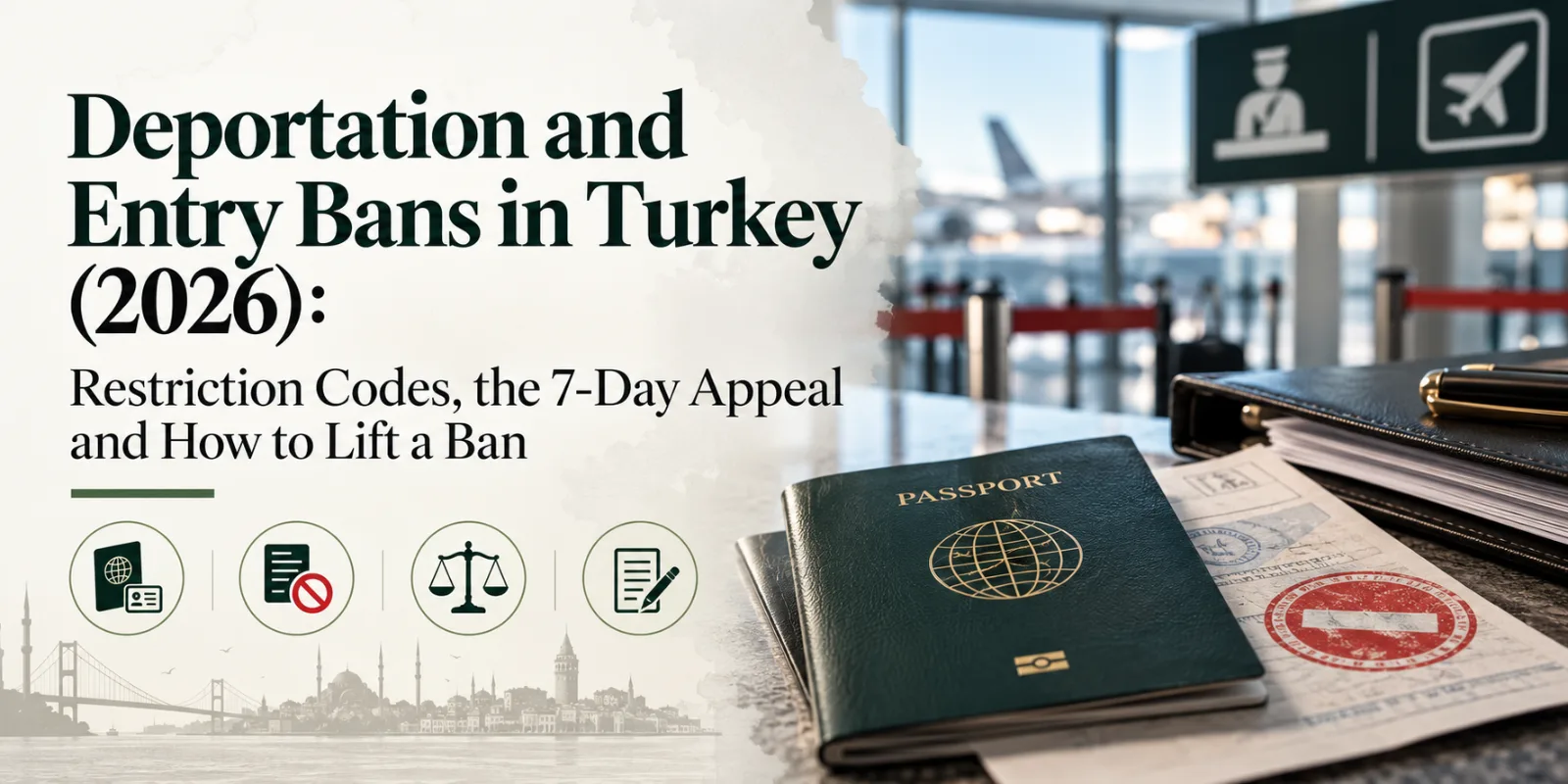
The grounds for deportation from Turkey, who cannot be deported, the 7-day appeal to the administrative court, removal centres and detention limits, entry ban durations, restriction codes such as Ç-113, and how to lift an entry ban.