Criminal Defence Lawyer in Istanbul & Ankara, Turkey
As an English-speaking criminal lawyer based in Istanbul and acting in Ankara and across Turkey, our office represents suspects, defendants and foreign nationals at every stage of Turkish criminal proceedings, from the first police interview to the final appeal. In a criminal case the right of defence arises from the very first moment of the investigation. Statements given at the police station or before the prosecutor stay in the file until the end, so the first hours often shape the whole case.
For a foreign national, a criminal file can have a second consequence: it may also affect a residence permit or lead to a deportation decision, which is a separate administrative procedure with its own short deadlines. This page explains in plain English how Turkish criminal procedure works, what rights a person has after an arrest, the penalties for offences that often involve foreigners, and how sentences, appeals and criminal records work.
Our office acts both as defence counsel for suspects and defendants and as the representative of victims and complainants. Throughout the process the client is told, in plain terms, where the file stands and which steps the law allows.
Criminal Lawyer in Istanbul, Turkey: What the Office Handles
A criminal lawyer in Turkey covers the full life of a file: attending police questioning, examining the evidence gathered during the investigation, objecting to custody, detention or judicial control decisions, preparing the defence for trial and, where necessary, appealing to the regional court of appeal or the Court of Cassation. For a suspect or defendant who is a foreign national, a criminal lawyer in Istanbul typically also works with the interpreter appointed by the authorities and, where relevant, with the person's consulate.
The office also acts on the other side of criminal files: for victims of fraud, assault, threats or forged documents who want to file a complaint, follow the investigation, join the trial as an intervening party (katılan) or object to a decision not to prosecute.
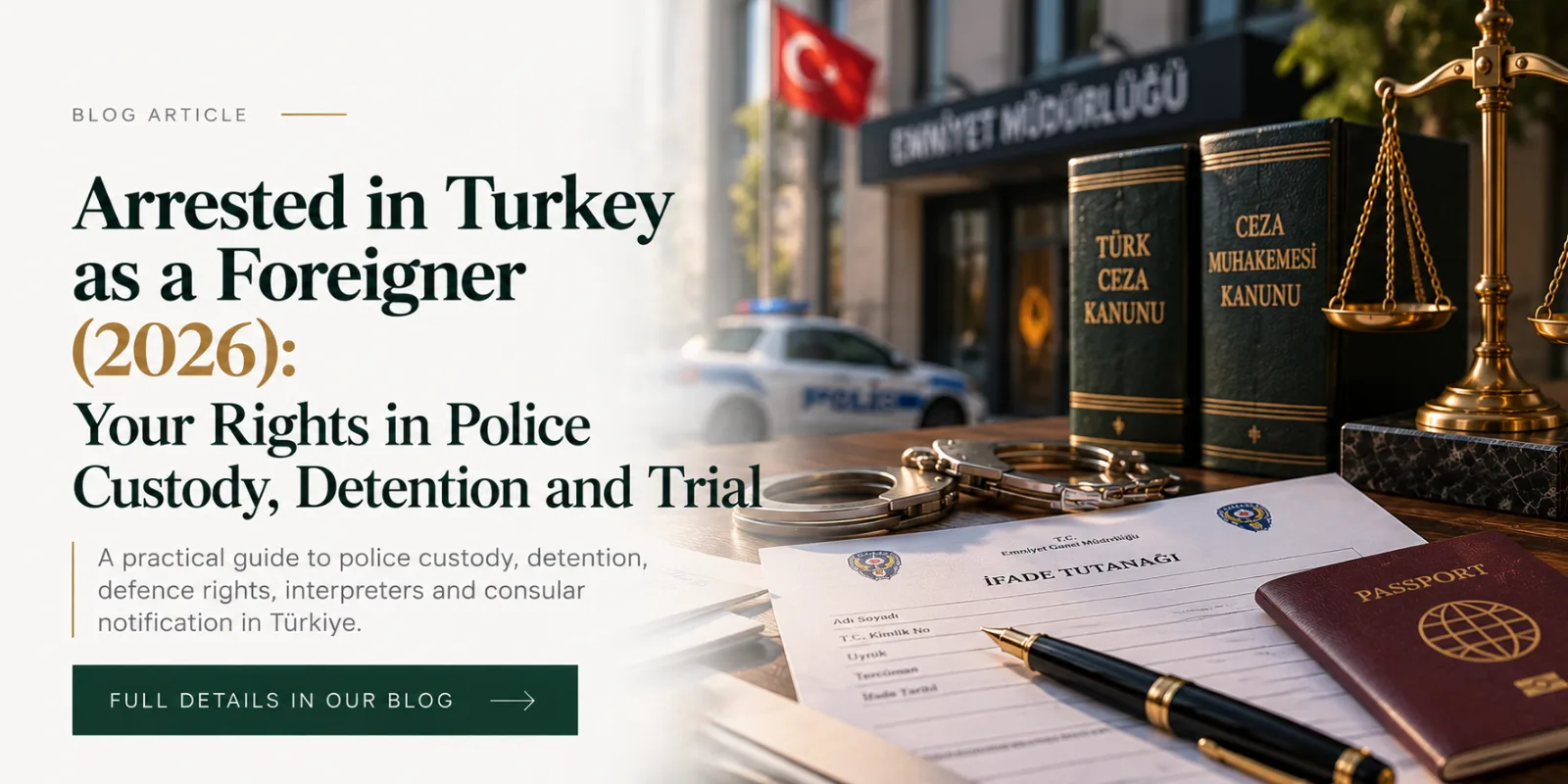
What Happens If You Are Arrested in Turkey?
After an arrest the person is normally held in police custody (gözaltı) while the prosecutor decides what to do. The law limits custody to 24 hours from the moment of arrest, not counting the time needed to bring the person to the nearest judge, which itself cannot exceed 12 hours (Article 91 of the Code of Criminal Procedure, known as CMK). For offences committed collectively, where evidence is hard to collect or there are many suspects, the prosecutor can extend custody by written order, one day at a time, for up to three more days. At the end of custody the person is either released or brought before a criminal judgeship of peace (sulh ceza hakimliği), which decides on detention or judicial control.
A suspect may be assisted by one or more lawyers at every stage, and up to three lawyers may be present while a statement is taken during the investigation (CMK Article 149). The lawyer's right to meet the client in private and to be present during the statement cannot be blocked or restricted. The only exception is a restriction of up to 24 hours that a judge may order for certain terrorism and state security offences and organised drug trafficking, during which no statement can be taken (Article 154).
If the suspect says he or she is unable to choose a lawyer and asks for one, the bar association appoints one (Article 150). A lawyer is appointed even without a request when the suspect is a child or is disabled to a degree that prevents self-defence, and in every investigation and trial for an offence whose minimum penalty is more than five years' imprisonment.
The Right to an Interpreter During Questioning and Trial
A person who does not speak enough Turkish to explain himself or herself is entitled to an interpreter. At the investigation stage the interpreter is appointed by the judge or prosecutor, and at trial by the court; the essential points of the accusation and the defence are translated (CMK Article 202). Interpreters' costs for people who do not speak Turkish are paid by the State and are not charged to the defendant (Article 324).
The record of a statement is read to the person before it is signed (Article 147), which for a non-Turkish speaker happens through the interpreter. The signed record later becomes part of the evidence. A defendant may also choose to make the oral defence, after the indictment is read and after the prosecutor's final opinion, in another language with an interpreter of his or her choice from the official list; that interpreter is not paid by the State.
The Right to Remain Silent and to Have Family and Consulate Informed
Before questioning, the person must be told the accusation and that he or she has the legal right not to make any statement about it (CMK Article 147). Questions about identity are the exception: they have to be answered truthfully. The suspect can also ask for specific evidence to be collected in his or her favour.
A relative or another person chosen by the suspect is informed of the arrest without delay on the prosecutor's order (Article 95). If the person arrested is a foreign national, the consulate of his or her country is informed unless the person objects in writing (Article 95/2). This reflects Article 36 of the Vienna Convention on Consular Relations and exists alongside, not instead of, the right to a lawyer.
Police Statement (İfade) and Questioning by a Judge (Sorgu)
A statement (ifade) is taken by the police or the prosecutor; questioning (sorgu) is carried out by a judge, for example when detention is requested or at trial. Statements obtained by prohibited methods such as ill-treatment, torture, deception, threats or exhaustion cannot be used as evidence even if the person consented (CMK Article 148). A statement taken by the police without a lawyer present cannot be the basis of a judgment unless the suspect confirms it before a judge or court (Article 148/4).
Statements given at different stages are compared with each other. In practice, contradictions between the first police statement and later accounts are among the points most often relied on against a defendant.
Objecting to Police Custody: Who Can Apply
The person in custody, the lawyer, the legal representative, the spouse or a first or second-degree blood relative (such as a parent, child, sibling or grandparent) can apply to the criminal judgeship of peace against the arrest, the custody order or its extension, asking for immediate release. The judge examines the application on the papers and decides immediately, and in any case before 24 hours have passed (CMK Article 91/5).
A person released because custody expired or by the judge's decision cannot be arrested again for the same act unless new and sufficient evidence is obtained and the prosecutor so decides (Article 91/6).
Police Custody Rules for Tourists and Foreign Residents
The same custody limits apply to Turkish citizens and foreigners; there is no separate, longer custody period for foreign nationals. In practice, language barriers and the time needed to reach a consulate make this short window particularly important. Special rules exist for certain offences caught in the act and for terrorism offences, which are outside the scope of this page.
Why the First Hours Matter in a Criminal Case in Turkey
The statement a suspect gives at the very first interview, often before any lawyer has seen the file, frequently shapes the entire course of a case. A later statement can change the account, but the earlier one stays in the file and the difference itself becomes a point of discussion.
Objection periods against custody, detention and judicial control decisions are short, and evidence favourable to the defence, such as camera footage, messages or witnesses, is in practice often easiest to secure early, before it is lost or deleted. Involving a criminal lawyer in Turkey at the point of arrest or at the first summons, rather than after an indictment has already been filed, changes which options remain available.
Pre-Trial Detention in Turkey (Tutuklama): When Can a Judge Order It?
Pre-trial detention is not a punishment but a protective measure. A judge can order it only where concrete evidence shows a strong suspicion that the offence was committed and there is a ground for detention, such as concrete facts suggesting a risk of flight or hiding, or a strong suspicion that the person will destroy evidence or put pressure on witnesses or victims (CMK Article 100). Detention cannot be ordered where it would be disproportionate to the importance of the case and the expected penalty.
During the investigation detention is ordered by the criminal judgeship of peace at the prosecutor's request; at trial it is ordered by the court (Article 101). The decision has to show, with concrete facts, the strong suspicion, the ground for detention, its proportionality and why judicial control would not be enough.
Catalogue Offences: When a Ground for Detention Can Be Presumed
For offences listed in Article 100/3, a ground for detention can be presumed where there is strong suspicion based on concrete evidence. The list includes, among others, intentional killing, aggravated forms of intentional injury, sexual assault, child sexual abuse, theft, robbery, drug manufacturing and trafficking, migrant smuggling and human trafficking, and intentional injury against a woman.
When Detention Is Not Allowed
Detention cannot be ordered for offences punishable only by a judicial fine, or for offences whose maximum prison penalty is two years or less, except for intentional offences against bodily integrity (CMK Article 100/4). In these files, judicial control can still be imposed.
Maximum Length of Pre-Trial Detention in Turkey
For cases outside the assize court's jurisdiction, detention may last at most one year, which can be extended by six months in compulsory cases. For assize court cases the limit is two years, which can be extended with reasons, but the extensions may not exceed three years in total, or five years for terrorism and certain state security offences (CMK Article 102).
At the investigation stage the limits are shorter: six months for cases outside the assize court's jurisdiction and one year for assize court cases, with longer limits for terrorism, state security and collectively committed offences. Time spent in custody and detention is deducted from any final prison sentence (Article 63 of the Turkish Penal Code, known as TCK).
How Is a Detention Order Challenged in Turkey?
An objection can be filed within two weeks of learning of the decision, by a petition to the judge who issued it or by a statement recorded by the court clerk (CMK Article 268). The two-week period has applied since Law No. 7499 of 2024; before that it was seven days. If the issuing judge does not correct the decision, the objection is sent within three days at most to the reviewing authority. Detention and judicial control decisions of a criminal judgeship of peace are reviewed by a judge of the criminal court of first instance (asliye ceza) in the same judicial district (Article 268/3-b).
Detention Reviews and Applications for Release
A suspect or defendant may ask for release at every stage of the investigation and trial (CMK Article 104). During the investigation, the criminal judgeship of peace must review, at intervals of no more than 30 days, whether detention should continue, after hearing the suspect or the lawyer (Article 108). At trial the court decides on continued detention at every hearing and, where needed, between hearings.
In practice, new facts such as a fixed address, regular work or family ties in Turkey are put forward in these reviews, together with a proposal for a less restrictive measure such as judicial control.
Compensation for Unlawful or Unjustified Detention
The State can be asked to pay pecuniary and non-pecuniary damages in situations listed in CMK Article 141, for example where a person was arrested or detained outside the conditions set by law, was not brought before a judge within the legal custody period, was not told the reasons for the arrest, or was lawfully detained but later received a non-prosecution decision or an acquittal.
The claim must be made within three months of being notified that the decision has become final, and in any event within one year of the date it became final (Article 142). Since Law No. 7499 of 2024, claims based on lawful detention followed by non-prosecution or acquittal, and certain related claims, are decided by the Compensation Commission (Tazminat Komisyonu) under Law No. 6384 rather than by the assize court.
Judicial Control (Adli Kontrol) in Turkey: Reporting, Travel Bans and House Arrest
Judicial control is the main alternative to detention. Instead of being detained, the suspect is placed under one or more obligations (CMK Article 109). The law lists, among others, not leaving the country; reporting regularly to a place set by the judge, usually a police station; not driving vehicles; undergoing treatment, in particular for drug or alcohol dependence; depositing a sum of money as security; not possessing weapons; not leaving the home; not leaving a certain area; and not going to certain places.
Is There Bail in Turkey? Depositing a Security
Turkish law does not use the word bail in the common-law sense, but one judicial control obligation is to deposit a security (güvence) fixed by the judge at the prosecutor's request, taking the suspect's financial situation into account and payable in one go or in instalments (CMK Article 109/3-f).
The security has two parts. The part that secures attendance and compliance with the obligations is returned when the obligations are met. The other part can be used for the victim's losses, public costs and fines if there is a conviction, and is returned on non-prosecution or acquittal (Articles 113 to 115).
House Arrest and Credit Against the Sentence
Time spent under judicial control is in principle not deducted from a later prison sentence. Two exceptions exist: the treatment obligation and the obligation not to leave the home. For house arrest, every two days are counted as one day when the sentence is calculated (CMK Article 109/6).
What Happens If Judicial Control Is Breached?
If a suspect or defendant deliberately fails to comply with judicial control obligations, the competent judge or court can immediately order detention, whatever the length of the prison sentence that could be imposed (CMK Article 112). For this reason, the exact terms of an order, such as reporting days and places, matter in practice.
Can I Leave Turkey During a Criminal Investigation? Exit Bans Explained
It depends on whether a ban on leaving the country has been imposed as a judicial control measure (CMK Article 109/3-a). Where no such measure exists, a suspect or defendant is generally not prevented by the criminal file from travelling while an investigation or trial is ongoing, although foreign nationals may face separate immigration measures.
Where an exit ban is in place, it is applied at the border in practice, and leaving in breach of it, like any other deliberate breach of judicial control, can lead to a detention order (Article 112). An exit ban can be challenged by objection, and its lifting can be requested when circumstances change. How to check whether a ban exists and how it is lifted is explained in Exit Ban in Turkey: How to Check, Lift and Travel.
Attending Criminal Hearings from Abroad
A defendant who has already been questioned by the court can be excused from attending later hearings on request (CMK Article 196/1). Where a defendant abroad would find it difficult to attend on the hearing date, the questioning can be carried out at an earlier hearing or through another court by letters rogatory (istinabe) (Article 196/6). In practice the defence lawyer then follows the hearings and keeps the client informed.
Turkish Criminal Procedure Step by Step: From Investigation to Verdict
An investigation begins once suspicion of an offence comes to the attention of the police or the public prosecutor, either through a complaint or of the authorities' own motion. It is run by the prosecutor, with the police collecting evidence on the prosecutor's instructions. During the investigation the lawyer can examine the file and take copies, unless a judge has restricted access for certain serious offences because it could endanger the investigation; even then, the records of the suspect's own statements and expert reports remain accessible (CMK Article 153).
How a Criminal Investigation Ends in Turkey
If the evidence is not sufficient to justify a public prosecution, the prosecutor issues a decision of no grounds for prosecution (kovuşturmaya yer olmadığına dair karar, often called KYOK) (CMK Article 172). The victim can object to it within two weeks of notification before the criminal judgeship of peace (Article 173). If there is sufficient suspicion, the prosecutor files an indictment (iddianame) with the competent court.
For offences punishable by a maximum of three years or less, other than those subject to conciliation or advance payment, the prosecutor may instead postpone the public prosecution for five years if the conditions of Article 171 are met, including the full repair of the damage. If no intentional offence is committed during that period, a decision of non-prosecution follows.
The Trial Stage (Kovuşturma)
The trial begins once the court accepts the indictment. The court hears the defendant, witnesses and experts, and the parties discuss the evidence at hearings. Defence counsel's principal tasks at this stage include contesting the evidence, examining witnesses, challenging expert reports and presenting evidence favourable to the defendant. From the acceptance of the indictment the lawyer can examine the whole file and the secured evidence (CMK Article 153/4).
Possible Outcomes at the End of a Criminal Trial
A trial can end in a conviction, an acquittal, a deferral of the announcement of the verdict (HAGB), a decision that no penalty is to be imposed, or the dismissal of the case, for example after a successful conciliation or the withdrawal of a complaint for an offence subject to complaint. Each of these has different effects on the criminal record and, for foreigners, on immigration files.
Which Court Hears Your Criminal Case in Turkey?
Which court is competent depends on the offence charged, not on the nationality or residence of the accused. Three kinds of judicial bodies matter in practice. The criminal judgeship of peace (sulh ceza hakimliği) does not try cases; during the investigation it decides on detention, judicial control, searches and seizures, and hears objections to many investigation decisions (Law No. 5235, Article 10).
The criminal court of first instance (asliye ceza mahkemesi) sits with a single judge and hears most offences. The assize court (ağır ceza mahkemesi), which sits as a panel of a president and two members, hears offences punishable by more than ten years' imprisonment or by life imprisonment, together with listed offences such as robbery, forgery of an official document by a public officer and fraudulent bankruptcy (Law No. 5235, Articles 9 and 12).
In principle the case is heard where the offence was committed (CMK Article 12). For offences committed by using information systems, banks or bank cards, the courts of the victim's place of residence are also competent (Article 12/6), which matters for victims of online fraud.
Drug Charges in Turkey: Personal Use or Trafficking?
Turkish law draws a sharp line between buying, accepting or possessing drugs for personal use and trafficking them. The law does not set a fixed quantity below which possession is automatically treated as personal use. In practice the classification depends on the whole file: the quantity, the packaging, whether scales or small bags were found, messages on the phone and seized cash. Medicines that are legal elsewhere but subject to prescription controls in Turkey can also lead to investigations.
Penalty for Drug Use or Possession for Personal Use in Turkey
Buying, accepting or possessing drugs for personal use, or using drugs, is punishable by two to five years' imprisonment (TCK Article 191/1). The penalty is increased by half where the act takes place in public places within 200 metres of schools, dormitories, hospitals, barracks, places of worship and similar buildings (Article 191/10).
Five-Year Deferral of Prosecution and Probation
In an investigation for personal use, the prosecutor postpones the public prosecution for five years, without requiring the general conditions of CMK Article 171 (TCK Article 191/2). During this period the suspect is placed under probation (denetimli serbestlik) for at least one year, which can be extended by six-month periods for up to two more years, and may be required to undergo treatment; testing is ordered at least twice a year (Article 191/3).
If the person complies until the end of the five years, a decision of non-prosecution is issued. If the person persistently breaches the obligations, or again buys, accepts, possesses or uses drugs during the period, the public prosecution is brought (Article 191/4).
Seeking Treatment Before an Investigation Starts
A person who uses drugs and applies to the authorities or a health institution for treatment before an investigation is opened is not punished, and public officials and health professionals are not obliged to report that person (TCK Article 192/4). A person who reveals, before the authorities learn of it, from whom, where and when the drugs were obtained, and thereby helps catch the suppliers or seize the drugs, is also not punished (Article 192/2).
Drug Trafficking Charges: Why the Classification Matters
Selling, offering, giving, transporting, storing, buying or possessing drugs without a licence within the country, where this amounts to trafficking, is punishable by no less than ten years' imprisonment and a judicial fine (TCK Article 188/3); importing or exporting is punishable by twenty to thirty years (Article 188/1). The penalty is increased by half for substances such as heroin, cocaine, synthetic cannabinoids or amphetamines (Article 188/4).
The special five-year deferral for personal use does not apply to trafficking, and detention is more likely, since drug trafficking is among the offences for which a ground for detention can be presumed. The first defence question in many drug cases is therefore the legal classification of the act.
Drug Cases, Residence Permits and Deportation
Separately from the criminal case, the migration authorities may treat a drug case as a threat to public order or public health and cancel a residence permit or issue a deportation decision (Law No. 6458 on Foreigners and International Protection, Article 54). This administrative route runs independently, even where the prosecution has been deferred. A deportation decision can be challenged before the administrative court within seven days of notification (Article 53).
Fraud Charges and Fraud Complaints in Turkey
Fraud (dolandırıcılık) is prosecuted ex officio, so no complaint period applies. Speed still matters in practice, because transferred money often moves quickly from account to account.
Penalties for Simple and Qualified Fraud in Turkey
Simple fraud, deceiving someone through fraudulent conduct to obtain a benefit to that person's or another's detriment, is punishable by one to five years' imprisonment and a judicial fine of up to 5,000 days (TCK Article 157).
Qualified fraud, for example using information systems, banks or credit institutions as a tool, or pretending to be a public official or a bank, insurance or credit institution employee, is punishable by three to ten years' imprisonment and a judicial fine (Article 158). In those situations the minimum prison term is four years and the fine cannot be less than twice the benefit obtained. The penalty increases by half where three or more people act together, and doubles where the offence is committed within a criminal organisation.
Giving Your Bank Account or Card Details to Someone Else
Many foreigners are surprised to learn that handing over a bank account, a card or the information needed to use an account, often for a small payment, can lead to an investigation for participation in fraud when the account is used to move fraud proceeds. Under Article 158/4, added by Law No. 7589 of 16 July 2026, where a person's participation is limited to giving such payment instruments or account access details to someone else in order to obtain an unjust benefit, the penalty is reduced by half.
The reduction lowers the penalty but does not make the conduct lawful, and the account is usually frozen as well. The banking side of these files is covered in Crypto P2P and Binance: Bank Account Frozen in Turkey.
How Fraud Victims File a Criminal Complaint in Turkey
A complaint can be made to the chief public prosecutor's office (Cumhuriyet Başsavcılığı) or to the police or gendarmerie, either in writing or orally to be recorded (CMK Article 158). The material usually attached includes transfer receipts, the IBAN of the receiving account, messages, screenshots showing names, numbers and dates, and the names of witnesses.
For offences committed through information systems, banks or cards, the courts of the victim's place of residence are also competent (Article 12/6). Complaints about offences committed abroad that must be prosecuted in Turkey can also be filed with Turkish embassies and consulates (Article 158/3).
Recovering Money: The 48-Hour Account Suspension and Seizure
Since Law No. 7571 of 24 December 2025, where there is reasonable suspicion of theft through information systems, fraud through information systems or banks, fraud by impersonating officials or bank staff, or misuse of bank cards, a bank, payment institution or crypto-asset service provider can suspend the account used in the offence for up to 48 hours and must report it to the prosecutor immediately (CMK Article 128/A). The account holder is informed and can apply to the prosecutor to lift the suspension; the prosecutor decides within 24 hours.
Within the suspension period the money can be seized by a judge's decision, or by the prosecutor's written order in urgent cases, which has to be approved by a judge. Seized proceeds that are found to belong to the victim are returned during the investigation or trial. Outside this fast-track route, the seizure of accounts follows the general rules of Article 128.
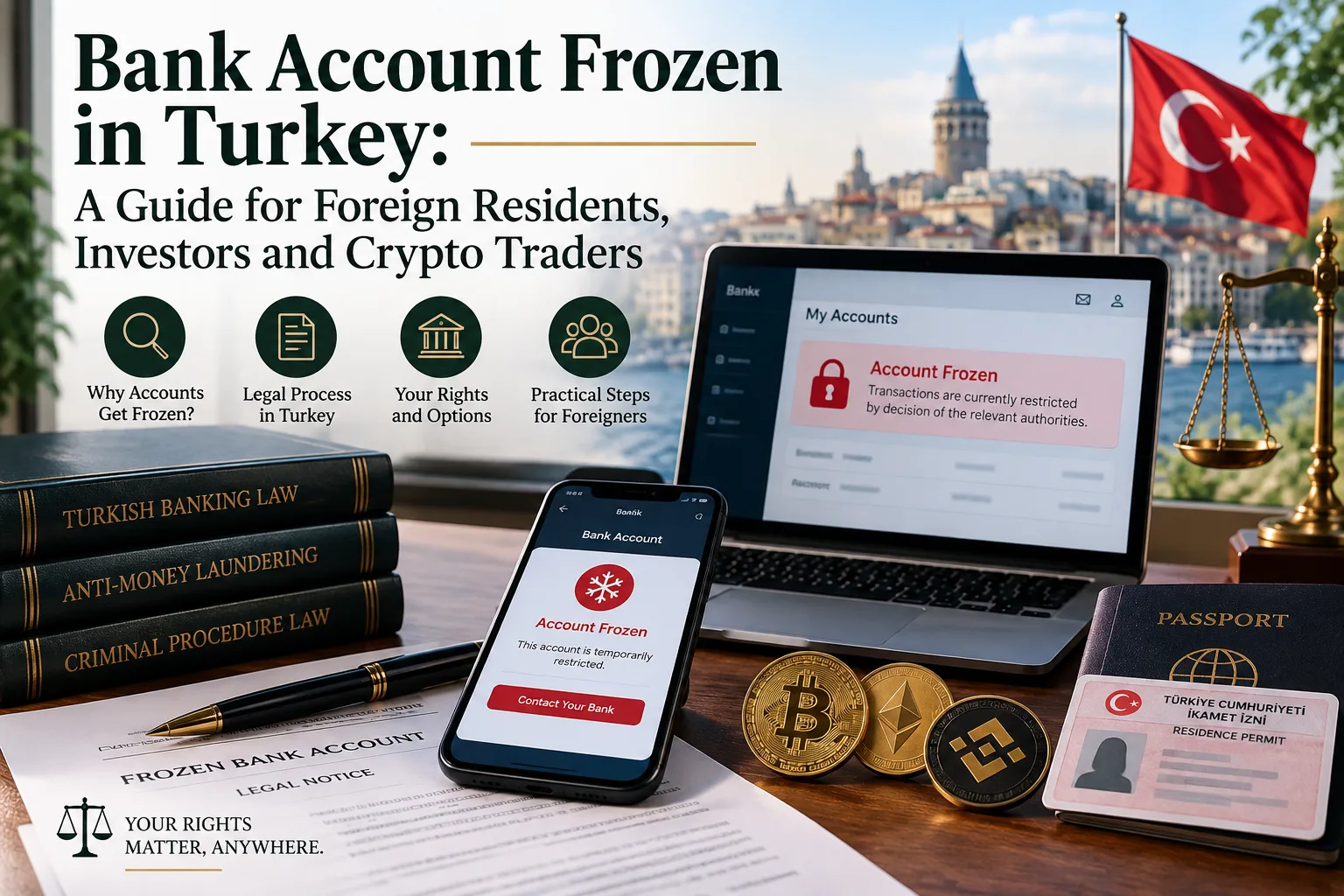
Bank Account Frozen in a Criminal Investigation in Turkey
A bank account can be blocked in connection with a criminal file in several ways: a suspension of up to 48 hours by the bank itself under CMK Article 128/A, a seizure (elkoyma) ordered by a criminal judgeship of peace under Article 128, or an administrative measure taken by MASAK, the Financial Crimes Investigation Board. For a seizure under Article 128 for listed offences such as fraud or theft, the law requires a report on the value obtained from the offence, from an authority such as BDDK, SPK or MASAK, which is to be prepared within three months and can be extended by two months.
The first practical step is usually to find out from the bank which authority imposed the block and under which file number, because the route to challenge it depends on that answer. The situation of foreign residents and investors is covered in Bank Account Frozen in Turkey.
Theft and Shoplifting in Turkey: Penalties and Effective Remorse
Simple theft is punishable by one to three years' imprisonment (TCK Article 141). Qualified theft carries heavier penalties: three to seven years, for example for property in public institutions, places of worship or public transport vehicles and stations (Article 142/1), and five to ten years, for example for pickpocketing or snatching, theft using information systems, or theft of property kept locked or inside a building (Article 142/2).
Returning the Property: Effective Remorse (Etkin Pişmanlık)
If the offender personally shows remorse and fully compensates the victim, by returning the property or paying for the damage, after the offence but before the trial stage begins, the penalty is reduced by up to two-thirds. If this happens after the trial has begun but before judgment, the reduction is up to one-half (TCK Article 168). Partial compensation counts only with the victim's consent. The same rules apply to fraud, breach of trust and damage to property, so the timing of compensation can change the outcome considerably.
Shoplifting and Residence Permits
A theft from a shop can look minor, but for a foreigner it can be relied on as a public order ground to cancel a residence permit or issue a deportation decision, even where the criminal case ends with a lenient outcome. Simple theft is among the offences subject to conciliation (CMK Article 253).
Assault, Bar Fights and Domestic Violence Charges in Turkey
Intentional injury is punishable by one year and six months to three years' imprisonment (TCK Article 86/1). If the injury is minor enough to be treated with simple medical intervention, the penalty is six months to one year and six months, or a judicial fine, and prosecution requires the victim's complaint (Article 86/2); where the victim is a woman, the minimum cannot be less than nine months. These ranges reflect the amendment made by Law No. 7550, in force since June 2025.
Assault Against a Spouse or Relative, or With a Weapon
If the injury is committed against a parent or grandparent, a child or grandchild, a spouse, a former spouse or a sibling, against a person unable to defend themselves, or with a weapon, the penalty is increased by half and prosecution does not depend on a complaint (TCK Article 86/3). For this reason, a spouse's withdrawal of a complaint does not end such a case. Intentional injury against a woman is also among the offences for which a ground for detention can be presumed (CMK Article 100/3).
The Medical Report After an Assault
In injury cases, the degree of injury recorded in the forensic medical report determines the legal classification and the penalty. A report obtained soon after the incident therefore carries particular weight, as injuries are harder to prove once they have healed. Women facing violence can also apply for protection orders under Law No. 6284 on the protection of the family and the prevention of violence against women, alongside a criminal complaint.
Threats, Insults and Social Media Offences in Turkey
Threatening to attack someone's life, body or sexual integrity, or that of a relative, is punishable by six months to two years' imprisonment (TCK Article 106/1), and by two to seven years where it is done with a weapon, anonymously, by several people together or by exploiting the intimidating power of a criminal organisation (Article 106/2).
Insult, by attributing a concrete act or fact to someone or by swearing at them, is punishable by three months to two years' imprisonment or a judicial fine. The same penalty applies when the insult is made through a voice, written or video message addressed to the victim, such as a WhatsApp message (Article 125/1 and 125/2), and it is increased where the insult is made publicly.
Complaints and Advance Payment in Insult Cases
Ordinary insult is prosecuted only on complaint. The complaint must be filed within six months of learning of the act and the offender, and for insult in any case within two years of the act (TCK Article 73, as amended in 2024). Insult is excluded from conciliation (CMK Article 253/3); instead, since 2024 most insult offences fall within advance payment, where paying the amount notified by the prosecutor ends the matter without a public prosecution (TCK Article 75).
Spreading Disinformation and Removing Online Content
Publicly spreading false information about the country's internal or external security, public order or public health, solely to create anxiety, fear or panic among the public and in a way capable of disturbing public peace, is punishable by one to three years' imprisonment (TCK Article 217/A). Sharing rumours in group chats can raise the same question, and such files can also come up in a foreigner's residence assessment.
Separately, the former procedure for blocking online content on personal-rights grounds under Article 9 of Law No. 5651 was annulled by the Constitutional Court, with effect from 10 October 2024; the procedure for violations of private life under Article 9/A remains.
Keeping Electronic Evidence
Online offences are usually proven with screenshots showing the name, number and date, and the prosecutor may ask for the phone itself to be examined. The original conversation therefore remains relevant even after a complaint has been filed. Searching and copying computers and digital records during an investigation is subject to the conditions of CMK Article 134.
Cybercrime and Digital Evidence Defence in Turkey
Offences committed through information systems include unlawfully entering or remaining in a system, punishable by up to one year's imprisonment or a judicial fine (TCK Article 243/1); hindering or disrupting a system, one to five years (Article 244/1); damaging, deleting, altering or transferring data, six months to three years (Article 244/2); and obtaining an unjust benefit through such acts, two to six years where no other offence is committed (Article 244/4). Misusing another person's bank or credit card is punishable by three to six years (Article 245/1).
In these files the defence often focuses on how the digital evidence was obtained, whether the chain of custody of a device or account was maintained, and whether data was searched and copied in line with CMK Article 134. Crypto-asset and online banking allegations raise the same questions.
Traffic Accidents and Negligence Offences in Turkey
Causing a person's death by negligence, for example in a traffic accident, is punishable by two to six years' imprisonment, and by two to fifteen years where more than one person dies, or where one or more people die and others are injured (TCK Article 85). Negligent injury is punishable by four months to two years' imprisonment or a judicial fine, increased according to the seriousness of the injury (Article 89).
Prosecution for negligent injury depends on a complaint, except where the act was committed with conscious negligence and goes beyond the basic form (Article 89/5). A prison sentence for a negligent offence can be converted into a judicial fine even if it is long, where the other conditions are met, unless the negligence was conscious (Article 50/4). Negligent injury is also subject to conciliation.
White-Collar Crime, Breach of Trust and Forged Documents
Fraud, breach of trust, embezzlement, bribery, forgery of documents and offences under banking, capital markets and money-laundering legislation form a distinct category of practice. These files are typically document-heavy and rely on financial evidence, such as bank records, company accounts and expert accounting reports, rather than on witness testimony alone, so the defence work centres on the documents from the outset.
Breach of trust, disposing of property entrusted for safekeeping or a specific use, is punishable on complaint by six months to two years' imprisonment and a judicial fine. Where the property was entrusted in the course of a profession, trade or service relationship, or under a power to manage another's property, the penalty is one to seven years (TCK Article 155). Since Law No. 7571 of December 2025, the penalty is doubled where the property is a motor vehicle, boat or aircraft (Article 155/3).
Property Sold With a Forged Power of Attorney
Foreign property owners are sometimes targeted with forged identity documents or a forged power of attorney used to sell their property at the land registry. Forging an official document, or using a forged one, is punishable by two to five years' imprisonment, and the penalty increases by half where the law treats the document as valid until its forgery is proven (TCK Article 204).
The criminal complaint runs alongside a civil action to cancel the title transfer; both are covered in Property Sold Without My Knowledge in Turkey.
Offences Foreigners in Turkey Can Commit Without Realising
Many criminal files involving foreigners begin with conduct the person did not think of as a crime, such as handing over a bank account, giving someone a lift across a border region or buying a cheap second-hand phone. Flying drones or taking photographs near military zones without authorisation can also lead to investigations under special legislation.
Housing or Renting to Undocumented Foreigners
Allowing a foreigner who has no valid travel document, foreigner identity card, residence permit or travel permit to enter or leave the country, travel within it, stay or be accommodated, or renting property to such a person, is subject to an administrative fine for each foreigner under Law No. 6458 (Article 102/2), unless the act is defined as a separate crime. In practice, landlords and accommodation providers therefore check the documents of foreign tenants and guests.
Transporting Irregular Migrants
Helping a foreigner enter or stay in Turkey illegally, or helping anyone leave the country illegally, in order to obtain a direct or indirect material benefit, is the offence of migrant smuggling. It is punishable by five to eight years' imprisonment and a judicial fine, even if it remains at the attempt stage (TCK Article 79). Drivers who believed they were carrying ordinary paying passengers sometimes face this charge.
Buying a Phone or Goods of Unknown Origin
Buying, accepting, selling or transferring property obtained through a crime, without having taken part in that crime, is punishable by six months to three years' imprisonment and a judicial fine (TCK Article 165). An invoice or a written sales contract therefore matters in practice when buying a second-hand phone or car. This offence is subject to conciliation.
Conciliation (Uzlaştırma) in Turkish Criminal Cases
For offences listed in CMK Article 253, the file is sent to a conciliation bureau, and an independent conciliator tries to reach an agreement between the suspect and the victim. The list covers offences prosecuted only on complaint and, regardless of complaint, a number of other offences: intentional injury (except the aggravated forms in Article 86/3), negligent injury, threats under Article 106/1, violation of the home, simple theft, breach of trust (except Article 155/3), simple fraud under Article 157 and buying or accepting stolen goods, among others.
Qualified fraud under Article 158 is not on the list. Even where an offence requires a complaint, conciliation is excluded for offences against sexual integrity, stalking and insult (Article 253/3).
How the Conciliation Process Works
The conciliator makes an offer to the parties, who have seven days to answer; silence counts as refusal (CMK Article 253/4). The conciliator normally concludes within 30 days of receiving the documents, and the bureau can extend this twice, by up to 20 days each time (Article 253/12). Statements made during the talks cannot be used as evidence (Article 253/20).
If the suspect performs the agreed obligation at once, a decision of non-prosecution is issued; if payment is deferred, in instalments or continuous, the public prosecution is postponed and is brought if the agreement is not honoured (Article 253/19). A failed conciliation cannot be repeated (Article 253/18).
Several Offences in One File
If an offence subject to conciliation is committed together with an offence outside it against the same victim, the conciliation rules do not apply. Since Law No. 7571 of December 2025 there is an exception where the other offence falls within advance payment: conciliation then still applies to the offence that is subject to it (CMK Article 253/3).
Advance Payment (Önödeme)
Advance payment applies, outside the offences subject to conciliation, to offences punishable only by a judicial fine or by imprisonment with an upper limit not exceeding six months, and to some specifically listed offences, including most forms of insult (TCK Article 75). The prosecutor notifies the suspect of the amount; if it is paid within ten days together with investigation costs, no public prosecution is brought. On request made within those ten days, the amount may be paid in three equal monthly instalments; if an instalment is missed, the investigation continues.
Deferral of the Verdict (HAGB), Suspended Sentences and Alternatives
Not every conviction means prison. Several mechanisms allow a short sentence not to be executed, and in less serious files one of them is often the realistic aim of the defence. Foreigners can benefit from them under the same conditions as Turkish citizens, although the immigration effect is assessed separately.
What Is HAGB in Turkey? Deferral of the Announcement of the Verdict
If the penalty imposed is two years' imprisonment or less, or a judicial fine, the court can defer the announcement of the verdict (hükmün açıklanmasının geri bırakılması, HAGB) (CMK Article 231, as amended by Law No. 7589 in July 2026). The conditions are that the defendant has no previous conviction for an intentional offence, the court is satisfied that he or she will not reoffend, and the damage has been fully repaired, or will be paid in monthly instalments during the supervision period.
The defendant is then supervised for five years. If no new intentional offence is committed and the obligations are observed, the verdict is set aside and the case is dismissed. A deferred sentence cannot also be suspended or converted. HAGB decisions are kept in a special register rather than the ordinary criminal record, and they can be appealed to the regional court.
Suspended Prison Sentences (Erteleme)
A prison sentence of two years or less can be suspended, or three years or less for people under 18 or over 65 at the time of the act, provided the person has not previously been sentenced to more than three months' imprisonment for an intentional offence and the court is convinced that he or she will not reoffend (TCK Article 51). A supervision period of one to three years is set, which cannot be shorter than the sentence itself.
Converting Short Prison Sentences into Fines or Other Measures
A prison sentence of one year or less is a short-term sentence and can be converted into a judicial fine or another alternative measure, such as full repair of the damage, a ban on going to certain places, or community work with the person's consent (TCK Articles 49 and 50). Courts can also reduce a sentence by up to one-sixth for discretionary reasons such as the defendant's background, social relations, remorse after the offence and during the trial, or the possible effect of the penalty on the defendant's future (Article 62).
How Prison Time Is Calculated in Turkey: Conditional Release
A person sentenced in Turkey usually does not spend the whole sentence stated in the judgment inside prison. The execution system allows conditional release (koşullu salıverilme) after part of the sentence has been served with good behaviour; the rest is spent under supervision outside prison.
The One-Half Rule and Its Exceptions
As a rule, people sentenced to a fixed prison term can be conditionally released after serving half of it with good behaviour; for life imprisonment the period is 24 years and for aggravated life imprisonment 30 years (Law No. 5275 on the Execution of Sentences, Article 107). A two-thirds ratio applies to certain offences, including intentional killing, many sexual offences, torture, offences against private life and espionage, and to offences committed within a criminal organisation.
Execution rules are amended from time to time, so each case is calculated according to the offence and the date it was committed. A first estimate can be made with the conditional release calculator.
Supervised Release Before the Conditional Release Date
Prisoners in an open prison with good behaviour who have one year or less left until their conditional release date can ask to serve that remaining part outside under probation, on a decision of the enforcement judge (Law No. 5275, Article 105/A). Since June 2025 the prisoner must also have served in prison at least one-tenth of the period to be spent there until conditional release, and not less than five days. Longer windows apply to women with children aged up to six and to seriously ill, disabled or elderly prisoners.
How Long Is a Prison Year in Turkey?
A prison year in Turkey is a full calendar year. A day is 24 hours and a month 30 days, and years are calculated according to the official calendar (TCK Article 61/6). There is no shortened prison year; the reduction in time actually spent inside comes from conditional release and supervised release, not from a shorter year.
Open Prisons in Turkey
An open prison (açık ceza infaz kurumu) has no high-security perimeter. Under the relevant regulation, sentenced persons can be transferred there after a period in a closed prison with good behaviour, and some short sentences start there directly; people convicted of certain serious offences are excluded.
Is There a General Amnesty in Turkey?
A general or special amnesty can only be granted by the Grand National Assembly with a three-fifths majority of its total number of members (Constitution, Article 87). Messages on social media about an approaching amnesty have no legal effect until a law is actually passed and published in the Official Gazette, and they do not change hearing dates or appeal deadlines. Judicial reform packages (yargı paketi) sometimes change execution rules, but the scope of each change is found only in the published text.
How Are Criminal Judgments Appealed in Turkey?
A first-instance judgment can be appealed to the regional court of appeal (istinaf) within two weeks of service of the judgment with its written reasoning (CMK Article 273). The regional court's judgment can then, in the cases allowed by law, be appealed on points of law to the Court of Cassation (Yargıtay), again within two weeks of service of the reasoned judgment (Article 291). Before Law No. 7499 of 2024 the period was seven days and ran from the pronouncement.
Missing the deadline makes the judgment final. A detained defendant can lodge the appeal through the prison director, which stops the clock (Article 263). The deadline can be checked with the appeal deadline calculator.
Judgments That Cannot Be Appealed
Some decisions are final at first instance, such as convictions to a judicial fine of up to 15,000 Turkish lira, other than fines converted from prison terms, and acquittals for offences punishable by a judicial fine of no more than 500 days (CMK Article 272/3). Prison sentences of 15 years or more are reviewed by the regional court of its own motion (Article 272/1).
An appeal to the Court of Cassation is not available against many regional court decisions, for example where the regional court rejected on the merits an appeal against a prison sentence of five years or less (Article 286/2). For the defendant, failing to state reasons in the appeal does not prevent the examination (Article 273/4).
Criminal Record (Adli Sicil) in Turkey: What Appears and When It Is Deleted
A criminal record certificate (adli sicil kaydı) can be obtained through e-Devlet or from a prosecutor's office and is often requested by employers and in some residence and citizenship procedures. Once a sentence has been executed, the time limit for executing it has expired, or a general amnesty applies, the conviction is removed from the criminal record and moved to the archive record (Law No. 5352, Article 9). Convictions to judicial fines and suspended sentences go directly to the archive.
The archive record is deleted completely five years after the conditions for archiving were met for ordinary convictions. For convictions that cause a loss of rights under Article 76 of the Constitution or other laws, the periods are 15 years if a decision restoring the rights is obtained, or 30 years without one (Article 12). HAGB decisions, prosecution deferrals and decisions after advance payment are recorded in special registers that only prosecutors, judges and courts can consult for a later case.
Can a Criminal Case Lead to Deportation from Turkey?
A deportation decision can be taken against a foreigner considered a threat to public order, public security or public health (Law No. 6458, Article 54/1-d), and a criminal investigation or conviction may be relied on for this. A residence permit can also be cancelled or its renewal refused. In addition, when a foreigner sentenced to imprisonment is released on probation or conditionally, and in any case once the sentence is completed, the case is reported to the Ministry of Interior for assessment of deportation (TCK Article 59).
An appeal against a deportation decision is filed with the administrative court within seven days of notification; the foreigner is not deported during that period or while the case is pending, unless he or she consents, and the court's decision is final (Law No. 6458, Article 53/3). This is a separate track from the criminal defence. Entry bans and the restriction codes that often follow are explained in Deportation, Entry Bans and Restriction Codes in Turkey, and the wider residence side on the immigration law page.
Effect on Turkish Citizenship Applications
For the ordinary naturalisation route, applicants must be of good moral character and must not pose an obstacle in terms of national security and public order (Turkish Citizenship Law No. 5901, Article 11). A criminal file can therefore be relevant to a citizenship application, and its practical effect depends on the offence, the outcome and whether the matter has concluded.
Does a Lenient Outcome Remove the Immigration Risk?
Not always. The migration authorities assess the public order risk independently and may rely on the facts rather than on the type of criminal decision alone. This is why the criminal defence and the residence situation are usually considered together from the start.
Extradition from Turkey and Interpol Red Notices
Extradition is governed by Law No. 6706 on International Judicial Cooperation in Criminal Matters, together with treaties to which Turkey is a party, such as the European Convention on Extradition. A foreigner can be extradited for an offence punishable under both Turkish law and the law of the requesting state by a maximum of at least one year's imprisonment, or, for a final conviction, where the sentence imposed is at least four months (Article 10).
Requests are examined first by the Ministry of Justice as the central authority and then by the assize court of the place where the person is (Articles 13 and 15); its decision can be appealed to the Court of Cassation, which decides within three months (Article 18). Carrying out an extradition decision requires the approval of the President (Article 19).
Grounds for Refusing Extradition
Extradition is refused, among other grounds, where the person is a Turkish citizen; where there are strong reasons to believe the person would be prosecuted or punished because of race, ethnic origin, religion, nationality, membership of a social group or political opinion, or would face torture or ill-treatment; where the offence is a thought crime, a political offence or a purely military offence; where it is time-barred or covered by an amnesty; where the person has already been acquitted or convicted in Turkey for the same act; or where the offence carries the death penalty or a penalty incompatible with human dignity, unless sufficient assurances are given (Law No. 6706, Article 11). The court may also refuse where extradition would be disproportionately harsh because of personal circumstances such as long residence in Turkey or marriage.
Provisional Arrest on an Interpol Red Notice
A person can be provisionally arrested before the formal request arrives, at the requesting state's request and with the Ministry's approval (Law No. 6706, Article 14). The person is brought before a criminal judgeship of peace within 24 hours at the latest and is informed about extradition by consent and its consequences; judicial control can be ordered instead of detention. Under the principle of reciprocity, provisional detention lasts at most 40 days if no extradition documents arrive; under a treaty, the treaty period applies.
A challenge to the Red Notice itself is a separate procedure before Interpol's Commission for the Control of Files, independent of the extradition case in Turkey.
Rights of Crime Victims and Complainants in Turkey
A victim can ask for evidence to be collected, ask the prosecutor for copies of documents as long as this does not harm the investigation, object to a decision of non-prosecution, be informed of hearings, and join the public prosecution as an intervening party (katılan) at any stage until the first-instance judgment (CMK Articles 234 and 237). Only a victim who has joined the case can appeal against the decision ending it. For offences prosecuted only on complaint, the complaint must be filed within six months of learning of the act and the offender (TCK Article 73).
Bar-Appointed Lawyers for Certain Victims
A victim without a lawyer can ask the bar association to appoint one in cases of sexual assault, child sexual abuse, stalking, intentional injury against a woman, torture or torment, and offences punishable by a minimum of more than five years' imprisonment. For child victims and victims unable to express themselves, a lawyer is appointed without a request (CMK Article 234). Compensation for the harm suffered is in practice claimed before the civil courts, where the criminal file is often used as evidence.
Following a Criminal Complaint from Outside Turkey
A complaint and the subsequent case can be followed through a lawyer acting under a power of attorney, which can be issued before a Turkish consulate abroad, so personal travel is not needed at most stages.
How Long Does a Criminal Case Take in Turkey?
The investigation stage can conclude within weeks for a straightforward file, or take considerably longer where financial records, digital evidence or many witnesses are involved. Once an indictment is filed, the trial typically runs for several months to over a year at first instance, and longer if the case goes to appeal. In practice, files with a detained defendant are generally handled with priority.
A lawyer reviewing the file at the outset can usually give a realistic range once the offence and the evidence are known, although an exact timetable cannot be set in advance. Prosecution is also subject to limitation periods: for example eight years for offences punishable by up to five years' imprisonment, and fifteen years for those punishable by more than five but less than twenty years (TCK Article 66).
How Much Does a Criminal Lawyer Cost in Turkey?
Criminal defence fees in Turkey cannot fall below the Attorneyship Minimum Fee Tariff (Avukatlık Asgari Ücret Tarifesi), which is prepared each year by the Union of Turkish Bar Associations. Our office's fees are set within this framework; the amount depends on the stage the file is at (police custody, investigation, trial or appeal) and the seriousness of the offence charged, and can only be quoted once the specific file has been reviewed.
What to Consider When Choosing a Criminal Lawyer in Turkey
Relevant considerations include familiarity with the type of offence involved, the ability to communicate clearly in a language the client understands, availability for urgent matters such as police custody, and the ability to explain in plain terms what stage the file is at and what the realistic range of outcomes looks like. A lawyer who cannot clearly explain the difference between an investigation, a trial and an appeal is not yet in a position to discuss strategy.
The Role of a Criminal Lawyer Beyond the Courtroom
A criminal lawyer's role extends well beyond speaking at hearings: examining the evidence in the file, securing evidence favourable to the defence, properly challenging expert reports, making sure no time limit is missed and keeping the client informed make up most of the work. A suspect or defendant is legally entitled to act without a lawyer, except where a lawyer is mandatory, but given the complexity of files and the strict time limits this choice can lead to a serious loss of rights.
Criminal Lawyer in Ankara and Across Turkey
A criminal case is in principle heard by the court of the place where the offence was committed (Article 12 of the Code of Criminal Procedure). If a person is detained in Ankara, the statement, the investigation and the trial take place there, and the lawyer attends in that city. A criminal lawyer in Turkey registered with a Turkish bar can act before every prosecutor's office and court in the country.
The office is located in Istanbul. We act as a criminal lawyer in Istanbul and follow files in Ankara from Istanbul, attending the Ankara police stations, prosecutors' offices and courts when the procedure requires it. Someone looking for a criminal lawyer in Ankara therefore does not need a different lawyer in each city: the same lawyer can follow the custody stage, the detention hearing and the trial wherever they take place.
Key Time Limits in Turkish Criminal Proceedings
Step
Time limit
Legal basis
Police custody
24 hours from arrest, plus up to 12 hours to reach the nearest judge
CMK Art. 91/1
Extension for collectively committed offences
Up to 3 more days, one day at a time, by written order of the prosecutor
CMK Art. 91/3
Application against custody
Judge decides immediately, at the latest within 24 hours
CMK Art. 91/5
Objection to a detention or judicial control decision
2 weeks from learning of it (7 days until 2024)
CMK Art. 268
Review of detention during the investigation
At intervals of no more than 30 days
CMK Art. 108
Objection to a decision of non-prosecution
2 weeks from notification
CMK Art. 173
Complaint for offences subject to complaint
6 months from learning of the act and offender; for insult, at most 2 years from the act
TCK Art. 73
Answer to a conciliation offer
7 days; silence counts as refusal
CMK Art. 253/4
Advance payment
10 days from notification, or 3 monthly instalments on request
TCK Art. 75
Appeal to the regional court (istinaf)
2 weeks from service of the reasoned judgment
CMK Art. 273
Appeal to the Court of Cassation (temyiz)
2 weeks from service of the reasoned judgment
CMK Art. 291
Lawsuit against a deportation decision
7 days from notification
Law No. 6458, Art. 53/3
Compensation claim for detention
3 months from notification of finality, at most 1 year from finality
CMK Art. 142
Penalties for Common Offences in Turkey
Offence
Basic penalty
Legal basis
Drug use or possession for personal use
2 to 5 years, with a 5-year deferral of prosecution
TCK Art. 191
Drug trafficking within Turkey
Not less than 10 years and a judicial fine
TCK Art. 188/3
Simple fraud
1 to 5 years and a judicial fine
TCK Art. 157
Qualified fraud (banks, internet, impersonation)
3 to 10 years and a judicial fine; at least 4 years in these cases
TCK Art. 158
Simple theft
1 to 3 years
TCK Art. 141
Qualified theft
3 to 7 years, or 5 to 10 years for the forms in Art. 142/2
TCK Art. 142
Intentional injury
1 year 6 months to 3 years
TCK Art. 86/1
Minor intentional injury
6 months to 1 year 6 months or a judicial fine, on complaint
TCK Art. 86/2
Threat against life or body
6 months to 2 years
TCK Art. 106/1
Insult, including by message
3 months to 2 years or a judicial fine
TCK Art. 125
Publicly spreading misleading information
1 to 3 years
TCK Art. 217/A
Misuse of another person's bank card
3 to 6 years and a judicial fine
TCK Art. 245/1
Negligently causing death
2 to 6 years
TCK Art. 85/1
Migrant smuggling
5 to 8 years and a judicial fine
TCK Art. 79
Buying or accepting stolen goods
6 months to 3 years and a judicial fine
TCK Art. 165
Forgery of an official document
2 to 5 years
TCK Art. 204/1
Your Rights from the Moment of Arrest in Turkey
Stage
Right
Legal basis
At arrest
To be told your legal rights immediately
CMK Art. 90/4
Before the statement
To know the accusation, remain silent and have a lawyer
CMK Arts. 147 and 149
During the statement
Interpreter paid by the State if you do not speak Turkish
CMK Arts. 202 and 324
During custody
A relative and, for foreigners, the consulate informed
CMK Art. 95
During custody
You, your lawyer, your spouse or first or second-degree relatives can apply for release
CMK Art. 91/5
End of custody
Release, or appearance before a judge with a lawyer present
CMK Art. 91/7
After a detention order
Objection within 2 weeks and review at least every 30 days
CMK Arts. 268 and 108
Criminal Courts and Judicial Bodies in Turkey
Body
What it handles
Note
Criminal judgeship of peace (sulh ceza hakimliği)
Detention, judicial control, searches and seizures during the investigation
Does not try cases
Criminal court of first instance (asliye ceza)
Most offences
Single judge
Assize court (ağır ceza)
Offences punishable by more than 10 years, life imprisonment and listed offences
President and two members
Regional court of appeal (istinaf)
Appeals against first-instance judgments
2 weeks from the reasoned judgment
Court of Cassation (Yargıtay)
Appeals on points of law where allowed
2 weeks from the reasoned judgment
Sentencing, Release and Record Rules at a Glance
Rule
Threshold or period
Legal basis
Deferral of the verdict (HAGB)
Sentence of 2 years or less, or a judicial fine; 5-year supervision
CMK Art. 231
Suspended sentence
2 years or less (3 years for under 18 or over 65); 1 to 3 years' supervision
TCK Art. 51
Conversion of a short sentence
1 year or less
TCK Arts. 49 and 50
Conditional release
Half of a fixed term; two-thirds for listed offences; 24 or 30 years for life
Law No. 5275, Art. 107
Supervised release
Last year before conditional release, from an open prison
Law No. 5275, Art. 105/A
Credit for custody and detention
Deducted from the prison sentence
TCK Art. 63
House arrest credit
Two days count as one day
CMK Art. 109/6
Deletion of the archive record
5 years for ordinary convictions
Law No. 5352, Art. 12
Limitation period for prosecution
8 years for offences up to 5 years; 15 years above 5 and below 20 years
TCK Art. 66
Matters Handled in This Area
Defence counsel for suspects at the investigation stage
Attendance at police and prosecutor interviews and judicial questioning
Applications against custody and objections to detention and judicial control orders
Defence counsel for defendants at the prosecution stage
Defence in drug, fraud, theft, assault, cybercrime and negligence cases
Criminal complaints for victims of fraud and other offences
Representation of injured and intervening parties
Objections concerning account suspensions and seizures in criminal files
Preparation of appeals to the regional and supreme courts
Conciliation and advance payment procedures
Coordination of criminal files with residence, deportation and citizenship matters
Extradition and Interpol Red Notice proceedings
Compensation claims for unlawful detention
Applications for the deletion of criminal records
Frequently Asked Questions
What happens if I am arrested in Turkey as a foreigner?
The law gives foreigners the same core rights as Turkish citizens: to be told the accusation, to remain silent, to have a lawyer and an interpreter paid by the State, and to have a relative and the consulate informed (CMK Articles 95, 147, 149 and 202). Police custody is limited to 24 hours in principle (Article 91), after which the person is released or brought before a judge.
How long can the police hold someone in custody in Turkey?
Up to 24 hours from the arrest, not counting up to 12 hours needed to reach the nearest judge. For collectively committed offences, the prosecutor can extend custody by written order, one day at a time, for up to three more days (CMK Article 91). The limits are the same for foreigners and Turkish citizens.
Do I have to give a statement to the Turkish police?
The law gives a suspect the right not to make any statement about the accusation, and the person must be told this before questioning (CMK Article 147). Questions about identity are the exception and have to be answered truthfully. A statement taken by the police without a lawyer cannot be the basis of a judgment unless it is confirmed before a judge (Article 148/4).
I have been called to give a statement. Must I have a lawyer present?
As a rule it is not compulsory, but the assistance of defence counsel is a constitutional right. A lawyer is mandatory where the suspect is a child or disabled to a degree that prevents self-defence, and for offences carrying a minimum sentence of more than five years (CMK Article 150). Those unable to choose a lawyer can ask the bar association to assign one.
Do I have the right to a free interpreter if I don't speak Turkish?
Yes. An interpreter is appointed by the judge or prosecutor during the investigation and by the court at trial, and translates the essential points of the accusation and the defence (CMK Article 202). The costs are paid by the State and are not charged to the person (Article 324/5).
I am a foreign national and have been detained in Turkey. Will my embassy be told?
Yes, unless you object in writing: the consulate of the country of nationality is informed of the arrest or custody (CMK Article 95/2), in line with Article 36 of the Vienna Convention on Consular Relations. This right exists alongside, not instead of, the right to a lawyer.
Can family members object to a relative's police custody?
Yes. The spouse and first or second-degree blood relatives, as well as the person, the lawyer and the legal representative, can apply to the criminal judgeship of peace for immediate release. The judge decides on the papers before 24 hours have passed (CMK Article 91/5).
What is the difference between police custody and pre-trial detention in Turkey?
Police custody (gözaltı) is the short period after an arrest, ordered by the prosecutor and limited to 24 hours in principle. Pre-trial detention (tutuklama) is ordered by a judge where there is strong suspicion and a ground for detention, and can last much longer, subject to the maximum periods in CMK Article 102.
Can a detention order be challenged?
Yes. An objection may be lodged within two weeks of learning of the order (CMK Article 268; the period was seven days until 2024). It is filed with the judge who issued it; detention orders of a criminal judgeship of peace are then reviewed by a judge of the criminal court of first instance. Release can also be requested at any stage (Article 104).
Is there bail in Turkey?
Not in the common-law sense, but a judge can order a security deposit (güvence) as a judicial control measure instead of detention (CMK Article 109/3-f). The part covering attendance is returned when the obligations are met, and the rest is returned on non-prosecution or acquittal (Article 115).
What is judicial control (adli kontrol) in Turkey?
It is the alternative to detention: obligations such as a travel ban, regular reporting to a police station, house arrest, not going to certain places or depositing a security (CMK Article 109). A deliberate breach can lead to an immediate detention order, whatever the possible sentence (Article 112).
Can I leave Turkey during a criminal investigation?
It depends on whether a ban on leaving the country has been ordered as a judicial control measure. Without such a ban, the criminal file alone does not generally prevent travel; with one, leaving in breach of it can lead to a detention order. A ban can be challenged by objection, and a defendant abroad can in some cases be excused from attending hearings (CMK Article 196).
What is the penalty for drug use or possession in Turkey?
Buying, accepting, possessing drugs for personal use, or using them, is punishable by two to five years' imprisonment (TCK Article 191). In such investigations the prosecutor first postpones the prosecution for five years with at least one year of probation; if the person complies, the case ends with non-prosecution.
Will a foreigner be deported for a drug case in Turkey?
A drug case can be relied on as a public order or public health ground to cancel a residence permit or issue a deportation decision (Law No. 6458, Article 54), even where the prosecution was deferred. A lawsuit against a deportation decision can be filed with the administrative court within seven days of notification (Article 53).
Is renting out or selling my bank account a crime in Turkey?
If the account is used to move fraud proceeds, the account holder may be investigated for participation in fraud. Since July 2026, where participation is limited to handing over cards, account details or access information to obtain an unjust benefit, the penalty is halved (TCK Article 158/4), but it remains a criminal offence and the account is usually frozen.
How is a fraud complaint filed in Turkey?
A complaint can be filed with the chief public prosecutor's office or with the police or gendarmerie, in writing or orally (CMK Article 158), with transfer receipts, the receiving IBAN, messages and screenshots. For fraud committed through banks or the internet, the victim's home courts are also competent (Article 12/6), and a fast 48-hour account suspension procedure exists under Article 128/A.
My bank account was frozen in a fraud investigation. What happens next?
It depends on the source of the block: a bank suspension of up to 48 hours under CMK Article 128/A, a seizure ordered by a criminal judgeship of peace under Article 128, or an administrative MASAK measure. The bank can usually say which authority imposed it and the file number, and the route for challenging it follows from that.
What is the penalty for theft in Turkey?
Simple theft is punishable by one to three years (TCK Article 141), and qualified theft by three to seven years or five to ten years depending on the form (Article 142). Returning the property or paying for the damage before the trial stage can reduce the penalty by up to two-thirds (Article 168).
If the complaint is withdrawn, do the proceedings end?
This depends on whether prosecution of the offence is subject to complaint. For offences subject to complaint, withdrawal generally ends the investigation or the case (TCK Article 73). For offences prosecuted ex officio, such as intentional injury against a spouse, withdrawal does not end the proceedings.
What is the difference between an offence subject to complaint and one prosecuted ex officio?
For offences subject to complaint, an investigation begins only upon the victim's complaint, which must be filed within six months of learning of the act and the offender. For offences prosecuted ex officio, the prosecutor opens an investigation as soon as the offence comes to light, even without any request from the victim. Which category applies is stated in the relevant provision of the law.
Is insulting someone on WhatsApp or social media a crime in Turkey?
Yes. Insult is punishable by three months to two years' imprisonment or a judicial fine, including through a written, voice or video message addressed to the victim (TCK Article 125). It is prosecuted on complaint, is excluded from conciliation and, in most forms, falls within advance payment (Article 75).
What is HAGB in Turkish criminal law?
HAGB is the deferral of the announcement of the verdict. Where the sentence is two years' imprisonment or less, or a judicial fine, the court can defer the verdict for a five-year supervision period; if no new intentional offence is committed and the obligations are met, the case is dismissed (CMK Article 231).
How is prison time calculated in Turkey?
As a rule, a fixed prison term allows conditional release after half has been served with good behaviour, with two-thirds for listed offences, 24 years for life imprisonment and 30 years for aggravated life imprisonment (Law No. 5275, Article 107). Time in custody and detention is deducted (TCK Article 63). The conditional release calculator gives a first estimate.
Is there a general amnesty in Turkey?
An amnesty can only be granted by Parliament with a three-fifths majority of its total members (Constitution, Article 87), and it takes effect only once the law is published in the Official Gazette. Reports on social media have no effect on hearing dates or appeal deadlines.
How long do I have to appeal a criminal judgment in Turkey?
Two weeks from service of the judgment with its written reasoning, both for an appeal to the regional court (CMK Article 273) and for an appeal to the Court of Cassation (Article 291). Until 2024 the period was seven days from the pronouncement. A missed deadline makes the judgment final.
Will a criminal investigation affect my residence permit or citizenship application?
It can. A residence permit can be cancelled or a deportation decision taken on public order grounds (Law No. 6458, Article 54), and the ordinary naturalisation route requires good moral character and no public order or security obstacle (Law No. 5901, Article 11). The specific effect depends on the offence, the outcome and whether the matter has concluded.
Can I be extradited from Turkey, and what if I'm the subject of an Interpol Red Notice?
Extradition is governed by Law No. 6706 and applicable treaties and is decided by an assize court, with an appeal to the Court of Cassation. It is refused on statutory grounds such as Turkish citizenship, political or military offences, a risk of persecution or torture, or the death penalty without assurances (Article 11). A person provisionally arrested on a Red Notice is brought before a judge within 24 hours.
Can someone be compensated for unlawful detention in Turkey?
Yes, in the situations listed in CMK Article 141, including detention followed by non-prosecution or acquittal. The claim is made within three months of notification of finality and at most one year after the decision became final (Article 142); some claims are now decided by the Compensation Commission under Law No. 6384.
When is a criminal record deleted in Turkey?
Once the sentence has been executed, the conviction is moved from the criminal record to the archive record (Law No. 5352, Article 9). The archive record is deleted completely five years later for ordinary convictions, with longer periods for convictions causing a loss of rights (Article 12). HAGB decisions are kept in a special register instead.
What is effective remorse, and how does it affect sentencing?
Effective remorse allows a reduced penalty, or in some offences no penalty, where the offender takes steps set out by law after the offence, such as returning property or helping the authorities. For theft and fraud, full compensation before the trial stage reduces the penalty by up to two-thirds, and before judgment by up to one-half (TCK Article 168).
Which court hears my criminal case: criminal court of first instance or assize court?
This depends on the offence charged, not on the accused's nationality or residence. The assize court (ağır ceza) hears offences punishable by more than ten years or life imprisonment and certain listed offences, sitting as a three-judge panel; most other offences go to the criminal court of first instance (asliye ceza), which has a single judge (Law No. 5235).
Do you handle white-collar and financial crime cases?
Yes, including fraud, breach of trust, embezzlement, bribery, forgery of documents and offences under banking, capital markets and money-laundering legislation. These cases typically turn on financial and documentary evidence.
Can I get an English-speaking criminal lawyer in Turkey?
Yes. Our office represents clients in English throughout a criminal case in Turkey, including at police custody, court hearings and any appeal. The official interpreter appointed by the authorities still translates the proceedings themselves.
Who handles criminal cases at the office, and in which languages?
Av. Ömer Faruk Doğan holds an IELTS score of 7, pursued graduate legal studies and research in Italy and Poland, and has experience advising international companies and foreign individuals. Clients can be represented in English as well as Turkish throughout a criminal case, by a criminal lawyer in Istanbul who also follows files across Turkey.
My relative was detained in Ankara. Can a criminal lawyer in Istanbul represent them?
Yes. The statement and hearing take place in Ankara, where the offence is investigated (Article 12 of the Code of Criminal Procedure). A criminal lawyer in Turkey registered with a Turkish bar can act before all prosecutors' offices and courts, so the file is followed from Istanbul with attendance at the Ankara courts as needed; there is no need to find a separate lawyer in Ankara for each step.
How long does a criminal case take in Turkey?
It depends on the file. An investigation may end within weeks or take much longer where financial or digital evidence is involved, and a first-instance trial often lasts several months to over a year, with appeals adding further time. Prosecution is also subject to limitation periods, such as eight years for offences punishable by up to five years (TCK Article 66).
Who can stop you leaving Turkey, how to check for an exit ban, how long judicial control can last, the two-week objection and four-month review, why tax debts no longer lead to bans, and what foreigners do about residence meanwhile.
What happens if you are arrested in Turkey as a foreigner: the 24-hour custody limit, consulate notification, your right to a lawyer and a free interpreter, detention and travel bans, the two-week objection period, trial and deportation risks.
A Turkish bank account frozen after a P2P crypto sale usually means the payment you received was linked to someone else's fraud — not that you are automatically liable. What the law says and how to protect yourself.