Binance P2P Bank Account Freeze in Turkey (2026): Why It Happened, Are You Liable, How the Money Is Released
Why a Turkish bank account is frozen after a Binance or BtcTurk P2P sale, the five types of freeze, CMK 128/A, your SPK rights against the exchange, liability, objections, and steps for foreigners.
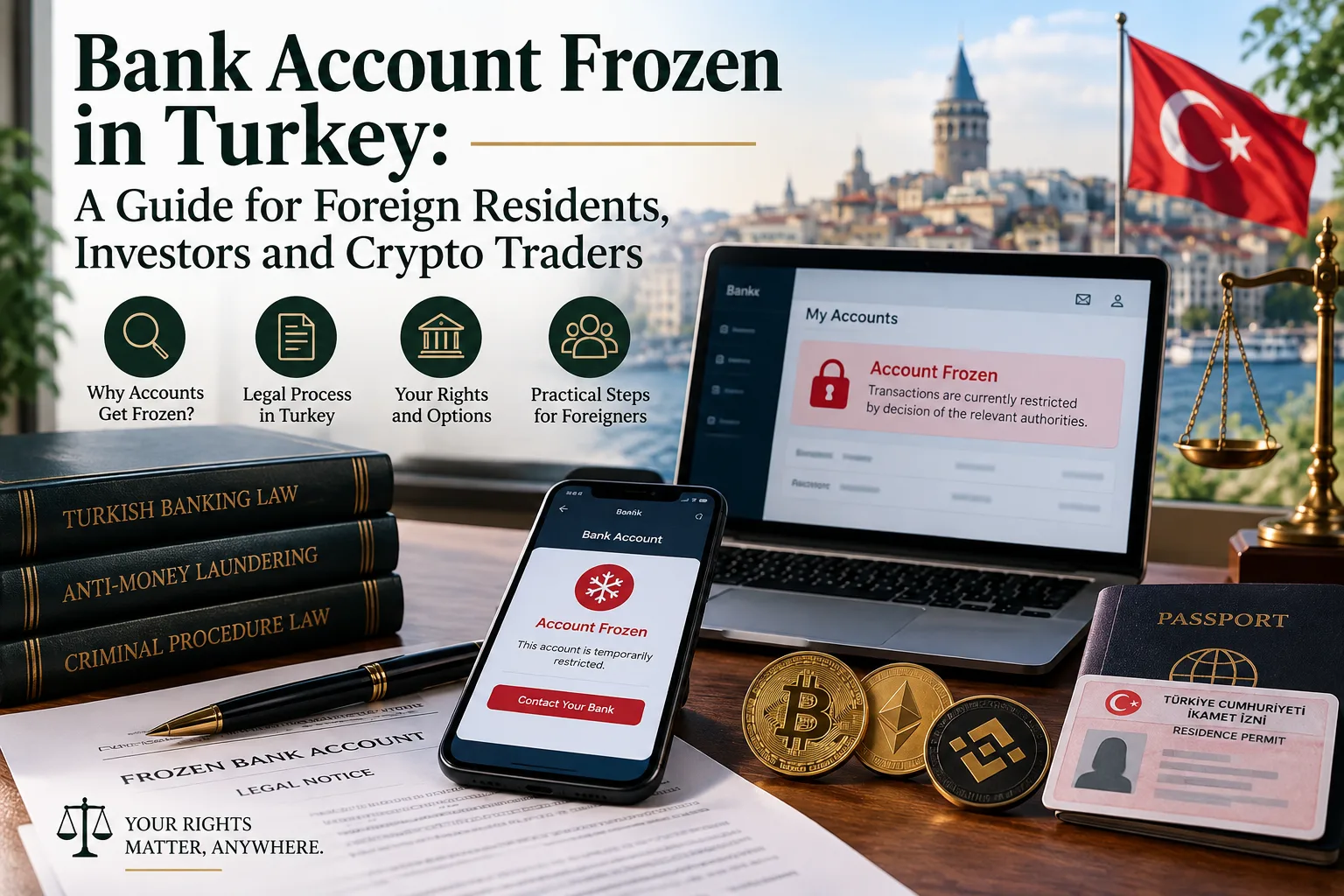
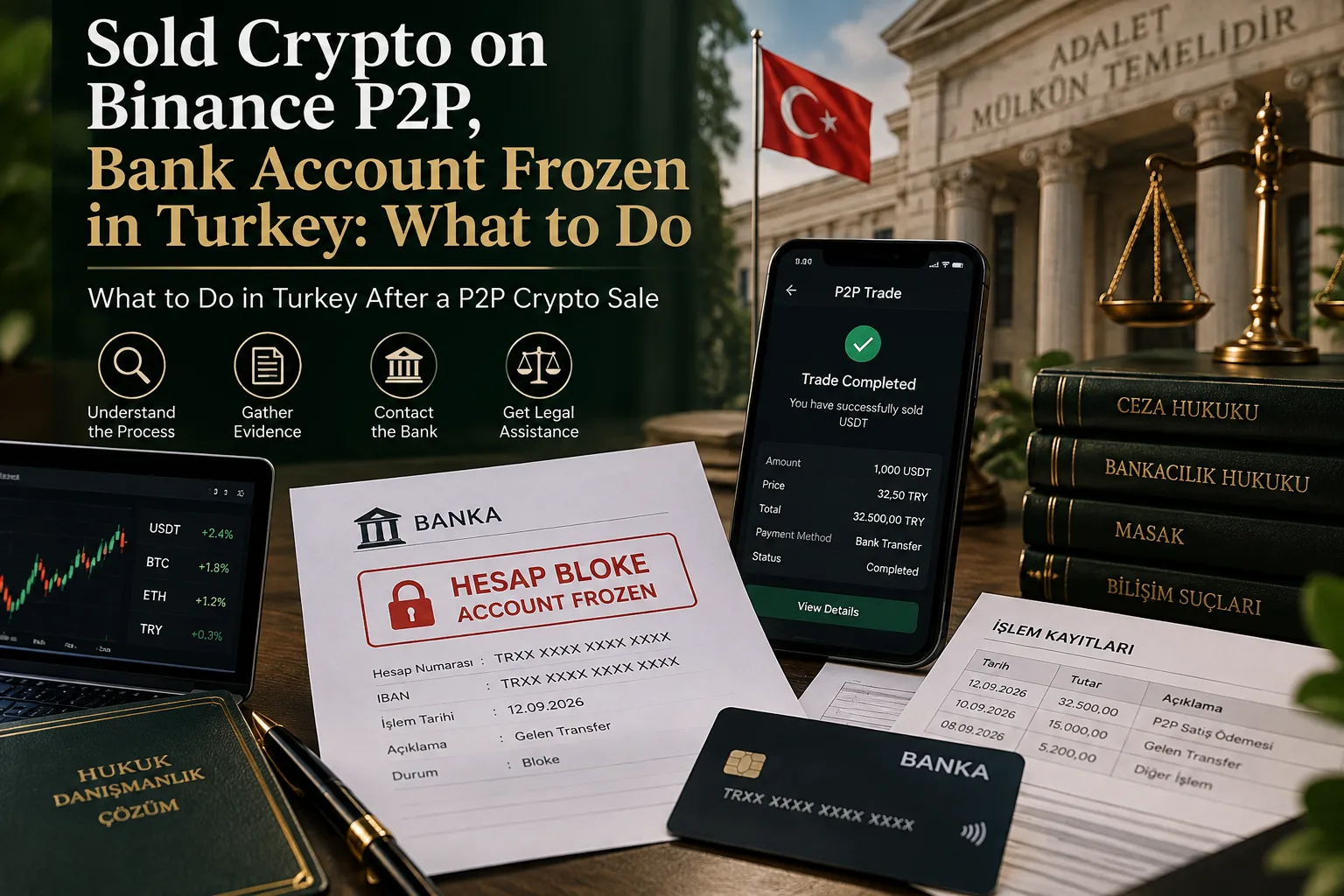
You sold USDT or another coin on Binance P2P or BtcTurk, the buyer's transfer arrived in your Turkish bank account, you released the crypto, and days later the account was frozen. This guide explains, from the seller's side, why that happens, which law the freeze rests on, what the prosecutor investigates, what rights you have against the exchange, and which records decide the file. It also covers what changes for foreign residents and investors.
If you have a matter on this topic:
Istanbul time (UTC+3), weekdays 09:00–18:00
Which freeze do I have? A two-minute diagnostic
"Frozen" covers several different legal acts. Each has a different decision-maker, time limit and place to apply, so the first task is to find out which one you are facing.
| What you see | Likely measure | Who decides | Where to apply |
|---|---|---|---|
| Notice that the account is suspended "for 48 hours" after a complaint | CMK 128/A suspension | The bank, payment institution or exchange | Chief public prosecutor's office; decision within 24 hours |
| Restriction that lasts a few business days with no explanation, sometimes renewed | MASAK postponement | Minister of Treasury and Finance (may be delegated) | MASAK; the prosecutor once the file is referred |
| Notice quoting a criminal judgeship of peace and an investigation number | Seizure (CMK 128) | Judge; in urgent cases the prosecutor with later approval | Objection to the same judgeship within two weeks |
| Notice from an enforcement office or tax office | Attachment for a debt (haciz) | Enforcement office, tax office, SGK | The issuing office; the debt itself is the issue |
| Bank asks for documents, refuses transfers or closes the account | Bank's own risk decision | The bank | Written request to the bank; consumer route |
| Exchange account restricted, withdrawals blocked, "under review" | Platform measure (own review or chain notice) | The exchange | The exchange's internal complaint mechanism (Art. 35/C-1) |
If more than one applies, each is handled separately: lifting a 128/A suspension does nothing about a bank's decision to end the relationship.
How a Binance or BtcTurk P2P sale works, and what the seller cannot see
In a P2P (peer-to-peer) trade the buyer and seller are matched on the platform. The crypto being sold stays locked in the platform's escrow until the payment is confirmed. The buyer sends the agreed lira amount to the seller's bank account by transfer or FAST; when the seller sees the money, the seller releases the crypto. The platform verifies the buyer's identity under its own customer rules, and the Capital Markets Law obliges crypto asset service providers to identify their customers under Law No. 5549 (Law No. 6362, Art. 35/C-1) [M4].
What the seller cannot see is whether the money is really the buyer's own. That is where the problem starts.
What is triangle fraud and how does a P2P seller end up in the chain?
The pattern known in Turkish practice as triangle fraud (üçgen dolandırıcılık) involves three people: the fraudster (F), the real victim (V) and the P2P seller (S).
- F accepts S's sell offer on the platform, and S's IBAN is shown to F.
- At the same time F is deceiving V with an "investment account", a "refund" or a fake sale listing, and gives V the IBAN of S as the account to pay.
- V sends the money to S's account. S sees exactly the P2P amount on screen and releases the crypto to F, who disappears.
- V realises the fraud and complains. The receipt shows S's account. The bank suspends S's account, and the prosecutor records S as the account holder in the file.
The person who actually received value is F; the money trail ends at S.
When the sender's name does not match the buyer
Platform P2P rules require payment from an account in the buyer's own name. The SPK Communiqué also provides that money transfers between a platform and its customers may be carried out "only through bank accounts belonging to the customers themselves" (Communiqué III-35/B.2, Art. 51/3) [D3]. A sender name that differs from the buyer's platform name is the clearest sign of triangle fraud, and whether the seller noticed it is one of the first questions in the prosecutor's file.
The five legal bases of a freeze, and the usual order
For a P2P seller the most common order is a 128/A suspension or a risk hold first, then a seizure requested by the prosecutor. A MASAK postponement appears when the file turns into a laundering suspicion; decisions can be chained, and in one file the Court of Cassation reviewed nine consecutive seven-business-day MASAK decisions that kept an account restricted for about six months [D4]. See also our guide on bank accounts frozen in Turkey.
CMK 128/A for crypto sellers: chain notification, return to the victim and the ten-day rule
Article 128/A, added by Law No. 7571 and in force since 25 December 2025, allows a bank, payment service provider or crypto asset service provider to suspend "any account used in the offence" for up to 48 hours where there is reasonable suspicion of aggravated fraud or theft through information systems or banks (Penal Code Art. 158/1-f and l) or card offences (Art. 128/A-1) [M1] [D5]. Three paragraphs matter specifically to a P2P seller.
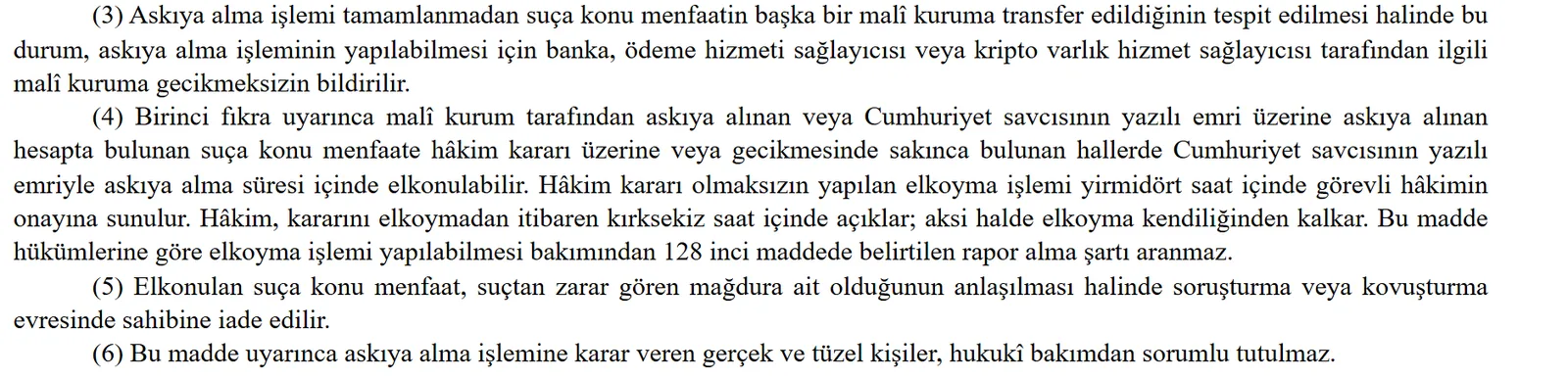
Paragraph 3: if the money went to your exchange, the bank tells the exchange
"If, before the suspension is completed, it is found that the criminal proceeds have been transferred to another financial institution, this is notified to that institution without delay" (Art. 128/A-3, translated by us) [M1]. This is why bank and exchange accounts are often frozen on the same day.
Paragraph 5: if the money is returned to the victim, what happens to the seller?
"Seized criminal proceeds found to belong to the victim are returned to their owner during the investigation or prosecution" (Art. 128/A-5, translated by us) [M1]. The return does not depend on the seller's good faith. If it is ordered, the seller has given away crypto and received nothing. The seller's loss is then claimed from the person who received the crypto: a person who causes damage through a wrongful act compensates it (Code of Obligations, Art. 49), and several persons who caused the same damage are jointly liable (Art. 61) [M7]. Our guide on debt collection in Turkey covers enforcing such a claim once it is established.
Paragraph 7: the platform hands over its records within ten days
Information requested by a prosecutor, judge or court from a bank, payment provider or crypto provider has to be sent within ten days; otherwise the prosecutor fines the institution 50,000 to 300,000 TL (Art. 128/A-7) [M1]. The order ID, escrow and chat records held by the platform reach the prosecutor as official records and are compared with the seller's account of events.
The exchange side: when Binance TR or BtcTurk freezes your crypto account
Law No. 7518 added customer rights to the Capital Markets Law for platforms on the SPK list.
| Provision | What it says | What it means for you |
|---|---|---|
| Art. 35/C-1 | Platforms must run internal mechanisms that resolve complaints effectively; any term that excludes or limits their liability to customers is void | A written complaint is the first step, and a terms-of-service waiver does not end the dispute |
| Art. 35/C-3 | Platforms monitor and report market abuse | An account may be reviewed for trading patterns, separate from fraud complaints |
| Art. 35/C-5 | Transfers must carry sender and recipient information | A transfer with missing data may be held |
| Art. 35/C-7 | Customer cash and crypto cannot be attached, pledged or included in the bankruptcy estate for the platform's debts | Your assets are kept apart from the platform's own estate |
| Art. 35/C-4 | No investor compensation scheme covers crypto | There is no state-backed payout if assets are lost |
| CMK 128/A-6 | An institution that suspends under 128/A is not civilly liable | No damages claim against the exchange for a lawful 48-hour suspension |
Internal complaint and void liability waivers (Art. 35/C-1)
The Capital Markets Law states that "any contractual term that excludes or limits the provider's liability towards its customers is void" (Art. 35/C-1, translated by us) [M4]. A discretionary-freeze clause in the terms cannot by itself defeat a claim. Complain in writing through the official channel, ask for the legal basis and the requesting authority, and keep the reference number.
Market abuse review, travel rule and missing sender data (Art. 35/C-3 and 35/C-5)
Not every exchange freeze comes from a fraud complaint. Under the MASAK Regulation, identity checks and transfer information are required from a 30,000 TL threshold on crypto platforms (Arts. 5/1-b and c, 24/A, from 7 October 2026) [D9]. A withdrawal to an external wallet with no identified owner, or a deposit from an unhosted wallet, can be held until the information is supplied.
Are my assets safe if the exchange collapses? Segregation and no investor compensation
Customer money and crypto "cannot be attached, pledged or included in the bankruptcy estate" for the platform's debts (Art. 35/C-7, translated by us) [M4]. The Communiqué requires customer cash to be held in a separate customer bank account that may not be used for any other purpose (Communiqué III-35/B.2, Arts. 51/2, 51/4, 51/5) [D3]. The protection works in one direction only. It does not stop your own creditors, such as the tax office, SGK or an enforcement office, from attaching your balance. Crypto is also outside the investor compensation scheme and deposit insurance (Art. 35/C-4) [M4], so segregation is the main protection.
Delisted token or frozen account?
A token being removed from the platform (delisting) is a different event from an account freeze. When a platform delists an asset, it announces a period during which customers can sell or withdraw. Platforms must keep a written listing procedure that also sets out how trading in an asset is ended (Art. 35/C-2) [M4]. If you miss the period, the question is whether the notice was adequate and the platform followed that procedure. It does not mean anyone suspects you.
What the prosecutor does: CMK 161, the statement, non-prosecution and indictment
The bank reports the suspension with its documents to the chief public prosecutor's office without delay (Art. 128/A-2). The prosecutor may carry out any investigation directly or through the police and may request information from all public officials (Art. 161) [M1]. If the evidence creates sufficient suspicion, the prosecutor files an indictment (Art. 170/2); if not, a decision of non-prosecution is issued and notified to a suspect whose statement was taken (Art. 172/1). A person harmed by the offence may object to a non-prosecution decision within two weeks at the criminal judgeship of peace (Art. 173) [M1].
Invited to give a statement: capacity and typical questions
The summons states the capacity: victim, witness or suspect. A suspect who does not speak enough Turkish has the right to an interpreter during the statement [M1]. Typical questions: do you know the sender, to whom did you release the crypto, how many P2P trades have you done, and why did you continue if the names differed. The procedure is in arrested in Turkey as a foreigner.
Turkish court decisions on crypto fraud files
No published Court of Cassation ruling found in the Bedesten database concerns a P2P seller as such. The decisions below show which steps a prosecutor cannot skip and how intent and jurisdiction are assessed. Quotations are translated by us.
Money sent to a crypto platform's account: the incomplete investigation ruling
In a Denizli file the complainant, deceived with an investment promise, had sent money to the bank account of a crypto trading platform. The 11th Criminal Chamber held that "the full identity and address details of the officer(s) of the company holding the account to which the money was sent, and of the holders of the GSM lines reported by the complainant, must be established and their statements taken as suspects", and that account movements and IP records had to be gathered. The non-prosecution decision given without these steps was reversed in the interest of law [D1].
Binance: KYC records, letters rogatory and a specialist report
In a file involving deposits through a Binance account, the same chamber held that "detailed information must be requested from the entities described as centralised exchanges, through which money transfers were found to have been made using identity verification (KYC)", "directly or by letters rogatory abroad", and that "a technical report must be obtained from a specialist on information technology and the cryptocurrency market" [D2].
Forwarding money and the "other incidents" test
In the file of an account holder who forwarded money received into the account, the chamber treated the question whether the account had been used in other fraud incidents as relevant to intent [D6]. For a regular trader this cuts both ways: many complaints increase suspicion, but the ability to explain each one with a platform record shows a commercial activity.
Which court hears a claim against the exchange?
The Istanbul Regional Court of Appeal, 14th Civil Chamber, held that "crypto assets are financial assets" and that "under Article 4/1(f) of the Turkish Commercial Code, actions arising from disputes concerning financial institutions are absolute commercial cases" [D10]. The claim against the platform therefore went to the commercial court, and mediation is a precondition before suing (Commercial Code, Art. 5/A) [M9]. This is a single, final decision of one regional appeal chamber, not settled Court of Cassation case law, and an individual customer may argue that the claim is a consumer dispute instead.
Decisions cited by case number only
- Court of Cassation, 11th Criminal Chamber, E.2021/16966 K.2024/7470: unless intent and material benefit are shown with concrete evidence, the arrival of money in an account is not enough for a conviction.
- Court of Cassation, 8th Criminal Chamber, E.2024/24160 K.2025/3482: to the same effect.
- Court of Cassation, 11th Criminal Chamber, E.2021/18047 K.2025/4646: persons who played an active role in receiving and forwarding the money can be held liable.
Am I liable as a P2P seller? Penal Code Articles 158/1-f and 158/4
Fraud using information systems, banks or credit institutions as an instrument is the aggravated form in Article 158/1-f of the Penal Code. Fraud is an intentional offence; money arriving in an account is not enough on its own. Article 158/4, added by Law No. 7589 on 16 July 2026, halves the sentence where a person's participation is limited to giving another person the details or instruments needed to use their bank, payment or crypto account [M5].
What distinguishes a P2P seller from other account holders is that the seller gave real value for the money: the crypto was delivered, and the blockchain records it. A person who rents out an account receives money for nothing.
Intent is inferred from outward signs:
| Point examined | Looks favourable | Looks unfavourable |
|---|---|---|
| Sender's name | Identical to the buyer's name on the platform | Payment from a different person or a company |
| Amount | Equal to the listed P2P amount | Split payments or more than agreed |
| Where the trade took place | Inside the platform, with escrow | Agreed by messaging outside the platform |
| What happened to the money | Stayed in the seller's own accounts | Distributed to third parties within minutes |
| Account history | Regular, recorded trades over a long period | New account, many senders in a short time |
| Buyer's identity | Verified buyer with a trading history | New, unverified buyer |
Aggravated fraud is outside reconciliation (uzlaştırma), so a P2P file has no "settle and close" route.
Records that protect a P2P seller
| Record | What it shows | Where it comes from |
|---|---|---|
| Order ID and trade screen | That the payment corresponds to a specific P2P sale | Platform trade history |
| Escrow release record and TXID | That the seller actually delivered | Platform record; on-chain transaction ID |
| Bank receipt and sender name | Who sent the money and whether the name matched | Banking app or branch |
| In-platform chat | That communication concerned only the trade | Platform |
| Buyer's KYC data | That the trade was with a verified account | Requested by the prosecutor (Art. 128/A-7) |
| Full P2P history export | Regular, consistent trading activity | Platform export |
| On-chain analysis report | Where the crypto came from and where it went | Analysis service or court-appointed specialist |
Is Binance legal in Turkey? Law No. 7518, the SPK list and Article 99/A
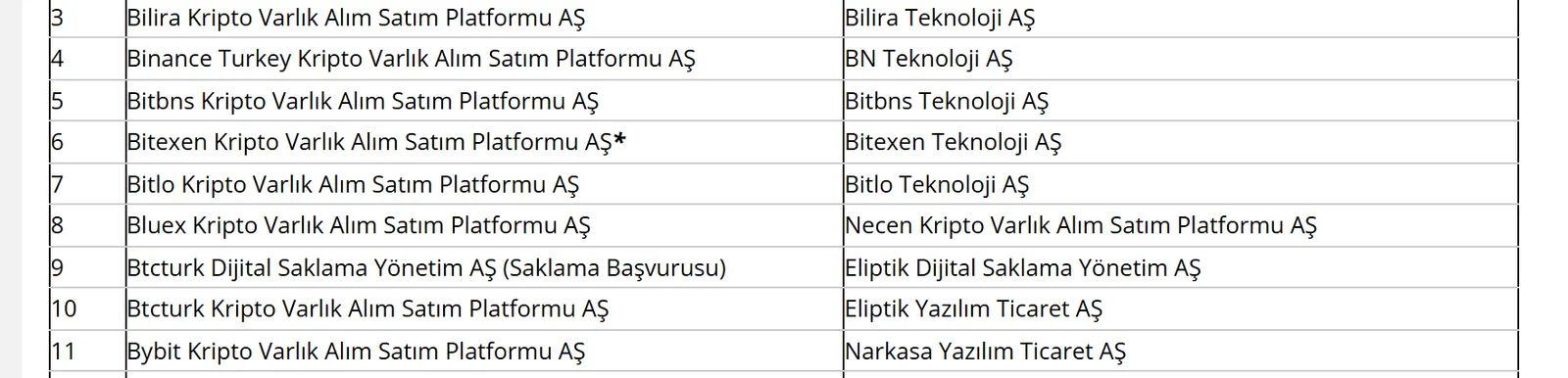
Law No. 7518 (Official Gazette 2 July 2024, No. 32590) made SPK permission compulsory for crypto asset service providers (Law No. 6362, Art. 35/B-1) [M4]. Its "List of Those in Operation", headed provisional, contained 52 entities on 11 October 2026: Binance Turkey Kripto Varlık Alım Satım Platformu AŞ (formerly BN Teknoloji AŞ) is number 4, Btcturk Kripto Varlık Alım Satım Platformu AŞ number 10, Btcturk Dijital Saklama number 9, and Paribu's companies numbers 40 and 41 [D7]. The SPK warned that inclusion on the list "does not mean that the entities have been authorised" [D8]. Binance's Turkish company is within the licensing process, which is different from a finished authorisation.
Platforms established abroad that target persons resident in Turkey "are deemed unlicensed crypto asset service provision"; a Turkish-language website or advertising to residents is enough (Art. 99/A-1) [M4]. Records from a platform abroad are requested by letters rogatory [D2], and the Article 35/C protections apply mainly to companies on the SPK list. No provision prohibits a sale of crypto between two persons.
Law No. 7518 contains no tax provision. Whether crypto gains are taxed depends on the general income tax rules and your tax residence; for new residents see Turkey's 20-year tax exemption on foreign income and our tax law page.
MASAK rules for crypto: the 30,000 TL threshold and suspicious transaction reports
Crypto asset service providers are obliged parties under Law No. 5549. Identity verification is compulsory on crypto platforms where a transaction or linked transactions reach 30,000 TL, and the same threshold applies to the sender and recipient information in crypto transfers (Regulation, Arts. 5/1-b and c, 24/A, from 7 October 2026) [D9]. What concerns a P2P seller more is the suspicious transaction report: where there is any suspicion that assets were obtained illegally, the obliged party reports to MASAK regardless of amount (Law No. 5549, Art. 4/1; Regulation, Art. 27/2) [M2] [D9]. The bank may not disclose the report to anyone, including the parties (Art. 4/2), which is why a bank does not explain a freeze.
Where a bank cannot verify identity or learn the purpose of the relationship, it does not carry out the transaction and may end the relationship (Regulation, Art. 22). Suspicion is assessed "where necessary by considering several transactions together" (Art. 27/3) [D9], so a regular seller's account is judged as a whole. The documented answer is the platform trade export with order IDs matching the payments.
Press reports in 2025 described a draft that would give MASAK direct powers to close accounts, limit transactions and blacklist crypto addresses. We have not been able to confirm whether such powers were enacted beyond Article 128/A, so this guide does not treat them as law.
How far can the bank restrict on its own? Banking Law Articles 61 and 73
The right of depositors to withdraw what is due to them "cannot be restricted in any way", except under pledge, lien, assignment and set-off rules and "the powers granted and the obligations imposed by other laws" (Banking Law, Art. 61) [M3]. MASAK, 128/A, seizure and attachment fall under those other laws; a restriction based only on the bank's internal risk view does not. A bank will not disclose another customer's data, such as the complainant's identity, because customer data is secret (Art. 73/3) [M3], but your own account data is not secret from you. A written request can ask which transaction was restricted, when, and at whose request.
Where the restriction rests on the bank's own decision and the account holder is an individual, the dispute is a consumer dispute (Law No. 6502, Art. 3) [M6]. In 2026, disputes below 186,000 TL go to the consumer arbitration committee and larger ones to the consumer court after mediation (Arts. 68, 73/A). An objection to a committee decision can be made within two weeks (Art. 70). MASAK, 128/A and judicial seizures are not consumer disputes. See our consumer law page.
Objecting to a seizure and getting the money released
Where the money was seized by a criminal judgeship of peace, an objection is made within two weeks of learning of the decision, by petition to the judgeship that made it (Art. 268/1) [M1]. If the judgeship does not accept it, the file goes to the next judgeship (Art. 268/2-3). The records table above is the content of the objection. It may ask to lift the seizure or limit it to the disputed amount. Our deadline calculator computes the two-week period.
A 128/A suspension ends when the 48 hours run out or the prosecutor lifts it; a seizure by the prosecutor that the judge does not approve within 48 hours lapses (Art. 128/A-4). Where money held under seizure is no longer needed for the investigation, its return is ordered on request or on the authority's own motion (Art. 131/1) [M1]. After non-prosecution the balance is released; money found to be the victim's goes to the victim. The request is a petition to the prosecutor's office quoting the investigation number.
Compensation: bank, state, fraudster, platform
| Against | Basis | Where and when |
|---|---|---|
| The bank (restriction with no legal basis) | Breach of contract (Code of Obligations, Art. 112) [M7] | Consumer route; closed for a lawful 128/A suspension (Art. 128/A-6) |
| The State (unlawful or overlong seizure) | CMK Art. 141/1-j [M1] | High criminal court; three months from notice of finality, one year at most (Art. 142) |
| The fraudster and others in the chain | Wrongful act and joint liability (Arts. 49, 61) [M7] | Civil court; the criminal outcome is strong evidence |
| The platform (unjustified freeze, failure to act) | Contract plus Art. 35/C-1 [M4] | Commercial court after mediation, per the Istanbul decision [D10]; consumer route arguable |
If you are the victim, or the seller who was also harmed
If the money you sent to an IBAN given by a fraudster reached a P2P seller's account, that account can be suspended and seized, and the money is returned to you if it is found to be yours (Art. 128/A-5) [M1]. If the money has already become crypto moved on-chain, recovery depends on whether it can be stopped at a platform. The general routes are on our IT and cybercrime law page.
The seller is also harmed: the crypto was delivered and the payment is seized or returned. The seller can complain against the person who received the crypto. If a prosecution is opened, persons harmed by the offence may join the case as intervening parties until judgment (Art. 237/1) [M1].
Sample complaint to the prosecutor or the platform
A structure, not a form to sign; it is filed in Turkish, and the English version lets a foreign seller check what is said in their name.
To the Chief Public Prosecutor's Office of [city] / To the complaints unit of [platform]
Complainant / account holder: [name, passport or foreigner ID number, address in Turkey or lawyer's address]
Subject: Request to lift the suspension under CMK Article 128/A on account [IBAN] / review of the restriction on platform account [user ID], and complaint against the buyer of P2P order [order ID].
Facts: On [date] I sold [amount and asset] through the P2P service of [platform], order [order ID]. The buyer [platform name of buyer] paid [amount] TL to my account; the sender shown on the receipt is [name]. I released the asset from escrow on [date and time], transaction hash [TXID]. On [date] my account was restricted.
Explanation: The payment corresponds exactly to the order above. I received no other value from the sender and have no other connection with them. The incoming money has remained in my accounts. My trading history on the platform is attached.
Requests: That the suspension be lifted, or limited to the disputed amount; that the buyer's KYC, IP and trade records be requested from the platform; that my complaint against the buyer be recorded as a person harmed by the offence; for the platform, that the legal basis of the restriction and the requesting authority be stated in writing.
Attachments: order screen, escrow release record, TXID, bank receipt, in-platform chat, P2P history export, copy of passport or residence permit, power of attorney if filed by a lawyer.
For foreigners: account opening, transfers abroad, leaving Turkey and a power of attorney
These are general principles; the details depend on the bank, platform and file.
Opening and keeping an account as a foreigner
Turkish banks open accounts for foreigners with a passport and a Turkish tax number, and many ask for a residence permit or foreigner identity number. Non-residents are subject to enhanced due diligence, so source-of-funds questions come sooner and more often. Exchanges on the SPK list onboard residents of Turkey; a short-term visitor using a global platform from Turkey is in the grey zone of Article 99/A [M4].
Transfers abroad during a freeze
A 128/A suspension or a seizure blocks the account or amount concerned, so outgoing SWIFT transfers from it stop. A chain notice can follow money to another institution in Turkey; a foreign bank is reached only through mutual legal assistance, as the Court of Cassation's reference to letters rogatory shows [D2]. Moving money abroad after learning of a complaint can be read against the seller's account of good faith, so it is better to wait until the type of freeze is known.
Leaving Turkey and answering a summons from abroad
An open investigation does not stop you leaving Turkey automatically. A judge may, however, impose judicial control including a ban on leaving the country (Art. 109/3-a) [M1]; whether one exists can be checked through e-Devlet or a lawyer, as described in our exit ban guide. Give the prosecutor a current or lawyer's address so a summons is not missed.
Power of attorney and residence permit
A power of attorney can be given at a Turkish consulate, or before a notary abroad with an apostille and sworn translation. The lawyer then follows the file electronically on UYAP, files the application or objection, attends hearings and can receive released funds into a client account; details are in hiring a lawyer in Turkey from abroad. No provision of the Law on Foreigners makes a freeze or an open investigation a ground for cancelling a residence permit. A foreigner who must stay in Turkey by decision of a judicial authority can apply for a short-term permit on that ground (Law No. 6458, Art. 31/1-g) [M8]. Deportation and entry bans are separate administrative acts, explained in deportation and entry bans in Turkey; residence years for a long-term permit are counted as in permanent residence in Turkey.
Tax and enforcement debts: can creditors reach my exchange balance?
Asset segregation under Article 35/C-7 protects your balance from the platform's creditors, not from yours [M4]. A tax office, SGK or an enforcement office pursuing a debt of yours can send an attachment notice to the platform as well as to the bank. That is a debt attachment, handled with the issuing office, and it is unrelated to the fraud file.
Death of the account holder: heirs and frozen crypto
If the account holder dies while the account or exchange balance is frozen, the freeze does not end with the death. A seizure in a criminal file continues until the prosecutor or court decides; heirs can apply for return of the money that is not proceeds of the offence. Separately, banks and platforms release assets of a deceased person to heirs only after a certificate of inheritance and a tax clearance under the Inheritance Tax Law (Law No. 7338, Art. 17) [M10]. For a foreign deceased, which law governs the estate and how a foreign certificate is recognised are covered in inheritance in Turkey for foreigners.
Timeline of a P2P freeze in Turkey
| Stage | Period | Basis |
|---|---|---|
| Bank or exchange suspends, reports to the prosecutor | Up to 48 hours | CMK Art. 128/A-1, 2 |
| Prosecutor's decision on the application to lift | 24 hours | CMK Art. 128/A-2 |
| Prosecutor's seizure to the judge; judge's decision | 24 hours + 48 hours | CMK Art. 128/A-4 |
| MASAK postponement | Up to seven business days per decision | Law No. 5549, Art. 19/A |
| Platform's reply to the prosecutor | Ten days | CMK Art. 128/A-7 |
| Objection to seizure | Two weeks from learning of it | CMK Art. 268 |
| Objection to non-prosecution (harmed party) | Two weeks from notification | CMK Art. 173 |
| Claim against the platform | Mediation first | Commercial Code, Art. 5/A |
| Compensation for unlawful seizure | Three months from finality, one year at most | CMK Arts. 141/1-j, 142 |
Mistakes seen in P2P freeze files
- Closing the platform account or deleting the trade history. The platform keeps the records anyway, and deletion can be read as intent.
- Releasing the crypto although the sender's name differed. This is the clearest sign of triangle fraud and the first question in the statement.
- Waiting without learning the type of freeze. The application to the prosecutor, the two-week objection, the consumer route and the platform complaint are different doors.
- Continuing to trade on the same account. New complaints join the file under the "other incidents" test.
- Giving a statement without the records. A seller who cannot explain escrow, an order ID and a TXID has not explained a real trade.
Crypto lawyer in Istanbul and Turkey: what a lawyer does in a P2P freeze file
The work follows an order: identify the basis of the freeze; assemble the platform and bank records into the explanation for the prosecutor; file the application to lift a 128/A suspension or the objection to a seizure; complain to the platform under Article 35/C-1; attend the statement; and, at the end, pursue the release of the money and any compensation or civil claim. The file is often in the victim's city; a Turkish lawyer acts before any prosecutor's office through UYAP. We handle these files from our office in Maltepe, Istanbul. See our Istanbul and Ankara court guides, the criminal law page and the glossary.
Sources
This guide describes Turkish law as of 18 October 2026 in general terms. It is not legal advice; every file depends on its own records and dates.
Frequently Asked Questions
Why was my Turkish bank account frozen after a Binance P2P sale?
In most files the buyer paid you with money taken from a fraud victim, who was told to send it to your IBAN. When the victim complains, the bank marks the money in your account as proceeds of an offence and suspends the account under CMK Article 128/A or its own risk rules.
How do I know which kind of freeze I have?
Look at the notice and the timing. A 48-hour suspension after a complaint is CMK 128/A; a short restriction of a few business days is usually MASAK; a notice naming a criminal judgeship of peace is a seizure; a notice from an enforcement or tax office is a debt attachment; a request for documents or account closure is the bank's own decision.
How long does a P2P freeze last in Turkey?
A CMK 128/A suspension lasts at most 48 hours, a MASAK postponement up to seven business days per decision, and a judge's seizure for as long as the investigation needs. A bank's or platform's own measure has no fixed period but is limited by law.
Why were my bank and exchange accounts frozen on the same day?
Article 128/A-3 requires an institution to notify the next institution without delay if the proceeds moved on before the suspension was completed. If you moved the lira to your exchange balance, the bank tells the exchange, which then suspends too.
Will I lose the money if it came from a fraud victim?
If the court finds the money belongs to the victim, it is returned to the victim under Article 128/A-5, whether or not you acted in good faith. Your loss is then claimed from the person who received the crypto, under Articles 49 and 61 of the Code of Obligations.
Am I criminally liable for receiving fraud money as a P2P seller?
Fraud is an intentional offence, and money arriving in an account is not enough on its own. Intent and benefit have to be shown with concrete evidence. A seller who delivered crypto through escrow and can document the trade is in a different position from someone who rented out an account.
What should I bring to a statement at the prosecutor's office?
The order ID and trade screen, the escrow release record and transaction hash, the bank receipt showing the sender's name, the in-platform chat and an export of your P2P history. A foreign suspect who does not speak enough Turkish is entitled to an interpreter.
How do I object to a seizure order?
An objection is filed within two weeks of learning of the decision, by petition to the criminal judgeship of peace that issued it. If that judgeship does not accept it, the file goes to the next judgeship. The objection can ask for the seizure to be lifted or limited to the disputed amount.
Is Binance licensed in Turkey?
Binance Turkey's company is on the SPK's provisional list of providers in operation, number 4 on 11 October 2026. The SPK has said that being on the list does not mean authorisation; it means the company is within the licensing process.
Can the exchange rely on its terms to refuse any liability?
Article 35/C-1 of the Capital Markets Law makes any term that excludes or limits the provider's liability to customers void. The exception is a lawful suspension under CMK 128/A, for which the suspending institution is not civilly liable.
Are my crypto assets safe if the exchange goes bankrupt?
Customer cash and crypto cannot be attached, pledged or included in the platform's bankruptcy estate for the platform's debts. There is, however, no investor compensation scheme or deposit insurance for crypto, and segregation does not protect the balance from your own creditors.
Which court hears a claim against a crypto exchange?
The Istanbul Regional Court of Appeal, 14th Civil Chamber, treated such a claim as an absolute commercial case for the commercial court, with mediation required first. That is a single regional decision, so the competent court should be checked for each file.
What happens if a token I hold is delisted?
Delisting is not a freeze and does not mean anyone suspects you. The platform announces a period to sell or withdraw; after that, the balance is handled under its published procedure, and disputes go through the complaint channel and, if needed, the courts.
Can I leave Turkey while the investigation is open?
An investigation does not stop you leaving automatically, but a judge may impose an exit ban as judicial control. Check before travelling, and leave a current address or a lawyer's address with the prosecutor so a summons is not missed.
Can I handle the whole file from abroad?
A Turkish lawyer acting under a power of attorney, given at a Turkish consulate or before a notary abroad with an apostille and sworn translation, can follow the file on UYAP, file applications and objections and receive released funds.
Can I transfer my money abroad while the account is frozen?
Outgoing transfers from a suspended or seized account stop. Moving money abroad after learning of a complaint can also be read against your account of good faith, so it is better to wait until the type of freeze is clear.
What happens if the account holder dies while the account is frozen?
A criminal seizure continues after death until the prosecutor or court decides. Heirs then need a certificate of inheritance and a tax clearance under the Inheritance Tax Law before the bank or platform releases the assets.
Can I claim compensation for an unjustified freeze?
Against the bank, for a restriction with no legal basis, under Article 112 of the Code of Obligations; against the State, for an unlawful seizure, under CMK Article 141/1-j within three months of finality; against the platform at the commercial court after mediation.
- Binance P2P bank account frozen
- crypto P2P Turkey
- CMK 128/A crypto
- crypto exchange account frozen Turkey
- P2P seller criminal liability Turkey
- triangle fraud P2P
- is Binance legal in Turkey
- SPK crypto rights
- foreigner bank account frozen Turkey
Our services in this area
Criminal Law