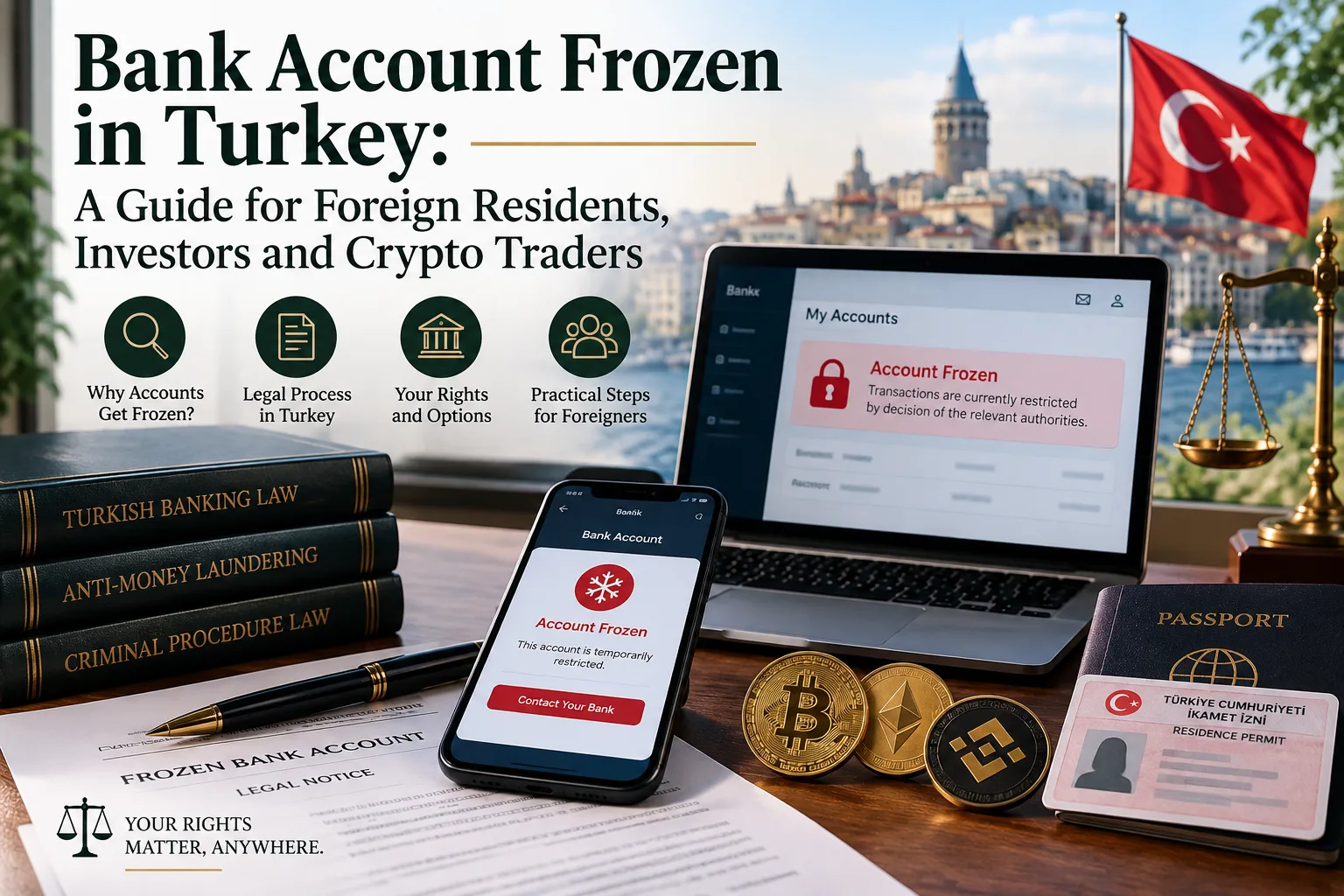
Bank Account Frozen in Turkey: A Guide for Foreign Residents, Investors and Crypto Traders
If your Turkish bank account has been frozen, the reason usually falls into one of four categories — a bank's own hold, a MASAK suspension, the new CMK 128/A mechanism, or an enforcement lien. Here is what each means and what to do.
If your Turkish bank account has suddenly been frozen or restricted, you are not alone — this happens regularly to foreign residents, investors and remote workers in Turkey, often without warning and with little explanation from the bank. This guide explains, in plain English, the three legal mechanisms that can freeze a Turkish bank account, how they differ, how long each one lasts, and what a foreign account holder — including someone who sold cryptocurrency through a peer-to-peer (P2P) platform such as Binance or BtcTurk — should do next.
If you have a matter on this topic:
Not Every Frozen Account Is a "MASAK Freeze"
Turkish banks and account holders often use the term "MASAK block" loosely to describe any restriction, but in practice a frozen account can arise from one of four distinct legal sources, each with its own timeline and its own procedure for resolving it:
| Type of Freeze | Legal Basis | Duration | Who Decides |
|---|---|---|---|
| Internal bank compliance hold | The bank's own risk/AML policy | Varies, no statutory cap | The bank |
| MASAK suspension (Law No. 5549, Art. 19/A) | Suspicion of money laundering or terrorist financing | 7 business days, fixed by law | The Minister, on the Financial Crimes Investigation Board's (MASAK) confirmation |
| CMK Art. 128/A suspension (new, in force since 25 December 2025) | Suspicion of a limited list of cyber-enabled property offences | Up to 48 hours | The bank/payment institution/crypto asset service provider itself, then reviewed by a prosecutor |
| Enforcement (icra) or tax lien | An existing, finalised debt | Until the debt is paid or the lien is lifted | Enforcement office / tax office |
Knowing which of these four applies to your case determines who you need to contact and how quickly you need to act.
MASAK Freezes Explained: Law No. 5549, Article 19/A
Turkish banks, payment institutions and — since recent legislation — crypto asset service providers are "obliged institutions" under Law No. 5549 on the Prevention of Laundering of Proceeds of Crime. When a transaction looks suspicious (a sudden large inflow inconsistent with the account holder's known income, funds moved on quickly to third parties, transfers linked to high-risk jurisdictions, and similar patterns), the institution reports it to MASAK, Turkey's financial intelligence unit.
Under Article 19/A of that law, once the Board confirms the suspicion, the Minister (a power that may be delegated to a deputy minister) is authorised to suspend the transaction, or refuse to allow it to proceed, for a period of seven business days — no longer. This period exists to allow MASAK to verify the suspicion, analyse the transaction, and, if warranted, refer the matter to the prosecutor's office. The law does not provide for an extension of this period; when it expires, either the transaction is released or the matter has already moved into a judicial track (see below).
Because Article 4 of Law No. 5549 makes the filing of a suspicious transaction report confidential, the bank is not permitted to tell you that it has reported you to MASAK — this is why account holders frequently receive no clear explanation, which is frustrating but not, by itself, evidence of wrongdoing on the bank's part.
The New CMK Article 128/A Mechanism (2025-2026): What Changed for Foreign Account Holders
Law No. 7571, adopted on 24 December 2025 and published in the Official Gazette on 25 December 2025, added a new Article 128/A to the Code of Criminal Procedure (CMK). This is a separate, more recent mechanism from the MASAK process above, and it explicitly covers crypto asset service providers as well as banks and payment institutions — which makes it directly relevant to anyone trading cryptocurrency in or from Turkey.
Which Offences Does It Cover?
Article 128/A applies only to a defined list of cyber-enabled property offences: aggravated theft committed through information systems (Turkish Penal Code Art. 142/2-e), aggravated fraud committed using banking/credit institutions or information systems (Art. 158/1-f and -l), and misuse of bank or credit cards (Art. 245). It does not apply to every criminal allegation.
How the 48-Hour Suspension Works
Where there is reasonable suspicion that one of these offences is involved, the bank, payment institution or crypto asset service provider may, on its own initiative and without a prior court order, suspend the transaction or account for up to 48 hours, reporting the suspension to the public prosecutor immediately. The prosecutor must decide, within 24 hours, whether to lift the suspension or refer it for a seizure order, which then requires a judge's approval within the same 48-hour window; if no judicial decision arrives in time, the suspension lapses automatically and the account is released.
Unlike the confidential MASAK process, Article 128/A expressly requires that the account holder be notified of the suspension, and gives the account holder the right to apply to the public prosecutor's office to have it lifted, with a decision due within 24 hours of that application.
Why This Matters Especially for Crypto and Binance/BtcTurk P2P Users
A recurring — and often unfair — scenario involves foreign residents who sell cryptocurrency through a P2P platform. A buyer pays via bank transfer, the seller releases the crypto from escrow once the payment is confirmed, and days later it turns out the buyer's payment came from a third party who had themselves been defrauded elsewhere. The bank or exchange then freezes the seller's account, even though the seller had no knowledge of, or connection to, the underlying fraud.
If this happens to you, the single most important thing you can do is preserve your platform records: the order ID, the in-platform chat with the buyer, proof of when the crypto left escrow, and your account statement. Turkish criminal courts have repeatedly held that merely receiving funds that turn out to be connected to a fraud is not, by itself, enough for a conviction — intent and financial benefit must be shown, and a consistent, well-documented explanation of how the transaction actually happened is the strongest protection a P2P seller has. An independent on-chain analysis report tracing the cryptocurrency's movement can also be valuable technical evidence, particularly because not every prosecutor or police officer is familiar with how P2P escrow systems work.
If the Bank Won't Explain the Freeze, What Can I Actually Do?
- Request a written explanation from the bank, including the date of the restriction and, where the bank is willing to share it, its legal basis. The bank may not always be able to confirm a MASAK report, but it can usually confirm whether the hold is its own internal compliance measure.
- Ask whether a prosecutor's file number exists. If the matter has moved beyond a MASAK hold into Article 128/A or a criminal investigation, there will be a file you or your lawyer can reference.
- Gather documentation of the transaction's legitimate source — an employment contract, invoices, a sale agreement, remittance records from a known relative, or, for crypto transactions, your platform's order history.
- Track the statutory deadline. A MASAK freeze cannot lawfully exceed seven business days; a 128/A suspension cannot exceed 48 hours without judicial approval. If your account is still frozen well past these periods with no explanation, this is itself a strong signal that the matter has escalated and needs prompt legal attention.
Does This Affect My Residence Permit or Visa Status?
A bank account freeze, by itself, is a financial/criminal-procedure matter and does not automatically affect a residence permit or visa. However, if the matter develops into a criminal investigation, it can become relevant to future residence permit renewals or to a naturalisation application, since Turkish authorities generally ask about pending criminal matters. This is one more reason to resolve the underlying issue — rather than simply waiting for the freeze to lift on its own — if the file has moved beyond a short-lived MASAK hold.
Step-by-Step: What Actually Happens After a Freeze
| Stage | What Happens | What You Can Do |
|---|---|---|
| 1. Suspicious activity flagged | The bank's own compliance system flags the transaction | Request written confirmation from the bank |
| 2. Report to MASAK | The bank files a confidential suspicious transaction report | This stage is confidential by law; the bank cannot confirm it to you |
| 3a. MASAK suspension (if ordered) | Transaction suspended for up to 7 business days | Gather proof of the funds' legitimate source |
| 3b. CMK 128/A suspension (if applicable) | Account suspended up to 48 hours; you are notified | Apply to the public prosecutor's office within 24 hours |
| 4a. Suspicion resolved | Funds/account released | Normal use resumes |
| 4b. Referred for investigation | Prosecutor opens a file; possible seizure order | Engage a lawyer promptly; deadlines are short |
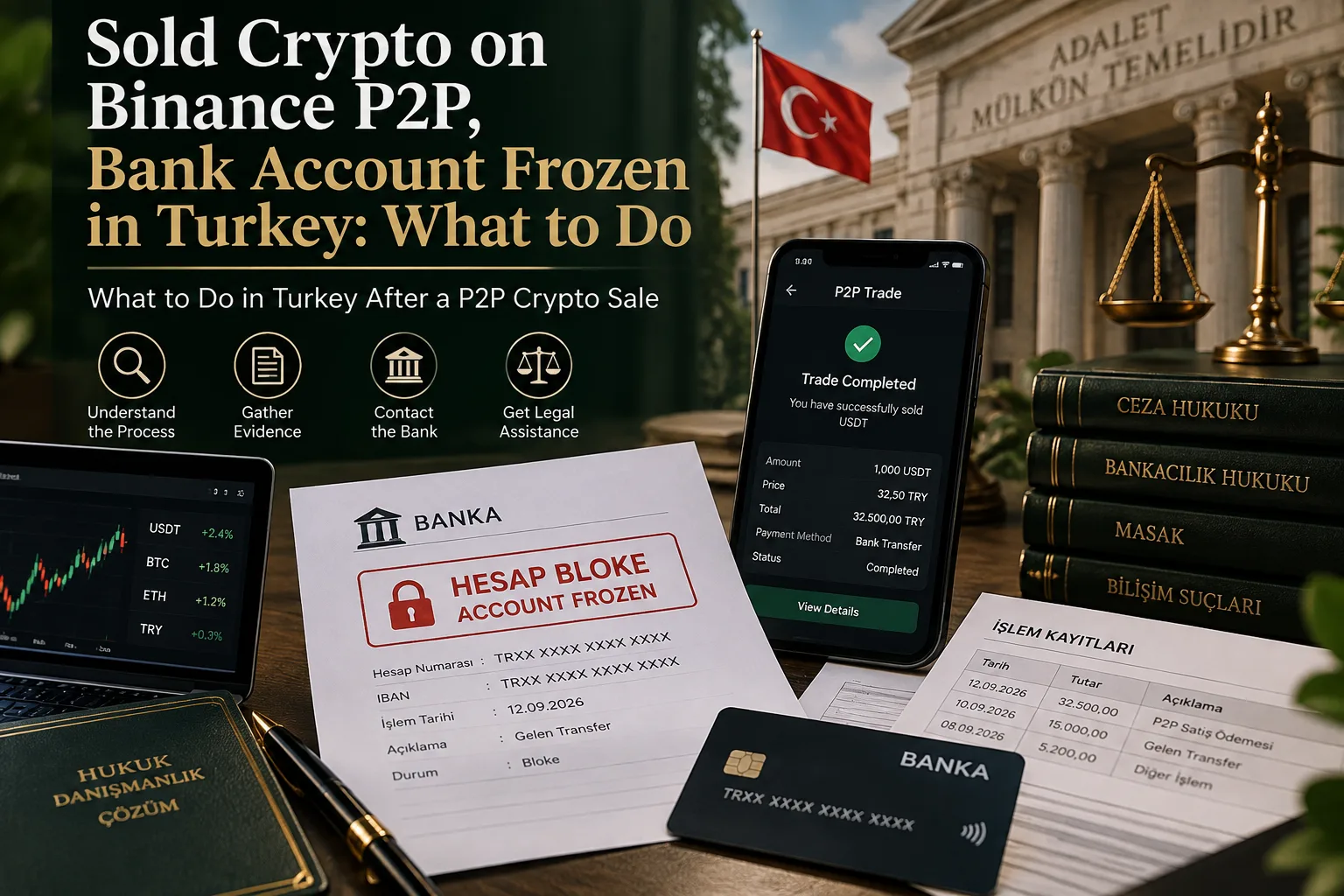
Related guide: Sold Crypto on Binance P2P, Bank Account Frozen in Turkey: What to Do
Choosing a Lawyer for a Frozen Account or MASAK Matter
Because the relevant deadlines are measured in hours and business days rather than weeks, look for a lawyer who can be reached quickly, who is comfortable working in English (or your language) as well as Turkish, and who can explain — in terms you actually understand — which of the four mechanisms above applies to your case before recommending a course of action. A lawyer who cannot clearly identify whether you are dealing with a bank compliance hold, a MASAK suspension, a CMK 128/A suspension, or an enforcement lien is not yet in a position to advise you correctly, since each requires a different response.
Criminal Lawyer in Istanbul and Ankara for Frozen Account Cases
A freeze under Article 128/A of the Code of Criminal Procedure or a seizure order is part of a criminal investigation, and a criminal case is in principle heard where the offence was committed (Article 12). The prosecutor's office handling the file may therefore be in Istanbul, Ankara or another city, even if you live elsewhere. A criminal lawyer in Turkey registered with a Turkish bar can act before every prosecutor's office and court.
We follow frozen account and MASAK files as a criminal lawyer in Istanbul and before the prosecutors and courts in Ankara. The full criminal process is on our criminal lawyer in Turkey page, and crypto-related freezes are covered in Crypto P2P and Binance: Bank Account Frozen in Turkey.
What Happens If I Am Cleared? Can I Claim Compensation?
If the investigation results in a decision that there are no grounds for prosecution, or in an acquittal, and you were subject to a seizure or similar coercive measure during the process, Turkish law (CMK Art. 141 et seq.) allows a claim for compensation for the resulting loss. That claim must be filed with the relevant Assize Court within three months of being notified that the decision has become final, and in any event within one year of the date of finality — missing this deadline generally extinguishes the right to compensation, so it is worth tracking from the moment the underlying decision is issued.
Frequently Asked Questions
My Turkish bank account was frozen with no explanation. Is this legal?
Yes, it can be. Banks are barred by Law No. 5549 from confirming a MASAK suspicious transaction report, so a lack of explanation is not by itself evidence of wrongdoing. Ask the bank whether the hold is an internal compliance measure or something else, and request everything in writing.
How long can MASAK legally freeze my account?
Seven business days under Article 19/A of Law No. 5549. The law provides no mechanism to extend this period — after seven business days, the transaction is either released or the matter has already moved into a separate judicial process.
What is the new CMK Article 128/A, and does it apply to crypto exchanges?
It is a mechanism introduced by Law No. 7571 (in force since 25 December 2025) that lets banks, payment institutions and crypto asset service providers suspend an account for up to 48 hours where a specific list of cyber-enabled offences is suspected. It explicitly covers crypto asset service providers, and the account holder must be notified and has the right to apply to the prosecutor's office to have it lifted within 24 hours.
I sold crypto on Binance P2P and my bank account was frozen because of the buyer. Am I liable?
Not automatically. Turkish courts have held that receiving funds that later turn out to be connected to fraud does not by itself establish criminal liability — intent and financial benefit must be shown. Keeping your order ID, chat history and transaction records is the strongest protection.
Can a frozen bank account affect my Turkish residence permit?
Not directly or automatically. It only becomes relevant if the matter develops into a criminal investigation, since immigration authorities generally ask about pending criminal matters in later applications.
If I'm cleared, can I get compensation for a frozen account?
If a seizure or similar coercive measure was applied and you are later cleared (no grounds for prosecution or acquittal), Turkish law allows a compensation claim under CMK Art. 141, filed with the Assize Court within three months of the decision becoming final and in any case within one year.
My account was frozen by a prosecutor in Ankara but I live in Istanbul. Can a criminal lawyer in Istanbul handle it?
Yes. A lawyer registered with a Turkish bar can act before all prosecutors' offices and courts in Turkey, and files are followed electronically through UYAP. The investigation is handled where the offence is being investigated, so a criminal lawyer in Ankara or in Istanbul can make the objection and follow the file.
- bank account frozen Turkey
- MASAK freeze
- MASAK frozen account foreigner
- Law 5549 Article 19/A
- CMK 128/A Turkey
- 48-hour account suspension Turkey
- bank won't explain freeze Turkey
- frozen account residence permit
- Binance BtcTurk account frozen
- crypto trader bank freeze Turkey
- frozen account compensation Turkey
- financial crimes investigation Turkey
- unfreeze bank account Turkey
- foreign investor bank account Turkey
- suspicious transaction report Turkey
Our services in this area
Criminal Law