Severance Pay in Turkey If You Are Fired (2026): Foreign Employees, Notice Pay and Your Work Permit
What a foreign employee fired in Turkey is owed: notice pay, severance pay with the 2026 ceiling and a worked example, unused leave, reinstatement and the one-month mediation deadline, unpaid wages, and what happens to the work permit and residence.
If you are fired in Turkey as a foreign employee, two questions come at once: how much severance pay in Turkey you are owed, and whether you can stay in the country. Turkish labour law protects foreign workers in the same way as Turkish workers, but the deadlines are short and the work permit is cancelled when the job ends.
If you have a matter on this topic:
1. Fired in Turkey as a foreigner: does Turkish labour law protect me?
Yes. The Turkish Labour Act No. 4857 applies to employees working in Turkey under an employment contract, and its rules on notice, severance, wages, annual leave and job security do not depend on the worker's nationality [M1]. A wage agreed in foreign currency can be paid in Turkish lira at the rate on the payment day (Art. 32) [M1]. The questions that change the answer are not nationality but the following:
| Question | Why it matters | Article |
|---|---|---|
| How long did you work for the employer? | Sets the notice period and whether severance is owed (one full year) | 4857 Art. 17; 1475 Art. 14 |
| How many workers does the employer have? | Job security (reinstatement) applies in workplaces with 30 or more workers | 4857 Art. 18 |
| Is your contract open-ended or fixed-term? | Reinstatement rules apply to open-ended contracts; repeated fixed-term contracts without an essential reason count as open-ended | 4857 Arts. 11, 18 |
| Who ended the contract, and for what reason? | Severance is not owed if the employer ends the contract for misconduct of the kind listed in the law | 4857 Art. 25/II; 1475 Art. 14 |
| Did you hold a work permit? | Decides what happens to your right to stay | 6735 Art. 15; 6458 Art. 27 |
If you worked without insurance or without a work permit, the questions are partly different; our Arabic guide on working without insurance in Turkey covers that situation.
2. What am I owed when fired in Turkey? Severance pay, notice pay and more
A dismissal can give rise to several separate payments. Each has its own rule:
| Payment | When it is owed | Amount | Basis |
|---|---|---|---|
| Notice pay (ihbar tazminatı) | The employer ends an open-ended contract without giving the notice period | Wages for 2, 4, 6 or 8 weeks, depending on service | 4857 Art. 17 |
| Severance pay (kıdem tazminatı) | At least one full year of service, and the employer ends the contract other than for listed misconduct | 30 days' wages per year, capped at TRY 73,729.87 per year (Jul–Dec 2026) | 1475 Art. 14 |
| Unused annual leave | Whenever the contract ends, for any reason | Leave days unused, at the last wage | 4857 Art. 59 |
| Unpaid wages, overtime, bonuses | Any amount earned but not paid | As earned | 4857 Arts. 32, 41 |
| Job security compensation | The dismissal is found invalid and the employer does not take the worker back | 4–8 months' wages, plus up to 4 months' lost wages | 4857 Art. 21 |
| Bad-faith compensation | Job security does not apply and the right to dismiss was abused | Three times the notice pay | 4857 Art. 17 |
3. How much notice must my employer give? Notice pay in Turkey
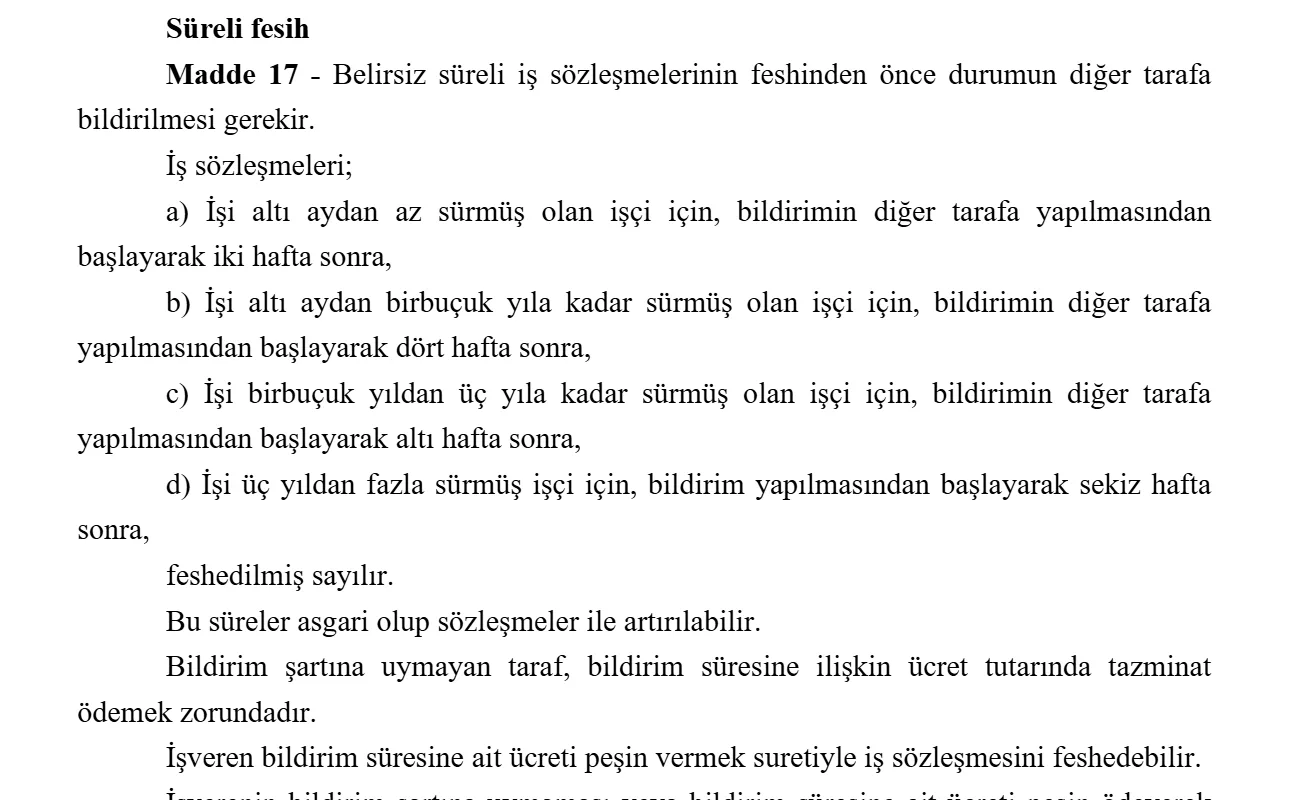
An open-ended employment contract ends only after notice is given to the other side. The notice periods depend on how long the employee has worked (Labour Act, Art. 17) [M1]:
| Length of service | Notice period | Notice pay if notice is not given |
|---|---|---|
| Less than 6 months | 2 weeks | 2 weeks' wages |
| 6 months to 1.5 years | 4 weeks | 4 weeks' wages |
| 1.5 to 3 years | 6 weeks | 6 weeks' wages |
| More than 3 years | 8 weeks | 8 weeks' wages |
These are minimums; a contract can give longer periods. An employer can end the contract at once by paying the wages for the notice period in advance, and doing so does not prevent the job security rules from applying [M1]. Our notice pay calculator applies these periods.
Time off to look for a new job during notice
During the notice period, the employer must give at least two hours a day, within working hours and without deducting pay, so that the employee can look for a new job; the employee may combine these hours and use them together at the end of the notice period, after telling the employer (Art. 27) [M1].
4. Severance pay in Turkey for foreign employees: who qualifies and how much?
Severance pay (kıdem tazminatı) is governed by Article 14 of the old Labour Act No. 1475, which remains in force [M2]. It is owed for 30 days' wages for each full year of service, with part-years paid proportionally, when the employee has worked at least one year and the contract ends in one of these ways [M2]:
- the employer ends it, other than for the misconduct listed in the law;
- the employee ends it for a just cause recognised by the law (for example, unpaid wages);
- military service, retirement, a woman's resignation within one year of marriage, or the employee's death.
| Rule | What it means | Basis |
|---|---|---|
| Minimum service | At least one full year with the same employer (periods with the same employer are added together) | 1475 Art. 14 |
| Wage used | Not only the basic wage: regular money and money-value benefits (such as meal or transport payments) are included | 1475 Art. 14 |
| Annual ceiling | TRY 73,729.87 per year of service, for terminations from 1 July to 31 December 2026 | 1475 Art. 14; Ministry announcement [T1] |
| Late payment | The court awards the highest deposit interest for the delay | 1475 Art. 14 |
| Time limit | Five years | 4857 Additional Art. 3 |
Severance pay ceiling in Turkey for 2026
The ceiling is updated twice a year. For terminations from 1 January to 30 June 2026 it was TRY 64,948.77 per year of service, and for terminations from 1 July to 31 December 2026 it is TRY 73,729.87 [T1]. A monthly wage above the ceiling is calculated on the ceiling. Severance pay that must be paid under Law No. 1475 is exempt from income tax (Income Tax Law Art. 25/7-a) [M6].
How severance pay in Turkey is calculated: a worked example
An employee worked for 3 years and 4 months. The gross monthly wage plus regular benefits was TRY 96,000, and the employer ended the contract in October 2026 without notice and without a reason listed in the law.
| Item | Calculation | Gross amount (TRY) |
|---|---|---|
| Severance pay | The monthly wage (96,000) is above the ceiling, so 73,729.87 is used: 73,729.87 × 3 + 73,729.87 × 4/12 | 245,766.23 |
| Notice pay | More than 3 years' service: 8 weeks = 56 days; 96,000 / 30 = 3,200 per day; 56 × 3,200 | 179,200.00 |
| Unused annual leave (example: 10 days) | 10 × 3,200 | 32,000.00 |
The ceiling applies to severance pay only; notice pay and leave pay are calculated on the actual wage. Our severance pay calculator applies the current ceiling. Amounts in a real file depend on the documents, and statutory deductions are made from gross amounts.
When severance pay is not owed
Severance is not owed if the employer ends the contract under Article 25/II of the Labour Act, which lists conduct such as dishonesty, serious insults or threats, theft, or unjustified absence for two consecutive working days, and the employer must use that right within six working days of learning of the conduct and in any case within one year (Arts. 25-26) [M1]. An ordinary resignation without a just cause recognised by the law does not give severance either [M2].
5. Can I get my job back in Turkey? Reinstatement for foreign employees
Turkish law gives some employees job security: the employer must have a valid reason for dismissal related to the employee's competence or conduct, or to the needs of the business (Art. 18) [M1]. It applies when all of these are true [M1]:
| Condition | Rule |
|---|---|
| Size of workplace | 30 or more workers (all workplaces of the employer in the same line of business are counted together) |
| Service | At least six months with the employer |
| Contract | Open-ended; chained fixed-term contracts without an essential reason count as open-ended from the start (Art. 11) |
| Position | Not an employer's representative running the whole business (Art. 18) |
The dismissal must be in writing with a clear and precise reason, and an employee cannot be dismissed for reasons related to conduct or performance without first being heard (Art. 19) [M1]. Trade union activity, filing complaints against the employer, race, colour, sex, marital status, family responsibilities, pregnancy, religion or political opinion are not valid reasons (Art. 18) [M1].
The one-month deadline and mediation
An employee who claims that no reason was given or that the reason is not valid must apply to a mediator within one month of being notified of the dismissal. If mediation fails, a case can be filed in the labour court within two weeks of the final mediation report. The employer must prove that the dismissal had a valid reason (Art. 20) [M1].
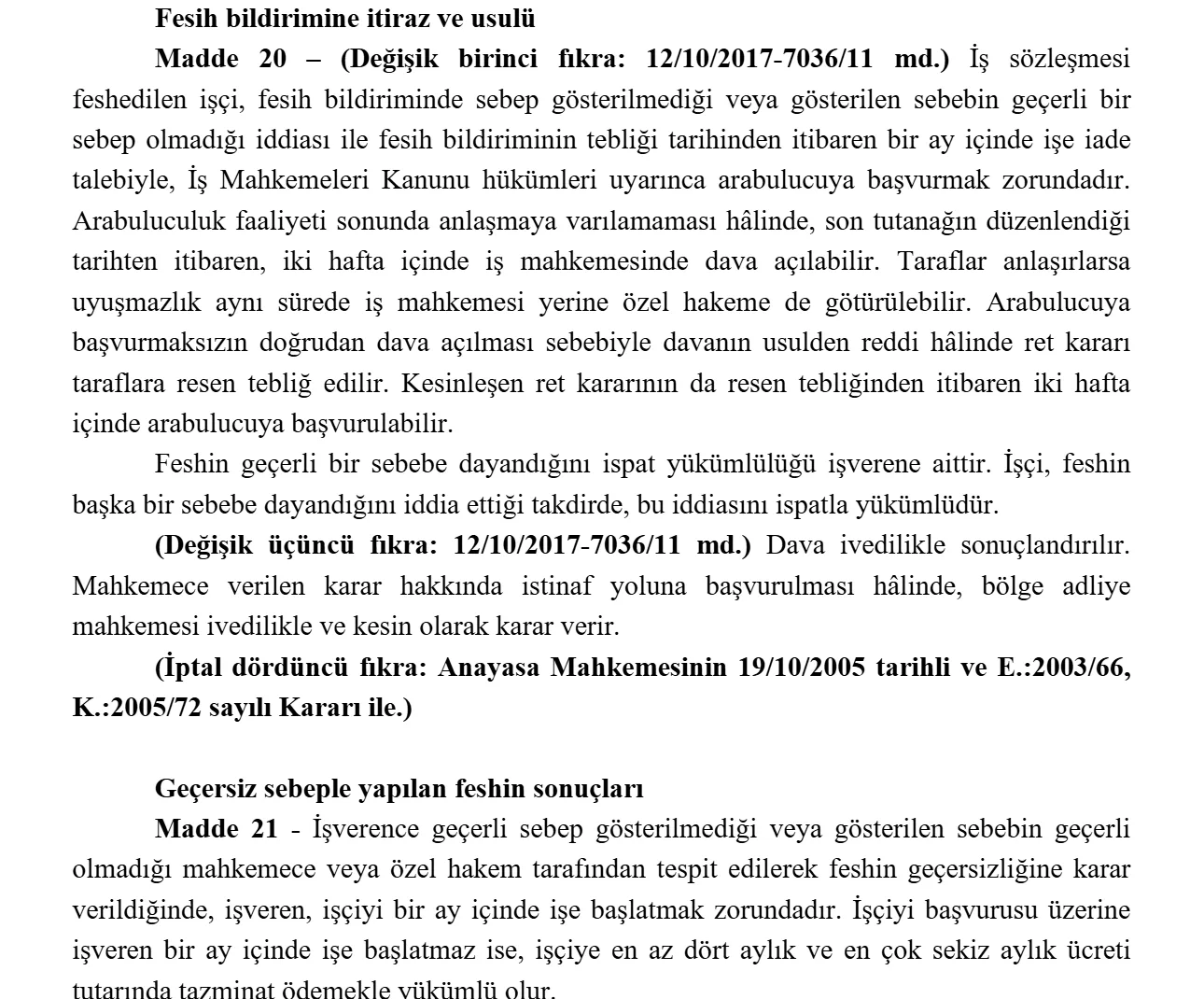
What happens if the dismissal is found invalid?
| Step | Rule (Labour Act, Art. 21) |
|---|---|
| Return to work | The employee applies to the employer within 10 working days of being notified of the final decision; otherwise the dismissal is treated as valid |
| Employer takes the employee back | Within one month of the application |
| Employer refuses | Compensation of 4 to 8 months' wages, set by the court |
| Wages for the idle period | Up to 4 months' wages and other rights until the decision becomes final |
| Amounts in the judgment | Set in money, on the wage at the date of the case |
A labour court decision in a reinstatement case can be appealed to the regional court, which decides finally (Art. 20) [M1]. Our reinstatement compensation calculator shows the 4-8 month range and the idle-period wages.
6. Why you cannot go straight to court: mandatory mediation in Turkish labour disputes
For claims based on the law or an employment contract, and for reinstatement, applying to a mediator first is a condition of the lawsuit; a case filed without mediation is dismissed on procedure (Labour Courts Law No. 7036, Art. 3) [M3]. The exception is compensation for work accidents and occupational diseases [M3]. In practice this means that the first formal step after a dismissal is usually the mediation office, and that the final mediation report is attached to any later lawsuit.
7. What happens to my work permit and residence permit after I am fired?
This is the part that is specific to foreign employees:
| Rule | Effect | Basis |
|---|---|---|
| A work permit is cancelled when the foreigner's work ends for any reason | Dismissal ends the permit | 6735 Art. 15/2-ç [M4] |
| The employer must notify the Ministry within 15 days that the employment has ended | The authorities learn of the end of the job | 6735 Art. 22 [M4] |
| A valid work permit counts as a residence permit | When the work permit ends, so does the residence it provided | 6458 Art. 27/1 [M5] |
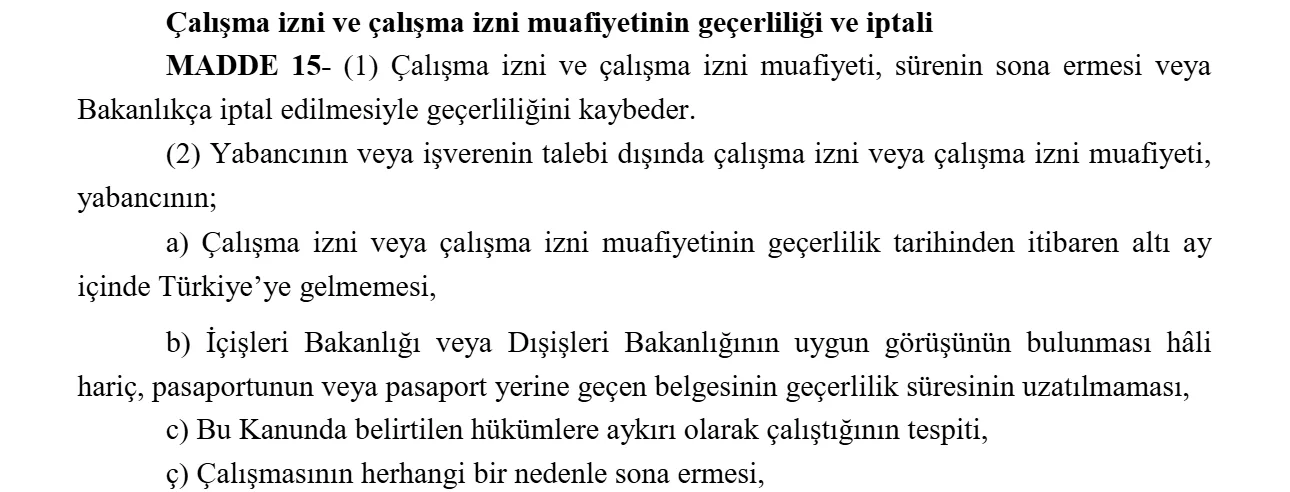
The Labour Act's reinstatement rules do not contain a residence rule of their own; the right to stay follows the Law on Foreigners. After a work permit ends, a foreigner's stay must rest on another permit, such as a short-term or family residence permit, if the conditions of one are met. Staying without a valid permit can lead to overstay fines and entry bans, explained in our guide to deportation and entry bans and in our overstay calculator. Years spent on work permits also matter for long-term residence.
8. My salary has not been paid: what does Turkish law allow?
| Situation | Rule | Article |
|---|---|---|
| Wages unpaid for 20 days after the payment date | The employee may refuse to work; this is not a strike, and the employee cannot be dismissed or replaced for it | 4857 Art. 34 |
| Interest on late wages | The highest interest rate applied to deposits | 4857 Art. 34 |
| Wages not paid in accordance with the law or contract | The employee may end the contract at once for just cause | 4857 Art. 24/II-e |
| Severance after such a resignation | Owed, because it is a resignation for just cause | 1475 Art. 14 |
| Time limit for wage claims | Five years | 4857 Art. 32 |
9. I was fired for "misconduct": what are my rights?
An employer that relies on misconduct must point to one of the situations listed in Article 25/II of the Labour Act and act within six working days of learning of it, and in any case within one year of the act, unless the employee obtained a financial benefit (Art. 26) [M1]. For dismissals based on conduct or performance that are not listed misconduct, the employee must be heard first (Art. 19) [M1]. Whether the reason given was real is examined in the mediation and, if needed, in court, where in reinstatement cases the employer carries the burden of proof (Art. 20) [M1].
The exit code in your social security record (SGK çıkış kodu)
When employment ends, the employer enters a code in the Social Security Institution's system showing the reason, and it appears in the service record on e-Devlet. Code 04 means that the employer ended an open-ended contract without stating a just cause. Code 29 was used for dismissals for conduct contrary to morality and good faith; it was abolished by SGK Circular 2021/9 of 1 April 2021 and replaced by nine codes, 42 to 50, each matching one paragraph of Article 25/II [T2]. The employer writes the code; whether the reason itself is real is examined in mediation and in court.
10. Small employers and fixed-term contracts: when job security does not apply
If the workplace has fewer than 30 workers or the employee has less than six months' service, reinstatement is not available. Even then, if the employer abused the right to dismiss, the employee is owed three times the notice pay, plus notice pay itself if notice was not given (Art. 17) [M1]. Fixed-term contracts end on their date; but repeated fixed-term contracts without an essential reason are treated as open-ended from the start (Art. 11) [M1], which can bring notice pay and job security into play. Foreign employees whose contracts follow the length of the work permit often ask about this rule.
11. Deadlines after a dismissal in Turkey
| Deadline | For what | Basis |
|---|---|---|
| 1 month from notice of dismissal | Applying to a mediator for reinstatement | 4857 Art. 20 |
| 2 weeks from the final mediation report | Filing the reinstatement case | 4857 Art. 20 |
| 10 working days from notice of the final decision | Applying to the employer to return to work | 4857 Art. 21 |
| 6 working days / 1 year | The employer's window to dismiss for listed misconduct | 4857 Art. 26 |
| 15 days | Employer's notification to the Ministry that a foreign employee's work has ended | 6735 Art. 22 |
| 5 years | Severance, notice, bad-faith and equal-treatment compensation, annual leave pay, wages | 4857 Art. 32; Additional Art. 3 |
12. I have already left Turkey: can I still claim severance and notice pay?
Leaving Turkey does not end the claims; the five-year time limits continue to run (Labour Act, Art. 32 and Additional Art. 3) [M1]. Mediation and any lawsuit are carried out in Turkey, so a former employee abroad usually acts through a lawyer in Turkey holding a power of attorney, signed at a Turkish consulate or before a notary with an apostille. The one-month reinstatement deadline, however, runs regardless of where the employee is.
13. Which documents prove what a foreign employee is owed?
| Document | What it proves |
|---|---|
| Employment contract (and any renewals) | Start date, wage, open-ended or fixed-term |
| Payslips and bank transfers | The actual wage, including benefits used for severance |
| Social security (SGK) service record | Insured days and employer; available on e-Devlet |
| Work permit and its dates | Legal status and continuity of employment |
| The dismissal letter | Date of notice (starts the one-month deadline) and the reason given |
| Emails, messages, warnings, defence statements | Whether the reason was real and whether the employee was heard |
| Annual leave records | Unused leave days |
| Number of employees (company records, SGK) | Whether job security applies (30 workers) |
14. Employment lawyer in Istanbul, Ankara and across Turkey for foreign employees
Labour disputes go first to the mediation office and then to the labour court where the work was done or where the employer is based. Most foreign employees work in İstanbul, where many consult an employment lawyer in Istanbul; in the capital, cases are followed by a lawyer in Ankara before the Ankara labour courts; and employees who have left the country usually act through a lawyer in Turkey with a power of attorney.
Sources and References
Legislation
[M1] Labour Act No. 4857, Arts. 11, 17-21, 24-27, 32, 34, 41, 59, Additional Art. 3
[M2] Labour Act No. 1475, Art. 14 (severance pay, still in force)
[M3] Labour Courts Law No. 7036, Art. 3
[M4] International Workforce Law No. 6735, Arts. 15, 22
[M5] Law on Foreigners and International Protection No. 6458, Arts. 27, 31
[M6] Income Tax Law No. 193, Art. 25/7-a (severance pay exemption)
Official announcements
[T2] Social Security Institution (SGK) Circular No. 2021/9 (1 April 2021) on employment exit codes
This article is general information about Turkish law as of 3 October 2026. It is not legal advice and does not assess any individual case. Amounts are gross illustrations.
Frequently Asked Questions
How much severance pay will I get if I am fired in Turkey?
30 days' wages for each full year of service, with part-years paid proportionally, based on the wage plus regular benefits and capped at TRY 73,729.87 per year for terminations from 1 July to 31 December 2026 (Law 1475 Art. 14). Notice pay and unused leave are paid in addition.
Is severance pay taxed in Turkey?
Severance pay that must be paid under Labour Act No. 1475 is exempt from income tax (Income Tax Law Art. 25/7-a).
I was fired in Turkey as a foreigner. What am I entitled to?
Depending on the facts: notice pay (2-8 weeks' wages, Labour Act Art. 17), severance pay after one full year (30 days' wages per year, Law 1475 Art. 14), unused annual leave (Art. 59), unpaid wages, and in workplaces with 30+ workers possibly reinstatement or 4-8 months' compensation (Arts. 18-21).
Does Turkish labour law apply to foreign employees?
Yes. The Labour Act's rules on notice, severance, wages, leave and job security do not depend on nationality. A wage agreed in foreign currency can be paid in lira at the rate on the payment day (Art. 32).
How is severance pay calculated in Turkey?
30 days' wages for each full year of service, with part-years paid proportionally, using the wage plus regular benefits, capped at TRY 73,729.87 per year for terminations from 1 July to 31 December 2026 (Law 1475 Art. 14).
What is the severance pay ceiling in Turkey in 2026?
TRY 73,729.87 per year of service for the period 1 July - 31 December 2026, as announced by the Ministry of Labour. The ceiling applies only to severance pay, not to notice pay.
How much notice must my employer give in Turkey?
2 weeks for less than 6 months' service, 4 weeks for 6 months to 1.5 years, 6 weeks for 1.5 to 3 years, and 8 weeks for more than 3 years (Labour Act Art. 17). Without notice, the employer owes wages for that period.
Do I get severance pay if I resign?
Not for an ordinary resignation. Severance is owed if you resign for a just cause recognised by the law, for example when wages are not paid in accordance with the law or contract (Labour Act Art. 24/II-e).
Can I get my job back after being fired in Turkey?
If the workplace has 30 or more workers, you have at least 6 months' service on an open-ended contract and the reason is not valid, the dismissal can be challenged; the employer either takes you back within a month or pays 4-8 months' wages plus up to 4 months' lost wages (Arts. 18-21).
What is the deadline to challenge a dismissal in Turkey?
One month from the notice of dismissal to apply to a mediator; if mediation fails, two weeks from the final report to file in the labour court (Labour Act Art. 20).
Do I have to go to mediation before suing my employer?
Yes, for claims based on the law or the contract and for reinstatement; a case filed without mediation is dismissed on procedure. Work accident compensation is the exception (Law 7036 Art. 3).
Who has to prove the reason for my dismissal?
In reinstatement cases the employer must prove that the dismissal had a valid reason (Labour Act Art. 20). If the employee claims a different real reason, the employee must prove that claim.
What happens to my work permit if I am fired in Turkey?
It is cancelled, because a work permit ends when the foreigner's work ends for any reason (International Workforce Law Art. 15/2-ç). The employer must notify the Ministry within 15 days (Art. 22).
Can I stay in Turkey after losing my job?
A valid work permit counts as a residence permit (Law on Foreigners Art. 27/1). When it ends, the right to stay must rest on another permit, such as a short-term or family residence permit, if its conditions are met; staying without one can lead to overstay fines and entry bans.
Does a reinstatement case let me stay in Turkey while it continues?
The Labour Act's reinstatement rules contain no residence rule of their own; the right to stay is governed by the Law on Foreigners.
My salary has not been paid. Can I stop working?
If wages are not paid within 20 days of the payment date, the employee may refuse to work, cannot be dismissed or replaced for that reason, and late wages carry the highest deposit interest rate (Labour Act Art. 34).
My employer says I was fired for misconduct. Do I lose severance?
Only if the reason is one listed in Article 25/II and the employer acted within 6 working days of learning of it and within 1 year (Art. 26). Whether the reason was real is examined in mediation and in court.
What does exit code 04 mean in my SGK record?
Code 04 means the employer ended an open-ended contract without stating a just cause. Code 29 (conduct contrary to morality and good faith) was abolished by SGK Circular 2021/9 and replaced by codes 42 to 50, each matching a paragraph of Labour Act Article 25/II.
Is unused annual leave paid when I am fired?
Yes. Whenever the contract ends, for any reason, unused annual leave is paid at the last wage (Labour Act Art. 59).
What is bad-faith compensation in Turkey?
Where job security does not apply (for example, fewer than 30 workers) and the employer abused the right to dismiss, the employee is owed three times the notice pay, plus notice pay if notice was not given (Labour Act Art. 17).
My contract is fixed-term because of my work permit. Am I protected?
Fixed-term contracts end on their date, but repeated fixed-term contracts without an essential reason are treated as open-ended from the start (Labour Act Art. 11), which can bring notice pay and job security into play.
How long do I have to claim severance and unpaid wages?
Five years for severance, notice, bad-faith and equal-treatment compensation, annual leave pay and wages (Labour Act Art. 32 and Additional Art. 3).
I have left Turkey. Can I still claim?
Yes, the claims survive and the five-year limits continue. Mediation and lawsuits take place in Turkey, so former employees abroad usually act through a lawyer in Turkey with a power of attorney.
Do I get time off to look for a new job during notice?
Yes. The employer must give at least two hours a day without pay deduction, which can be combined and used together at the end of the notice period (Labour Act Art. 27).
Does severance include my bonuses and benefits?
Yes. Regular money and money-value benefits provided under the contract or law, such as meal or transport payments, are taken into account (Law 1475 Art. 14).
What documents do I need for a claim against my employer?
The contract, payslips and bank transfers, the SGK service record, the work permit, the dismissal letter, messages and warnings, leave records and evidence of the number of employees.
Where can I find an employment lawyer in Istanbul or Ankara?
Many foreign employees in İstanbul consult an employment lawyer in Istanbul; cases in the capital are followed by a lawyer in Ankara before the Ankara labour courts, and former employees abroad act through a lawyer in Turkey with a power of attorney.
- severance pay in Turkey
- severance pay Turkey 2026
- how to calculate severance pay in Turkey
- severance pay calculation Turkey
- severance pay ceiling Turkey 2026
- is severance pay taxed in Turkey
- notice pay Turkey
- fired from job in Turkey
- Turkish labour law severance pay
- Turkish employment law termination
- unfair dismissal Turkey
- reinstatement lawsuit Turkey
- foreign employee rights Turkey
- work permit cancelled after dismissal
- residence after losing job Turkey
- unpaid salary Turkey
- mandatory mediation labour Turkey
- annual leave pay Turkey
- SGK exit code 04
- employment lawyer Istanbul
- employment lawyer Turkey
- lawyer in Ankara