How to Hire a Lawyer in Turkey from Abroad: Costs and Power of Attorney (2026)
How a person living abroad appoints a lawyer in Turkey: the power of attorney at a Turkish consulate or before a local notary with an apostille, the authority it must contain, how much a lawyer costs under the 2025-2026 minimum fee tariff, court costs and security for costs, and what needs personal attendance.
Many people who live outside Turkey need a lawyer in Turkey for a divorce, a property sale, an inheritance or a debt, and ask whether this can be done without travelling. In most matters it can, through a power of attorney, but how that document is prepared and how lawyers' fees work in Turkey are the two points that cause most delays.
If you have a matter on this topic:
1. Can I hire a lawyer in Turkey without travelling to Turkey?
In most civil, commercial, family, property and enforcement matters, yes. A Turkish lawyer acts for the client on the basis of a power of attorney, files it with the court or the enforcement office, and follows the case through the electronic court system (UYAP). The law requires the lawyer to submit the original power of attorney approved or drawn up by a notary, or a copy certified by the lawyer, to the case file (Code of Civil Procedure, Art. 76) [M2]. Copies certified by the lawyer count as official copies before all courts and public offices (Attorneyship Act, Art. 56) [M1].
What usually cannot be done entirely from abroad is anything the law ties to the person themselves: in an agreed (uncontested) divorce, for example, the judge must hear the spouses in person (Civil Code, Art. 166/3) [M4]. Section 7 lists these situations.
2. Who can act as a lawyer in Turkey, and how can I check a lawyer is registered?
Only lawyers registered with a Turkish bar association can represent clients before Turkish courts. Admission to the profession requires, among other things, Turkish citizenship, a Turkish law degree (or a foreign law degree completed with exams) and the completion of the legal traineeship (Attorneyship Act, Art. 3) [M1]. A lawyer qualified in another country therefore usually works together with a lawyer in Turkey rather than appearing before Turkish courts directly.
Checking registration on the bar roll
Registration can be checked on the lawyer search of the Union of Turkish Bar Associations (barobirlik.org.tr) and on the roll of the relevant bar, for example the Istanbul Bar Association's roll (istanbulbarosu.org.tr). A Turkish lawyer's name, bar and registration number are usually also written on letterheads and in the power of attorney itself. Professional rules do not allow lawyers to promise a particular outcome, so a promise of a guaranteed result is one of the signs people abroad often look out for.
3. What is a power of attorney in Turkey and what must it say?
A power of attorney (vekâletname) is the document by which the client authorises the lawyer to act. For court cases, Turkish practice uses a litigation power of attorney (dava vekâletnamesi), which authorises the lawyer to bring, defend and follow cases and enforcement proceedings. A general wording covers ordinary steps, but the law lists acts that a lawyer cannot carry out unless the power of attorney gives express authority for them.
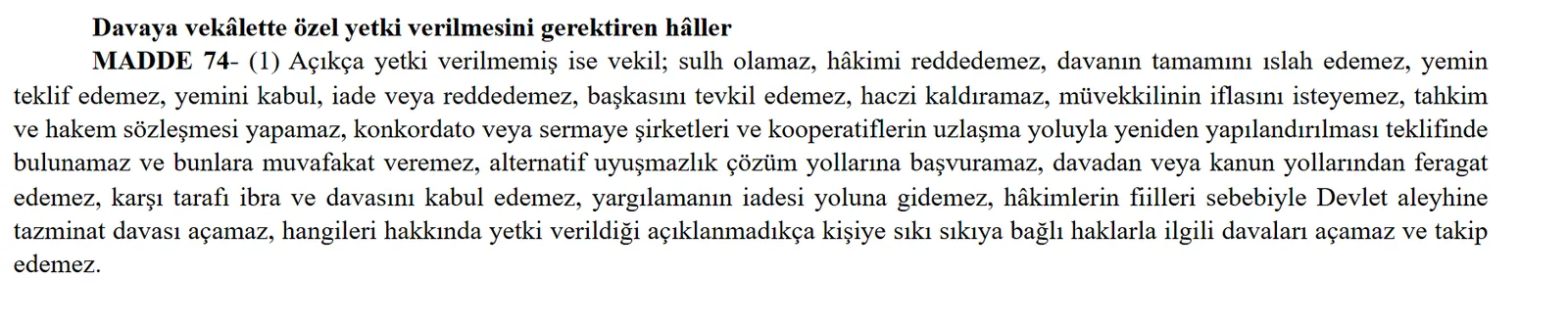
Acts that need express authority (Code of Civil Procedure, Art. 74)
Without express authority, the lawyer cannot settle the case, challenge the judge, amend the whole claim, offer or accept an oath, appoint another lawyer, lift an attachment, request the client's bankruptcy, agree to arbitration, agree to a composition (konkordato), use alternative dispute resolution such as mediation, withdraw the case or an appeal, release the other side or accept their claim, apply for a retrial, sue the State for a judge's acts, or bring and follow cases about rights strictly personal to the client unless those are named (Art. 74) [M2].
This matters in practice because many disputes in Turkey now pass through compulsory mediation before court (labour, commercial and consumer disputes in particular): if the power of attorney does not authorise alternative dispute resolution and settlement, the lawyer cannot sign a mediation agreement for the client.
Receiving money on the client's behalf
Whether the lawyer may receive payments collected from the other side, from an enforcement office or from a bank is also written into the power of attorney. In Turkish practice this authority is known as ahzu kabz. If it is not included, payments are made to the client personally.
Working with another lawyer
If the power of attorney allows the lawyer to appoint another lawyer (tevkil), the lawyer may follow the case together with, or through, another lawyer, for example for a hearing in another city, while remaining responsible to the client (Attorneyship Act, Art. 171) [M1].
4. How to give a power of attorney from abroad
There are two routes. Which one is used usually depends on the country, the time available and the matter.
At a Turkish consulate or embassy
Turkish consulates and embassies carry out notarial acts, including powers of attorney, usually by appointment through the consular services system (konsolosluk.gov.tr). The document is drawn up in Turkish, so it does not need an apostille or a translation and can be used in Turkey as it is. Consulates generally ask for a passport, the full name of the lawyer (often with bar and registration number) and the wording of the authority. The usual difficulty is the waiting time for an appointment.
Before a local notary, with an apostille
A power of attorney can also be signed before a notary in the country of residence. If that country is a party to the 1961 Hague Apostille Convention, as Turkey is, the competent authority there adds an apostille. In Turkey, the document is then translated by a sworn translator and the translation is approved by a Turkish notary. This route avoids a consular appointment but adds translation time, and the wording has to match what Turkish courts and offices expect.
Countries outside the Apostille Convention
Where the country is not a party to the Apostille Convention, the document is legalised instead: usually by that country's foreign ministry and then by the Turkish consulate, before translation in Turkey.
| Route | Language | Extra steps | Typical issue |
|---|---|---|---|
| Turkish consulate or embassy | Turkish | None; usable in Turkey directly | Appointment waiting time |
| Local notary + apostille | Local language | Sworn translation and notary approval in Turkey | Wording that does not cover the needed authority |
| Local notary + legalisation | Local language | Foreign ministry and Turkish consulate legalisation, then translation | Longest route |
Details that commonly cause a power of attorney to be refused
Names spelt differently from the passport (especially names with Turkish characters), a missing passport or foreign identity number, an authority that is too general for the transaction (for example a property sale without the property being identified), and a missing authority to settle, withdraw or receive money are the most frequent reasons a power of attorney has to be signed again.
5. Powers of attorney for specific matters
Divorce
Divorce is a right strictly personal to the spouse, so the power of attorney names the divorce case expressly (Art. 74) [M2]. In a contested divorce, the case is usually followed by the lawyer. In an agreed divorce, the law requires the judge to hear the spouses in person and be satisfied that they agreed freely (Civil Code, Art. 166/3) [M4], so the spouse attends that hearing. Our guide on divorce in Turkey for foreigners and the page on divorce lawyers in Istanbul explain the process; a divorce granted abroad is a separate question covered in recognition of a foreign divorce in Turkey.
Buying or selling property
The land registry works with a special power of attorney that identifies the property and the transaction (sale, purchase, mortgage), and may cover paying fees and taxes and signing the official deed. A general litigation power of attorney is not used for a sale at the land registry. Our guide on selling property in Turkey as a foreigner covers the tax side, and property sold without my knowledge covers what happens when a power of attorney is misused.
Inheritance
Heirs who live in different countries can each sign a power of attorney at the Turkish consulate where they live, appointing the same lawyer. The usual authority covers the certificate of inheritance, the inheritance tax return, transfer of title deeds, closing or collecting bank accounts and, where heirs cannot agree, the partition case. See inheritance in Turkey for foreigners.
Unpaid wages, debts and compensation
Labour and commercial money claims pass through compulsory mediation first, so the authority to use alternative dispute resolution and to settle is part of the wording. A creditor abroad can start enforcement proceedings through a lawyer without travelling, as explained in debt collection in Turkey.
Criminal complaints and criminal cases
A victim can file a criminal complaint and join the case through a lawyer, with authority to complain, to join the proceedings and to appeal. A suspect or defendant has separate rights, including the right to a lawyer from the first statement; our guide on being arrested in Turkey as a foreigner covers that situation.
6. How much does a lawyer cost in Turkey?
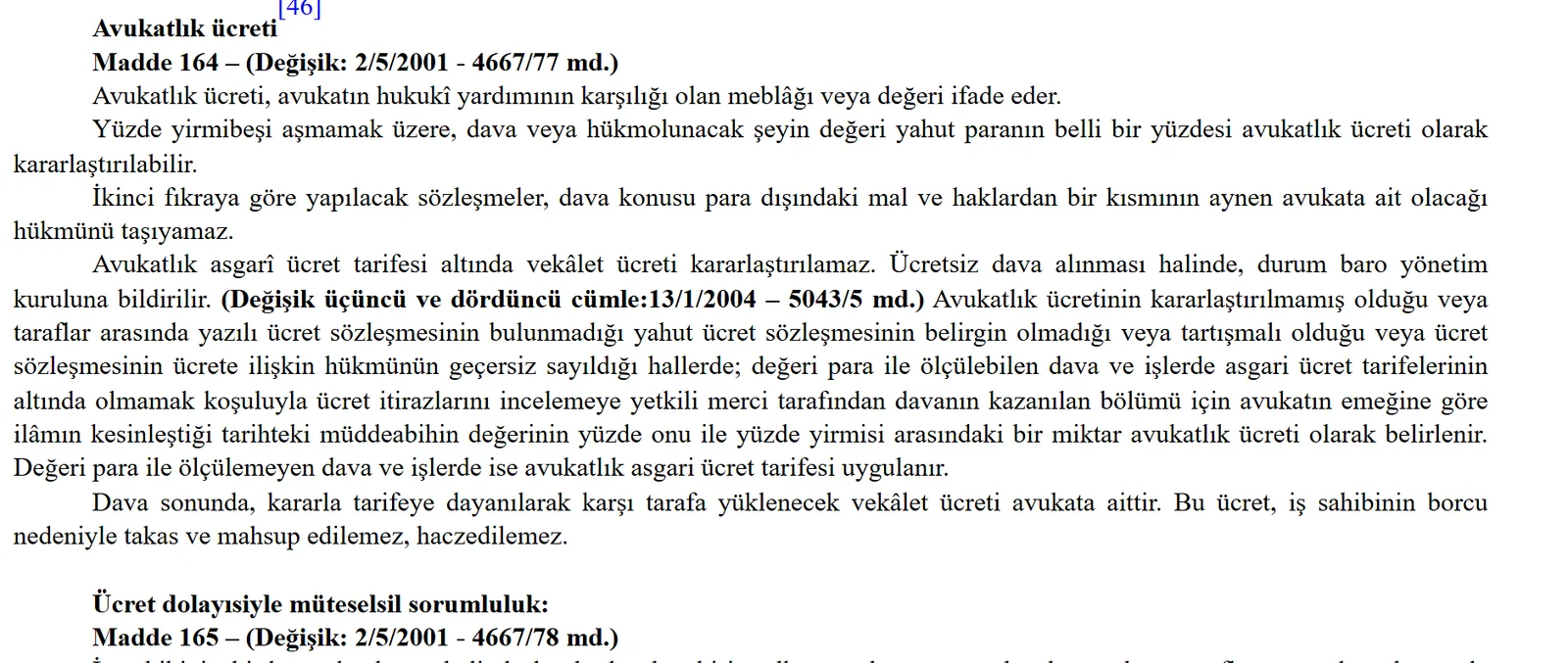
Turkish law leaves the fee to agreement between lawyer and client, within three limits: the fee cannot be lower than the minimum fee tariff, a percentage fee cannot exceed 25% of the value of the claim, and the agreement should state the legal work covered and the amount (Attorneyship Act, Arts. 163-164) [M1].
The minimum fee tariff (AAÜT) 2025-2026
The Union of Turkish Bar Associations publishes a minimum fee tariff (Avukatlık Asgari Ücret Tarifesi) each year. The tariff in force was published in the Official Gazette on 4 November 2025 [T1]. Some of its amounts:
| Work | Minimum fee (2025-2026) |
|---|---|
| Oral consultation at the lawyer's office, first hour | TRY 4,000 (each further hour TRY 1,800) |
| Case before a civil court of peace (sulh hukuk) | TRY 30,000 |
| Case before a civil court of first instance (asliye mahkemesi) | TRY 45,000 |
| Case before a consumer court | TRY 22,500 |
| Case before a high criminal court (ağır ceza) | TRY 65,000 |
| Enforcement proceedings (icra takibi) | TRY 9,000 |
These are lower limits, not price lists: the actual fee depends on the work, the value of the dispute and the agreement. The tariff is renewed every year, usually in the autumn.
The written fee agreement and the 25% cap
A fee agreement is valid without a particular form, but agreements that are not in writing are proved under the general rules (Art. 163) [M1]. A fee can be set as a fixed amount, as a percentage of the claim or of what is awarded (up to 25%), or as a combination. A percentage agreement cannot give the lawyer part of non-monetary property in kind, such as a share of a house (Art. 164) [M1].
Court fees and expenses are separate
Court fees (harç), the advance for expenses (gider avansı) used for notifications, expert reports and witnesses, and translation costs are paid in addition to the lawyer's fee. Their amount depends on the type and value of the case.
Security for costs for foreign claimants
A foreign person or company bringing a case in a Turkish court, joining a case as claimant or starting enforcement proceedings must provide security set by the court to cover the other side's costs and losses, unless the court exempts them on the basis of reciprocity (Private International and Procedural Law, Art. 48) [M3]. A Turkish citizen who does not habitually live in Turkey is also asked for security when bringing a case, subject to the exceptions in the Code of Civil Procedure (Art. 84) [M2]. Whether reciprocity exists depends on the claimant's country, often through international conventions.
Costs awarded against the losing side
At the end of a case, the court orders the losing side to pay a legal fee based on the tariff. By law that amount belongs to the lawyer, and it cannot be set off against the client's debts (Art. 164) [M1]. It is therefore separate from the fee agreed between lawyer and client, unless their agreement says otherwise about how the two relate.
Legal aid
People who cannot pay court costs without serious hardship to themselves and their family can apply for legal aid for court and enforcement costs (Code of Civil Procedure, Art. 334) [M2], and bar associations run legal aid offices that provide a lawyer (Attorneyship Act, Art. 176) [M1]. For foreigners, legal aid in civil cases also depends on reciprocity (Art. 334/3) [M2].
7. What can be done from abroad, and what needs personal attendance?
| Step | Usually through the lawyer | Personal attendance |
|---|---|---|
| Filing a case, hearings, petitions, appeals | Yes | Not usually |
| Enforcement proceedings and collecting money | Yes, with authority to receive money | No |
| Mediation in labour, commercial and consumer disputes | Yes, with authority for alternative dispute resolution and settlement | No |
| Agreed (uncontested) divorce hearing | The lawyer attends too | Yes, the judge hears the spouses in person (Civil Code, Art. 166/3) |
| Questioning a party in person, when the court orders it | The lawyer attends | Yes |
| Medical examination by the Forensic Medicine Institute (injury, malpractice) | The lawyer arranges the appointment | Yes |
| Signing the deed at the land registry | Yes, with a special power of attorney | No |
8. Language: Turkish courts and English-speaking lawyers
Proceedings before Turkish courts and offices are conducted in Turkish, and documents in another language are filed with a Turkish translation; foreign public documents are usually apostilled or legalised. Communication between lawyer and client, on the other hand, can take place in any language both understand. Many foreign clients therefore look for an English-speaking lawyer in Istanbul or elsewhere in Turkey, who explains the Turkish documents and the stages of the case in English while the case itself runs in Turkish.
9. Following the case from abroad
The court file is kept in the electronic court system (UYAP), which the lawyer uses to file petitions, follow hearing dates and receive decisions. Clients abroad usually receive hearing dates, the minutes of hearings, expert reports and decisions from the lawyer, together with a translation or summary where needed. Notifications to the lawyer are made electronically, which is why deadlines can start running in Turkey while the client is abroad.
10. Ending the power of attorney or changing lawyers
A client can revoke a power of attorney at any time, usually by a notice through a notary or a Turkish consulate. The law protects the lawyer's fee: if the lawyer is dismissed, the full fee is owed unless the dismissal was because of the lawyer's fault or negligence; and a lawyer who drops a case without a justified reason cannot claim a fee and returns any advance (Attorneyship Act, Art. 174) [M1]. When lawyers change, the new power of attorney and the handover of the file are timed so that no deadline is missed.
11. Documents usually requested for a first assessment
| Document | Why it is useful |
|---|---|
| Passport (and Turkish foreign identity number, if any) | Identification and the wording of the power of attorney |
| Any decision, notification or letter already received from Turkey | Shows the stage of the matter and running deadlines |
| Contracts, title deeds, bank records, messages | The facts the case will rely on |
| Marriage, birth or death certificates (apostilled) | Family and inheritance matters |
| Earlier powers of attorney given to anyone in Turkey | Whether another authority already exists or needs revoking |
12. English-speaking lawyer in Istanbul and Ankara for clients abroad
Most matters of people living abroad are heard where the property, the employer, the other party or the family court is located. Many of these are in Istanbul, where clients abroad often work with a lawyer in Istanbul; cases before the Ankara courts are followed by a lawyer in Ankara or, through delegation, by the same lawyer; and matters elsewhere are handled by a lawyer in Turkey under the same power of attorney. The practice areas most often involved are divorce and family, real estate, inheritance and immigration.
Sources and References
Legislation
[M1] Attorneyship Act No. 1136, Arts. 3, 56, 163, 164, 171, 174, 176
[M2] Code of Civil Procedure No. 6100, Arts. 74, 76, 84, 334
[M3] Private International and Procedural Law No. 5718 (MÖHUK), Art. 48
[M4] Turkish Civil Code No. 4721, Art. 166
Official publications
[T2] Turkish consular services (konsolosluk.gov.tr): appointments for notarial acts at consulates
Frequently Asked Questions
Can I hire a lawyer in Turkey without travelling to Turkey?
In most civil, commercial, family, property and enforcement matters, yes. The lawyer acts on the basis of a power of attorney signed at a Turkish consulate or before a local notary with an apostille and translation, and follows the case through the electronic court system.
Where can I sign a power of attorney for Turkey from abroad?
At a Turkish consulate or embassy, usually by appointment through konsolosluk.gov.tr, or before a local notary. A consular power of attorney is in Turkish and is used directly; a local one is apostilled (or legalised) and then translated and approved by a notary in Turkey.
Does a power of attorney from a foreign notary need an apostille?
If the country is a party to the 1961 Hague Apostille Convention, an apostille is added there; otherwise the document is legalised by that country's foreign ministry and the Turkish consulate. In Turkey it is then translated by a sworn translator and approved by a notary.
What must a power of attorney for a Turkish lawyer include?
The client's details as in the passport, the lawyer's name, and the matters covered. Acts such as settling, withdrawing, accepting the other side's claim, appointing another lawyer or using mediation need express authority (Code of Civil Procedure, Art. 74). Receiving money on the client's behalf is also written in.
How much does a lawyer cost in Turkey?
Fees are agreed between lawyer and client but cannot be lower than the minimum fee tariff. In the 2025-2026 tariff (Official Gazette, 4 November 2025), for example, a case before a civil court of first instance is TRY 45,000 and an office consultation is TRY 4,000 for the first hour. Court fees and expenses are separate.
Can a Turkish lawyer charge a percentage of the claim?
Yes, up to 25% of the value of the claim or of what is awarded (Attorneyship Act, Art. 164). The agreement cannot give the lawyer part of non-monetary property in kind.
Do foreigners have to pay security for costs in Turkish courts?
A foreign claimant must provide security set by the court for the other side's costs unless exempted on the basis of reciprocity (Private International and Procedural Law, Art. 48). Whether reciprocity applies depends on the claimant's country.
Who keeps the legal fee the court awards against the losing side?
By law it belongs to the lawyer and cannot be set off against the client's debts (Attorneyship Act, Art. 164). It is separate from the fee agreed between lawyer and client unless their agreement says otherwise.
Can I get a divorce in Turkey without coming to Turkey?
A contested divorce is usually followed by the lawyer. In an agreed divorce, the judge must hear the spouses in person (Civil Code, Art. 166/3), so the spouse attends that hearing. The power of attorney names the divorce case expressly.
Can my lawyer sell my property in Turkey for me?
The land registry works with a special power of attorney that identifies the property and the transaction. A general litigation power of attorney is not used for a sale at the land registry.
How can I check that a lawyer in Turkey is registered?
Through the lawyer search of the Union of Turkish Bar Associations (barobirlik.org.tr) or the roll of the relevant bar, such as the Istanbul Bar Association. Only lawyers registered with a Turkish bar can represent clients before Turkish courts.
Can a foreign lawyer represent me in a Turkish court?
Admission to the Turkish bar requires, among other things, Turkish citizenship and Turkish legal training (Attorneyship Act, Art. 3), so lawyers qualified abroad usually work together with a lawyer in Turkey.
Are Turkish court proceedings in English?
No. Proceedings are conducted in Turkish and foreign documents are filed with a Turkish translation. Communication between the lawyer and the client can be in English with an English-speaking lawyer.
Can I change my lawyer in Turkey?
Yes, by revoking the power of attorney, usually through a notary or a Turkish consulate. If the lawyer is dismissed without fault on the lawyer's part, the full agreed fee is owed (Attorneyship Act, Art. 174).
Is there legal aid for foreigners in Turkey?
Legal aid for court costs exists for people who cannot pay them (Code of Civil Procedure, Art. 334), and bar associations run legal aid offices. For foreigners in civil cases, legal aid also depends on reciprocity (Art. 334/3).
Is there an English-speaking lawyer in Istanbul or Ankara for clients abroad?
Yes. Doğan Hukuk Bürosu is an Istanbul law firm whose lawyer, Av. Ömer Faruk Doğan, works in English and Turkish for clients abroad, in cases before the Istanbul courts and, as a lawyer in Ankara or elsewhere in Turkey, before courts in other cities under the same power of attorney.
Is this article legal advice?
No. It is general information about Turkish law as of 6 October 2026. Every matter depends on its own facts and documents; to have a situation assessed, our office can be contacted.
- lawyer in Turkey
- lawyer in Ankara
- English-speaking lawyer Istanbul
- power of attorney Turkey
- Turkish consulate power of attorney
- lawyer fees Turkey
- apostille Turkey
- immigration lawyer Istanbul
Our services in this area
Law on Foreigners