Ç-104 (C-104) Code in Turkey: Two-Year Entry Ban After an Overstay — and How It Differs from Ç-114 (2026)
What the Ç-104 (C-104) code means in Turkish rulings, the two-year overstay ban, unpaid fines, special visas, lifting it from abroad and the 60-day lawsuit, and how the one-year Ç-114 judicial code differs.
Ç-104 (often typed "C-104" or "C104") is a Turkish restriction code linked to a two-year entry ban for foreigners who overstayed their residence. Two published Council of State rulings describe it as "2 yıl Türkiye'ye giriş yasağı", a two-year ban on entering Turkey. Ç-114 (also typed "C-114") is the code entered for foreigners subject to judicial proceedings, and in the rulings it appears with a one-year entry ban. Both are entry-ban codes; their legal bases differ.
If you have a matter on this topic:
This guide covers Ç-104 and Ç-114, a code from the same "Ç" family: what each means in the rulings, how long it lasts and what it leaves behind. Finding out about a code, lifting it and going to court are covered once, for both codes. Other codes are covered in our main restriction codes guide. Marks such as [L1] refer to laws and regulations, [R1] to court rulings and [O1] to other official sources, all listed at the end. The article gives general information; every file turns on its own documents.
How are Ç-104 and Ç-114 related? Both are entry-ban codes; their legal bases differ. In the rulings Ç-104 is a two-year ban tied to a residence violation, that is, staying beyond the lawful period [R1] [R2]. Ç-114 is a one-year ban tied to judicial proceedings against the person; in the files described in the rulings, the code was usually entered after a deportation [R10] [R7]. The two codes are set side by side in the comparison table.
What Is the Ç-104 (C-104) Code in Turkey?
Ç-104 is one of the letter-and-number marks ("tahdit kodu", restriction code) that the Turkish migration authority and police enter on a foreigner's record. The Presidency of Migration Management (Göç İdaresi Başkanlığı) does not publish a list of codes or their meanings; what is known comes from court rulings. For Ç-104 there are two published Council of State (Danıştay) rulings:
- May 2024 ruling: It quotes the first-instance administrative court, which rejected the case on the ground that there was no unlawfulness "in the Ç-104 restriction code act imposing a two-year entry ban on the claimant, who had up to two years of residence violation after lawful entry" [R1].
- September 2025 ruling: The case had been filed to annul "the act dated 25/12/2024 concerning a two-year entry ban to Turkey with the Ç-104 restriction code". The ruling states that the act was taken by the "Istanbul Governorship Provincial Directorate of Migration Management" [R2].
One detail in the May 2024 ruling deserves mention: in the part describing the subject of the case, the act is called an entry ban "with the O-100 restriction code", while the first-instance summary says Ç-104 [R1]. The ruling does not explain the difference. The meaning given in this article rests on the first-instance summary and on the September 2025 ruling.
Why "Ç" and not "C"?
"Ç" is a Turkish letter pronounced like "ch". Foreign keyboards usually lack it, so people search for "C-104", "C104" or "Ch-104"; they all refer to the same code. In the rulings, most codes starting with Ç appear as timed entry bans. The long name of Ç-114 is written as "Ç-(Timed entry ban) 114-(Foreigners Subject to Judicial Proceedings, 1 Year Ban)" [R10], and another ruling spells out a related code as "Ç-süreli yurda giriş yasağı-105", which reads as "Ç - timed entry ban - 105" [R9]. Read this way, the letter marks a timed entry ban and the number its reason and length. Ç-101 appears with a three-month ban, Ç-114 with one year, Ç-104 with two years and Ç-105 with five years [R5] [R10] [R1] [R9]. No official definition of the letter has been published.
Is Ç-104 the same as a deportation stamp?
Ç-104 is an entry ban record; a deportation decision (sınır dışı etme kararı) is a separate administrative act. They often appear together, because the law says that "the entry of foreigners deported from Turkey shall be banned" by the Presidency or the governorships [L1]. A deported person therefore also receives an entry ban, recorded with a code. But a ban can also be imposed without any deportation, for example when a person who overstayed leaves on their own [L2] [O1]. Ç-114 is also an entry ban record; in its files it usually followed a deportation [R10]. The 7-day period to challenge a deportation decision is explained in our deportation guide.
How Long Is the Ç-104 Ban, and Where Do the Two Years Come From?
Both rulings link Ç-104 to a two-year ban [R1] [R2]. The law sets only the outer limit, not the ban for each length of overstay. Under Article 9/3 of Law No. 6458 on Foreigners and International Protection, "the duration of the entry ban shall not exceed five years. However, where there is a serious threat to public order or public security, this period may be extended by the Presidency by up to ten more years" [L1]. Article 9/8 leaves the detailed rules to the Ministry.
The only public text linking overstay length to ban length is a statement dated 9 June 2020, still published on the migration authority's website [O1]. The two-year ban appears in two separate rows:
| Situation in the statement | Length of overstay | Entry ban |
|---|---|---|
| Comes to the border on their own before being detected and pays the fine | 2 to 3 years | 2 years |
| Does not pay the fine; does not leave within the period given to leave; invited to leave after an overstay of 3 months or more; did not leave in time after a residence or work permit refusal; deported under escort, and similar | 1 to 2 years | 2 years |
The statement does not name codes, so it is not possible to say for certain which row Ç-104 corresponds to. The words "up to two years of residence violation" in the May 2024 ruling [R1] match the second row (1 to 2 years), but that is only an observation based on comparing periods. Our overstay and entry ban calculator shows the period the statement sets for a given overstay; it does not assess any individual case. Ç-114 cannot be worked out from this table, because it depends on judicial proceedings rather than on the length of a stay.
What counts as overstaying in Turkey?
Overstaying a residence permit means staying in Turkey after the permit has expired. The law says a deportation decision is taken about those who hold a residence permit and, "without an acceptable reason, exceed the duration of their residence permit by more than ten days after it expires" [L3]. Exceeding a visa or visa exemption by more than ten days is a separate deportation ground [L3]. The migration authority's statement treats all of these as a "violation of the right of legal stay": visa, visa exemption, residence permit, work permit and work permit exemption [O1]. A person whose permit was cancelled and who stays on can end up here too; see our V-69 guide.
Ç-104 compared with Ç-101 and Ç-105
- Ç-101: "Ç-101 (foreigner who violated visa/residence, 3 months ban)" [R5].
- Ç-104: up to two years of residence violation, 2-year entry ban [R1] [R2].
- Ç-105: "Ç-timed entry ban-105, 2-5 years visa violation with a 5-year ban record" [R9].
Google also suggests "banned from Turkey for 5 years"; in the rulings that period is linked to Ç-105, not Ç-104. Which code was entered can only be seen from the person's current record.
When Does the Two-Year Ban Start and End?
The day the two years start depends on how the person left Turkey. Under Article 8/2-a of the Implementing Regulation of the Law on Foreigners and International Protection, "for foreigners to be deported, the entry ban starts on the date the foreigner leaves the country" [L2]. For a deported person, the two years run from the actual day of exit, not from the date of the decision.
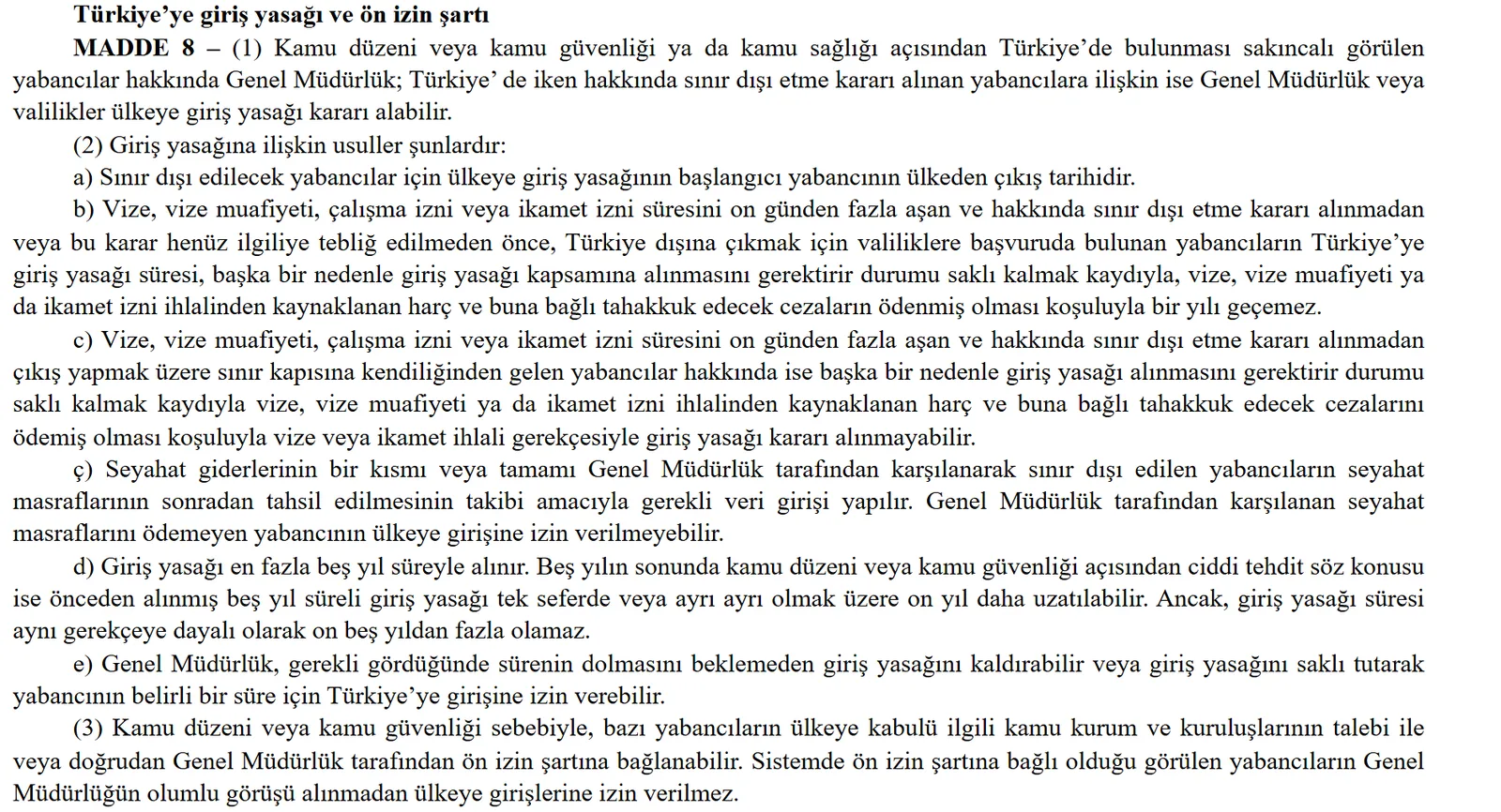
For people who leave on their own, the Regulation distinguishes two situations [L2]:
- Those who apply to the governorship and leave: where a foreigner has exceeded a visa, visa exemption, work permit or residence permit by more than ten days and applies to the governorship to leave before a deportation decision is taken or notified, the entry ban "cannot exceed one year", provided the fees and fines arising from the overstay have been paid (8/2-b).
- Those who come to the border on their own: for a foreigner who comes to the border gate to leave before any deportation decision and pays the fees and fines, "an entry ban decision on grounds of visa or residence violation may not be taken" (8/2-c).
Articles 9/4 and 9/5 of the law use similar wording for those who apply to the governorship and for those invited to leave who leave in time: an entry ban "may not be taken" [L1]. "May not" does not oblige the authority to waive the ban; it is discretion given to the authority.
Does Ç-104 disappear by itself after two years?
The published Ç-104 rulings do not say whether the code is removed automatically when the period ends. Rulings on other timed codes include examples of a code being removed "automatically" at the end of its term; one is the Ç-114 file described below [R10], and others are covered in our main codes guide. Whether the record has actually gone, and whether another code has been entered, can only be seen from the current record.
I paid nothing at the border. Can I enter after the ban ends?
The last paragraph of the migration authority's statement answers this directly: even if the entry ban has expired, foreigners who have not paid administrative fines and other public debts arising from the Fees Law No. 492 and other legislation "are not permitted to enter our country as long as they do not pay these fines and public debts, under Articles 7 and 15 of Law No. 6458" [O1].
Article 15 of the law says that a visa is not issued to those who "do not accept to pay" debts arising from a visa violation or a previous residence permit; Article 9/7 allows governorships to make entry subject to prior permission "because of administrative fines and public debts" [L6] [L1]. The Regulation adds that a foreigner whose deportation costs were paid by the state and who does not repay them "may not be allowed to enter" [L2]. So even after two years, an unpaid fee, fine or travel cost can cause a problem at the border.
The overstay fine itself depends on nationality, the length of the overstay and age; according to the Istanbul Provincial Directorate of Migration Management, the amount is learned at the border gate when leaving [O2]. For that reason this article gives no figure.
What Happens If I Try to Enter Turkey With Ç-104 or Ç-114?
- At the border: Article 15 bars visas for "those whose entry into Turkey is banned", and Article 7 turns back those listed in Article 15 as "inadmissible passengers" even if they are visa-exempt [L6].
- If the person gets in: The law provides that a deportation decision is taken about "those found to have come to Turkey despite an entry ban" (54/1-ı) [L3]. Article 102 also sets an administrative fine for "those who have entered Turkey despite their entry having been banned under paragraphs one and two of Article 9", increased by half if repeated within a calendar year [L4]. The amount in the law is revalued every year.
The rulings show that entering before a ban ends can lead to a new and longer ban: in a Ç-105 file, the person had come to Turkey in breach of the ban using different identity details; when caught, the ban was re-issued and the five years started again from that date [R3].
Ç-114 (C-114) Code in Turkey: What It Means and the One-Year Entry Ban
Ç-114 is a restriction code entered for foreigners subject to judicial proceedings, and in the rulings it appears with a one-year entry ban. Like Ç-104 it is a timed entry ban record, but its source is criminal proceedings against the person, not a residence violation. Two Council of State rulings spell out what it stands for [R10] [R7].
The full name of the code and "1 Yıl Men"
A March 2022 ruling, relying on the preliminary review form in a citizenship file, quotes this record: "on 16/08/2006 ... the Istanbul Foreigners Branch Directorate entered the restriction Ç-(Timed entry ban) 114-(Foreigners Subject to Judicial Proceedings, 1 Year Ban), and this restriction was automatically removed by the General Directorate of Security on 17/08/2007" (translated) [R10].
An October 2021 ruling uses a short form: "a 1-year restriction entered with the Ç-114 code (foreigners subject to judicial proceedings)" (translated) [R7]. "Men" in the rulings means a ban: "1 Yıl Men" means entry to Turkey is banned for one year. Other Ç codes follow the same pattern; in a ruling of the Council of State 10th Chamber of 10.06.2021, Ç-116 appears as "Foreigners Threatening Public Morals and Public Health - 1 year ban" (translated) [R14].
Does "judicial proceedings" mean a conviction?
The examples in the rulings show that a conviction was not awaited: the code was entered right after the events, before any criminal case ended. In the March 2022 file the person was processed for "forgery" on 11/08/2006, deported on 15/08/2006 and given Ç-114 the next day; the criminal case ended later [R10]. In the October 2021 file the code was entered "on the ground that she confessed to the prosecutor" to tampering with her earlier residence permit (translated) [R7]. What matters for the code is the existence of judicial proceedings, not their outcome.
How long does Ç-114 last? One year and "automatic" removal
All three published rulings link Ç-114 to a one-year ban:
- A code entered in Istanbul in 2006 ran from 16/08/2006 to 17/08/2007 and "was automatically removed" [R10].
- A code entered in 2013 was recorded as a "1-year entry ban" [R7].
- A 2015 Council of State ruling quoted by the Constitutional Court says the Diyarbakır Police Directorate placed a US citizen "under a 1-year entry ban to Turkey with the Ç-114 code as of 20.8.2010 because he was among foreigners subject to judicial proceedings" (translated) [R13].
The law sets only an upper limit: "The duration of the entry ban shall not exceed five years." (translated) [L1] The one year comes from the code's own definition, not from the law. How the Council of State views periods resting only on internal circulars is covered in the section on how courts have looked at Ç-coded bans; the Ç-114 rulings refer to no circular.
A Ç-114 ban lifted before the year ended
In the October 2021 file a one-year ban imposed on 12/02/2013 ended early. The person came "to Turkey on 16/04/2013 with a specially annotated visa for family reunification", and "the 1-year entry ban with the Ç-114 code was lifted on 18/04/2013" (translated) [R7]. The law gives this power expressly: the Presidency "may lift the entry ban or, without prejudice to the entry ban, allow the foreigner to enter Turkey for a certain period" [L1]. Although "those whose entry into Turkey is banned" are among those refused visas, the law allows an exception: "a visa may be issued with the approval of the Minister" (translated) [L6].
When was Ç-114 imposed? Facts from the rulings
The rulings show different kinds of "judicial proceedings":
- Fake entry-exit stamp in a passport: A Russian national's passport had been given a fake entry-exit stamp by someone promising to extend her visa. At exit from Istanbul Atatürk Airport the passport was seized, she was deported and Ç-114 was entered. In the criminal case she was sentenced to 1 year 8 months under Article 204/1 of the Turkish Criminal Code, with the pronouncement of the judgment deferred [R10].
- Tampering with a residence permit: The code was entered for a Moldovan national on the ground that she had forged an official document by tampering with her earlier residence permit and had confessed this to the prosecutor; by her account a deportation decision was taken in 2013 [R7].
- Together with a security inquiry: In the Diyarbakır file a US citizen received both an "istizan" decision, meaning entry is not allowed without consulting the Ministry of Interior, and a one-year Ç-114 ban; the first-instance rejection was upheld by the Council of State [R13].
A 2024 jurisdiction ruling also describes a record meaning "(foreigners subject to judicial proceedings)", with the code number redacted, entered over an "intentional injury incident" (translated) [R12]. As the number cannot be seen, we cite it only as a record with the same meaning, not as a Ç-114 example.
The legal basis of Ç-114: an entry ban for deported foreigners
In the Ç-114 files the ban usually followed a deportation. Article 9/2 of Law No. 6458 covers this situation: "the entry of foreigners deported from Turkey shall be banned" by the Presidency or the governorships [L1]. Unlike "may ban" in the first paragraph, this paragraph says "shall be banned".
The deportation decision itself rests on Article 54, whose subparagraphs list those considered for deportation under Article 59 of the Turkish Criminal Code, those who "use false information or forged documents in procedures for entry, visas and residence permits", and those posing a threat to public order or public security (54/1-a, c, d) [L3]. The Ç-114 rulings do not say which subparagraph was used; the fake stamp and tampering allegations resemble the use of forged documents in subparagraph (c). In the intentional injury example, the ruling expressly relied on subparagraph (d) [R12].
Ç-114 and residence permits: the Moldovan file
Article 33 of the law says a short-term residence permit is not issued to a foreigner subject to an entry ban [L7]:

The Moldovan national lived with her mother in Turkey on a family residence permit due to expire on 02/06/2015; on 28/05/2015 she applied to the Istanbul Provincial Directorate of Migration Management for a short-term permit. The administration cited the 2013 Ç-114 record and refused, saying she "had to come to Turkey with a specially annotated visa" (translated). The administrative court rejected her case under 33/1-ç [R7].
The Council of State unanimously reversed. The ban had been lifted on 18/04/2013 and she had later been given a family residence permit, so "it is clear that there was no entry ban on the claimant on the date of the act". The claim of an entry ban "cannot be accepted as the ground of the act", and there was no "legal obstacle" to applying to the governorship to switch from family to short-term residence (translated) [R7].
The Council of State relied on Article 22, which lists exceptional cases where residence applications may be made to governorships; one, as quoted in the ruling, is "switching from a family residence permit to a short-term residence permit" (translated) [R7] [L7]. So she could not be required to leave and return with a visa. The code entered after a residence permit is cancelled is covered in our V-69 guide.
Can an expired Ç-114 cause problems later?
Citizenship application by marriage. In the March 2022 file the 2006 Ç-114 appeared on the preliminary review form of a 2011 application for citizenship by marriage. The inquiry found the marriage "a normal marriage", yet the application was refused under Article 16/1-c of Turkish Citizenship Law No. 5901, the condition of "having no situation constituting an obstacle in terms of national security and public order" (translated). The administration cited the 1 year 8 month sentence and the regulation's rule on prison sentences over six months [R10].
The Council of State reversed by majority. Under the law's preamble, the condition aims to keep out "those who commit crimes seriously disrupting public order directed at the existence and functioning of the state"; the offence here was "not of a nature to prevent the claimant from becoming a Turkish citizen" (translated) [R10]. Ç-114 can thus come up in an application years later, but it was not decisive on its own.
International protection file. In a December 2020 ruling the person argued that, among the records used against him in an international protection case, "the Ç-114 restriction record had expired", as shown by a migration authority letter of 14/04/2016; the G-87 and N-87 records in the same file had been annulled by the court. The Council of State accepted the request for rectification and upheld the judgment annulling the protection refusal (translated) [R11]. More on G-87 is in our G-87 guide.
How is a Ç-114 code lifted?
In the Ç-114 files the code ended in three ways: "automatically" when the year ran out [R10], by the administration lifting it early [R7], and by an administrative letter confirming expiry [R11]. While it is in force, the request and the lawsuit work as for Ç-104; see lifting a code and going to court. The route seen most often in the Ç-114 rulings is a different one: a lawsuit against a residence or citizenship refusal that relied on an expired or lifted Ç-114 [R10] [R7].
Is the code removed if I am acquitted?
Published rulings do not explain how the criminal outcome (acquittal, non-prosecution or deferral of the pronouncement of the judgment) affects Ç-114. In the examples the code had run its year while the criminal case was still pending. In the March 2022 file the Council of State separately assessed the nature of the offence for which pronouncement had been deferred [R10]. Criminal proceedings against foreigners are covered in arrested in Turkey as a foreigner.
Ç-104 vs Ç-114: Comparison Table
The table uses only the sources cited in this article; where the rulings say nothing, it says so.
| Point | Ç-104 | Ç-114 |
|---|---|---|
| Meaning in the rulings | Two-year entry ban on a person with "up to two years of residence violation after lawful entry" [R1] | "Foreigners Subject to Judicial Proceedings, 1 Year Ban" [R10] [R7] |
| Reason | Exceeding a residence permit or visa [R1] [O1] | Judicial proceedings against the person, such as a fake stamp or a tampered permit; no conviction awaited [R10] [R7] |
| Legal basis | Law No. 6458, Art. 9 (at most 5 years); periods by overstay length in the migration authority's statement [L1] [O1] | In the files, entered after a deportation; Art. 9/2 ("shall be banned"), and Art. 54 for the deportation decision [L1] [L3] |
| Length | 2 years [R1] [R2] | 1 year [R10] [R7] [R13] |
| At the end of the period | The Ç-104 rulings do not say whether it is removed automatically | Removed "automatically" in one file [R10]; expiry confirmed by an administrative letter in another [R11] |
| After the period | No entry while fines and public debts are unpaid [O1] | Cited years later against residence and citizenship applications; both refusals reversed [R7] [R10] |
| Specially annotated visa | Entry for a set period while the ban stays is allowed [L1]; no Ç-104 example in the rulings | Entry on 16/04/2013 for family reunification; ban lifted on 18/04/2013 [R7] |
| Lifting | Request to the Presidency; implied refusal after 30 days without an answer [L1] [L5] | The same request route [L1] [L5]; in the rulings, most often a lawsuit against a linked residence or citizenship refusal [R7] [R10] |
| Lawsuit | 60 days; Istanbul administrative courts where the Istanbul provincial migration office imposed the ban [L5] [R2] | 60 days; 7 days against a linked deportation. Challenged together with a deportation, jurisdiction followed the deporting authority [L5] [L3] [R12] |
Ç-101, Ç-104 and Ç-105 all depend on exceeding a visa or residence period [R5] [R1] [R9]. G codes are security-based: G-87 "General Security" and G-82 "activity against national security"; the rulings give them no set duration. As in the Diyarbakır file, Ç-114 can appear alongside a security record [R13]; N-82, which makes entry subject to the Presidency's permission, is such a record.
How Do I Check If I Have a Ç-104 or Ç-114 Code?
"Turkey entry ban check" is a common search, but there is no "restriction code check" or "entry ban check" service on e-Devlet, the Turkish government portal; our main guide explains this. A code usually comes to light through notification of the ban or during an application. In the rulings, Ç-114 surfaced during a residence application and on the preliminary review form of a citizenship application [R7] [R10]. The Regulation sets out who notifies an entry ban in three situations [L2]:
- When applying abroad: where a person applies to a consulate for a visa, residence or work permit, consular staff notify the ban.
- If the person is in Turkey: the governorship notifies it.
- When leaving: the police unit at the border gate notifies those against whom an entry ban decision has been taken.
In practice, a person leaving after an overstay may be handed a form about the ban when paying the fine at the border; in the Ç-105 file, an "information form" was notified "against signature" [R3]. Keeping that form and the payment receipt helps later to show the date and length of the ban. If there is no document, the record can be requested by petition to the provincial migration office or to the Presidency, directly or through a lawyer. The same route works for a record that has expired: in the international protection file, the person proved with a letter from the migration authority that the Ç-114 record had expired [R11].
What should the notification say?
The law says the notification of an entry ban must include "how foreigners can effectively exercise their right to object to the decision and their other legal rights and obligations in this process" (Law No. 6458, Art. 10) [L6]. The same article provides for notification at the border for bans under 9/1, but leaves notification of bans under 9/2, those imposed on deported persons, to governorships. In the Ç-114 files the code followed deportation directly, and the rulings do not describe how it was notified. If the document does not state the length, legal basis or way to object, that gap can be raised when the time limit is counted and in the case itself.
How to Lift Ç-104 or Ç-114 Early: Removal and Temporary Entry
The law gives the Presidency of Migration Management two powers: "The Presidency may lift the entry ban or, without prejudice to the entry ban, allow the foreigner to enter Turkey for a certain period." [L1] The Regulation repeats that this can be done "where deemed necessary, without waiting for the period to expire" [L2]. The power does not depend on the code number, so before the two years of Ç-104 or the one year of Ç-114 end, two routes exist:
- Lifting the ban: the record is removed altogether.
- Temporary entry while the ban stays: the ban remains, but the person can be let in for a set period, for example for family or health reasons. In the rulings such entries were made with a "specially annotated visa" (özel meşruhatlı vize). Although banned persons are among those refused visas, the law allows an exception: "a visa may be issued with the approval of the Minister" [L6]. The example is the Ç-114 file above, where the ban was lifted two days after such an entry [R7].
The request is made by petition to the Presidency or to the provincial migration office. Under Article 10 of Law No. 2577 on Administrative Procedure, "if no answer is given within thirty days, the request is deemed refused", and that refusal can be challenged in court (translated) [L5]. Our main guide describes a file where a lawyer's request was not processed because no power of attorney was attached.
What usually matters in a request to lift the ban?
The law sets no conditions for lifting; it is the authority's discretion. The points that come up in the rulings and the law are:
- For Ç-104, the length of the overstay and its reason (for example a residence application filed on time but still pending).
- Whether fees, fines and any deportation costs have been paid [O1] [L2].
- Family ties in Turkey; the law says residence decisions take into account "family ties, length of residence, the situation in the country of origin and the best interest of the child" (Law No. 6458, Art. 25/1).
- Whether there is any other code or criminal record.
None of these decides the result on its own; every request is assessed on its documents.
Lifting the code from abroad with a power of attorney
Most people with Ç-104 are already outside Turkey, and Ç-114 files often begin with a deportation. The request and any lawsuit can be filed by a lawyer in Turkey under a power of attorney (vekâletname), usually signed at a Turkish consulate or before a local notary with an apostille and a sworn Turkish translation. Our guide to hiring a lawyer in Turkey from abroad explains the practical steps and costs.
Challenging Ç-104 or Ç-114 in Court: 60 Days and Which City
An entry ban is an administrative act, challenged by an annulment action at the administrative court (idare mahkemesi). As there is no special period, the general 60-day period of Article 7 of Law No. 2577 on Administrative Procedure applies, starting on the day after "written notification" [L5]. How the period is counted where no notification was made is explained with examples in our main guide.
Our appeal period calculator counts the days from a notification date. If there is also a deportation decision, the period against that is "seven days from notification of the decision", and the two periods run separately [L3]. Because Ç-114 was usually entered together with a deportation, the distinction matters more often there. Under Article 53 as amended by Law No. 7533 (21 November 2024), the foreigner is not deported without consent during the lawsuit period or until the case ends [L3]. Details are in our deportation guide.
Istanbul or Ankara? The September 2025 ruling
Under Article 32 of Law No. 2577, the competent court is the administrative court of the place of the authority that took the act, and the rule is one of public order [L5]. The September 2025 Ç-104 file shows how this can cost time in practice [R2]:
- A lawyer for a Turkmen national filed a case against the Presidency of Migration Management to annul the Ç-104 ban dated 25 December 2024.
- On 10 February 2025, Istanbul 17th Administrative Court held that the Ankara Administrative Court was competent.
- On 25 March 2025, Ankara 1st Administrative Court held that the Istanbul Administrative Court was competent.
- On 16 September 2025, the Council of State found that the act was taken by the "Istanbul Governorship Provincial Directorate of Migration Management", held the Istanbul administrative courts competent and sent the file to Istanbul 17th Administrative Court.
About seven months passed on the question of competence alone. The office that entered the code decides the city: codes entered by the Presidency are challenged in Ankara. The courts' locations are in our Istanbul court guide and Ankara court guide.
When the code is challenged together with a deportation: the July 2024 ruling
If the code and the deportation are challenged in one case, jurisdiction can become an issue in another way. In the 2024 ruling an Iranian national sued to annul both the deportation and the code meaning "foreigners subject to judicial proceedings". The Council of State held that the intentional injury incident caused both, that "the more fundamental act is the deportation", and, as the Istanbul Provincial Directorate of Migration Management had ordered the deportation, sent the case to Istanbul Administrative Court (translated) [R12]. The claimant had sued the Ağrı migration office.
Appeal and a petition sent at 23:57: the May 2024 ruling
A first-instance judgment in an entry ban case can be appealed to the regional administrative court (istinaf). The appeal period described in the ruling is 30 days from notification of the judgment [R1]. In the May 2024 Ç-104 file [R1]:
- The administrative court rejected the case; the judgment was notified to the person on 29 March 2023.
- The lawyer sent the appeal through the UYAP lawyer portal, Turkey's electronic court system, at 23:57 on 28 April 2023, the last day; a second petition with attachments went at 00:02 on 29 April, and only the second one was put in the file.
- The regional administrative court rejected the appeal as out of time.
- The Council of State, noting that the petition had been sent on the last day, counted it as in time and unanimously reversed.
The ruling is not about the merits of Ç-104, and the later outcome has not been published.
How Courts Have Looked at Ç-Coded Bans
No published Council of State ruling decides the merits of a Ç-104 ban; in the May 2024 file the first-instance court found the act lawful [R1]. In the Ç-114 rulings the dispute was mostly about an old record's effect on later applications [R7] [R10]. Rulings on similar Ç codes show the questions courts ask.
A ban based only on an internal circular
The periods for Ç codes are not in the law but in internal rules of the administration. The Council of State upheld the annulment of a five-year Ç-105 ban based on a 2003 police circular; the first-instance court had held that "a restriction not provided for in the law cannot be introduced by an administrative regulation" [R3]. That file dates from before Law No. 6458. Today Article 9/8 leaves the details to the Ministry [L1]; whether later rules would be treated the same way is not clear from published rulings.
Proportionality: a long ban for a short overstay
In a 2020 ruling, a five-year Ç-120 ban imposed on a person who had stayed 116 days within 180 and could not pay the fine was annulled as "not compatible with the principle of proportionality"; the Council of State upheld that annulment as final [R4]. The example shows that a court can examine whether the length of a ban fits the seriousness of the overstay.
A residence application filed in time
In a Ç-101 file, a British national had agreed at entry to apply for residence within ten days and had applied the next day; when leaving, the person could not show the application receipt and received a three-month ban. The administrative court annulled the ban because the application had not been checked; the Council of State upheld this [R5]. In Ç-104 files too, whether the overstay was counted correctly and whether a pending application was considered are points that can be raised.
Ç-104, Ç-114, Marriage to a Turkish Citizen and Family Life
A spouse or children in Turkey are often given as a reason to lift a ban. A 2024 Constitutional Court judgment draws an important line: the applicant had married a Turkish citizen about two years after a ban was imposed. The Court said the person had "married at a date long after the entry ban was imposed and while aware of the ban", so there was no "existing family life" when the ban was imposed, and it found the family-life complaint inadmissible [R6]. That ban was a security code, not Ç-104 or Ç-114, but the reasoning shows why it matters whether the family tie existed before the ban. Marriage-based residence is covered in our guide to marrying a Turkish citizen.
The rulings have also dealt with old bans being used against new applications. The Council of State found unlawful the refusal of a residence application, based on an earlier entry ban, from a person whose ban had been lifted and who had come with a specially annotated visa; this is the Ç-114 Moldovan file described above [R7]. In another file it found unlawful a refusal based on "restriction records entered earlier and later cancelled" [R8]. After the ban ends, the long-term route is described in our long-term residence permit guide.
What a Lawyer in Istanbul Checks in a Ç-104 or Ç-114 File
- Which codes are on the record? Whether V-69, G-87, N-87, an istizan record, a deportation record or an unpaid fine record is also there; another code can change the direction of the file [R11] [R13].
- Is the code still active? Entry date, removal date or an administrative letter confirming expiry; these dates decided the Ç-114 Moldovan and protection files [R7] [R11].
- Which office imposed the ban, and when? This decides the court's city and the end date.
- How did the person leave? Deported, within the period to leave, or on their own; the exit date and the papers given at the border.
- For Ç-104, was the overstay counted correctly? Entry date, permit expiry, any pending residence application.
- For Ç-114, what were the judicial proceedings and how did the criminal case end? Statement record and deportation decision; judgment, deferral of pronouncement or dismissal. The nature of the offence was discussed in the citizenship file [R10].
- Were the fees and fines paid? Receipts and any deportation costs.
- Family in Turkey: citizenship of spouse and children, and whether the marriage came before or after the ban.
- Which act is challenged? The code, a residence refusal, a citizenship refusal or the deportation; the time limit and the court depend on it.
This list is not a road map; other steps may arise in each file depending on the documents.
Entry Ban Lawyer in Istanbul, Ankara and Across Turkey
Both published Ç-104 files involved acts taken in Istanbul; in the 2025 file the ban was imposed by the Istanbul provincial migration office and the case was sent to Istanbul 17th Administrative Court [R2]. Two Ç-114 examples also come from Istanbul [R10] [R7]. Cases against bans and residence acts of the Istanbul provincial migration office, and against deportation decisions of the Istanbul Governorship, are heard by the Istanbul administrative courts [R2] [R12], and where the person lived in Istanbul (Kadıköy, Maltepe, Kartal, Ataşehir or elsewhere) does not change that [L5]. Codes entered by the Presidency are challenged in Ankara, and a lawyer in Turkey registered with any Turkish bar can act there.
Our office is in Maltepe, on the Asian side of Istanbul. As an immigration and entry ban lawyer in Istanbul, we deal with foreigners' residence, citizenship and restriction code files and with families in Turkey waiting for a spouse who cannot return. For a person abroad, the request and the case can be run with a power of attorney. Other topics are on our Law on Foreigners and Administrative Law pages; Turkish terms are explained in our glossary. An exit ban, which stops a person leaving Turkey, is a different matter covered in our exit ban guide.
Sources
| Code | Source | Subject |
|---|---|---|
| L1 | Law No. 6458 on Foreigners and International Protection, Art. 9 | Entry ban: 9/2 ban for deported persons; 9/3 at most 5 years, +10 years; 9/4-9/5 "may not be taken"; 9/6 lifting and temporary entry; 9/7 prior permission; 9/8 detailed rules |
| L2 | Implementing Regulation of the Law on Foreigners and International Protection, Arts. 8, 9 | Ban starts on the exit date; one-year limit for those applying to the governorship; those coming to the border; travel costs; 15-year limit; lifting; notification |
| L3 | Law No. 6458, Arts. 53, 54 | 7 days against deportation; Law No. 7533 amendment; 54/1-a, c, d grounds; 54/1-e, g visa and residence violation; 54/1-ı entering despite a ban |
| L4 | Law No. 6458, Art. 102 | Administrative fine for entering despite a ban (102/1-b), increase on repetition |
| L5 | Law No. 2577 on Administrative Procedure, Arts. 7, 10, 11, 32 | 60-day period, implied refusal after 30 days, stopping of the period, competent court |
| L6 | Law No. 6458, Arts. 7, 10, 15 | Inadmissible passengers; notification of the entry ban; persons not issued a visa (15/1-b banned persons, 15/1-ğ those not accepting to pay debts), Minister's exception |
| L7 | Law No. 6458, Arts. 22, 33 | Residence application to the governorship (family to short-term); 33/1-ç no short-term permit during a ban |
| O1 | Presidency of Migration Management, statement on entry bans for foreigners who violate their legal stay (09.06.2020) | Ban periods by length of overstay; no entry while fines and public debts are unpaid, even after the ban expires |
| O2 | Istanbul Provincial Directorate of Migration Management, "34 Questions - 34 Answers" (18.11.2020) | Overstay fine depends on nationality, length and age; learned at the border gate |
| R1 | Council of State 10th Chamber, 22.05.2024, E.2023/3752 K.2024/2090 | First-instance summary: up to two years of residence violation, two-year ban, "Ç-104 restriction code act"; UYAP petition at 23:57 in time; regional court decision reversed |
| R2 | Council of State 10th Chamber, 16.09.2025, E.2025/1731 K.2025/3878 | "Two-year entry ban to Turkey with the Ç-104 restriction code"; Istanbul provincial migration office; Istanbul courts competent |
| R3 | Council of State 10th Chamber, 10.03.2021, E.2016/3056 K.2021/1050 | Ç-105, 5 years; re-issued after entry despite the ban; annulment of a circular-based act upheld |
| R4 | Council of State 10th Chamber, 08.12.2020, E.2020/3217 K.2020/5912 | Five-year Ç-120 ban disproportionate; annulment upheld (final) |
| R5 | Council of State 10th Chamber, 25.11.2020, E.2016/14985 K.2020/5406 | "Ç-101 (visa/residence violation, 3 months ban)"; ban imposed without checking a timely application annulled |
| R6 | Constitutional Court, Ramiz Islamov, App. No. 2020/37579, 03.10.2024 | Marriage after the ban: no "existing family life"; family-life complaint inadmissible |
| R7 | Council of State 10th Chamber, 20.10.2021, E.2016/938 K.2021/4947 | "Ç-114 code (foreigners subject to judicial proceedings), 1 year"; entry with a specially annotated visa and lifting of the ban; Istanbul residence refusal based on the lifted ban unlawful, reversed |
| R8 | Council of State 10th Chamber, 25.11.2020, E.2016/3625 K.2020/5405 | Refusal based on earlier, later-cancelled records unlawful |
| R9 | Council of State 10th Chamber, 06.04.2021, E.2016/14686 K.2021/1614 | "Ç-timed entry ban-105, 2-5 years visa violation with 5-year ban record" |
| R10 | Council of State 10th Chamber, 08.03.2022, E.2017/1053 K.2022/1213 | Full name of Ç-114; automatic removal; citizenship refusal reversed |
| R11 | Council of State 10th Chamber, 01.12.2020, E.2018/3842 K.2020/5485 | Expiry of Ç-114 confirmed by letter; G-87 and N-87 annulled; protection refusal annulment upheld |
| R12 | Council of State 10th Chamber, 09.07.2024, E.2024/2898 K.2024/2698 | Redacted "(foreigners subject to judicial proceedings)" code; intentional injury; 54/1-d; Istanbul court competent |
| R13 | Constitutional Court [Plenary], Amanda Jolyn Krause and Others, App. No. 2019/40761, 15.02.2024, § 26 | Quoting Council of State 10th Chamber E.2012/5665 K.2015/4303 (13.10.2015): Diyarbakır, istizan and 1-year Ç-114 ban |
| R14 | Council of State 10th Chamber, 10.06.2021 | Ç-116 "Foreigners Threatening Public Morals and Public Health - 1 year ban" |
Frequently Asked Questions
What does the Ç-104 (C-104) code mean in Turkey?
In Council of State rulings Ç-104 appears with a two-year entry ban. One ruling summarises it as a two-year ban on a foreigner who had up to two years of residence violation after lawful entry.
How long is the Ç-104 entry ban?
Two years in both published rulings. Under Law No. 6458 an entry ban lasts at most five years and can be extended by up to ten more years where there is a serious threat.
When does the two-year Ç-104 ban start?
Under the Implementing Regulation, for a deported foreigner the entry ban starts on the date the person leaves Turkey. The two years run from the actual exit, not from the date of the decision.
What is the Ç-114 (C-114) code in Turkey?
In Council of State rulings its full name is 'Ç-(Timed entry ban) 114-(Foreigners Subject to Judicial Proceedings, 1 Year Ban)'. The code shows a one-year entry ban imposed on a foreigner subject to judicial proceedings.
How long is the Ç-114 entry ban?
All three published rulings link Ç-114 to a one-year ban. In one file the General Directorate of Security removed the code automatically one year after it was entered.
Does Ç-114 require a criminal conviction?
In the examples in the rulings the code was entered right after the judicial proceedings, before the criminal case ended. In one file it was entered five days after the forgery proceedings, and the criminal case ended later.
What is the difference between Ç-104, Ç-105 and Ç-114?
In the rulings Ç-104 is a two-year ban for up to two years of residence violation, and Ç-105 appears as a five-year ban for a 2 to 5 year visa violation; Ç-101 appears with a three-month ban. These codes depend on exceeding a visa or residence period. Ç-114 is a one-year ban linked not to an overstay but to judicial proceedings against the person.
Is Ç-104 or Ç-114 the same as deportation?
Both codes are entry ban records; deportation is a separate decision. The law says deported foreigners are banned from entry, and in the Ç-114 files the code was usually entered after a deportation. A ban can also be imposed without deportation, for example after leaving on one's own following an overstay.
How do I get a Ç-104 code lifted?
The Presidency of Migration Management can lift a ban early or allow entry for a set period while the ban remains. A request left unanswered for thirty days is deemed refused, and that refusal can be challenged at the administrative court.
How is a Ç-114 code removed?
In the rulings the code ended automatically when the period ran out, by the administration lifting it early, or by an administrative letter confirming expiry. The Presidency can lift a ban; a request unanswered for thirty days is deemed refused and can be challenged in court.
Does Ç-104 disappear automatically after two years?
The published Ç-104 rulings do not say. In rulings on other timed codes, such as a Ç-114 file, the code was removed automatically at the end of its term; whether a record has gone can only be seen from the current record.
Can I enter Turkey before a Ç-104 or Ç-114 ban ends?
The Presidency can lift a ban early or allow entry for a set period while it remains; the decision is discretionary. The law bars visas for banned persons but allows a visa with the Minister's approval. In one Ç-114 file the person came with a specially annotated visa for family reunification and the ban was lifted two days later.
My ban has ended but I did not pay the overstay fine. Can I enter Turkey?
According to the migration authority's 2020 statement, foreigners who have not paid administrative fines and public debts are not let in even after the ban has expired. Unpaid deportation costs can also block entry.
What happens if I enter Turkey while a Ç-104 or Ç-114 ban is in force?
A banned person can be refused at the border as an inadmissible passenger. If the person gets in, the law provides for a deportation decision and an administrative fine, and a rulings example shows a ban being restarted.
If I pay the fine and leave on my own, will I get Ç-104?
Under the Regulation, an entry ban may not be imposed on a foreigner who comes to the border on their own before any deportation decision and pays the fees and fines. For those who apply to the governorship first, the ban cannot exceed one year if the payments are made.
Can an old or lifted Ç-114 affect a residence or citizenship application?
In the rulings old Ç-114 records were cited years later. The Council of State unanimously reversed a short-term residence refusal based on a ban that had been lifted, and reversed a refusal of citizenship by marriage based on a 2006 Ç-114 and the related criminal case, finding the offence did not bar citizenship.
If I am acquitted in the criminal case, is Ç-114 removed?
Published rulings do not explain how the criminal outcome affects Ç-114. In the examples the code had run its one year before the criminal case ended; criminal case decisions are used as important documents in later applications.
How long do I have to challenge a Ç-104 or Ç-114 code in court?
The general 60-day period of the Administrative Procedure Law applies, counted from the day after written notification. A deportation decision in the same file has a separate 7-day period from its notification.
Which court hears a Ç-104 or Ç-114 case, Istanbul or Ankara?
The administrative court of the place of the office that imposed the ban. The Council of State held the Istanbul administrative courts competent for a Ç-104 ban imposed by the Istanbul provincial migration office. Where a judicial proceedings code and a deportation were challenged together, it let jurisdiction follow the authority that ordered the deportation.
I am married to a Turkish citizen. Will Ç-104 be lifted?
Family ties can be raised in a request to lift the ban, but the decision is discretionary and differs from file to file. The Constitutional Court found no existing family life where the marriage took place after the ban and with knowledge of it.
How can I check if I have a Ç-104 or Ç-114 code, or prove that it has expired?
There is no restriction code check on e-Devlet. In the rulings codes came to light through notification, during a residence application or on a citizenship review form. In one file a person proved that a Ç-114 record had expired with a letter from the migration authority; such a letter can be requested by petition.
I live on the Asian side of Istanbul. Where is my Ç-104 or Ç-114 case heard?
Cases against bans and residence acts of the Istanbul Provincial Directorate of Migration Management are heard by the Istanbul administrative courts. Living in Kadıköy, Maltepe, Kartal or Ataşehir does not change the competent court; what decides it is the office that took the act.
- Ç-104 code Turkey
- C-104 code Turkey
- c114 code turkey
- Turkey restriction codes
- tahdit kodu
- entry ban Turkey
- turkey overstay ban
- lift entry ban Turkey
- Law on Foreigners 6458
Our services in this area
Law on Foreigners