
Off-Plan Property in Turkey: What Happens If the Developer Goes Bust? (2026)
What off-plan buyers can expect when a Turkish developer files for konkordato or goes bankrupt: the title deed and annotations, the moratorium timeline, converting a flat claim into money, the 15-day and one-month registration periods, ranking and completion insurance.
When the developer of an off-plan property in Turkey goes bust, stops building or files for konkordato, buyers who paid for flats not yet delivered want to know one thing: will they get the flat or their money back? The answer depends less on the developer than on what the buyer holds: a title deed, an annotated promise to sell, or only a contract and receipts.
If you have a matter on this topic:
1. Off-plan developer gone bust in Turkey: bankruptcy or konkordato?
| Konkordato | Bankruptcy (iflas) | |
|---|---|---|
| Aim | A court-approved plan to pay creditors, usually in part or over time, while the company continues | Liquidation of the company's assets and distribution to creditors |
| Who manages | The developer, under a commissioner's supervision (Art. 297/1) | The bankruptcy administration |
| Enforcement against the developer | Stopped during the moratorium (Art. 294) | Through the bankruptcy estate |
| A buyer's claim to a flat | Converted into money and reported to the commissioner; delivery possible with approval (Art. 294) | Converted into money; the administration may choose to deliver (Art. 198) |
| Registering claims | Within 15 days of the commissioner's announcement (Art. 299) | Within one month of the announcement (Art. 219) |
A konkordato that fails can end in bankruptcy, so buyers often follow both tracks over the life of one project.
2. Where do I stand? It depends on what I hold
| What the buyer holds | Position | Basis |
|---|---|---|
| Title deed (or condominium servitude) registered in the buyer's name | Owner: ownership of land is acquired by registration | Civil Code Art. 705 |
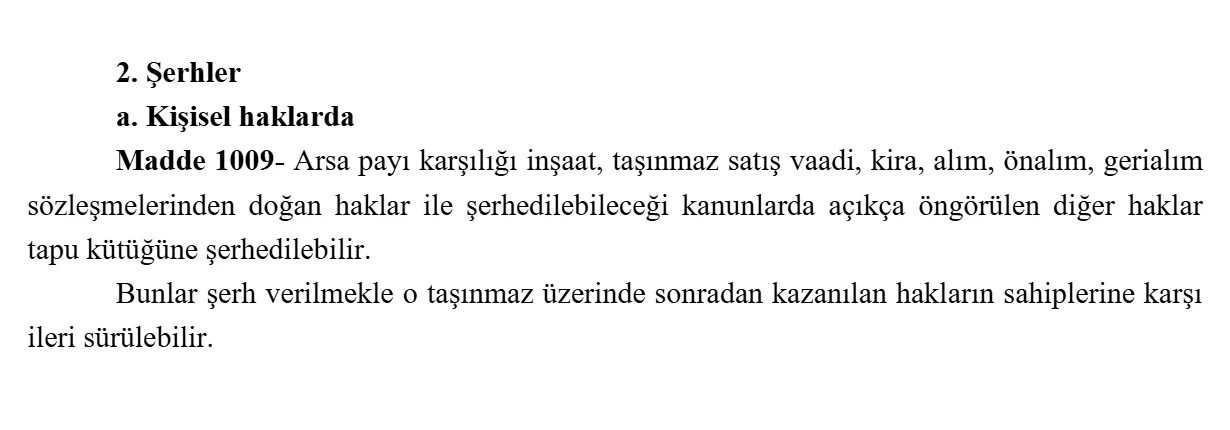
| Notarial promise to sell, annotated on the title | The right can be relied on against those who acquire rights in the property later | Civil Code Art. 1009 |
| Notarial promise to sell, not annotated | A personal claim against the developer | Civil Code Art. 1009 (no annotation) |
| Private contract and payment receipts only | A creditor of the developer | Enforcement and Bankruptcy Law Arts. 198, 294 |
| Flat bought from the contractor's share in a land-for-flats project | A buyer who relied in good faith on the land register is protected, unless he knew of the problem | Court of Cassation, Grand General Assembly, 2025 [Y1] |
Annotations on the title and their order
Court orders, attachments, bankruptcy decisions and the period granted by konkordato can also be annotated on the title, and then bind later acquirers (Civil Code Art. 1010) [M2]. The order of annotations on a title is therefore one of the first things examined in these files.
3. Konkordato in Turkey step by step: the timeline buyers face
| Stage | Rule | Enforcement and Bankruptcy Law |
|---|---|---|
| Temporary moratorium | 3 months, extendable by up to 2 months; total at most 5 months; a temporary commissioner is appointed | Art. 287 |
| Announcement | Published and notified to the land registry and others; creditors may object within 7 days that there are no grounds for a moratorium | Art. 288 |
| Definitive moratorium | 1 year if the konkordato appears able to succeed; extendable by up to 6 months | Art. 289 |
| Registering claims | Within 15 days of the commissioner's announcement; unregistered creditors are excluded from negotiations unless recorded in the balance sheet | Art. 299 |
| Creditors' vote | Accepted if signed by more than half of registered creditors and claims, or more than a quarter of creditors holding more than two thirds of claims | Art. 302 |
| Court decision | Within the definitive moratorium, or within up to 6 further months if needed | Art. 304 |
| Disputed claims | Creditors whose claims were disputed can sue within one month of the announcement of approval | Art. 308/b |
| Effect | Binding with the approval decision (or when it becomes final, if the plan says so) | Art. 308/c |
4. What happens to my claim to a flat in konkordato?
During the moratorium no enforcement proceedings can be brought against the developer, proceedings already started are suspended, and interim injunctions and attachments are not enforced (Art. 294) [M1]. How enforcement works against a debtor that is not in such a procedure is explained in our debt collection guide.
Is the flat still delivered?
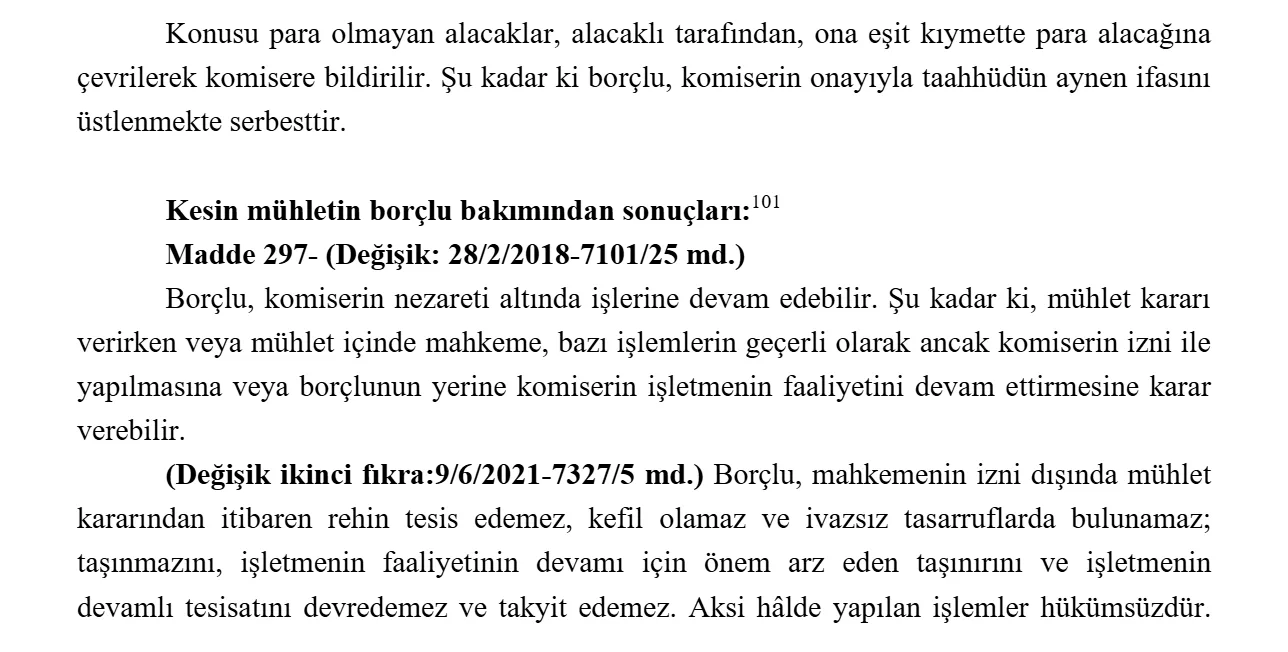
For a buyer, the key sentence is the last one of that article: a claim whose subject is not money, such as a claim to receive a flat, is converted by the creditor into a money claim of equal value and reported to the commissioner; the developer, however, is free to undertake specific performance with the commissioner's approval [M1]. Unless the approved plan says otherwise, interest stops running on unsecured claims from the date of the definitive moratorium [M1].
5. Can the developer transfer my flat's title during konkordato?
From the moratorium decision, the developer cannot, without the court's permission, create a mortgage, give a guarantee, make gratuitous transfers, or transfer or encumber its immovable property; transactions made in breach are void, and the court hears the commissioner before deciding (Art. 297/2) [M1]. A transfer of title to a buyer during the moratorium therefore needs court permission. The court can also order that certain acts are valid only with the commissioner's permission, or let the commissioner run the business (Art. 297/1) [M1].
6. The creditors' vote and when the court approves the plan
Only creditors affected by the plan vote, and the developer's spouse, children and close relatives are not counted in the majorities (Art. 302) [M1]. The court approves the plan only if, among other conditions, what is offered is more than creditors would probably receive in bankruptcy and is proportionate to the developer's resources (Art. 305) [M1]. A buyer who did not register a claim in time is excluded from the negotiations unless recorded in the balance sheet (Art. 299) [M1].
7. What happens if the developer goes bust: bankruptcy and off-plan buyers
| Rule | Enforcement and Bankruptcy Law |
|---|---|
| Bankruptcy makes the developer's debts due, except those secured by mortgages on immovables | Art. 195 |
| A claim whose subject is not money is converted into a money claim of equal value; the bankruptcy administration may undertake specific performance, and must give security if the creditor asks | Art. 198 |
| Creditors register claims within one month of the announcement | Art. 219 |
| Claims secured by a pledge or mortgage are paid first from the sale of the secured asset; unprivileged claims rank in the fourth class | Art. 206 |
Buyers without title in a bankruptcy
For a buyer without registered title or an annotated right, bankruptcy usually means a money claim in the fourth class, behind privileged claims such as employees' wages and severance (Art. 206) [M1]. A buyer whose flat was already registered in his or her name is in a different position, because the flat is the buyer's property (Civil Code Art. 705) [M2].
8. Building completion insurance: money outside the bankruptcy estate
For projects above a size set by the Ministry (by number of homes or total value), the seller must, before starting off-plan sales, take out building completion insurance or provide other guarantees set by the Ministry (Consumer Protection Law Art. 42/1) [M3]. Compensation, guarantees and similar securities provided under this insurance cannot be included in the bankruptcy or liquidation estate, cannot be attached, and cannot be subject to interim injunctions or attachments (Art. 42/2) [M3].

9. Consumer rights of off-plan buyers in Turkey
| Rule | Consumer Protection Law |
|---|---|
| No off-plan (prepaid) home sale to consumers without a building permit | Art. 40/3 |
| The sale must be registered at the land registry, or the promise to sell made by a notary; otherwise the seller cannot later rely on invalidity against the consumer | Art. 41/1 |
| No payment may be requested without a valid contract | Art. 41/2 |
| 14-day right of withdrawal | Art. 43 |
| Delivery within the agreed time and in any case within 48 months of the contract | Art. 44 |
| Right to withdraw without reason up to 24 months, with compensation to the seller of 2% to 8% depending on time; no amount can be claimed if the seller failed its own obligations | Art. 45 |
In a konkordato or bankruptcy, a refund owed after withdrawal or termination is a money claim, so it follows the registration and ranking rules above. The seller's failure to perform matters for whether any compensation is owed to it (Art. 45/2) [M3].
10. Flats from a land-for-flats project when the contractor fails
Many flats are sold from the contractor's share in a land-for-flats (kat karşılığı) project. If the landowner rescinds the contract with the contractor because of delay, buyers fear losing their flats. In a decision of 16 May 2025, the Grand General Assembly for the Unification of Judgments of the Court of Cassation held that a buyer who relied in good faith on the land register keeps the protection of the register, unless it is shown that the buyer knew of the problem [Y1]. The good-faith rules of the land register, and how courts approach them, are explained in property in Turkey sold without your knowledge.
11. What to check on the title deed of an off-plan flat
| Entry on the title | Why it matters |
|---|---|
| Owner or condominium servitude in the buyer's name | Ownership by registration (Civil Code Art. 705) |
| Annotation of a promise to sell or land-for-flats contract | Binds later right holders (Art. 1009) |
| Mortgage (ipotek) in favour of a bank | Secured claims are paid first from the asset (Bankruptcy Law Art. 206) |
| Attachment (haciz), bankruptcy or konkordato annotation | Restrictions on disposal (Civil Code Art. 1010) |
12. Foreign buyers: residence and citizenship when the project stops
Residence permits and citizenship applications based on property rest on the title deed. A foreign buyer who paid for an off-plan flat but holds no registered title is in the same creditor position as other buyers, which can affect plans tied to the property. How title deeds are obtained and what they are used for is explained in buying property in Turkey as a foreigner.
13. Time limits for buyers when a developer fails
| Time limit | For what | Basis |
|---|---|---|
| 7 days from the announcement | Objection to the temporary moratorium | Bankruptcy Law Art. 288 |
| 15 days from the commissioner's announcement | Registering a claim in konkordato | Art. 299 |
| 7 days after the creditors' meeting | Late signatures (accession) to the plan are counted | Art. 302 |
| 1 month from the announcement of approval | Lawsuit for a disputed claim | Art. 308/b |
| 1 month from the bankruptcy announcement | Registering a claim in bankruptcy | Art. 219 |
| 48 months from the contract | Latest delivery under an off-plan contract | Consumer Protection Law Art. 44 |
| 24 months from the contract | Withdrawal without reason | Art. 45 |
14. Documents for an off-plan buyer's claim
| Document | What it shows |
|---|---|
| Title deed record of the plot and the flat | Registration, annotations, mortgages and their order |
| Notarial promise to sell or the land registry sale | The form of the sale (Art. 41) |
| Pre-contract information form | The seller's statements on the project and delivery |
| Building permit | Whether off-plan sale was allowed (Art. 40/3) |
| Building completion insurance policy or guarantee | Protection outside the estate (Art. 42) |
| Bank transfers and receipts | The amount paid, the basis of the money claim |
| Konkordato or bankruptcy announcements | The start of the 7-day, 15-day and one-month periods |
15. Real estate lawyer in Istanbul, Ankara and across Turkey for off-plan buyers
Konkordato and bankruptcy files are handled by the commercial courts and enforcement offices where the developer is based, while title deed cases are heard where the property is located. Many off-plan projects are in İstanbul, where buyers look for a real estate lawyer in Istanbul; projects in the capital are followed by a lawyer in Ankara; and buyers living abroad usually act through a lawyer in Turkey with a power of attorney. Claims in bankruptcy and konkordato also fall within enforcement and bankruptcy law.
Sources and References
Legislation
[M1] Enforcement and Bankruptcy Law No. 2004, Arts. 195, 198, 206, 219, 287, 288, 289, 294, 297, 299, 302, 304, 305, 308/b, 308/c
[M2] Turkish Civil Code No. 4721, Arts. 705, 1009, 1010
[M3] Consumer Protection Law No. 6502, Arts. 40-45
Court decisions
[Y1] Court of Cassation, Grand General Assembly for the Unification of Judgments, 16.05.2025, E.2024/1, K.2025/2 (good-faith buyer from the contractor's share when the landowner rescinds)
This article is general information about Turkish law as of 3 October 2026. It is not legal advice and does not assess any individual case.
Frequently Asked Questions
What happens if an off-plan developer goes bust in Turkey?
It depends on what the buyer holds: a flat registered in the buyer's name is the buyer's property (Civil Code Art. 705); an annotated promise to sell binds later right holders (Art. 1009); a buyer with only a contract and receipts becomes a creditor in the konkordato or bankruptcy, where the claim to the flat is converted into money (Enforcement and Bankruptcy Law Arts. 198, 294).
My Turkish developer filed for konkordato. What happens to my flat?
It depends on what you hold. If the flat is registered in your name you are the owner (Civil Code Art. 705). If not, your claim to the flat is converted into a money claim and reported to the commissioner, although the developer may deliver with the commissioner's approval (Enforcement and Bankruptcy Law Art. 294).
What is konkordato in Turkey?
A court-supervised procedure in which a debtor in difficulty proposes a plan to pay creditors, under a temporary and then a definitive moratorium during which enforcement stops (Enforcement and Bankruptcy Law Arts. 287-308).
How long does a konkordato moratorium last?
The temporary moratorium is 3 months, extendable by up to 2 months (Art. 287); the definitive moratorium is 1 year, extendable by up to 6 months (Art. 289), and the court may continue it up to 6 more months to decide (Art. 304).
How do I register my claim in konkordato?
Creditors are invited by the commissioner's announcement to register their claims within 15 days; creditors who do not register are excluded from the negotiations unless recorded in the balance sheet (Art. 299).
Can the developer transfer the title to me during konkordato?
From the moratorium decision, the developer cannot transfer or encumber its immovable property without the court's permission; transactions in breach are void (Art. 297/2).
Can I sue or enforce against the developer during konkordato?
No. During the moratorium no enforcement can be started, existing proceedings stop, and interim injunctions and attachments are not enforced (Art. 294).
How do creditors approve a konkordato plan?
The plan is accepted if signed by more than half of registered creditors and claims, or by more than a quarter of creditors holding more than two thirds of claims (Art. 302).
My claim was disputed in konkordato. What can I do?
Creditors whose claims were disputed can file a lawsuit within one month of the announcement of the approval decision (Art. 308/b).
What happens to buyers if a Turkish developer goes bankrupt?
Claims become due (Art. 195), a claim to a flat is converted into money unless the bankruptcy administration undertakes delivery (Art. 198), claims are registered within one month of the announcement (Art. 219), and unprivileged claims are paid in the fourth class (Art. 206).
Where do off-plan buyers rank in a Turkish bankruptcy?
Without a registered title or annotated right, a buyer's money claim is usually unprivileged and ranks in the fourth class, after secured claims and privileged claims such as employees' wages (Art. 206).
Is my flat safe if the title is already in my name?
Ownership of land is acquired by registration (Civil Code Art. 705), so a flat registered in the buyer's name is the buyer's property, not the developer's asset. Mortgages and annotations on the title still matter.
What is an annotated promise to sell?
A notarial promise to sell recorded on the title deed. Once annotated, it can be relied on against those who acquire rights in the property later (Civil Code Art. 1009).
What is building completion insurance in Turkey?
For projects above a size set by the Ministry, sellers must take out building completion insurance or give other guarantees before off-plan sales; payments under it stay outside the bankruptcy estate and cannot be attached (Consumer Protection Law Art. 42).
Can a Turkish developer sell off-plan without a building permit?
No. Prepaid off-plan home sales to consumers cannot be made without a building permit (Consumer Protection Law Art. 40/3).
What is the latest delivery date for an off-plan flat in Turkey?
The agreed date, and in any case within 48 months of the contract (Consumer Protection Law Art. 44).
Can I withdraw from an off-plan purchase in Turkey?
Within 14 days without reason (Art. 43), and up to 24 months without reason with compensation of 2% to 8% to the seller depending on time; no amount can be claimed if the seller failed its own obligations (Art. 45).
I bought from the contractor's share and the landowner cancelled the contract. Do I lose the flat?
In a 2025 decision, the Court of Cassation's Grand General Assembly held that a buyer who relied in good faith on the land register keeps the register's protection, unless shown to have known of the problem.
Does interest run on my claim during konkordato?
Unless the approved plan says otherwise, interest on unsecured claims stops from the date of the definitive moratorium (Art. 294).
Can I object to the developer's konkordato?
Creditors can object within 7 days of the announcement of the temporary moratorium that there are no grounds for it, with their evidence (Art. 288).
What should I check on the title deed of an off-plan flat?
Whether the flat or servitude is in your name, whether your promise to sell is annotated, mortgages in favour of banks, and attachment, bankruptcy or konkordato annotations (Civil Code Arts. 705, 1009, 1010).
I live abroad. Can I follow a konkordato or bankruptcy file?
Yes, buyers abroad usually act through a lawyer in Turkey with a power of attorney, keeping track of the 7-day, 15-day and one-month periods that run from the announcements.
Where can I find a real estate lawyer in Istanbul or Ankara for a developer bankruptcy?
Many off-plan buyers in İstanbul look for a real estate lawyer in Istanbul; projects in the capital are followed by a lawyer in Ankara, and buyers abroad act through a lawyer in Turkey.
- off plan property Turkey
- off-plan developer bust Turkey
- what happens if developer goes bust
- Turkish developer bankrupt
- konkordato Turkey
- developer konkordato buyers
- construction company bankrupt Turkey
- konkordato claim registration 15 days
- bankruptcy claim registration Turkey
- off-plan flat not delivered Turkey
- building completion insurance Turkey
- annotated promise to sell Turkey
- satış vaadi şerhi
- land for flats contractor bankrupt
- kat karşılığı müteahhit iflas
- off-plan buyer rights Turkey
- title deed off-plan flat Turkey
Our services in this area
Real Estate Law