Enforcement and Bankruptcy Law
Debt Collection in Turkey: How to Recover Money Owed by a Turkish Company or Individual
How a debt is collected in Turkey: enforcement proceedings without a judgment, the seven-day objection, annulment and removal of objections, seizure of accounts and salaries, cheques, precautionary attachment, foreign judgments and limitation periods.
Debt collection in Turkey follows a legal route that works without going to court first: the creditor files enforcement proceedings, and the debtor has seven days to pay or object. Foreign companies and individuals can use the same route as Turkish creditors, with a few extra steps.
If you have a matter on this topic:
Istanbul time (UTC+3), weekdays 09:00–18:00
1. Can a foreign company or individual collect a debt in Turkey?
Yes. The Turkish enforcement system does not depend on the creditor's nationality or residence. A foreign company that sold goods to a Turkish buyer, a foreign individual who lent money to someone in Turkey, or an expat whose Turkish business partner never repaid a loan can all start proceedings at a Turkish enforcement office [M1]. Three points apply specifically to creditors abroad:
| Point | What the law says | Source |
|---|---|---|
| Address in Turkey | A creditor living abroad must show an address in Turkey in the enforcement request; if none is given, the location of the enforcement office counts as the address | 2004 Art. 58 |
| Security for costs | Foreign individuals and companies that sue or start enforcement proceedings in Turkey must give the security the court sets for costs and possible damages, unless exempted on the basis of reciprocity | 5718 Art. 48 |
| Representation | A lawyer in Turkey acts on the basis of a power of attorney; one signed abroad is usually given at a Turkish consulate or before a notary with an apostille | Notarial practice |
Whether security is actually required depends on the creditor's country and on treaties between that country and Turkey; this is one of the first things checked in a file with a foreign creditor [M5].
2. Which documents prove a debt in Turkey?
Enforcement without a judgment can be started on almost any claim, but the strength of the documents decides what happens if the debtor objects. Typical evidence, from strongest to weakest:
| Document | Why it matters |
|---|---|
| Signed acknowledgment of debt, ideally notarised | Allows the creditor to ask the enforcement court to remove an objection quickly (Art. 68) |
| Cheque or promissory note (bono) | Opens the special, faster enforcement route for negotiable instruments (Arts. 167-170) |
| Written contract and invoices | A trader who receives an invoice and does not object within eight days is deemed to accept its content (Commercial Code, Art. 21/2) |
| Bank transfer records | Show that money was actually paid; the reason for the payment still has to be shown |
| Emails, WhatsApp messages, statements of account | Support the claim, especially messages in which the debtor admits the debt or promises to pay |
Documents in a foreign language are filed with a Turkish translation; foreign public documents are usually apostilled. A loan made in cash with no written trace is the hardest to prove, because Turkish procedure law limits proof by witnesses for higher amounts.
3. Is a formal demand letter needed before collection starts?
Not always. Under the Code of Obligations, a debtor who has missed an agreed payment date is in default as soon as the date passes; where no date was agreed, default starts with the creditor's demand (Art. 117) [M2]. Default matters because default interest runs from that day. If the contract sets no interest rate, the rate is the one set by legislation on the day the interest falls due; a contractual default rate cannot exceed that rate by more than 100% (Art. 120) [M2]. For commercial debts the Central Bank advance rate is often relevant (Law No. 3095) [M6].
In practice, many creditors send a notarised warning letter (ihtarname) even when it is not required, because it fixes the date of default in writing and gives the debtor a last chance to pay. The content of such a letter is described in our Turkish article on unpaid invoices.
4. How do enforcement proceedings in Turkey work, step by step?
The ordinary route is enforcement without a judgment (ilamsız icra takibi). It runs as follows [M1]:
| Step | What happens | Time limit | Article |
|---|---|---|---|
| 1. Enforcement request | Filed at a competent enforcement office, in writing, orally or electronically through UYAP; it states the parties, the amount, the interest and the basis of the debt | — | 58 |
| 2. Payment order | The office sends the debtor an order to pay the debt and costs into the office's bank account, with warnings about objection and declaration of assets | Pay within 7 days | 60 |
| 3. Objection window | The debtor may object to the debt, the amount or the signature, in writing or orally at the enforcement office | 7 days from service | 62 |
| 4a. No objection | The proceedings become final and the creditor can request seizure | — | 78 |
| 4b. Objection | The proceedings stop; the creditor turns to the court (see section 6) | 1 year (annulment) or 6 months (removal) | 67, 68 |
Which enforcement office is competent?
For money debts, the jurisdiction rules of civil procedure apply by analogy, so the office at the debtor's domicile is generally competent; the office where the contract was made is also competent (Art. 50) [M1]. An objection to jurisdiction must be raised together with the objection to the debt itself [M1].
What does it cost to start?
Two fees are paid when the request is filed: a fixed application fee (TRY 732 in 2026) and an advance fee of 0.5% of the claim. A collection fee is added later, depending on when the debt is paid: 4.55% after service and before seizure, 9.1% before sale, 11.38% after sale. These costs are ultimately charged to the debtor. Our enforcement cost calculator gives an approximate total for a given amount.
5. What can be seized from a debtor in Turkey?
Once the proceedings are final, the creditor can request seizure without waiting for the debtor's declaration of assets. Through the national judicial network (UYAP), the enforcement office can query the debtor's assets electronically, including bank accounts, vehicles and land registry records, and seize what it finds (Art. 78) [M1].
| Asset | How it is reached | Limit |
|---|---|---|
| Bank accounts and receivables | Seizure notice to the bank or third party, which must then pay the enforcement office, not the debtor | Art. 89 |
| Salary and pensions | Deduction ordered from the employer | After the amount needed for the debtor's family is left, not less than one quarter of the salary may be seized (Art. 83) |
| Vehicles and real estate | Seizure entered in the traffic or land registry, then sale | Sale procedure |
| Household goods and personal items | Generally cannot be seized | Art. 82 (money, valuables, gold and antiques excepted) |
Does the debtor have to declare assets?
Yes. A debtor who does not object must declare assets within the seven-day period; the payment order warns that failing to do so, or making a false declaration, can lead to coercive detention and criminal penalties (Arts. 60, 74) [M1].
6. What if the debtor objects to the payment order?
An objection stops the proceedings. The creditor then has two court routes [M1]:
- Action to annul the objection (itirazın iptali): filed at a civil or commercial court within one year of being notified of the objection. The creditor proves the debt under the general rules. If the court finds the objection unjustified, the debtor can be ordered to pay compensation of not less than 20% of the amount; a creditor found to have pursued the debtor unjustly and in bad faith can face the same (Art. 67).
- Removal of the objection (itirazın kaldırılması): a faster procedure before the enforcement court, available within six months if the claim rests on a document with an acknowledged or notarised signature, or on an official document (Art. 68).
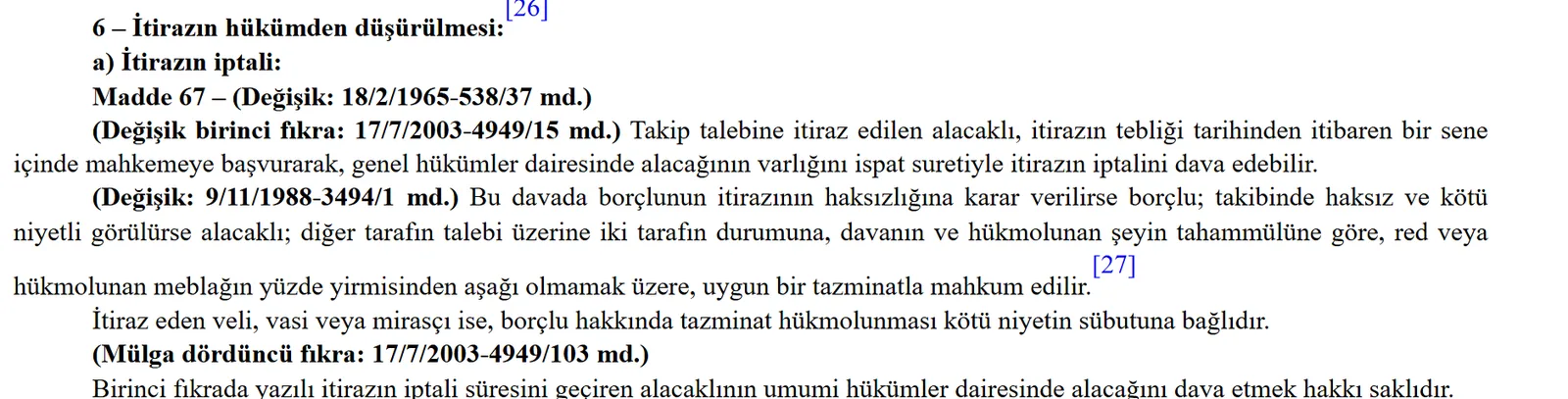
Missing the one-year period does not end the claim itself: the creditor can still bring an ordinary debt action under the general rules (Art. 67) [M1]. A sample of the petition used in the annulment action is in our petition samples.
7. Is mediation required before suing for a debt in Turkey?
It depends on the kind of debt. For commercial disputes whose subject is a sum of money, including actions to annul an objection, applying to a mediator is a condition for filing the lawsuit; the mediator has six weeks to conclude, extendable by two weeks (Commercial Code, Art. 5/A) [M3]. A lawsuit filed without any mediation attempt is dismissed on procedural grounds without examination (Mediation Act No. 6325, Art. 18/A) [M4]. While mediation is under way, limitation periods stop and time limits such as the one-year period for the annulment action do not run (Art. 18/A) [M4].
| Type of debt | Mediation before court? |
|---|---|
| Unpaid invoice between two businesses | Yes (commercial dispute) |
| Rent arrears | Yes for court actions; not for enforcement-based eviction (Art. 18/B) |
| Wages and severance owed by an employer | Yes (labour mediation) |
| Private loan between two individuals | No general requirement |
| Starting enforcement proceedings | No; mediation concerns lawsuits, not the enforcement request |
8. Unpaid invoices and commercial debts in Turkey
When the debtor is a Turkish company, a few commercial rules strengthen the creditor's position. A buyer who receives an invoice and does not object to its content within eight days is deemed to have accepted it (Commercial Code, Art. 21/2) [M3]. Disputes between two businesses about their commercial activity are commercial cases, heard by the commercial courts (Art. 4) [M3]. Where the parties run a current account, the balance at the end of the period is what is claimed; the commercial books of both sides often decide the case through an expert examination.
Before enforcement, a creditor sometimes asks whether the company is still solvent. If the debtor company has entered concordat (konkordato) or bankruptcy, individual enforcement stops and claims are registered in the collective procedure; our guide on a bankrupt developer explains how that procedure treats creditors.
9. Collecting a bounced cheque or promissory note in Turkey
Negotiable instruments have their own enforcement route. The payment order gives the debtor ten days to pay, and objections to the signature or to the debt must be brought within five days to the enforcement court, not the enforcement office (Art. 168) [M1]. A debtor who wrongly denies the signature can be fined ten per cent of the amount (Art. 168) [M1].
A bounced cheque can also have criminal consequences. On the holder's complaint, a person who caused a cheque presented in time to be marked "without funds" faces a judicial fine of up to 1,500 days, not less than the unpaid amount, and a ban on issuing cheques (Cheque Act No. 5941, Art. 5) [M7]. The criminal complaint and the enforcement proceedings run separately.
10. Can assets be frozen before the debtor hides them?
Yes, through a precautionary attachment (ihtiyati haciz). A creditor whose money debt is due and not secured by a pledge can ask the court to attach the debtor's assets in advance; for a debt not yet due, this is possible only in limited cases, such as when the debtor has no fixed residence or is hiding assets (Art. 257) [M1]. The creditor is liable for damage if the attachment proves unjustified and must normally give security; no security is required if the claim rests on a court judgment (Art. 259) [M1]. A precautionary attachment is often requested together with the enforcement request, so that bank accounts are blocked before the debtor learns of the proceedings.
11. I already have a foreign court judgment or arbitral award. Is it valid in Turkey?
A foreign judgment is not enforced automatically. It must first be declared enforceable by a Turkish court through an enforcement (tenfiz) action (Private International Law Act No. 5718, Art. 50) [M5]. The court checks, among other things, whether there is reciprocity between Turkey and the country of the judgment, whether the matter fell within the exclusive jurisdiction of Turkish courts, whether the judgment is clearly contrary to public order and whether the debtor was properly summoned (Art. 54) [M5]. Turkey is also a party to the New York Convention on foreign arbitral awards. Once recognised, the judgment or award is enforced like a Turkish judgment.
12. How long do I have to collect a debt in Turkey?
| Claim | Limitation period | Source |
|---|---|---|
| General rule for debts | 10 years | Code of Obligations Art. 146 |
| Rent, interest and other periodic payments | 5 years | Art. 147/1 |
| Small retail sales and small craft work | 5 years | Art. 147/3 |
| Claims between partners arising from a partnership agreement | 5 years | Art. 147/4 |
| Enforcement based on a court judgment | 10 years from the last step in the file | Enforcement Act Art. 39 |
| Cheques and promissory notes | Shorter special periods under the Commercial Code | Commercial Code |
Which period applies, and when it started, depends on the documents in each file [M2].
13. Is not paying a debt a crime in Turkey?
Generally, no. Failing to repay a loan or pay an invoice is a civil matter, collected through enforcement. It becomes a criminal matter only when there is a separate offence, such as obtaining the money by deception (fraud), a bounced cheque (see section 9) or hiding assets to defeat enforcement. An ordinary private debt also does not lead to an exit ban; exit bans in Turkey are imposed by courts in specific situations, such as criminal investigations, as explained in our exit ban guide. A frozen bank account, on the other hand, can be the result of an enforcement seizure; our article on frozen bank accounts in Turkey sets out the different causes.
14. Debt collection lawyer in Turkey: Istanbul, Ankara and other cities
Enforcement offices exist in every city, and the competent office is usually the one at the debtor's domicile or where the contract was made [M1]. A debt collection lawyer in Istanbul can follow files in Istanbul's courthouses and, through the electronic UYAP system and travel where needed, files in other cities. For debtors based in the capital, a lawyer in Ankara follows proceedings at the Ankara enforcement offices and courts; our office in Istanbul handles files in Ankara on the same basis, without an office there. A creditor abroad does not need to travel: a power of attorney signed at a Turkish consulate or apostilled abroad is enough for a lawyer in Turkey to act. The steps and costs of hiring a lawyer in Turkey from abroad are set out in a separate guide.
Where the claim arises from commercial activity, our enforcement and bankruptcy law and commercial law pages describe the wider framework.
15. Points that differ from file to file
- Whether the documents allow the faster removal procedure, or only the one-year annulment action.
- Whether a precautionary attachment is worth requesting at the start, and the security the court may ask for.
- Whether the debtor has seizable assets at all; the UYAP query gives the first answer.
- Whether the creditor's country requires security for costs, and how long translations and apostilles take.
- Whether the debt is commercial, so that mediation applies before any lawsuit.
- Whether limitation has started and whether it was interrupted.
Each file depends on its documents and on the debtor's situation; this guide describes the general framework, not the outcome of a particular case.
Sources
Legislation
[M1] Enforcement and Bankruptcy Act No. 2004, Arts. 39, 50, 58, 60, 62, 67, 68, 74, 78, 82, 83, 89, 167-170, 257, 259
[M2] Turkish Code of Obligations No. 6098, Arts. 117, 120, 146, 147
[M3] Turkish Commercial Code No. 6102, Arts. 4, 5/A, 21
[M4] Mediation in Civil Disputes Act No. 6325, Arts. 18/A, 18/B
[M5] Private International Law and Procedure Act No. 5718, Arts. 48, 50, 54
[M7] Cheque Act No. 5941, Art. 5
Tools on this site
Frequently Asked Questions
How does debt collection work in Turkey?
Most debts are collected through enforcement proceedings without a judgment. The creditor files a request at an enforcement office, the office sends the debtor a payment order, and the debtor has seven days to pay or object. Without an objection, the creditor can request seizure of bank accounts, vehicles, property and part of the salary.
Can a foreign company collect a debt from a Turkish company?
Yes. Foreign companies use the same enforcement offices and courts as Turkish creditors. A creditor living abroad must give an address in Turkey in the request, and foreign creditors may be asked to give security for costs unless reciprocity exempts them (Law No. 5718, Art. 48).
How long does the debtor have to object in Turkey?
Seven days from service of the payment order in ordinary enforcement proceedings (Enforcement Act, Art. 62). For cheques and promissory notes, objections to the enforcement court must be made within five days, and the debtor has ten days to pay (Art. 168).
What happens if the debtor objects?
The proceedings stop. The creditor can bring an action to annul the objection within one year, or, if the claim rests on a document with an acknowledged or notarised signature, ask the enforcement court to remove the objection within six months (Arts. 67, 68).
What is enforcement denial compensation (icra inkâr tazminatı)?
If the court finds the debtor's objection unjustified in an action to annul it, the debtor can be ordered to pay compensation of not less than 20% of the amount. A creditor who pursued the debtor unjustly and in bad faith can face the same compensation (Art. 67).
Is mediation mandatory for debt collection in Turkey?
For commercial money disputes, including actions to annul an objection, applying to a mediator is a condition for filing the lawsuit (Commercial Code, Art. 5/A). Starting enforcement proceedings does not require mediation, and there is no general mediation requirement for a private loan between two individuals.
Can a debtor's bank account be seized in Turkey?
Yes. Once the proceedings are final, the enforcement office can query assets through UYAP and send a seizure notice to banks, which must then pay the office instead of the debtor (Arts. 78, 89).
How much of a salary can be seized in Turkey?
After leaving the amount the enforcement officer considers necessary for the debtor and family, the seized portion cannot be less than one quarter of the salary (Art. 83). If there are several seizures, they are applied in order.
What does it cost to start enforcement proceedings in Turkey?
In 2026, a fixed application fee of TRY 732 and an advance fee of 0.5% of the claim are paid when the request is filed. A collection fee follows later, depending on the stage at which the debt is paid. These costs are ultimately charged to the debtor; our enforcement cost calculator gives an estimate.
Can I freeze the debtor's assets before starting a lawsuit?
A creditor whose money debt is due and unsecured can ask the court for a precautionary attachment (Art. 257). The creditor is liable for damage if it proves unjustified and normally has to give security, except where the claim rests on a court judgment (Art. 259).
Is a foreign court judgment enforceable in Turkey?
Only after a Turkish court declares it enforceable in an enforcement (tenfiz) action. The court checks reciprocity, jurisdiction, public order and whether the debtor was properly summoned (Law No. 5718, Arts. 50, 54). Turkey is also a party to the New York Convention on arbitral awards.
How long do I have to collect a debt in Turkey?
The general limitation period is ten years (Code of Obligations, Art. 146). Rent, interest and other periodic payments, small retail sales and claims between partners under a partnership agreement have five years (Art. 147). Enforcement based on a judgment is time-barred ten years after the last step in the file.
Is not paying a debt a crime in Turkey?
Generally not; an unpaid loan or invoice is a civil matter collected through enforcement. Criminal law comes into play only with a separate offence, such as fraud or a bounced cheque. A private debt also does not cause an exit ban.
What happens with a bounced cheque in Turkey?
The holder can start the special enforcement route for cheques and, separately, file a criminal complaint. The person who caused the cheque to bounce faces a judicial fine of up to 1,500 days, not less than the unpaid amount, and a ban on issuing cheques (Cheque Act No. 5941, Art. 5).
Do I need a demand letter before collecting a debt?
If a payment date was agreed, the debtor is in default once it passes; otherwise default starts with the creditor's demand (Code of Obligations, Art. 117). Many creditors still send a notarised demand because it fixes the date of default and interest in writing.
Can I collect a debt in Turkey without travelling there?
Yes. A lawyer in Turkey can act for a creditor abroad on the basis of a power of attorney signed at a Turkish consulate or before a foreign notary with an apostille. The proceedings themselves are followed through the electronic UYAP system.
Can a debt collection lawyer in Istanbul handle a file in Ankara?
Yes. A lawyer in Istanbul can follow enforcement files and lawsuits in Ankara and other cities through UYAP and by attending hearings where needed. Our office is in Istanbul and follows files in Ankara on that basis.
Which enforcement office is competent for my debt?
For money debts, the jurisdiction rules of civil procedure apply by analogy, so the office at the debtor's domicile is generally competent; the office where the contract was made is also competent (Art. 50).
What if the Turkish debtor company is bankrupt or in concordat?
Individual enforcement stops and the creditor registers the claim in the collective procedure. The outcome depends on the company's assets and the ranking of claims.
Are invoices binding if the buyer did not object?
Between traders, a buyer who receives an invoice and does not object to its content within eight days is deemed to have accepted it (Commercial Code, Art. 21/2). This is a presumption that the buyer can still try to rebut with other evidence.
- debt collection Turkey
- enforcement proceedings Turkey
- mandatory mediation Turkey
- commercial disputes Turkey
Our services in this area
Enforcement and Bankruptcy Law