How to Exit a Limited Company in Turkey: Leaving a Business Partner, Selling Your Shares and Removing a Partner
A guide for partners who want out of a Turkish company: share transfers and approval, the exit right and exit lawsuit, the exit payment, expulsion and the two-partner company, dissolution, ordinary partnerships, tax liability after leaving and residence permits.

To exit a limited company in Turkey, a partner has three main routes: sell the shares with the general assembly's approval, use an exit right in the articles of association, or ask the commercial court to let them leave for just cause. Which route works depends on the company's articles and on how far the partners still cooperate.
If you have a matter on this topic:
Istanbul time (UTC+3), weekdays 09:00–18:00
1. What kind of business do you share? Exit routes in Turkey differ
The first question is the legal form of the business, because each form has its own exit rules:
| Form | Typical for | How a partner leaves | Main articles |
|---|---|---|---|
| Limited company (limited şirket, Ltd. Şti.) | Small and family businesses, many foreign-owned companies | Share transfer with approval; exit right in the articles; exit lawsuit for just cause; dissolution lawsuit | Commercial Code 595, 636, 638-641 |
| Joint stock company (anonim şirket, A.Ş.) | Larger companies, investment structures | Share transfer under the articles; dissolution lawsuit by at least 10% for just cause | Commercial Code 531 |
| Ordinary partnership (adi ortaklık) | Two people running a shop or project without a company | Notice (open-ended partnerships), court termination for just cause, then liquidation | Code of Obligations 639-643 |
In a limited company, partners are not liable for the company's debts; they owe only the capital they committed and any additional obligations in the articles (Commercial Code, Art. 573) [M1]. The major exception is public debts such as taxes (see section 8).
2. Selling your shares in a Turkish limited company
The cleanest exit is to sell the shares, to the other partners or to an outsider. The law sets strict conditions (Art. 595) [M1]:
- The transfer and the agreement to transfer must be in writing, with the parties' signatures notarised.
- Unless the articles provide otherwise, the transfer needs the approval of the general assembly and takes effect only with that approval.
- Unless the articles provide otherwise, the general assembly can refuse approval without giving a reason.
- The articles can even prohibit transfers altogether.
- If the general assembly does not refuse within three months of the application, approval is deemed given.
- If transfer is prohibited or approval is refused, the partner's right to leave for just cause remains.
Approving a share transfer is a non-delegable power of the general assembly (Art. 616) [M1]. The articles may also give the other partners pre-emption or purchase rights; these are checked before any sale.
3. Leaving a limited company without a buyer: the exit lawsuit
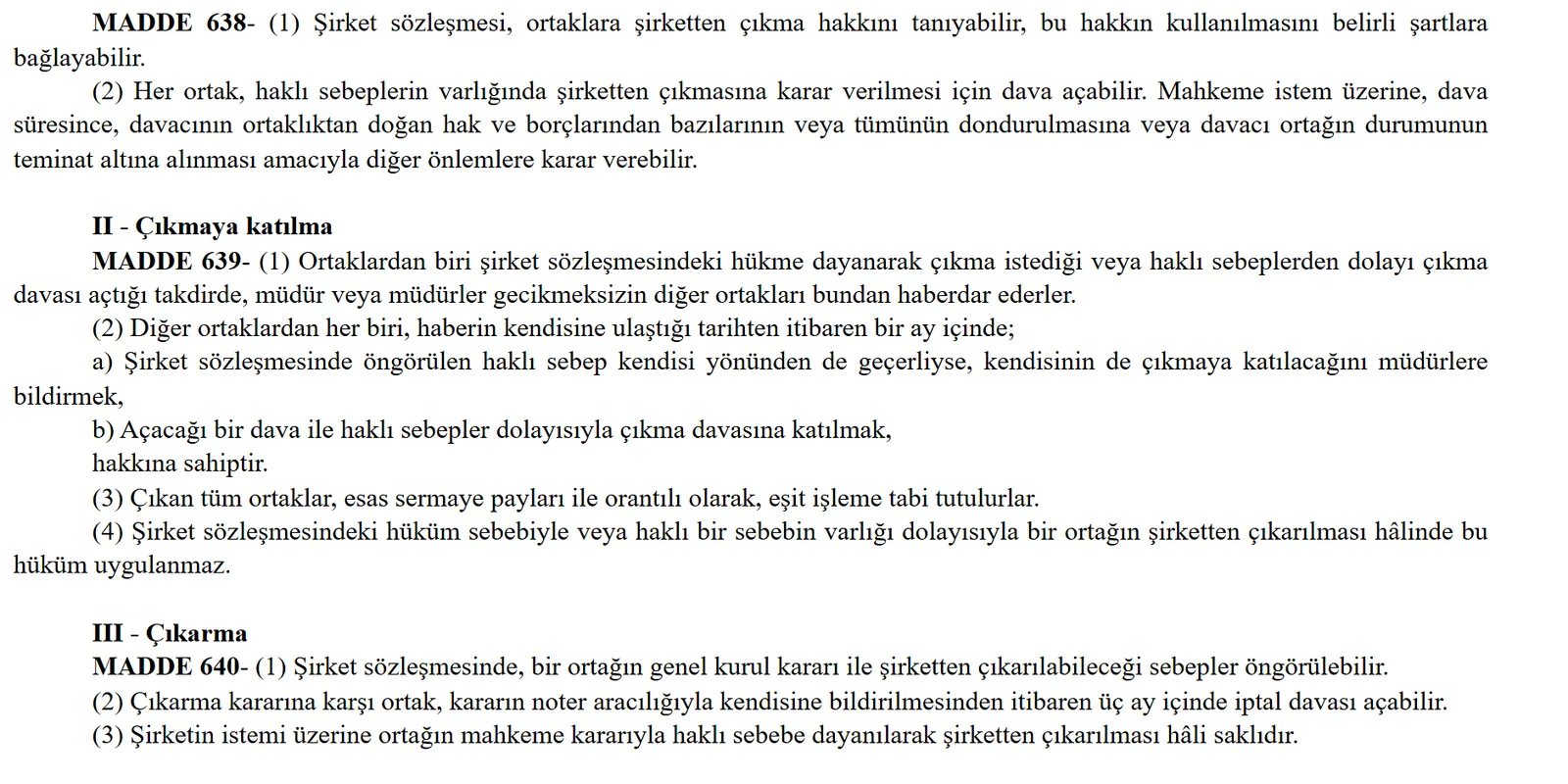
Where no buyer is found, or the other partners block a sale, the law offers a direct route out. The articles may grant partners a right to exit on stated conditions (Art. 638/1). In any case, every partner can sue for a court order allowing them to leave for just cause; during the lawsuit, the court may freeze some or all of the claimant's partnership rights and duties or take other measures to protect the claimant's position (Art. 638/2) [M1].
Can other partners join the exit?
When one partner applies to exit under the articles or sues for exit, the managers must inform the other partners without delay. Each of them has one month from learning of it to join the exit, and all departing partners are treated equally in proportion to their shares (Art. 639) [M1].
What counts as just cause?
The law does not list the causes. Courts look at whether continuing the partnership has become unreasonable for the partner in the circumstances. Situations argued in practice include a long-lasting deadlock that paralyses the company, a partner being shut out of management and information, profits never being distributed while the majority benefits in other ways, and a serious breakdown of trust. Whether a given situation is enough depends on the evidence and on the court.
How much does a leaving partner receive?
A partner who leaves is entitled to an exit payment equal to the real value of the shares (Art. 641/1) [M1]. Real value is not the nominal capital; it is normally established by an expert valuation of the company's assets, liabilities and business. Where the articles grant a contractual exit right, they may regulate the exit payment differently (Art. 641/2) [M1].
4. Can I remove a partner from a limited company in Turkey?
Removing (expelling) a partner is possible in two ways (Art. 640) [M1]:
- Grounds in the articles: the articles can list reasons for which the general assembly may expel a partner by resolution. The expelled partner can sue to annul the resolution within three months of being notified through a notary.
- Court order for just cause: the company can ask the court to expel a partner for just cause.
Both the resolution to expel under the articles and the resolution to apply to the court require a qualified majority: at least two-thirds of the votes represented, together with the absolute majority of the voting capital (Art. 621/1-h) [M1]. Adding expulsion grounds to the articles later requires a unanimous resolution of all partners (Art. 621/3) [M1].
The two-partner company
Many Turkish limited companies have exactly two partners. In a 2023 decision, the Court of Cassation's Assembly of Civil Chambers held that in a two-partner company the qualified majority of Article 621 is not reached by one partner alone, however large that partner's share; a resolution taken by one partner alone was treated as non-existent. A chamber of the Court of Cassation followed the same approach in 2024 [Y1][Y2]. In such companies, the court route, exit or dissolution, often becomes the practical option.
5. Dissolving a limited company for just cause
Where just cause exists, any partner can ask the court to dissolve the company. Instead of dissolution, the court may order that the claimant be paid the real value of the shares and leave the company, or choose another suitable solution (Art. 636/3) [M1]. Separately, if a required company organ has been missing for a long time or the general assembly cannot meet, a partner or creditor can ask the commercial court at the company's seat to dissolve it after giving the company time to remedy the situation (Art. 636/2) [M1].
In a joint stock company, the holders of shares representing at least one-tenth of the capital (one-twentieth in listed companies) can ask the commercial court at the company's seat for dissolution for just cause; the court may instead order them to be paid the real value of their shares at the date closest to the decision (Art. 531) [M1].
6. My partner keeps me in the dark: the right to information
Every partner in a limited company can ask the managers for information about all of the company's business and accounts and can inspect specific matters. Managers can restrict this only where there is a risk that the information will be used against the company, and the general assembly then decides; if the general assembly refuses unjustly, the court decides on the partner's request, and that decision is final (Art. 614) [M1]. Information obtained this way often forms the evidence for an exit or dissolution lawsuit.
7. An ordinary partnership without a company (adi ortaklık)
Two people running a shop, a restaurant or a project together without forming a company usually have an ordinary partnership under the Code of Obligations. It ends, among other cases, by unanimous decision, at the end of an agreed term, on the death of a partner unless the contract provides otherwise, and by court order where there is just cause, at any time (Art. 639) [M2]. A partnership for an indefinite term can be ended by any partner with six months' notice, effective at the end of the financial year, and not in bad faith or at an unsuitable time (Art. 640) [M2].
After it ends, the partnership is liquidated: debts are paid, partners' advances and expenses are refunded and contributions returned; any surplus is shared as profit, any shortfall as loss (Art. 643). A partner who contributed an item does not take it back as such but receives its agreed or original value (Art. 642) [M2]. Claims between partners under a partnership agreement become time-barred after five years (Art. 147/4) [M2].
8. Will the company's debts follow me after I leave?
For ordinary commercial debts, a limited company partner is not personally liable (Art. 573) [M1]. Public debts are different. Under Law No. 6183, limited company partners are directly liable, in proportion to their shares, for public debts that cannot be collected from the company, such as taxes. When a partner transfers shares, the transferor and the transferee are jointly liable for public debts relating to the period before the transfer (Art. 35) [M3]. Separately, managers who act as the company's legal representatives can be liable for uncollectable public debts under the same law (Art. 35 repeated) [M3].
| Debt | Partner's position after leaving |
|---|---|
| Commercial debts to suppliers and banks | Not personally liable, unless a personal guarantee was signed |
| Taxes and other public debts before the transfer | Liable in proportion to the shares, jointly with the buyer, if they cannot be collected from the company |
| Debts as former manager (legal representative) | Possible liability for uncollectable public debts of the managed period |
| Personal guarantees and bank sureties | Continue until released by the bank or creditor |
For this reason, a share sale agreement often includes the parties' allocation of past debts and a review of the company's tax and social security position before signing. A tax debt alone no longer leads to an exit ban, as our exit ban guide explains, but it can lead to enforcement against personal assets.
9. I am a foreign partner. What happens to my residence or work permit?
Many foreigners in Turkey hold a residence or work permit connected to their company. Leaving the company can remove the basis of that permit, so the permit's basis is reviewed before or together with the exit. Our guide to permanent residence in Turkey explains the long-term residence route, which does not depend on a company. A partner who is owed money by the company or the other partners after leaving can collect it as described in our debt collection guide.
10. Is mediation required in a partnership dispute in Turkey?
It depends on how the claim is framed. In commercial cases whose subject is a sum of money, applying to a mediator is a condition for filing the lawsuit (Commercial Code, Art. 5/A) [M1]. Claims for exit, expulsion or dissolution are about the partnership relationship itself rather than a sum of money; claims for unpaid dividends or other payments may fall within the money-claim rule. This is assessed for each claim before filing. Disputes concerning a company are heard by the commercial court of first instance (asliye ticaret mahkemesi), and dissolution claims at the court of the company's seat (Arts. 4, 531, 636) [M1].
11. Corporate lawyer in Turkey for partner disputes: Istanbul and Ankara
Exit, expulsion and dissolution lawsuits are filed at the commercial court where the company has its registered seat. A corporate lawyer in Istanbul follows cases at Istanbul's commercial courts and, through the electronic UYAP system and attendance where needed, cases in other cities. For companies registered in the capital, a lawyer in Ankara follows the Ankara commercial courts; our Istanbul office handles Ankara files on that basis, without an office there. Foreign partners living abroad can act through a power of attorney signed at a Turkish consulate. See also how to hire a lawyer in Turkey from abroad. Our corporate lawyer in Istanbul page covers the wider company law work in Turkey.
12. Points that differ from file to file
- What the articles of association say about transfers, exit rights, pre-emption and expulsion.
- How many partners there are and how the votes are distributed.
- Which facts can be shown as just cause, and with what documents.
- The company's real value and how an expert is likely to approach it.
- The company's tax and social security position before any transfer.
- Whether the partner's residence or work permit depends on the company.
Each company has its own articles and history; this guide describes the general framework, not the outcome of a particular dispute.
Sources
Legislation
[M1] Turkish Commercial Code No. 6102, Arts. 4, 5/A, 531, 573, 595, 614, 616, 621, 636, 638, 639, 640, 641
[M2] Turkish Code of Obligations No. 6098, Arts. 147, 639, 640, 642, 643
[M3] Law No. 6183 on the Collection of Public Receivables, Art. 35 and repeated Art. 35
Court decisions
[Y1] Court of Cassation, Assembly of Civil Chambers, 05.07.2023, E.2022/63, K.2023/722 (two-partner limited company; qualified majority of Art. 621 not reached by one partner)
[Y2] Court of Cassation, 11th Civil Chamber, 26.03.2024, E.2022/5513, K.2024/2475 (same approach)
Frequently Asked Questions
How do I exit a limited company in Turkey?
There are three main routes: sell your shares (written, notarised transfer approved by the general assembly unless the articles say otherwise), use an exit right in the articles, or sue at the commercial court for an order allowing you to leave for just cause and receive the real value of your shares (Commercial Code, Arts. 595, 638, 641).
Can my partner block the sale of my shares in a Turkish limited company?
Unless the articles provide otherwise, the general assembly can refuse approval without giving a reason, and the articles can even prohibit transfers. If it does not refuse within three months, approval is deemed given; if transfer is banned or refused, the right to leave for just cause remains (Art. 595).
What is the exit payment (ayrılma akçesi)?
A partner who leaves a limited company is entitled to an exit payment equal to the real value of the shares, usually established by an expert valuation (Art. 641). Where the articles grant a contractual exit right, they may regulate the payment differently.
What is just cause for leaving a company in Turkey?
The law does not list the causes; courts assess whether continuing has become unreasonable for the partner. Situations argued in practice include long deadlock, exclusion from management and information, and a serious breakdown of trust. Whether a situation is enough depends on the evidence.
Can I remove my business partner from the company?
A partner can be expelled by general assembly resolution on grounds listed in the articles, or by court order for just cause at the company's request (Art. 640). These resolutions need two-thirds of the votes represented and the absolute majority of the voting capital (Art. 621).
We are two partners. Can the majority partner expel me?
In a 2023 decision, the Court of Cassation's Assembly of Civil Chambers held that in a two-partner limited company the qualified majority of Article 621 is not reached by one partner alone, regardless of the share size; such a resolution was treated as non-existent. The court route often becomes the practical option in two-partner companies.
Can I ask the court to dissolve the company?
Yes, where just cause exists, any limited company partner can sue for dissolution. The court may instead order the partner to be paid the real value of the shares and leave, or another suitable solution (Art. 636/3).
Am I liable for the company's tax debts after selling my shares?
Limited company partners are liable in proportion to their shares for public debts that cannot be collected from the company, and on a share transfer the seller and buyer are jointly liable for public debts from before the transfer (Law No. 6183, Art. 35).
How long does an exit lawsuit take in Turkey?
It depends on the court, the expert valuation and any appeal. Valuation of the shares is often the longest stage. During the case the court can freeze some of the claimant's rights and duties (Art. 638/2).
Do I have a right to see the company's accounts?
Every partner can ask the managers for information about all business and accounts and inspect specific matters. If the general assembly refuses unjustly, the court decides, and its decision is final (Art. 614).
How does an ordinary partnership end in Turkey?
Among other cases, by unanimous decision, at the end of the agreed term, or by court order for just cause; an open-ended partnership can be ended with six months' notice effective at the end of the financial year (Code of Obligations, Arts. 639, 640).
What happens to the assets when an ordinary partnership ends?
The partnership is liquidated: debts are paid, advances and expenses refunded and contributions returned; any surplus is shared as profit and any shortfall as loss (Art. 643). A contributed item is returned at its agreed or original value, not in kind (Art. 642).
Can minority shareholders in a joint stock company seek dissolution?
Holders of at least one-tenth of the capital (one-twentieth in listed companies) can ask the commercial court for dissolution for just cause; the court may instead order them to be paid the real value of their shares (Art. 531).
Is mediation required before suing my partner?
Mediation is a condition for commercial lawsuits whose subject is a sum of money (Commercial Code, Art. 5/A). Exit, expulsion and dissolution claims concern the partnership itself; payment claims such as unpaid dividends may fall under the rule. This is assessed for each claim.
What happens to my residence permit if I leave my Turkish company?
If your residence or work permit depends on your role in the company, leaving can remove its basis, so the permit is reviewed together with the exit. Long-term residence is a route that does not depend on a company.
Can a corporate lawyer in Istanbul handle a company case in Ankara?
Yes. A lawyer in Istanbul can follow cases at the Ankara commercial courts through UYAP and by attending hearings where needed. Our office is in Istanbul and handles Ankara files on that basis.
Which court hears partnership disputes in Turkey?
Disputes concerning a company are heard by the commercial court of first instance; dissolution claims are filed at the court where the company has its registered seat (Commercial Code, Arts. 4, 531, 636).
How long do partners have to claim money from each other?
Claims between partners, or between partners and the partnership, arising from the partnership agreement become time-barred after five years (Code of Obligations, Art. 147/4).
- company law Turkey
- limited company Turkey
- business partner dispute Turkey
- commercial disputes Turkey
- mandatory mediation Turkey
Our services in this area
Corporate Law